

Global 5G Core Market Size and Forecast – 2026-2033
The global 5G core market is estimated to be valued at USD 6.22 Bn in 2026 and is expected to reach USD 53.80 Bn by 2033, exhibiting a compound annual growth rate (CAGR) of 36.1% from 2026 to 2033.
Key Takeaways of the Global 5G Core Market
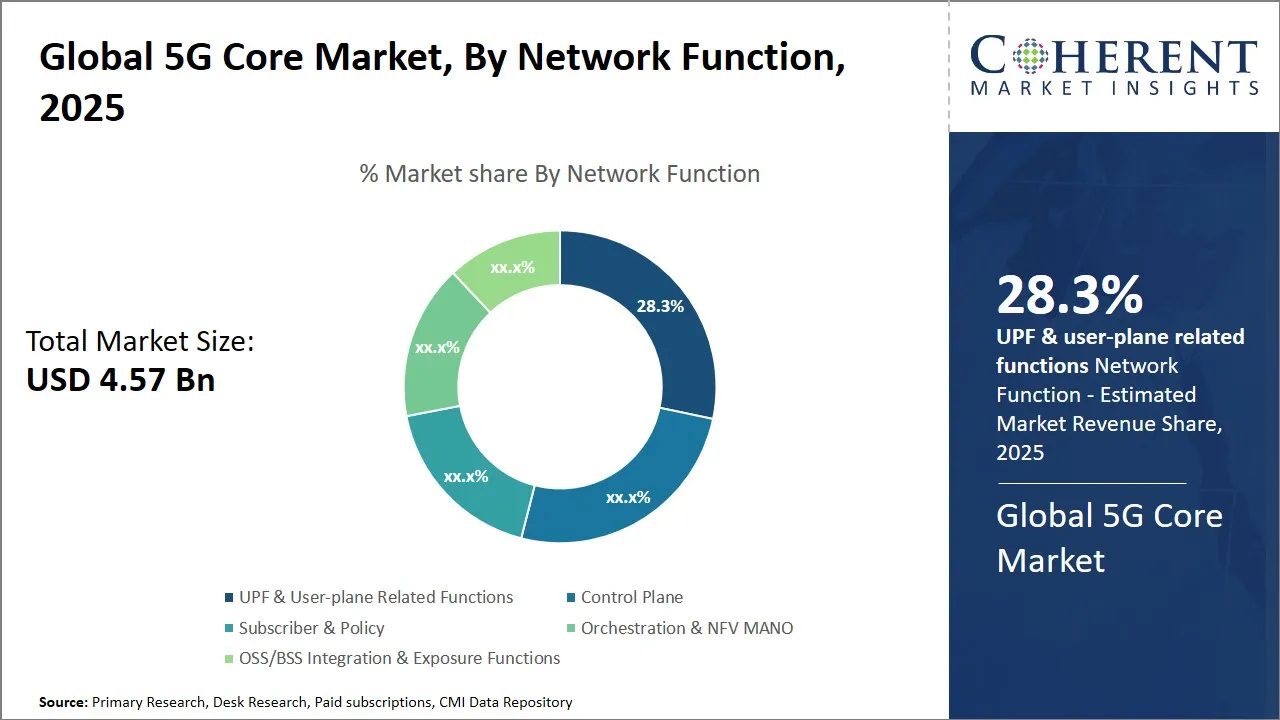
- The UPF & user-plane related functions segment leads the market holding an estimated share of 29.3 % in 2026.
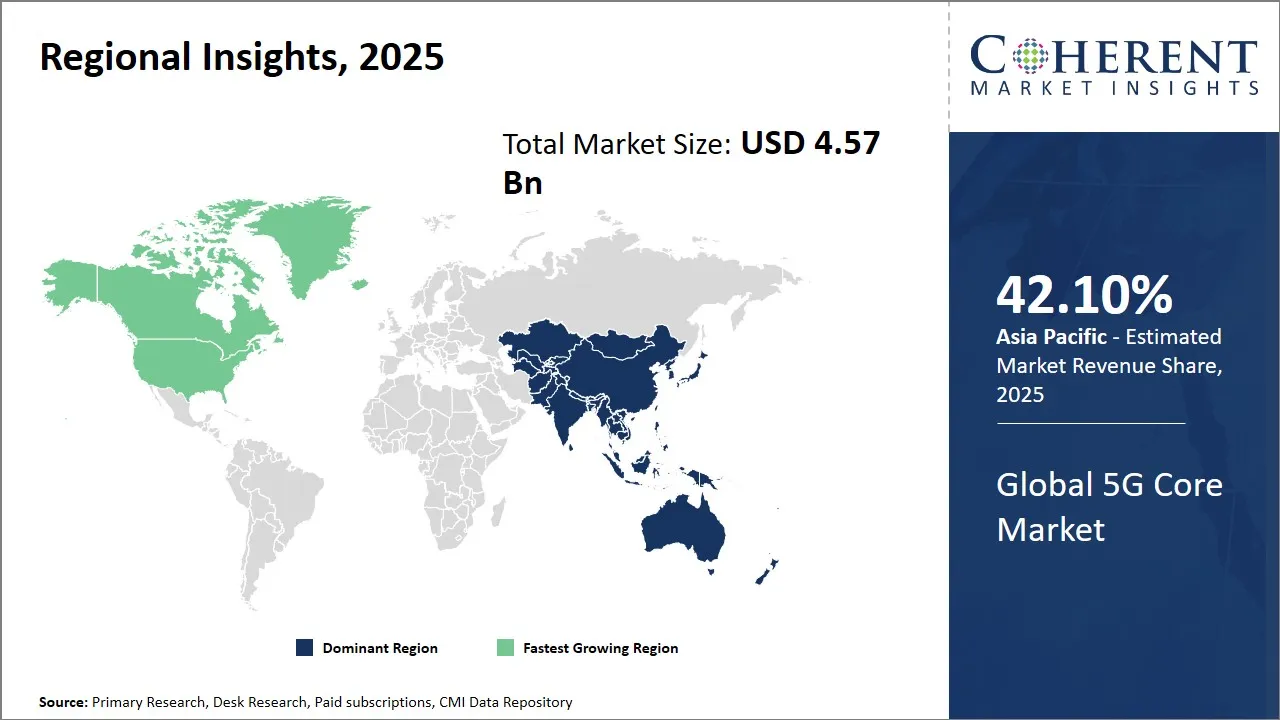
- Asia Pacific is estimated to lead the market with a share of 42.1 % in 2026.
- North America, holding an estimated share of 30.4 % in 2026, is projected to be the fastest growing region.
Market Overview
The market in witnessing a widespread adoption of network virtualization and cloud-native 5G core networks, which make possible greater flexibility and scalability. The integration of artificial intelligence and edge computing is also accelerating, optimizing network performance and reducing latency. Also, rising investments in smart city projects, autonomous vehicles, and IoT applications are adding to the demand for advanced 5G core solutions, adding to market growth.
Current Events and Its Impact
Current Events | Description and its Impact |
Geopolitical and Trade Developments |
|
Economic and Infrastructure Trends |
|
Segmental Insights
- Current Industry Events of 2026
- Market Size Estimation
- Regional Breakdown
- Competitive Landscape
- Customer Intelligence
- Segmental Analysis
- Pricing Analysis
- Key Market Drivers, Challenges & Future Trends
- Customized Insights Section
Global 5G Core Market Insights, by Network Function – High Demand for Data Traffic Management Fuels the Growth of UPF & User-Plane Related Functions Segment
The UPF & user-plane related functions is projected to account for 29.3% share in 2026. The User Plane Function (UPF) acts as the gateway for data forwarding, traffic routing, and packet inspection, which are essential for delivering high-speed and low-latency connectivity demanded by modern 5G use cases. One of the primary drivers for this segment’s growth is the exponential increase in mobile data traffic generated by applications such as Augmented Reality (AR), Virtual Reality (VR), Enhanced Mobile Broadband (eMBB), and Internet of Things (IoT) devices. These applications need efficient and intelligent handling of data flows to ensure smooth user experiences, which UPF makes possible by decoupling the user plane from the control plane to establish flexible and scalable network architectures.
Also, the UPF improves network slicing capabilities by allowing operators to use specific traffic paths and resources for different services, ensuring Quality of Service (QoS) tailored to different requirements such as mission-critical communications and low-power IoT connectivity. Also, the evolution of UPF towards cloud-native implementations helps telecom operators deploy these functions on virtualized and containerized environments, improving scalability and operational efficiency. The growing focus on security in 5G networks also shows the importance of UPF, as it makes possible robust user-plane security mechanisms, including traffic filtering and encryption, to protect data integrity and privacy. This aspect becomes increasingly vital as networks handle diverse and critical data flows.
Verizon’s nationwide Standalone (SA) 5G core deployment completed in July 2023, where the operator rolled out cloud-native User Plane Functions across more than 100 U.S. network sites. Verizon engineers highlighted that the distributed UPF architecture lets the company route data traffic closer to the edge, cutting latency for applications such as augmented-reality stadium experiences and massive IoT deployments.
Impact of AI on the 5G Core Market
Artificial intelligence (AI) is transforming the 5G core by automating network management, optimizing traffic flow, and enabling predictive maintenance. Cloud-native 5G cores generate massive real-time data from millions of connected devices; AI algorithms analyze this data to detect anomalies, predict congestion, and allocate network slices dynamically. Operators gain lower latency, improved service reliability, and reduced operational costs because AI systems can self-heal network faults and fine-tune resources without manual intervention. AI also strengthens security in the 5G core by continuously monitoring signaling patterns and identifying cyber-threats before they impact service.
A practical example is AT&T’s partnership with Nokia for a cloud-based, AI-driven 5G voice core and automation platform announced in February 2025. Using Nokia’s AI-powered analytics, AT&T can automatically adjust network slices to meet surging demand from applications such as augmented reality and connected vehicles.
Regional Insights
Asia Pacific 5G Core Market Analysis and Trends
The Asia Pacific region is projected to lead the market with a 42.1% share in 2026 because of its extensive telecom infrastructure investments, large consumer base, and robust technology ecosystem. Countries like China, South Korea, and Japan are at the forefront of 5G core network deployment, supported by progressive government policies that promote digital transformation and innovation. The presence of major telecom operators such as China Mobile, SK Telecom, and NTT DOCOMO, combined with leading network equipment providers like Huawei, ZTE, and Samsung, makes a strong industry ecosystem adding to 5G core adoption.
Also, Asia Pacific benefits from significant manufacturing capabilities and supply chain integration, which accelerate network rollouts. Governments in the region support partnerships between technology firms and telecom incumbents and invest heavily in R&D, adding to the region’s dominance. Trade dynamics, including regional trade agreements, facilitate the smooth flow of components and services necessary for 5G core development.
North America 5G Core Market Analysis and Trends
North America, holding an estimated share of 30.4% in 2026, exhibits the fastest growth in the 5G core market because of huge investments from both telecom operators and network equipment providers in the U.S. and Canada. The U.S. government’s strategic focus on digital infrastructure and spectrum allocation has propelled 5G core deployments. The competitive market environment, characterized by firms such as Verizon, AT&T, Ericsson, and Nokia, drives rapid innovation and adoption.
Additionally, the strong presence of cloud service providers like Amazon Web Services, Microsoft Azure, and Google Cloud—which are integrating edge computing and network functions virtualization with 5G cores—further propels growth. The trade dynamics in North America, including collaborations and technology exchanges with other regions, support the scaling of 5G core capabilities. Moreover, regulatory frameworks encouraging open RAN architectures and network security upgrades create new opportunities and momentum in the market.
5G Core Market Outlook for Key Countries
China 5G Core Market Analysis and Trends
China plays a central role in the global 5G core market, driven predominantly by government-led initiatives such as the “Made in China 2026” strategy and significant investment by state-owned enterprises. China Mobile, China Telecom, and China Unicom spearhead nationwide 5G network deployments using advanced 5G core solutions predominantly from Huawei and ZTE. The country’s robust manufacturing ecosystem and technological self-reliance initiatives foster continuous innovation in 5G core network technologies. Government subsidies and targeted policies designed to accelerate 5G adoption among industries like manufacturing, smart cities, and autonomous vehicles enhance the demand for sophisticated 5G core networks.
U.S. 5G Core Market Analysis and Trends
The U.S. stands out because of its competitive carrier landscape and fast adoption of cloud-native 5G core technologies. Leading telecom operators such as Verizon and AT&T are deploying next-generation core networks with vendors like Ericsson and Nokia, supported by advanced software capabilities from major cloud service providers. The U.S. government’s focus on securing 5G infrastructure and facilitating private sector investment adds to technological advancement. Also, initiatives encouraging open standards and interoperability attract new entrants and add to innovation, making the country’s position stronger as a technology leader in 5G core development.
South Korea 5G Core Market Analysis and Trends
South Korea remains a pioneer in the commercial deployment of 5G, with Korea Telecom, SK Telecom, and LG Uplus rolling out 5G core networks with a lot of involvement from domestic and global vendors like Samsung, Ericsson, and Nokia. The country’s high smartphone penetration, early adoption of advanced technologies, and government support through efficient spectrum policies accelerate 5G core adoption. South Korea’s telecom giants invest heavily in network slicing and edge computing integration, leveraging 5G cores to support a diverse set of vertical applications, from smart factories to immersive media.
Germany 5G Core Market Analysis and Trends
Germany 5G core market reflects strong momentum driven by its advanced industrial ecosystems and digital transformation efforts. Deutsche Telekom leads 5G core initiatives supported by vendors like Ericsson, Nokia, and Cisco. The German government’s Industry 4.0 and Digital Strategy policies emphasize the integration of 5G in manufacturing and automotive sectors, which significantly influence core network demand. Regulatory support for secure and resilient networks also plays a crucial role. Germany benefits from a collaborative industry environment involving telecom operators, equipment vendors, and industrial players working closely to deploy 5G cores tailored to enterprise needs.
India 5G Core Market Analysis and Trends
India 5G core market is rapidly evolving amid increasing mobile broadband demand and government initiatives aimed at creating a digital economy. Reliance Jio, Bharti Airtel, and Vodafone Idea are key telecom players focused on expanding 5G network coverage with core solutions sourced from Nokia, Ericsson, and Samsung. The Indian government’s proactive spectrum auctions and “Digital India” push incentivize investments in 5G core infrastructure. Challenges such as diverse geographic conditions and cost sensitivities shape the unique deployment strategies, with an increasing focus on open RAN and virtualized network functions to enhance scalability and reduce costs.
Market Players, Key Development, and Competitive Intelligence
Key Developments
- In June 2025, Ericsson announced the launch of Ericsson On-Demand, a new solution delivering core network services as a true software-as-a-service (SaaS) platform to Communications Service Providers (CSPs). The platform is designed with Google Cloud, leveraging AI infrastructure and Google Kubernetes Engine (GKE) - and is managed end-to-end by Ericsson.
- In March 2025, Mavenir, the cloud-native network infrastructure provider, and e& UAE, telecom arm of global technology group e&, announced a collaboration to advance e& UAE’s future of cloud-native converged packet core networks across 4G, 5G (NSA and SA) at Mobile World Congress in Barcelona, Spain.
- In February 2025, U.S. telecom operator AT&T, and Finnish network equipment maker, Nokia, signed a multi-year expansion agreement to upgrade AT&T's voice carriage and 5G network automation in the U.S.
- In November 2024, MTN South Africa signed a memorandum of understanding (MOU) with China Telecom and Huawei for strategic collaboration that could advance the mobile operator's offerings in 5G, cloud, AI and business solutions.
Top Strategies Followed by 5G Core Market Players
- Established market leaders primarily invest heavily in research and development (R&D) to continually innovate and introduce high-performance 5G core products that meet the stringent the demands of next-generation network infrastructures.
- In June 2025, Ericsson launched its 5G Core as-a-Service with Google Cloud after years of internal development on cloud-native microservices and AI orchestration—an investment aimed at maintaining technological leadership and premium contracts with tier-one operators.
- Mid-level players in the 5G core market adopt a different set of strategies centered on delivering cost-effective solutions that strike a balance between performance and affordability.
- In March 2025, Mavenir signed a multi-year deal with e& UAE to supply a converged 5G packet core built entirely on open-source and cloud-native components. By emphasizing open standards and software-based deployment, Mavenir reduces both capex and opex for operators, appealing strongly to customers seeking cost efficiency.
- Small-scale players in the global 5G core market differentiate themselves by concentrating on niche segments and delivering specialized or highly innovative products.
- Tejas Networks (India), partnered with Rakuten Symphony to provide specialized software-defined transport and integration services for private 5G and open RAN deployments. This targeted approach lets Tejas compete with larger multinational vendors by excelling in localized, high-customization projects
Market Report Scope
5G Core Market Report Coverage
| Report Coverage | Details | ||
|---|---|---|---|
| Base Year: | 2025 | Market Size in 2026: | USD 6.22 Bn |
| Historical Data for: | 2020 To 2024 | Forecast Period: | 2026 To 2033 |
| Forecast Period 2026 to 2033 CAGR: | 36.1% | 2033 Value Projection: | USD 53.80 Bn |
| Geographies covered: |
| ||
| Segments covered: |
| ||
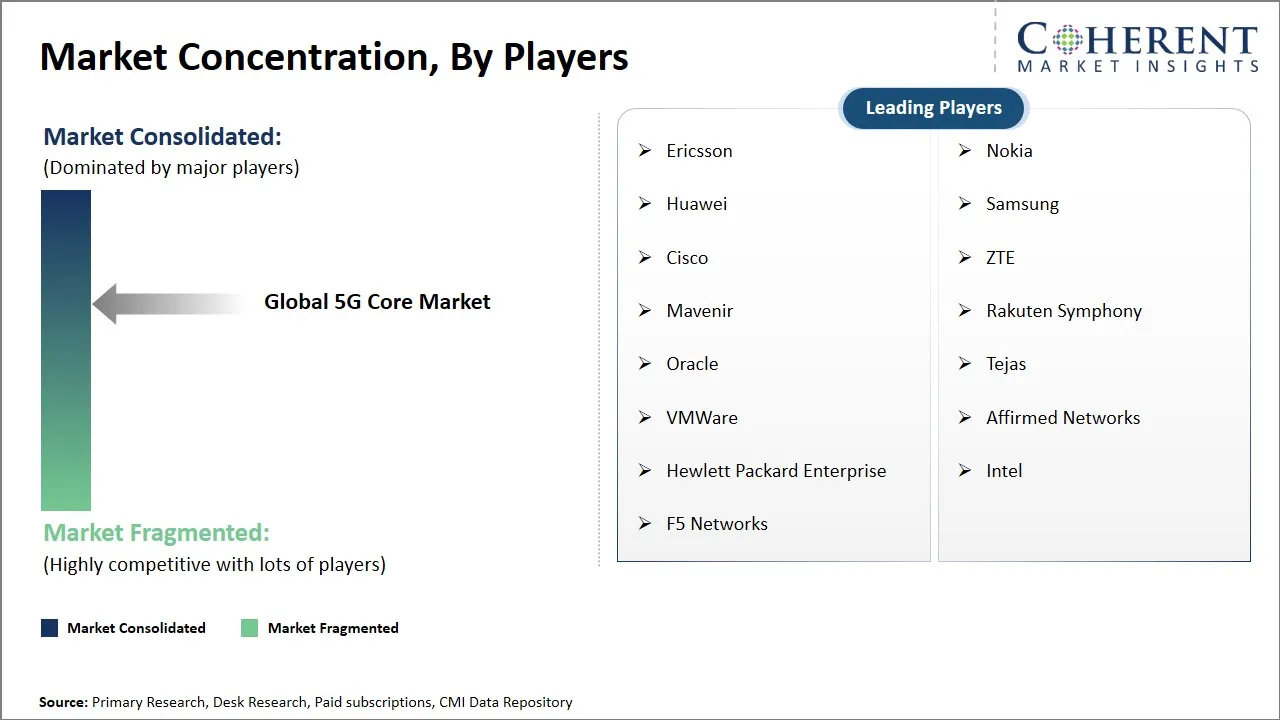
| Companies covered: | Ericsson, Nokia, Huawei, Samsung, Cisco, ZTE, Mavenir, Rakuten Symphony, Oracle, Tejas, VMWare, Affirmed Networks, Hewlett Packard Enterprise, Intel, and F5 Networks | ||
| Growth Drivers: |
| ||
| Restraints & Challenges: |
| ||
Market Dynamics
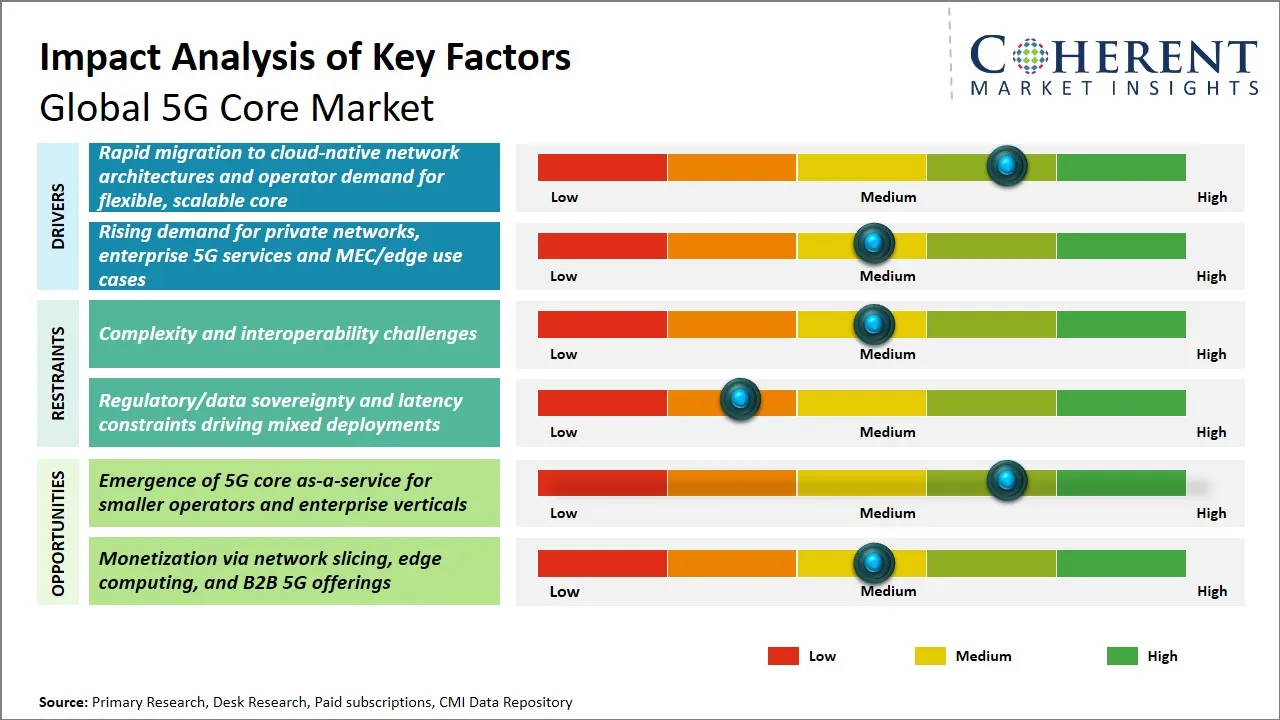
Global 5G Core Market Driver - Rapid Migration to Cloud-Native Network Architectures and Operator Demand for Flexible, Scalable Core
The telecommunications industry is witnessing an accelerated shift towards cloud-native network architectures, driven by operators’ growing need for more agile, flexible, and scalable core network solutions. Traditional hardware-centric core networks are increasingly being replaced or complemented by software-based, containerized deployments that can dynamically adapt to varying traffic demands and service requirements. This transformation enables operators to efficiently manage network resources, reduce latency, and rapidly roll out innovative services such as network slicing and edge computing. As operators strive to meet the ever-evolving consumer and enterprise demands for high-speed, low-latency connectivity, cloud-native 5G core infrastructures offer the scalability necessary to support massive IoT deployments and diverse use cases. Furthermore, the elastic nature of cloud-native cores allows for seamless integration with multi-cloud and hybrid cloud environments, enhancing operational efficiency while reducing total cost of ownership. Consequently, this dynamic migration is a key force propelling the adoption of next-generation 5G core networks worldwide.
Global 5G Core Market Opportunity – Emergence of 5G Core as-a-Service for Smaller Operators and Enterprise Verticals
The advent of 5G core as-a-Service is poised to revolutionize the global 5G core market by unlocking significant opportunities for smaller telecom operators and diverse enterprise verticals. Traditionally, deploying and managing 5G core networks required substantial capital investment, technical expertise, and operational complexity, which often constrained smaller operators and niche industry players from fully leveraging 5G capabilities.
However, the rise of cloud-native 5G core solutions offered in an as-a-service model drastically lowers entry barriers by providing scalable, flexible, and cost-effective network infrastructure options. This enables smaller Mobile Network Operators (MNOs), Mobile Virtual Network Operators (MVNOs), and enterprises, ranging from manufacturing, healthcare, transportation to smart cities, to deploy bespoke 5G networks or network slices tailored to their specific use cases without the burden of heavy upfront investments. In February 2025, AT&T signed a multi-year agreement with Nokia to deploy a fully cloud-native 5G voice core and automation platform across its U.S. network. Furthermore, the as-a-service model promotes rapid innovation and time-to-market by allowing these entities to access advanced network functions such as network slicing, edge computing, and enhanced security features on demand.
Analyst Opinion (Expert Opinion)
- National carriers remain the primary buyers of 5G core solutions as they race to support Enhanced Mobile Broadband (eMBB) and monetize network slicing. High-capacity UPF deployments allow operators to guarantee low-latency service tiers for premium consumers, cloud gaming, and live-streaming events.
- Manufacturing plants, logistics hubs, and energy utilities are increasingly deploying private 5G cores for ultra-reliable, low-latency connectivity. Demand is rising for flexible, cloud-native cores that integrate with factory automation, robotics, and real-time monitoring systems to replace or complement wired networks.
- Hyperscalers and regional data-center operators are investing in 5G Core-as-a-Service to serve sectors like healthcare, AR/VR entertainment, and smart cities. Their need for multi-tenant, API-driven cores creates a fast-growing market segment focused on scalability and developer-friendly orchestration.
Speak to the analyst
Want personalized insights?
Take the findings above to one of our principal consultants, or have the report rebuilt around the segments, geographies and competitors you actually track.
Market Segmentation
- Network Function Insights (Revenue, USD Bn, 2021 - 2033)
- UPF & user-plane related functions
- Control plane
- Subscriber & policy
- Orchestration & NFV MANO
- OSS/BSS integration & exposure functions
- Regional Insights (Revenue, USD Bn, 2021 - 2033)
- North America
- U.S.
- Canada
- Latin America
- Brazil
- Argentina
- Mexico
- Rest of Latin America
- Europe
- Germany
- U.K.
- Spain
- France
- Italy
- Russia
- Rest of Europe
- Asia Pacific
- China
- India
- Japan
- Australia
- South Korea
- ASEAN
- Rest of Asia Pacific
- Middle East
- GCC Countries
- Israel
- Rest of Middle East
- Africa
- South Africa
- North Africa
- Central Africa
- North America
- Key Players Insights
- Ericsson
- Nokia
- Huawei
- Samsung
- Cisco
- ZTE
- Mavenir
- Rakuten Symphony
- Oracle
- Tejas
- VMWare
- Affirmed Networks
- Hewlett Packard Enterprise
- Intel
- F5 Networks
Sources
Primary Research Interviews
Stakeholders
- Telecom Operators and Network Architects
- 5G Core Solution Vendors
- Cloud & Hyperscaler Partners
- Systems Integrators and Managed Service Providers specializing in 5G core deployments
- Enterprise IT Heads deploying Private 5G Networks (manufacturing, logistics, healthcare)
- Regulatory and Spectrum Authorities
Databases
- International Telecommunication Union (ITU) Statistics
- GSMA Intelligence Database
- U.S. Federal Communications Commission (FCC) 5G Deployment Data
- European Telecommunications Standards Institute (ETSI) Reports
- International Data Centre & Cloud Infrastructure Statistics (IDCIS)
Magazines
- Telecom Review
- Light Reading
- Mobile World Live Magazine
- Network Computing
- Cloud & Edge Tech Journal
Journals
- IEEE Communications Magazine
- Journal of Network and Systems Management
- International Journal of Wireless & Mobile Networks
- Journal of Cloud Computing: Advances, Systems and Applications
- Computer Networks Journal
Newspapers
- The Economic Times (India)
- Financial Times (UK) – Telecom Section
- Nikkei Asia – Technology & Telecoms
- The Wall Street Journal – Technology
- South China Morning Post – Tech
Associations
- 3rd Generation Partnership Project (3GPP)
- GSMA (Global System for Mobile Communications Association)
- European Telecommunications Network Operators’ Association (ETNO)
- Cellular Operators Association of India (COAI)
- Telecommunications Industry Association (TIA)
Public Domain Sources
- U.S. Federal Communications Commission (FCC)
- EUROSTAT
- International Telecommunication Union (ITU)
- World Bank – Digital Development Data
- ResearchGate
Proprietary Elements
- CMI Data Analytics Tool, Proprietary CMI Existing Repository of information for last 8 years
Get access to 250+ pages report
Every segment, forecast, competitor profile and data table behind the analysis above — available for instant download.
- ESOMAR Member
- ISO 9001:2015 Certified
- D-U-N-S Registered
- GDPR & CCPA Compliant
Missing comfort of reading report in your local language? Find your preferred language:
Transform your Strategy with Exclusive Trending Reports
Frequently Asked Questions
The global 5G core market is estimated to be valued at USD 6.22 billion in 2026 and is expected to reach USD 53.80 billion by 2033.
The CAGR of the global 5G core market is projected to be 36.1% from 2026 to 2033.
Rapid migration to cloud-native network architectures and operator demand for flexible, scalable core and rising demand for private networks, enterprise 5G services and MEC/edge use cases are the major factors driving the growth of the global 5G core market.
Complexity and interoperability challenges and regulatory/data sovereignty and latency constraints driving mixed deployments are the major factors hampering the growth of the global 5G core market.
In terms of network function, the UPF & user-plane related functions segment is estimated to dominate the market revenue share in 2026.
It is the central, cloud-native backbone of a 5G network that manages connectivity, mobility, security, and network slicing for devices and applications.
AI enables automated network management, predictive maintenance, and real-time traffic optimization, lowering costs and improving service.