

AIOps Platform Market
AIOps Platform Market size is estimated to be valued at USD 14.69 Bn in 2026 and is expected to reach USD 68.88 Bn in 2033, exhibiting a compound annual growth rate (CAGR) of 24.7% from 2026 to 2033.
Key Takeaways
- Based on Component, the Platform segment leads the market with highest shares in 2026, due to its integrated AI-centric capabilities.
- Based on Organization Size, the Small and Mid-Size companies segment leads the market with the largest share in 2026 due to strong demand for AIOps platform’s ability to operate with limited IT Staff and budgets.
- Based on Vertical, the IT & Telecom segment leads the market with the greatest share in 2026, driven the need to reduce downtime and automate complex operations.
- Based on Region, North America is estimated to lead the market with a share of 33.1% in 2026. While, Europe is considered to be the fastest growing region during the forecast period.
Market Overview
The AIOps (Artificial Intelligence for IT Operations) platforms market is rapidly growing as organizations seek smarter ways to manage complex IT environments. These platforms combine AI and ML with IT operations to automate processes, detect anomalies, and enable real-time decision-making.
The rising AIOps platform market demand is driven by the need for operational efficiency, real-time monitoring, and reduced downtime across cloud, hybrid, and on-premise systems. Industries such as banking, telecom, and healthcare are adopting AIOps to enhance service reliability and reduce manual workloads. AIOps is becoming essential to modern IT strategies as digital transformation accelerates.
Current Events and their Impact on the AIOps Platforms Market
Current Events | Description and its Impact |
Advancements in AI/ML Capabilities |
|
Technological Convergence Reshaping Competition |
|
End-User Feedback and Unmet Needs in the AIOps Platforms Market
Despite growing enterprise interest and steady vendor innovation, the adoption of AIOps platforms continues to face friction due to several recurring pain points reported by end users. Feedback collected from IT operations teams, DevOps practitioners, and SREs highlights a series of unmet needs that present both challenges and opportunities for market players.
Deployment and Integration Complexity
One of the most frequently cited concerns among users is the complexity involved in deploying AIOps solutions. Implementations often require extensive customization, prolonged onboarding, and significant integration effort with legacy infrastructure and disparate monitoring tools. Many users report that “out-of-the-box” functionality remains limited, and achieving full operational value can take several months. This implementation barrier significantly slows time-to-value, particularly for mid-sized organizations with limited IT resources.
Skills and Resource Limitations
AIOps platforms often require a blend of AI/ML proficiency and domain-specific IT operations expertise—skill sets that are rarely found in a single team. As a result, organizations are forced to either invest heavily in training or rely on managed services or system integrators. This skills gap leads to underutilization of platform features, reduced effectiveness, and extended deployment timelines.
Alert Noise and Operational Fatigue
While AIOps is positioned to reduce alert fatigue by correlating and suppressing redundant events, end users frequently report ongoing issues with excessive alerts and low-quality signal extraction. In many cases, platforms fail to provide reliable event correlation without intensive manual rule creation or tagging strategies. As a result, operations teams continue to experience high levels of alert noise, diminishing trust in the platform and forcing teams to revert to manual monitoring in critical cases.
- Current Industry Events of 2026
- Market Size Estimation
- Regional Breakdown
- Competitive Landscape
- Customer Intelligence
- Segmental Analysis
- Pricing Analysis
- Key Market Drivers, Challenges & Future Trends
- Customized Insights Section
Segmental Insights
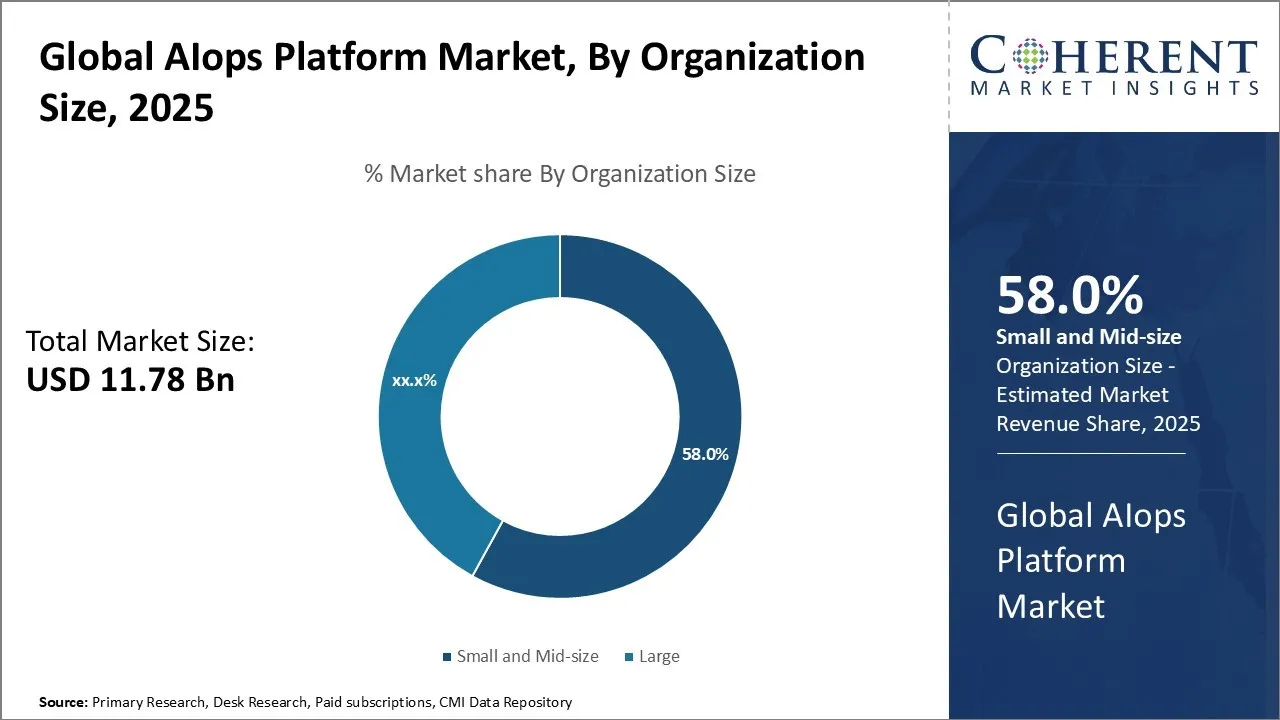
AIOps Platforms Market Insight, By Organization Size
Small and Mid-size Companies Acquires the Dominant Share as they are Operated with Limited IT Staff and Budget
In terms of organization size, the small and midsize companies’ segment is expected to dominate the global AIOps platforms market with a highest share in 2026, primarily due to strong demand for AIOps platform’s ability to operate with limited IT Staff and budgets. SMEs cannot always afford large IT teams or multiple monitoring tools. AIOps platforms consolidate functions such as performance monitoring, anomaly detection, and alerting into a single, automated system, reducing operational costs and manual intervention. Even small businesses are using cloud services, SaaS platforms, and hybrid infrastructures. AIOps helps them gain unified visibility and manage these setups proactively without building complex custom solutions.
In February 2025, Futran Solutions released its latest “AIOps 2025” vision, spotlighting transformative AI-driven automation in IT operations. The framework emphasizes predictive analytics, real-time anomaly detection, and self-healing systems to preempt downtime, optimize cloud resource allocation, and streamline incident response workflows.
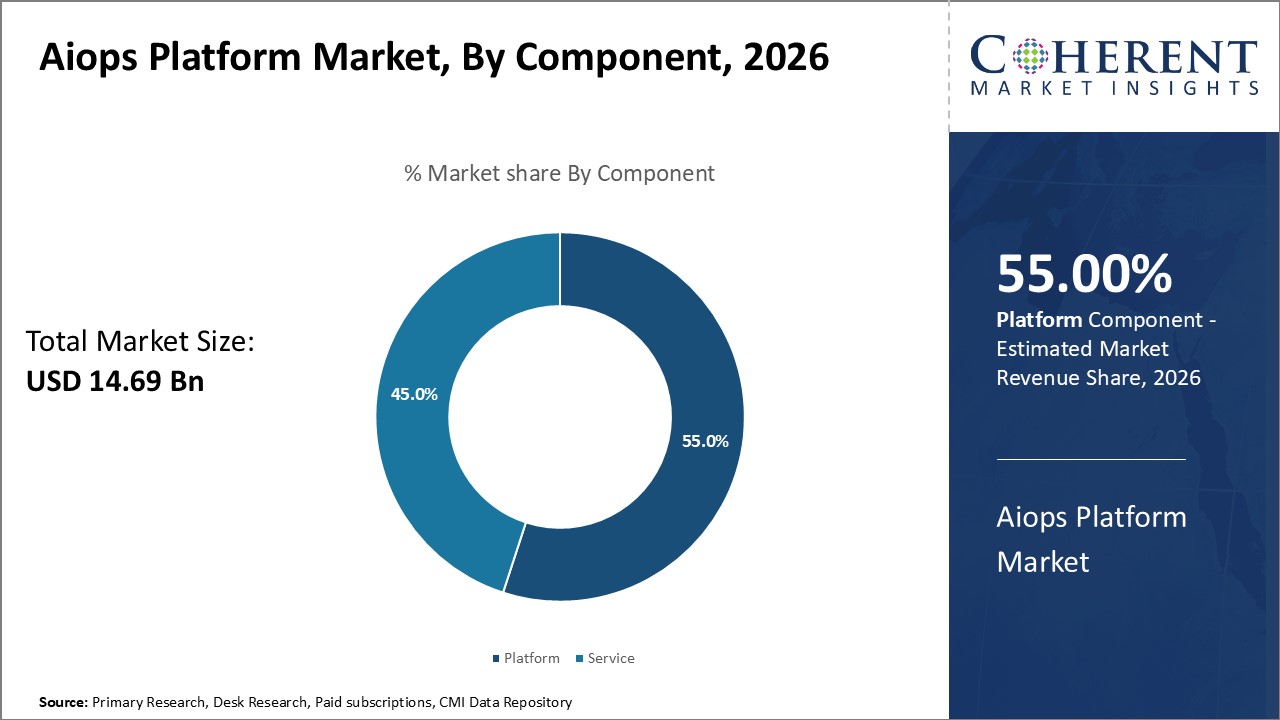
AIOps Platforms Market Insight, By Component
Platform Acquires the Dominant Share as it Integrate AI-centric Capabilities
In terms of component, the platform segment is expected to contribute with the highest share in the market in 2026 due to its integrated AI-centric capabilities which aligns with enterprises needs for scalable and proactive operations. AIOps platforms integrate essential functionalities such as event correlation, anomaly detection, predictive analytics, and automated incident response into a single, unified system. This holistic approach offers comprehensive IT oversight and workflow efficiency, making platforms more valuable than standalone services. Organizations especially in finance, healthcare, and IT demanding for real-time analytics powered by AI/ML to proactively address issues before they escalate. AIOps platforms are inherently designed for this, offering greater value than reactive, manual services.
In May 2025, Digitate, a leader in autonomous enterprise software, introduced flagship ignio™ AIOps platform on Amazon Web Services (AWS) Marketplace. This strategic move enables global customers to access, deploy, and scale ignio directly through AWS, streamlining procurement and integration. The AI-driven platform leverages machine learning to detect, diagnose, and resolve IT incidents autonomously, helping enterprises enhance service reliability and reduce operational costs.
AIOps Platforms Market Insight, By Verticals
IT & Telecom Dominates the Overall Market
In terms of verticals, the IT & telecom segment is expected to contribute the greatest share of the market in 2026, driven the need to reduce downtime and automate complex operations, along with improving customer experience and support the rollout of next-gen technologies such as %G, Edge computing, and AI-native cloud infrastructure. AIOps helps in increasing complex infrastructure, services, and customer demands. Telecom operators manage vast, geographically distributed network infrastructures (5G, fiber, edge). AIOps continuously monitors metrics like latency, packet loss, bandwidth, and device performance, using machine learning to detect anomalies in real-time. AIOps predicts potential system failures by analyzing historical log data and behavioral patterns.
In March 2025, At Mobile World Congress 2025 in Barcelona, Jio Platforms teamed up with Nokia, AMD, and Cisco to introduce an Open Telecom AI Platform, offering AI-driven orchestration across RAN, routing, AI data centers, and security layers. Designed to optimize efficiency, security, and revenue, this modular platform also targets global service providers with Jio as its initial pilot.
Regional Insights
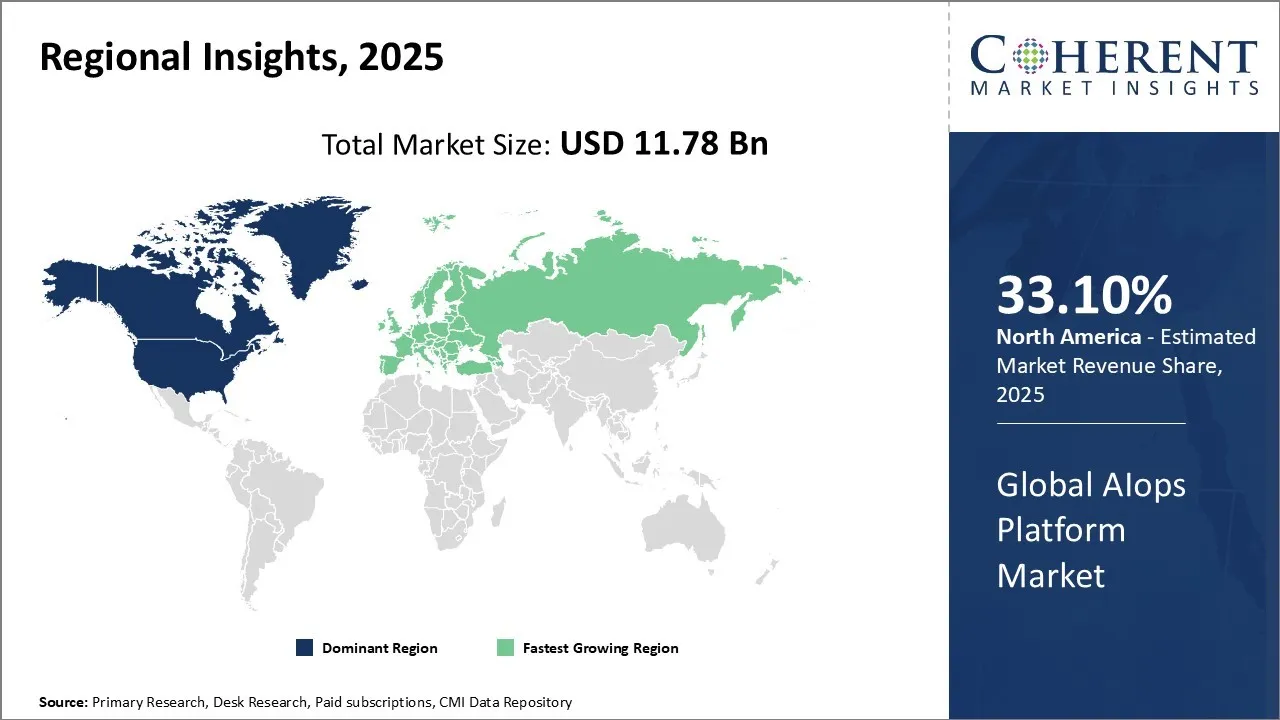
North America AIOps Platform Market Analysis & Trends
North America held the dominant position in the market in 2026 with 33.10% share and is projected to retain its dominance throughout the forecast period. The U.S. and Canada are major economies driving the growth of the AIOps platform market in this region, owing to the region being an early adopter of advanced technologies such as artificial intelligence, machine learning, big data, and analytics in the region. Moreover, the presence of IT companies such as Google, Microsoft Corporation, IBM, Oracle, and others plays a major role in the growth of the market in the region.
Experts forecast that by 2026, AIOps will shift from reactive to proactive/resilience-focused frameworks, particularly within North American organizations serious about digital transformation.
Europe AIOps Platform Market Analysis & Trends
Europe AIOps platform market is experiencing significant growth due to European enterprises rapidly moving to clou-native, hybrid and multi-cloud environment. Europe also has strict data protection and compliance requirements under the General Data Protection Regulation (GDPR) and the proposed EU AI Act are pushing companies to adopt transparent, auditable AI systems. AIOps platforms with built-in compliance reporting and explainable AI are well-suited for regulated sectors such as finance, telecom, and healthcare. A 2026 ISG report notes that Swiss enterprises increasingly demand AIOps and FinOps to manage multicloud complexity. Providers leveraging AIOps have cut operational workloads by 30–50%, optimizing both performance and costs. This is further accelerating the AIOps market share.
AIOps Platform Market Outlook Country-Wise
The U.S. AIOps Platform Market Trends
The U.S. AIOps platform market is characterized by advanced IT infrastructure, large-scale enterprises and heavy reliance on cloud ad hybrid environment. U.S. enterprises run vast multi-cloud, hybrid, and microservices-based environments that generate massive telemetry data (logs, metrics, traces). U.S. is rapid shifting towards cloud adoption. For instance, in 2024, JPMorgan Chase integrated AIOps with their hybrid cloud strategy to reduce MTTR (mean time to resolution) by 35%.
U.K. AIOps Platform Market Trends
The U.K. AIOps platform market is market by high demand in banking, insurance, and government sectors for service reliability and compliance. The UK's banking sector alone faces over £1 billion in fraud annually, with more than 3.3 million incidents recorded in 2024, a 12% increase from 2023. This sector is working towards maintaining high uptime and secure platforms to meet service-level agreements and regulatory standards, making AIOps essential.
Market Report Scope
AIOps Platform Market Report Coverage
| Report Coverage | Details | ||
|---|---|---|---|
| Base Year: | 2025 | Market Size in 2026: | USD 14.69 Bn |
| Historical Data for: | 2020 To 2024 | Forecast Period: | 2026 To 2033 |
| Forecast Period 2026 to 2033 CAGR: | 24.7% | 2033 Value Projection: | USD 68.88 Bn |
| Geographies covered: |
| ||
| Segments covered: |
| ||
| Companies covered: | International Business Machines Corporation, Splunk Inc., CA Technologies, VMware, Inc., Micro Focus International plc., HCL Technologies Limited, AppDynamics, BMC Software, Inc., Moogsoft, and FixStream Network Inc. | ||
| Growth Drivers: |
| ||
| Restraints & Challenges: |
| ||
Global AIOps Platform Market Growth Drivers
- The increasing adoption of cloud platform: The increasing adoption of cloud platforms from various organizations of different verticals such as banking, e-commerce, healthcare, and others accelerated demand for the AIOps platform. This has enabled businesses to manage complex infrastructure with greater automation and insights. This surge is fueling AIOps platform market growth, as enterprises seek tools to monitor performance, detect anomalies, and optimize cloud resource usage in real time. For example, in May 2024, Microsoft launched an enhanced version of its Azure Monitor with integrated AIOps features, helping companies automate root-cause analysis and reduce downtime in multicloud environments, further boosting adoption among global cloud users.
- Organizations are placing more emphasis on the quality and performance: Organizations are increasingly focused on IT performance due to growing reliance on digital systems. AIOps solutions are featuring intelligent monitoring, anomaly detection, and root-cause analysis which enhances service quality and reliability. The rising AIOps platform market value reflects this demand. For example, BigPanda reached a valuation of over USD 1.2 billion, highlighting strong investor confidence. In 2024, IBM acquired Netreo to expand its AIOps and observability capabilities. These developments show how AIOps is becoming essential for delivering efficient and resilient IT operations.
Global AIOps Platform Market Opportunities
- Consistent Growth in Data: The market is growing as a result of factors including the volume of data and alarms that must be evaluated as well as quicker and more precise root cause analysis. Additionally, rising cloud use, rising data volumes, and growing awareness of AIOps' possibilities in the business and corporate world are all predicted to generate profitable opportunities for the market's expansion.
Global AIOps Platform Market Trends
- The demand for smart machines and devices
The activities and transactions involved in banking operations are frequently done by clients, employees, and outside organizations. Due to the complexity of these processes, monitoring is crucial. Over the projection period, AIOps platform market forecast anticipates strong growth, driven by the ability of these platforms to provide real-time insights and automate issue resolution. For example, C.A. Technologies' AIOps platform, Digital Experience Insights, enables financial institutions to address complex IT challenges such as performance bottlenecks, capacity planning, and configuration management. In April 2025, a UK-based retail bank deployed a similar AIOps solution to cut resolution times by 40%, improving both uptime and fraud detection capabilities.
As there is a numerous high-profile data breaches over the past few years, banks and other financial institutions are particularly concerned with protecting the security of the data they produce.
AIops is being used by many banks and other financial organizations to improve efficiency. For instance, major Indian banks wanted to improve the efficiency of the on boarding of their digital merchants as well as streamline and make transactions easier for their new customers. QualityKiosk's AIops-based analytics solution AnaBot improved merchant onboarding success rates and increased revenue by 7% by better supporting ON-US & OFF-US transactions.
Approximately three-fourths (74%) of financial institutions in the U.S. and the U.K. reported an increase in cybercrime, according to British Aerospace (BAE) Systems Applied Intelligence. Cybercrime can have serious financial repercussions for businesses in addition to known financial losses, including collapsing stock prices, reputational harm, and legal action. AIops can assist in the prosecution of this crime. To protect vulnerable systems, AIops solutions provide round-the-clock monitoring, suspicious activity detection, and defense operation activation.
Analyst Opinion (Expert Opinion)
The AIOps platform market is no longer a peripheral innovation, it has become a central enabler of operational resilience and strategic IT transformation. From a technical and operational standpoint, AIOps is rapidly reshaping how enterprises manage hybrid and distributed environments, particularly where cloud-native architectures and continuous integration pipelines introduce volatility and complexity.
AIOps is not merely about automation; it is about intent-driven observability. Traditional IT operations teams are constrained by the inability to detect low-signal anomalies buried within voluminous telemetry. AIOps addresses this limitation by introducing correlation engines that analyze logs, metrics, and traces in real time to identify root causes, often before incidents impact service-level objectives (SLOs).
An excellent example of this is PayPal’s deployment of AIOps to reduce incident triage time by 60%, where machine learning was used to map incident clusters across Kubernetes pods and microservices in real time. Similarly, LinkedIn’s implementation of auto-remediation workflows through AI-led diagnostics led to a 70% decrease in mean time to resolution (MTTR) across its internal infrastructure layers. These are not proofs of concept, they are live operational cases that illustrate the transformative capacity of mature AIOps frameworks.
Moreover, AIOps is disrupting traditional ITSM platforms by rendering static runbooks obsolete. Through event deduplication and causality detection, platforms like Dynatrace and Moogsoft are achieving alert compression rates upwards of 95%, effectively eliminating alert fatigue and enabling operators to focus on decision-making rather than firefighting.
A trend that should not be underestimated is the convergence of AIOps with DevOps pipelines. By integrating anomaly detection into CI/CD workflows, AIOps is evolving into a pre-production assurance layer. Atlassian’s Jira Service Management, for example, leverages anomaly scoring models to block deployment artifacts likely to cause regressions, effectively embedding predictive operations into the software lifecycle.
Another critical shift is the move from centralized to federated intelligence. AIOps platforms are increasingly being embedded at the edge in 5G towers, smart factories, and satellite control centers, where telemetry volumes are impractical to backhaul. IBM’s Watson AIOps is now being applied at the edge layer for autonomous manufacturing diagnostics, providing context-aware recommendations to plant engineers.
Speak to the analyst
Want personalized insights?
Take the findings above to one of our principal consultants, or have the report rebuilt around the segments, geographies and competitors you actually track.
Key Developments
- In June 2025, India’s premier engineering institution, IIT Roorkee, partnered with edtech firm Futurense to launch the country’s first Advanced Certification in AI Engineering and AIOps. This intiatives equips working professionals with the skills to deploy agentic AI systems at an enterprise scale using tools like LangChain, Hugging Face, TensorFlow, Docker, and Kubernetes.
- In April 2025, SoundHound AI announced its Autonomics AIOps platform has been recognized as a Market Leader in the 2025 ISG Buyers Guide for AIOps. Autonomics ranked in the top-tier “Exemplary” category for overall AIOps capability, outperforming 19 other providers including BMC, Datadog, Dynatrace, and Splunk—in product experience and customer satisfaction.
- In February 2025, Inspeq AI debuted its Responsible AIOps (RAIOps) platform on Salesforce AppExchange, becoming the first operation-ready AI safety tool available to more than 150,000 Salesforce customers. The platform integrates seamlessly, offering rapid deployment—up to 4× faster development while cutting costs by 70% and improving reliability by 90%.
- In November 2024, Vitria Technology unveiled its VIA AI with Knowledge™ platform at FutureNet World, spotlighting a new generation of AIOps explicitly designed for telecom service assurance. The solution uses AI and machine learning to tackle legacy barriers in the industry, offering real-time analytics, event correlation, and automated incident remediation.
- In May 2023, IBM, a global technology and innovation company unveiled Watsonx, a new AI and data platform. Unveiled at the company's annual Think conference, Watsonx will give IBM's (IBM) customers the ability to release foundation models and generative AI and have them store and govern them in one place on any cloud environment.
Market Segmentation
- By Component (Revenue, USD Bn, 2021 - 2033)
- Platform
- Services
- By Organization Size (Revenue, USD Bn, 2021 - 2033)
- Small and Mid-size Companies
- Large Enterprises
- By Verticals (Revenue, USD Bn, 2021 - 2033)
- Banking, Financial Services, and Insurance
- Healthcare and Life Sciences
- Retail and Consumer Goods
- IT and Telecom
- Government
- Manufacturing
- Media and Entertainment
- Others
- By Region (Revenue, USD Bn, 2021 - 2033)
- North America
- U.S.
- Canada
- Latin America
- Brazil
- Argentina
- Mexico
- Rest of Latin America
- Europe
- Germany
- U.K.
- Spain
- France
- Italy
- Russia
- Rest of Europe
- Asia Pacific
- China
- India
- Japan
- Australia
- South Korea
- ASEAN
- Rest of Asia Pacific
- Middle East
- GCC Countries
- Israel
- Rest of Middle East
- Africa
- South Africa
- North Africa
- Central Africa
- North America
- Key Companies
- International Business Machines Corporation
- Splunk Inc.
- CA Technologies
- VMware, Inc.
- Micro Focus International plc.
- HCL Technologies Limited
- AppDynamics
- BMC Software, Inc.
- Moogsoft
- FixStream Network Inc
Sources
Primary Research Interviews from the following stakeholders
Stakeholders
- Interviews with IT operations managers, cloud architects, DevOps engineers, site reliability engineers (SREs), cybersecurity professionals, digital transformation officers, and software product heads across key markets.
Databases
- GitHub and GitLab project repositories on AIOps tooling and observability frameworks
- U.S. Bureau of Economic Analysis – ICT Services and Cloud Spending Data
- Eurostat – Digital Economy and Society datasets
- OECD ICT Database
- Ministry of Electronics and Information Technology (MeitY), India – National Cloud and AI Program Reports
- Open Source Initiative (OSI) contribution logs
- Department of Telecommunications (DoT), India – Digital Infrastructure Statistics
- Australian Bureau of Statistics – ICT Industry Output Data
- Canadian Digital Industries Economic Account
- U.S. National Institute of Standards and Technology (NIST) AI and Automation Benchmarks
Magazines
- CIO Magazine
- InfoWorld
- Network Computing
- DevOps.com
- TechTarget – AIOps and IT Operations section
- SD Times
- TechBeacon
- Cloud Tech News
- Infrastructure Intelligence (IT Ops and AI)
- Container Journal
Journals
- IEEE Transactions on Network and Service Management
- Journal of Systems and Software (Elsevier)
- ACM Transactions on Autonomous and Adaptive Systems
- Future Generation Computer Systems
- International Journal of Information Management
- Journal of Cloud Computing
- Journal of Big Data Analytics in Healthcare
- Journal of Web Engineering
Newspapers
- The Economic Times – CIO and Enterprise Tech section
- Business Standard – Cloud and Automation Trends
- Financial Times – Digital Infrastructure and Cloud Features
- The Hindu Business Line – Enterprise Technology Reports
- South China Morning Post – Cloud and AI Infrastructure
- Nikkei Asia – Software and Telecom Digitization
- Washington Post – Tech Industry Features (Cloud, AI)
- Mint – CIO & IT Infrastructure Insights
Associations
- Cloud Native Computing Foundation (CNCF)
- Open Observability Foundation
- IEEE Standards Association – AIOps and Automation Committees
- The Linux Foundation – LF AI & Data
- DevOps Institute
- IT Service Management Forum (itSMF)
- Confederation of Indian Industry (CII) – Digital Transformation & Automation Chapter
- European Telecommunications Standards Institute (ETSI) – Autonomous Networks Group
Public Domain Sources
- National Institute of Standards and Technology (NIST), U.S. – IT Ops and AIOps Publications
- Ministry of Electronics and Information Technology (MeitY), India – National Cloud and Automation Initiatives
- European Commission – AI Policy and Infrastructure Modernization Papers
- NITI Aayog – AI and Data Strategy Reports
- National Cloud Strategy Documents – Singapore, UK, Australia
- India Digital Ecosystem Architecture (InDEA) Framework
- AI and Data Ethics Framework – Australian Government
- U.S. Department of Homeland Security – AI and Infrastructure Security Updates
- Digital India Programme – MeitY AIOps Use Cases in Government IT
Proprietary Elements
- CMI Data Analytics Tool, and Proprietary CMI Existing Repository of information for last 8 years
*Definition: Artificial Intelligence for IT Operations (AIOps) is a multilayered technology platform that enhances IT operations by using machine learning and analytics to analyze the big data collected for various IT operations tools and devices to resolve issues in real-time.
Get access to 250+ pages report
Every segment, forecast, competitor profile and data table behind the analysis above — available for instant download.
- ESOMAR Member
- ISO 9001:2015 Certified
- D-U-N-S Registered
- GDPR & CCPA Compliant
Missing comfort of reading report in your local language? Find your preferred language:
Transform your Strategy with Exclusive Trending Reports
Frequently Asked Questions
The AIOps Platform Market is estimated to be valued at USD 14.69 Bn in 2026, and is expected to reach USD 68.88 Bn by 2033.
The global AIOps platform market is estimated to surpass US$ 35.24 Bn by 2033.
Major players operating in the market include International Business Machines Corporation, Splunk Inc., CA Technologies, VMware, Inc, Micro Focus International plc, HCL Technologies Limited, AppDynamics, BMC Software, Inc., Moogsoft, and FixStream Network Inc.
Among organization size, small and mid-size companies’ segment is estimated to witness significant growth, exhibiting the highest CAGR during the forecast period.
Increasing adoption of cloud platforms from various organizations of different verticals such as banking, e-commerce, healthcare, and others is one of the major factors that is expected to propel the growth of the market over the forecast period.
The CAGR of the AIOps Platform Market is projected to be 24.7% from 2026 to 2033.
IBM, Splunk, Dynatrace, Moogsoft, BMC, Broadcom, New Relic, and Micro Focus lead the AIOps platform market.