

Epistaxis Market Size and Forecast: 2026-2033
The Epistaxis Market is estimated to be valued at USD 1.2 Bn in 2026 and is expected to reach USD 2.1 Bn by 2033, exhibiting a compound annual growth rate (CAGR) of 4.8% from 2026 to 2033
Key Takeaways
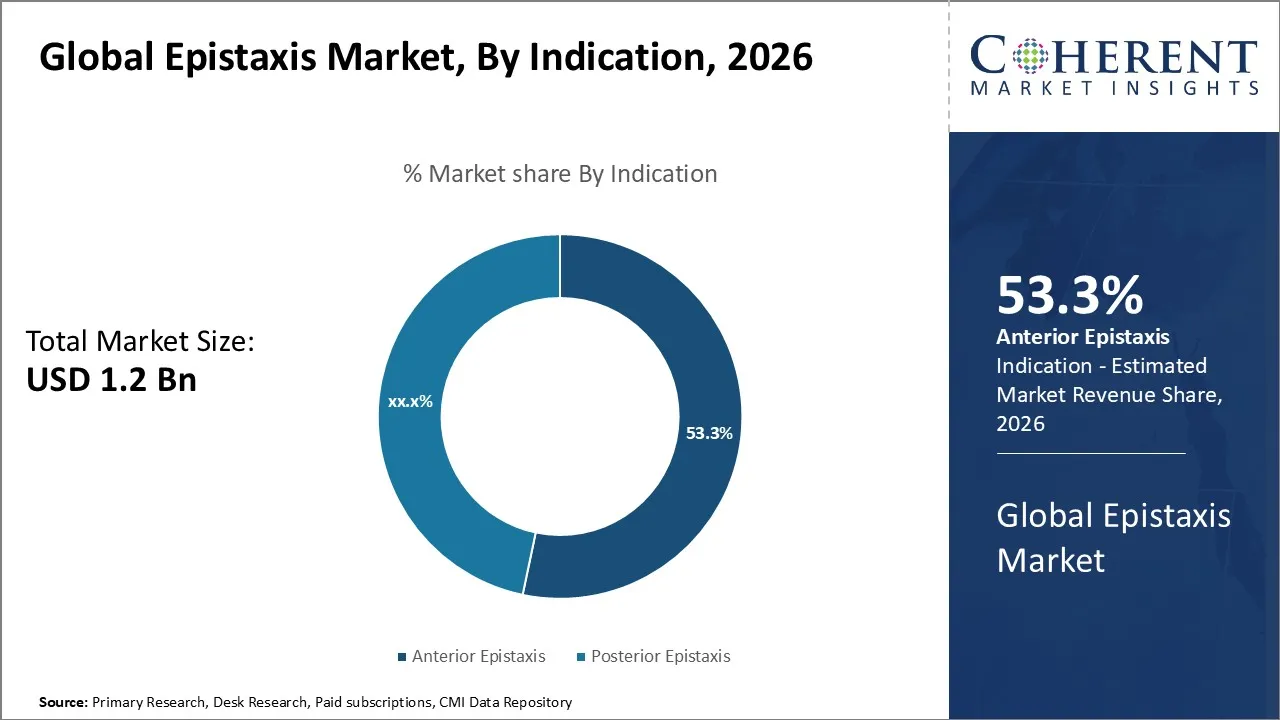
- By Indication, Anterior Epistaxis hold the largest market share of 53.3% in 2026 owing to its high prevalence & epidemiological dominance.
- By Product Type, Anesthetics expected to hold the largest market share of 34.6% in 2026 owing to the increasing volume of epistaxis procedures.
- By Distribution Channel, Hospital Pharmacies acquired the prominent market share of 42.2% in 2026 owing to the central role in acute & severe case management.
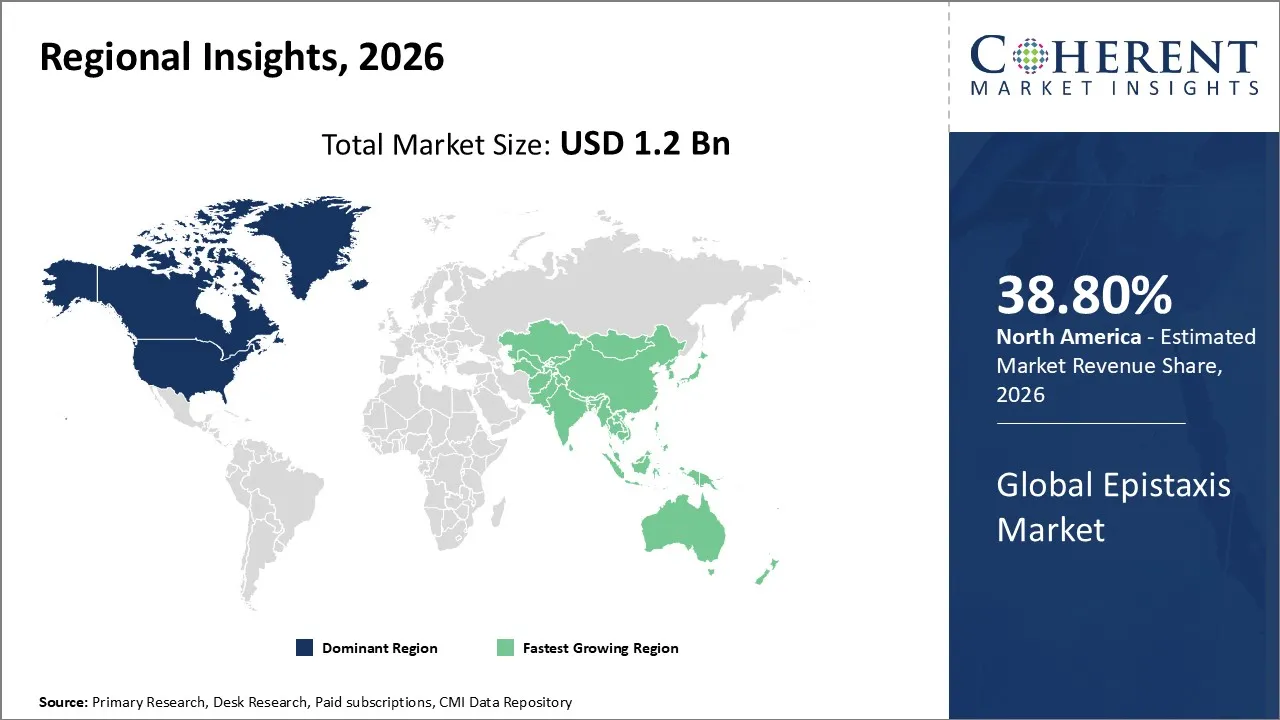
- By Region, North America dominates the overall market with an estimated share of 38.8% in 2026 owing to the advanced healthcare infrastructure.
Market Overview
High prevalence of nosebleeds across all age groups, especially among children and the elderly, drives the epistaxis market. Environmental factors such as dry air and pollution, along with increasing cases associated with hypertension and nasal conditions, support market growth. Healthcare providers are improving patient outcomes by adopting minimally invasive treatments, advanced nasal packing materials, and cautery techniques. Expanding healthcare infrastructure, rising awareness, and the widespread availability of over-the-counter and prescription therapies continue to propel steady global market expansion.
Current Events and their Impact on the Epistaxis Market
Current Events | Description and its impact |
Advances in Minimally Invasive Nasal Treatment Technologies |
|
Rising Prevalence of Air Pollution in Urban Asia-Pacific |
|
Supply Chain Disruptions Due to Global Semiconductor Shortages |
|
Segmental Insights
- Current Industry Events of 2026
- Market Size Estimation
- Regional Breakdown
- Competitive Landscape
- Customer Intelligence
- Segmental Analysis
- Pricing Analysis
- Key Market Drivers, Challenges & Future Trends
- Customized Insights Section
Epistaxis Market Insights, By Indication - Anterior Epistaxis contribute the highest share of the market owing to its growth of minimally invasive & OTC treatments
Anterior Epistaxis hold the largest market share of 53.3% in 2026. High occurrence of anterior epistaxis across all age groups, particularly among children and young adults, drives the epistaxis market. Environmental factors such as dry air, pollution, and seasonal changes increase the number of cases. Minor trauma, including nose picking and irritation of superficial nasal vessels, further boosts demand. Healthcare providers enable easy diagnosis and offer widely accessible outpatient treatments like nasal packing and cautery, while the availability of over-the-counter products supports consistent management and ongoing market growth.
Epistaxis Market Insights, By Product Type - Anesthetics contribute the highest share of the market owing to its Rising adoption of nasal packing & cautery
Anesthetics expected to hold the largest market share of 34.6% in 2026. Increasing demand for epistaxis procedures drives anesthetic use, as clinicians actively use them to manage pain during nasal packing and cauterization. Healthcare providers are adopting minimally invasive and outpatient treatments, which boosts the use of local and topical anesthetics. Expanding emergency and ambulatory care services further fuels demand. Ongoing advancements in anesthetic formulations enhance efficacy and patient comfort, while the growing number of pediatric and elderly cases increases the need for safe, fast-acting anesthesia in routine epistaxis management.
Epistaxis Market Insights, By Distribution Channel - Hospital Pharmacies contribute the highest share of the market owing to its immediate availability of specialized drugs
Hospital Pharmacies acquired the prominent market share of 42.2% in 2026. Hospital pharmacies actively drive the epistaxis market by supplying critical prescription drugs, hemostatic agents, and anesthetics for severe and recurrent cases. Clinicians integrate these pharmacies with procedures like nasal packing, cauterization, and surgical interventions, ensuring steady demand. High patient inflow in emergency and ENT departments, along with expanding hospital infrastructure, further boosts growth. Hospitals adopt advanced and innovative therapies, and regulatory oversight combined with professional supervision strengthens trust, positioning hospital pharmacies as a primary channel for efficient and reliable epistaxis treatment.
Regional Insights
North America Epistaxis Market Trends
North America dominates the overall market with an estimated share of 38.80% in 2026. The North American epistaxis market is advancing as healthcare providers increasingly adopt minimally invasive treatments and bioresorbable nasal packing materials. Patients and clinicians are actively promoting early diagnosis and proactive management of nosebleeds. Hospitals and outpatient clinics incorporate innovative hemostatic agents and anesthetics to improve treatment outcomes. Robust healthcare infrastructure, strict regulatory standards, and active participation from key market players accelerate product adoption. Additionally, the growing prevalence of risk factors such as hypertension and an aging population continues to influence market developments.
Asia Pacific Epistaxis Market Trends
The Asia Pacific epistaxis market is growing as healthcare providers and patients increasingly embrace improved medical infrastructure and ENT services. Hospitals and clinics are actively using advanced nasal packing materials, cautery devices, and local anesthetics to treat nosebleeds efficiently. Rising risk factors, including pollution, dry climates, and chronic health conditions, are driving more patient visits. Global and regional players are investing in innovative therapies, while government initiatives strengthen healthcare delivery, collectively accelerating the adoption of epistaxis treatments throughout the region.
United States Epistaxis Market Trends
The United States epistaxis market is expanding as healthcare providers actively adopt advanced minimally invasive procedures and innovative nasal packing solutions. ENT specialists use modern hemostatic agents and local anesthetics to improve patient comfort and treatment effectiveness. Patients increasingly seek early medical consultation due to growing awareness of nosebleeds. Strong hospital networks, well-established outpatient care services, and active involvement from leading medical device and pharmaceutical companies drive rapid adoption of new therapies. Rising risk factors like hypertension and an aging population further shape treatment demand.
Japan Epistaxis Market Trends
The Japan epistaxis market is expanding as healthcare providers actively adopt advanced ENT treatments, including minimally invasive procedures and bioresorbable nasal packing materials. Hospitals and clinics employ modern hemostatic agents and local anesthetics to enhance patient comfort and treatment outcomes. Growing public awareness prompts patients to seek early consultation for nosebleeds, while aging populations and rising comorbidities increase demand for effective management. Strong healthcare infrastructure, government initiatives, and active participation from leading medical device and pharmaceutical companies drive faster adoption of innovative epistaxis therapies nationwide.
Epistaxis Market Trend
Rise of Minimally Invasive Procedures
Healthcare providers are increasingly adopting minimally invasive treatments for epistaxis, such as endoscopic cauterization and absorbable nasal packing. These methods reduce patient discomfort, shorten recovery times, and improve clinical outcomes. Hospitals and outpatient clinics favor these procedures for efficiency, while patients prefer less painful interventions. The trend is accelerating innovation in devices and techniques, prompting manufacturers to develop advanced hemostatic agents, bioresorbable materials, and portable treatment kits to meet growing demand.
Growing Adoption of Advanced Hemostatic Agents
Clinicians are shifting toward innovative hemostatic agents, including gels, sprays, and powders, to manage anterior and posterior epistaxis effectively. These agents reduce bleeding time, improve procedural efficiency, and minimize recurrence. Hospitals and outpatient centers are adopting these solutions alongside traditional packing and cautery. Pharmaceutical companies are investing in research to enhance agent efficacy, biocompatibility, and ease of use, responding to demand for safer, faster, and more patient-friendly hemostatic options across various age groups.
Epistaxis Market Opportunity
Expansion in Outpatient and Ambulatory Care Settings
Outpatient clinics and ambulatory surgical centers offer a growing opportunity for epistaxis treatment providers. By supplying compact, easy-to-use nasal packing kits, topical anesthetics, and minor procedural devices, companies can tap into the demand for convenient, quick, and cost-effective care. Expanding into these facilities allows manufacturers to reach a wider patient base, support early intervention, and reduce hospital dependency, aligning with trends toward accessible, outpatient-focused ENT care while driving consistent product adoption.
Market Report Scope
Epistaxis Market Report Coverage
| Report Coverage | Details | ||
|---|---|---|---|
| Base Year: | 2025 | Market Size in 2026: | USD 1.2 Bn |
| Historical Data for: | 2020 To 2024 | Forecast Period: | 2026 To 2033 |
| Forecast Period 2026 to 2033 CAGR: | 4.8% | 2033 Value Projection: | USD 2.1 Bn |
| Geographies covered: |
| ||
| Segments covered: |
| ||
| Companies covered: | Smith & Nephew, Medline Industries, Inc, Bristol-Myers Squibb Pharma Company, Ciron Drugs, and King Pharmaceuticals, Inc | ||
| Growth Drivers: |
| ||
| Restraints & Challenges: |
| ||
Analyst Opinion (Expert Opinion)
- The epistaxis market reflects a clinical burden that extends well beyond simple nosebleeds, with up to 60% of individuals experiencing an episode in their lifetime, even though only a fraction seek medical attention, underscoring the latent demand for effective therapeutic interventions. In practice, conventional nasal packing achieves haemostasis in roughly 87–88% of emergency department cases, yet patient discomfort and the need for prolonged pack duration remain significant limitations.
- Despite incremental gains from topical agents and cautery, recurrent bleeding and comorbidities such as hypertension and anticoagulant use drive more complex management pathways, with nearly 40% of hospitalized epistaxis patients presenting cardiovascular-related factors. This clinical complexity highlights a clear market gap for targeted therapies that improve comfort, reduce recurrence, and integrate seamlessly across emergency, outpatient, and specialist settings. The rising adoption of absorbable and hemostatic-enhanced packing materials demonstrates practitioner preference for patient‑centric solutions, yet inconsistent treatment protocols and limited evidence defining optimal use patterns constrain broader adoption.
Speak to the analyst
Want personalized insights?
Take the findings above to one of our principal consultants, or have the report rebuilt around the segments, geographies and competitors you actually track.
Market Segmentation
- By Indication
- Anterior Epistaxis
- Posterior Epistaxis
- By Product Type
- Vasoconstrictors
- Anesthetics
- Antibiotic Ointments
- Cauterizing Agents
- By Distribution Channel
- Hospital Pharmacies
- Retail Pharmacies
- Online Pharmacies
- By Regional Insights
- North America
- U.S.
- Canada
- Latin America
- Brazil
- Argentina
- Mexico
- Rest of Latin America
- Europe
- Germany
- U.K.
- Spain
- France
- Italy
- Russia
- Rest of Europe
- Asia Pacific
- China
- India
- Japan
- Australia
- South Korea
- ASEAN
- Rest of Asia Pacific
- Middle East
- GCC Countries
- Israel
- Rest of Middle East
- Africa
- South Africa
- North Africa
- Central Africa
- North America
- Key Players Insights
- Smith & Nephew
- Medline Industries, Inc
- Bristol-Myers Squibb Pharma Company
- Ciron Drugs
- King Pharmaceuticals, Inc
Sources
Primary Research interviews
- ENT specialists, otolaryngologists, and general physicians
- Hospital procurement managers and pharmacy directors
- Medical device distributors and suppliers
Databases
- PubMed
- ClinicalTrials.gov
- FDA medical device databases
- WHO Global Health Observatory
Magazines
- ENT Today
- Physician’s Weekly
- Medical Device and Diagnostic Industry Magazine (MD+DI)
Journals
- International Journal of Pediatric Otorhinolaryngology
- The Laryngoscope
- Rhinology Journal
- Journal of Otolaryngology – Head & Neck Surgery
Newspapers
- The New York Times (Health Section)
- The Guardian (Healthcare)
- The Times of India (Health Section)
Associations
- American Academy of Otolaryngology–Head and Neck Surgery (AAO-HNS)
- European Academy of Otology and Neurotology (EAONO)
- World Health Organization (WHO)
- American Nose and Throat Association
Public Domain sources
- U.S. National Library of Medicine
- WHO Global Health Estimates
- CDC (Centers for Disease Control and Prevention) reports
- Government healthcare portals and datasets
Proprietary Elements
- CMI Data Analytics Tool
- Proprietary CMI Existing Repository of information for last 8 years
Get access to 250+ pages report
Every segment, forecast, competitor profile and data table behind the analysis above — available for instant download.
- ESOMAR Member
- ISO 9001:2015 Certified
- D-U-N-S Registered
- GDPR & CCPA Compliant
Missing comfort of reading report in your local language? Find your preferred language:
Transform your Strategy with Exclusive Trending Reports
Frequently Asked Questions
The global epistaxis market is estimated to surpass USD 2.1 Bn by 2033.
Major players operating in the global epistaxis market include Smith & Nephew, Medline Industries, Inc., Bristol-Myers Squibb Pharma Company, Ciron Drugs, and King Pharmaceuticals, Inc.
Among indication, anterior epistaxis segment is expected to account for major revenue share.
Increasing number of cases of nosebleeds is one of the major factors that is expected to propel growth of the market over the forecast period.
The global epistaxis market is estimated to exhibit a CAGR of 4.8% over the forecast period.
Among regions, North America is expected to hold dominant position in the market over the forecast period.