

Multiple Myeloma Drugs Market Size and Forecast – 2026 to 2033
The Multiple Myeloma Drugs Market is anticipated to grow at a CAGR of 6.3% with USD 30.7 Bn share in 2026 and is expected to reach USD 45.3 Bn in 2033. The multiple myeloma drugs market gains momentum as multiple myeloma cases increase, aging populations expand, and disease awareness improves. Myeloma incidence in the UK is projected to rise by 1% between 2024–2026 and 2038–2040, reaching approximately 8,300 new cases annually by 2038–2040.
Key Takeaways
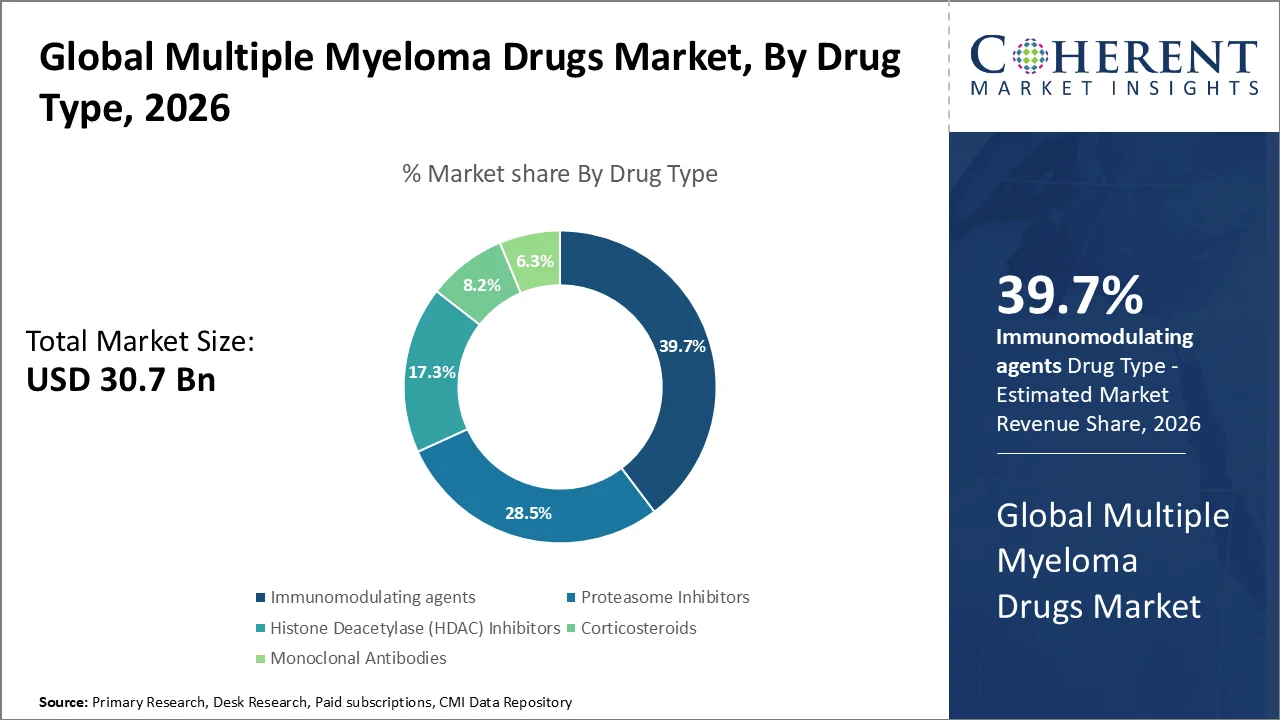
- Immunomodulating agents hold the largest market share of 39.7% in 2026 owing to the growing prevalence and diagnosis of multiple myeloma. According to Cancer Council Victoria, multiple myeloma incidence is 11 cases per 100,000 men and 6.4 cases per 100,000 women.
- Hospital Pharmacy expected to hold largest market share of 42.4% in 2026 owing to its increasing adoption of advanced therapies.
- North America is expected to acquire the dominant share of 43.2% in 2026 owing to the high and growing patient population. In the U.S., approximately 36,000 new multiple myeloma cases are diagnosed annually, accounting for 1.8% of all new cancer cases, with an incidence rate of about 7.3–7.4 cases per 100,000 people. More than 200,000 people are estimated to be living with the disease.
Current Events and Their Impact on the Multiple Myeloma Drugs Market
Current Event | Description and its Impact |
FDA Expands Teclistamab Use in Relapsed or Refractory Multiple Myeloma |
|
FDA Approval of Daratumumab for High-Risk Smoldering Multiple Myeloma |
|
Segmental Insights
- Current Industry Events of 2026
- Market Size Estimation
- Regional Breakdown
- Competitive Landscape
- Customer Intelligence
- Segmental Analysis
- Pricing Analysis
- Key Market Drivers, Challenges & Future Trends
- Customized Insights Section
Why is Immunomodulating agents Acquiring the Largest Market Share?
Immunomodulating agents hold the largest market share of 39.7% in 2026. Immunomodulating agents continue to gain demand because clinicians widely use lenalidomide and pomalidomide for their proven efficacy in multiple myeloma. These therapies strengthen combination regimens and maintenance treatment, while their oral formulations provide greater convenience for patients and healthcare providers. Rising multiple myeloma incidence, longer treatment durations, increasing relapsed or refractory cases, and the development of next-generation immunomodulatory therapies further drive market growth. For instance, Sandoz announced that TYRUKO (natalizumab-sztn), developed by Polpharma Biologics, is now available in the U.S. as the FDA-approved natalizumab biosimilar for relapsing multiple sclerosis. The program advises against concurrent use with antineoplastic, immunosuppressant, or immunomodulating drugs and emphasizes early PML detection and prompt TYRUKO discontinuation when PML is suspected.
Hospital Pharmacy expected to hold largest market share
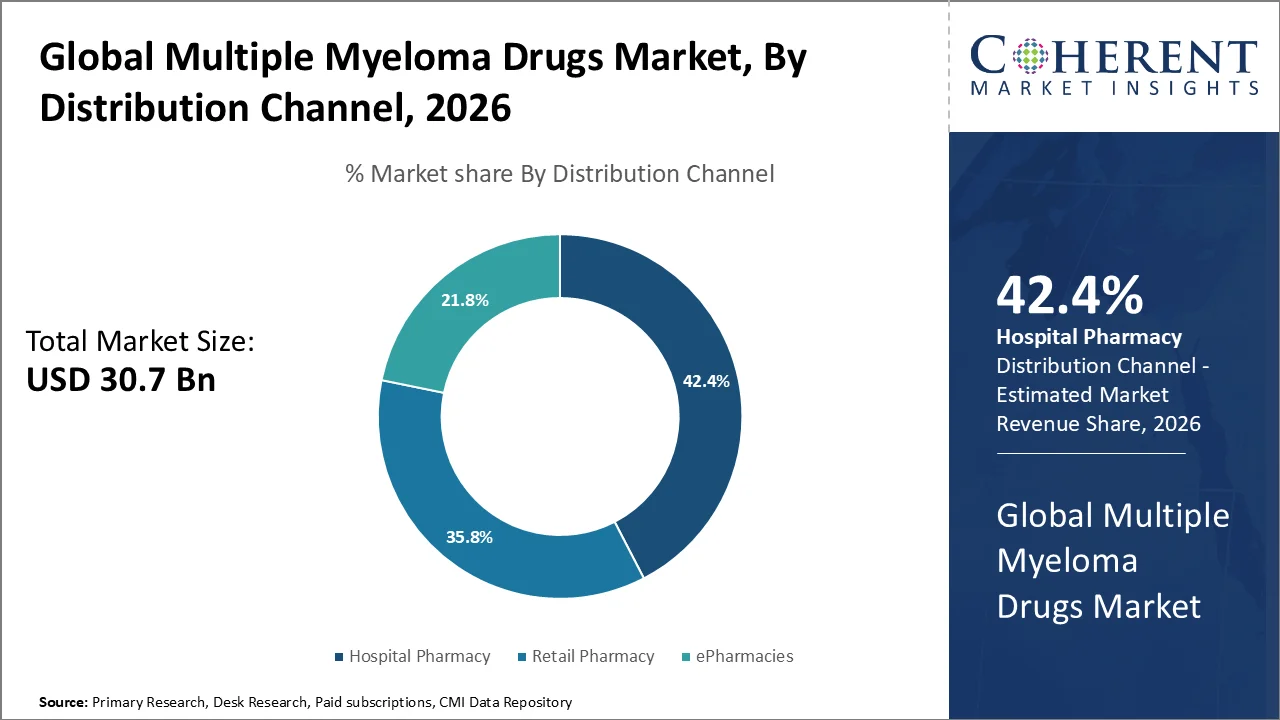
Hospital Pharmacy expected to hold largest market share of 42.4% in 2026 owing to its need for specialist medication management. Hospital pharmacies manage the increasing complexity of multiple myeloma treatment by handling specialty medicines and combination therapies while promoting safe medication use. Pharmacists verify prescriptions, adjust dosages, reconcile medications, educate patients, and monitor adverse reactions. Growing use of oral and injectable treatments further increases their role in coordinating therapy and supporting adherence. As treatment regimens become more complex, hospital pharmacies help optimize medication use, reduce drug-related problems, coordinate patient care, and support better treatment outcomes.
Multiple Myeloma Drugs Market Trends
- Growing adoption of novel immunotherapies such as bispecific antibodies and CAR-T cell therapies is transforming multiple myeloma treatment by providing new options for patients with relapsed or refractory disease and improving treatment outcomes. The expanding regulatory landscape illustrates this shift: the U.S. FDA has approved multiple BCMA-directed therapies, including CAR-T therapies and bispecific antibodies, while linvoseltamab-gcpt received accelerated FDA approval in July 2025 for adults with relapsed or refractory multiple myeloma who had received at least four prior lines of therapy.
- Growing focus on relapsed and refractory multiple myeloma is increasing demand for next-generation therapies as patients progress after exposure to multiple treatment classes. New mechanisms, including bispecific antibodies and cellular therapies, are expanding options for heavily pretreated patients. The FDA's 2025 accelerated approval of linvoseltamab specifically targeted adults with relapsed or refractory disease who had received at least four previous lines of therapy, demonstrating the continued development of therapies for patients with limited treatment options.
Regional Insights
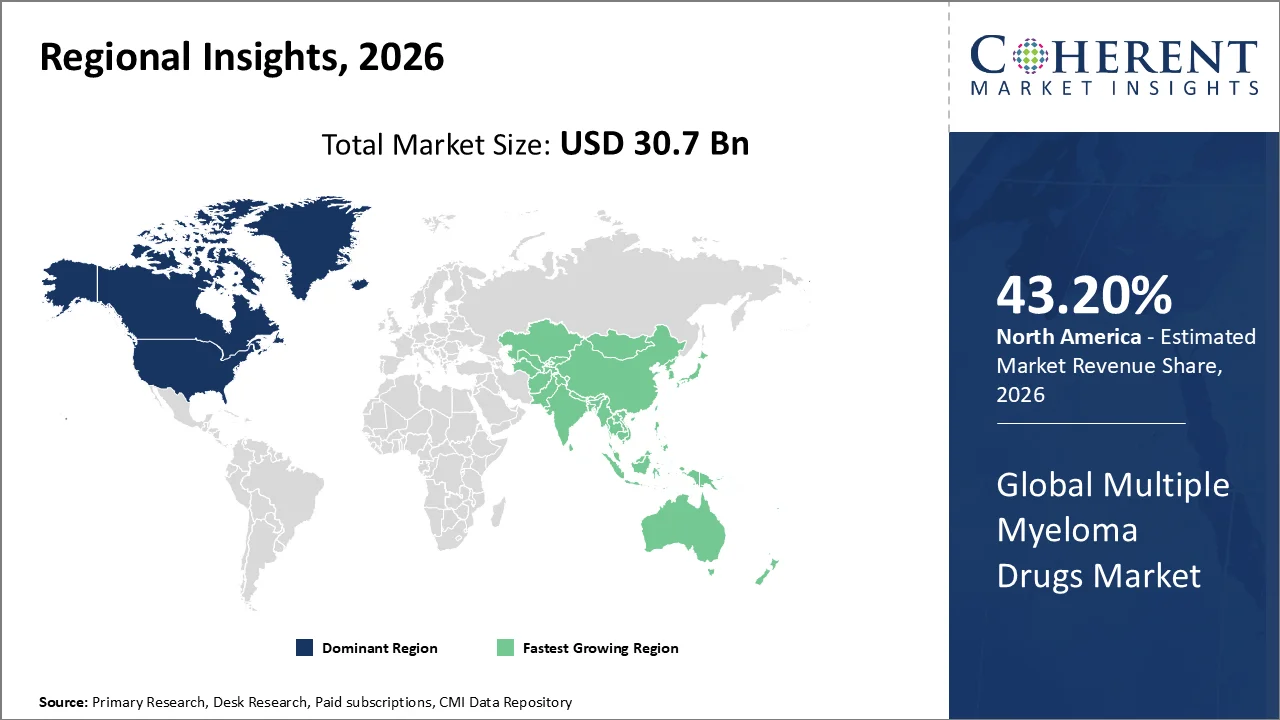
North America dominates owing to increasing incidence among certain demographic groups
North America is expected to acquire the dominant share of 43.2% in 2026. North America’s multiple myeloma drugs market is expanding as greater disease awareness and improved diagnosis increase treatment demand. Pharmaceutical companies are advancing research and developing innovative therapies, including targeted treatments, immunotherapies, CAR-T cell therapies, and bispecific antibodies. Regulatory support and new FDA approvals are helping healthcare providers access advanced treatment combinations more quickly. Patients and clinicians increasingly seek therapies that deliver better disease control, extend remission, and address relapsed or refractory multiple myeloma, further driving market growth across the region. For instance, GSK announced that the FDA approved Blenrep (belantamab mafodotin-blmf) with bortezomib and dexamethasone (BVd) for adults with relapsed or refractory multiple myeloma after at least two prior therapies, including a proteasome inhibitor and an immunomodulatory agent.
Asia Pacific Multiple Myeloma Drugs Market Trends
The Asia Pacific multiple myeloma drugs market is growing as rising disease prevalence, aging populations, improved diagnostic practices, and expanding oncology services increase treatment demand. Emerging economies are boosting healthcare investments and encouraging the use of advanced therapies. Governments are enhancing healthcare programs, patient registries, and reimbursement policies to expand access to treatment. Pharmaceutical companies and regional biotechnology firms are developing specialized cancer centers and strengthening research partnerships to accelerate innovation. Increasing disease awareness, evolving treatment guidelines, and wider access to targeted therapies and immunotherapies continue to drive market expansion. For instance, Pfizer launched Elranatamab, a BCMA-directed bispecific antibody, in India to treat adults with relapsed or refractory multiple myeloma (RRMM).
United States Multiple Myeloma Drugs Market Trends
The United States multiple myeloma drugs market is expanding as the rising disease burden and aging population increase demand for effective treatments, particularly for relapsed or refractory patients. The FDA continues to approve innovative therapies, including CAR-T cell therapies, bispecific antibodies, and targeted drugs, broadening available treatment options. Pharmaceutical companies are also developing advanced combination regimens that improve patient outcomes and survival. In addition, ongoing clinical research and substantial industry investment are accelerating drug innovation and supporting continued market growth. For instance, Johnson & Johnson announced FDA approval of TECVAYLI plus DARZALEX FASPRO for adults with relapsed or refractory multiple myeloma after one prior line of therapy.
China Multiple Myeloma Drugs Market Trends
China’s multiple myeloma drugs market is expanding as the patient population grows, the population ages, and disease awareness improves. Advances in diagnostic technologies enable healthcare providers to detect multiple myeloma earlier and more accurately. Physicians are increasingly adopting innovative treatments, including proteasome inhibitors, immunomodulatory drugs, and monoclonal antibodies, which drives demand for effective therapies. Broader healthcare coverage and the inclusion of key medicines in China’s National Reimbursement Drug List improve affordability and access. In addition, updated treatment guidelines, specialized hematology centers, and growing domestic pharmaceutical innovation further support market growth.
Who are the Major Companies in Multiple Myeloma Drugs Industry
Some of the major key players in Multiple Myeloma Drugs are Novartis, Johnson & Johnson, Elgene, Takeda Pharmaceuticals, and Amgen.
Key News
- In February 2026, Quest Diagnostics launched an ultrasensitive blood test for multiple myeloma MRD monitoring, offering NGS-comparable sensitivity while reducing the need for costly, invasive bone marrow biopsies.
Market Report Scope
Multiple Myeloma Drugs Market Report Coverage
| Report Coverage | Details | ||
|---|---|---|---|
| Base Year: | 2025 | Market Size in 2026: | USD 30.7 Bn |
| Historical Data for: | 2020 To 2024 | Forecast Period: | 2026 To 2033 |
| Forecast Period 2026 to 2033 CAGR: | 6.3% | 2033 Value Projection: | USD 45.3 Bn |
| Geographies covered: |
| ||
| Segments covered: |
| ||
| Companies covered: | Novartis, Johnson & Johnson, Elgene, Takeda Pharmaceuticals, and Amgen. | ||
Analyst Opinion
- Multiple myeloma is becoming a treatment-intensity market, not simply a diagnosis-driven market. Globally, multiple myeloma accounted for about 188,000 new cases and 121,000 deaths in 2022, highlighting the persistent need for effective therapy. In my view, the stronger commercial driver is the disease’s relapse-heavy nature: patients cycle through multiple lines of treatment, creating repeated demand for novel combinations rather than one-time drug use.
- Combination therapy is fundamentally reshaping prescribing behavior, and the clinical evidence is too strong for physicians to ignore. The PERSEUS trial showed 84.3% four-year progression-free survival with D-VRd versus 67.7% with VRd, while MRD negativity reached 75.2% versus 47.5%. I believe these results will continue pushing daratumumab-containing combinations deeper into frontline treatment and away from the traditional three-drug paradigm.
- The next major battleground is relapsed/refractory disease, where bispecific antibodies are changing the definition of viable treatment options. Teclistamab produced a 61.8% overall response rate in heavily pretreated patients, and its 2026 combination approval with daratumumab showed a hazard ratio of 0.17 for progression or death versus standard regimens in a 587-patient trial. My view is that BCMA-directed bispecifics and other immune therapies will capture disproportionate attention because they are delivering meaningful responses precisely where conventional therapies become increasingly ineffective.
Speak to the analyst
Want personalized insights?
Take the findings above to one of our principal consultants, or have the report rebuilt around the segments, geographies and competitors you actually track.
Market Segmentation
- By Drug Type (Revenue, USD Bn, 2021-2033)
- Immunomodulating agents
- Proteasome Inhibitors
- Histone Deacetylase (HDAC) Inhibitors
- Corticosteroids
- Monoclonal Antibodies
- By Distribution Channel (Revenue, USD Bn, 2021-2033)
- Hospital Pharmacy
- Retail Pharmacy
- EPharmacies
- By Region (Revenue, USD Bn, 2021-2033)
- North America
- U.S.
- Canada
- Latin America
- Brazil
- Mexico
- Argentina
- Rest of Latin America
- Europe
- Germany
- U.K.
- France
- Italy
- Spain
- Russia
- Rest of Europe
- Asia Pacific
- China
- India
- Japan
- Australia
- South Korea
- ASEAN
- Rest of Asia Pacific
- Middle East
- GCC
- Israel
- Rest of Middle East
- Africa
- South Africa
- Central Africa
- North Africa
- North America
Sources
Primary Research interviews
- Hematologists, medical oncologists, and multiple myeloma specialists
- Hospital-based oncology and hematology specialists
- Clinical investigators involved in multiple myeloma drug trials
- Hospital pharmacists and oncology pharmacists
- Transplant physicians and stem-cell transplant specialists
- Key opinion leaders (KOLs) in multiple myeloma
- Payers, reimbursement specialists, and healthcare decision-makers
- Patients and patient advocacy representatives, where appropriate
- Clinical research professionals and trial investigators
Databases
- U.S. FDA Drugs@FDA and drug approval databases
- ClinicalTrials.gov
- PubMed/MEDLINE
- National Cancer Institute (NCI) cancer drug and clinical-trial databases
- World Health Organization (WHO) databases
- European Medicines Agency (EMA) medicine and clinical-trial databases
- U.S. National Library of Medicine databases
- SEER (Surveillance, Epidemiology, and End Results) databases
- Global Cancer Observatory (IARC/WHO)
- National and regional cancer registries
- Drug utilization and prescription databases
- Hospital and institutional treatment databases
- Epidemiological and mortality databases
Magazines
- Oncology and hematology-focused medical magazines
- Pharmaceutical and biotechnology industry magazines
- Healthcare and life-sciences publications
- Medical news magazines
- Hospital and healthcare management publications
- Drug development and clinical research magazines
Journals
- The Lancet
- The Lancet Oncology
- Journal of Clinical Oncology
- Blood
- Blood Cancer Journal
- Leukemia
- Clinical Cancer Research
- Haematologica
- British Journal of Haematology
- European Journal of Haematology
- New England Journal of Medicine
- Journal of Hematology & Oncology
- Peer-reviewed publications covering multiple myeloma epidemiology, treatment, clinical trials, drug safety, and outcomes
Newspapers
- Reuters
- The New York Times
- The Wall Street Journal
- Financial Times
- The Guardian
- Major national and regional newspapers
- Healthcare and pharmaceutical news publications
- Medical news and regulatory news outlets
Associations
- International Myeloma Foundation (IMF)
- International Myeloma Society (IMS)
- American Society of Hematology (ASH)
- American Society of Clinical Oncology (ASCO)
- European Society for Medical Oncology (ESMO)
- European Hematology Association (EHA)
- American Association for Cancer Research (AACR)
- National Comprehensive Cancer Network (NCCN)
- Leukemia & Lymphoma Society (LLS)
- National Cancer Institute (NCI)
- Relevant national hematology and oncology societies
Public Domain sources
- U.S. Food and Drug Administration (FDA) drug approvals, prescribing information, safety communications, and clinical-trial reviews
- National Cancer Institute (NCI) cancer statistics, drug information, and clinical-trial resources
- ClinicalTrials.gov registered clinical trials
- PubMed/MEDLINE-indexed publications
- World Health Organization (WHO) databases and cancer statistics
- International Agency for Research on Cancer (IARC) and Global Cancer Observatory
- European Medicines Agency (EMA) public assessment reports and medicine information
- U.S. Centers for Disease Control and Prevention (CDC) cancer statistics
- SEER cancer incidence, survival, and mortality data
- National and regional government health databases
- Publicly available regulatory filings and clinical-trial publications
- International Myeloma Foundation educational and clinical-trial resources, which include information on multiple myeloma clinical research and treatment
- NCI's publicly available list of FDA-approved drugs for multiple myeloma and other plasma-cell neoplasms
Proprietary Elements
- CMI Data Analytics Tool
- Proprietary CMI Existing Repository of information for last 10 years
Get access to 250+ pages report
Every segment, forecast, competitor profile and data table behind the analysis above — available for instant download.
- ESOMAR Member
- ISO 9001:2015 Certified
- D-U-N-S Registered
- GDPR & CCPA Compliant
Missing comfort of reading report in your local language? Find your preferred language:
Transform your Strategy with Exclusive Trending Reports
Frequently Asked Questions
The Multiple Myeloma Drugs Market is anticipated to grow at a CAGR of 6.3% with USD 30.7 Bn share in 2026 and is expected to reach USD 45.3 Bn in 2033.
Key classes include proteasome inhibitors such as bortezomib and carfilzomib, immunomodulatory drugs such as lenalidomide and pomalidomide, and isatuximab, corticosteroids, and newer BCMA- or GPRC5D-directed therapies.
The strongest driver is the rapid shift toward multi-drug regimens and targeted immunotherapies.
Combination therapies attack myeloma through different biological mechanisms and can produce deeper responses than conventional regimens.
CAR-T therapies are creating a high-value treatment segment for patients with relapsed or refractory disease.
Bispecific antibodies are becoming increasingly important because they can redirect a patient’s T cells toward myeloma cells without requiring individualized cell manufacturing.