

Extruded Graphite Market Size and Share Analysis- 2026 To 2033
The Extruded Graphite Market size is anticipated to grow at a CAGR of 3.9%, with USD 152.7 Mn in 2026, and is expected to reach USD 199.6 Mn by 2033. The primary drivers are largely defined by increasing demand for extruded graphite in heat treatment, foundry and metallurgy operations, chemical processing, and other high-temperature industrial applications. The material's strong thermal and electrical conductivity, thermal-shock resistance, and chemical resistance support its use in demanding industrial environments. According to SGL Carbon, extruded graphite is manufactured through an extrusion process and, compared with isostatic graphite, generally has a coarser grain structure and lower strength but higher thermal and electrical conductivity.
Key Takeaways
- The rods segment is estimated to dominate the Extruded Graphite Market with 44.8% share in 2026. The segment’s growth is owing to the suitability of extruded graphite for producing long and large-format components, coupled with its high thermal conductivity, electrical conductivity, chemical resistance, and resistance to thermal shock. SGL Carbon’s current commercial portfolio demonstrates the breadth of this format, offering extruded graphite in cylindrical dimensions ranging from approximately 75 mm to 915 mm in diameter and lengths reaching 1,830 mm, alongside larger customized formats.
- The electrodes segment is expected to lead the application category with 31.6% share in 2026. The segment’s growth is owing to the extensive consumption of graphite electrodes in electric arc furnace steelmaking and other high-temperature metallurgical processes. According to the World Steel Association, global crude steel production stood at approximately 1,849.4 Mn tonnes in 2025. China produced 960.8 Mn tonnes, while India produced 164.9 Mn tonnes, supporting sustained graphite consumption across steel and metallurgical applications.
- Asia Pacific is expected to hold the prominent market share of 47.1% in 2026. The regional growth is owing to the concentration of steelmaking, foundry, refractory, chemical processing, and graphite manufacturing activities in China, India, Japan, and South Korea. India is currently the world’s second-largest aluminum producer and contributes nearly 6% of global aluminum production, according to the Ministry of Mines, Government of India.
Market Drivers
Expansion of Electric-Furnace Steelmaking is Strengthening Demand for Extruded Graphite
The Extruded Graphite Market is benefiting from the increasing use of electric-furnace-based steelmaking and high-temperature metallurgical processes. Extruded graphite offers high electrical conductivity, thermal conductivity, thermal-shock resistance, and resistance to aggressive processing environments, supporting its use in electrodes, melt treatment, furnace components, and continuous-casting applications.
According to the World Steel Association’s World Steel in Figures 2026, the electric-furnace route accounted for 30.3% of global crude steel production in 2025, compared to 29.1% in 2024. Global crude steel production is forecast to reach about 1.849 billion tons in 2025, implying that electric processes will be used to produce around 560 million tons of steel.
Expansion of Polysilicon Production is Creating New Demand for High-Temperature Graphite Components
The Extruded Graphite Market is also being driven by the rapid growth in the manufacturing of solar and silicon materials. Polysilicon production involves very high temperature and chemically demanding production environments. Graphite is used in reactor electrodes, converters, heaters and other process components due to its thermal stability and conductivity.
According to the IEA Photovoltaic Power Systems Programme’s Trends in Photovoltaic Applications 2025, global production of polysilicon was around 1.96 million tons in 2024, up 21.7% on the previous year.
Current Events and Their Impact on the Extruded Graphite Market
Current Event | Description and its Impact |
U.S. Department of Defense Expands Smart Materials and Programmable Matter Procurement Programs (2026) |
|
FDA and EU MDR Strengthen Regulatory Frameworks for Additive Manufacturing and Smart Implantable Materials (2026) |
|
- Current Industry Events of 2026
- Market Size Estimation
- Regional Breakdown
- Competitive Landscape
- Customer Intelligence
- Segmental Analysis
- Pricing Analysis
- Key Market Drivers, Challenges & Future Trends
- Customized Insights Section
Segmental Insights
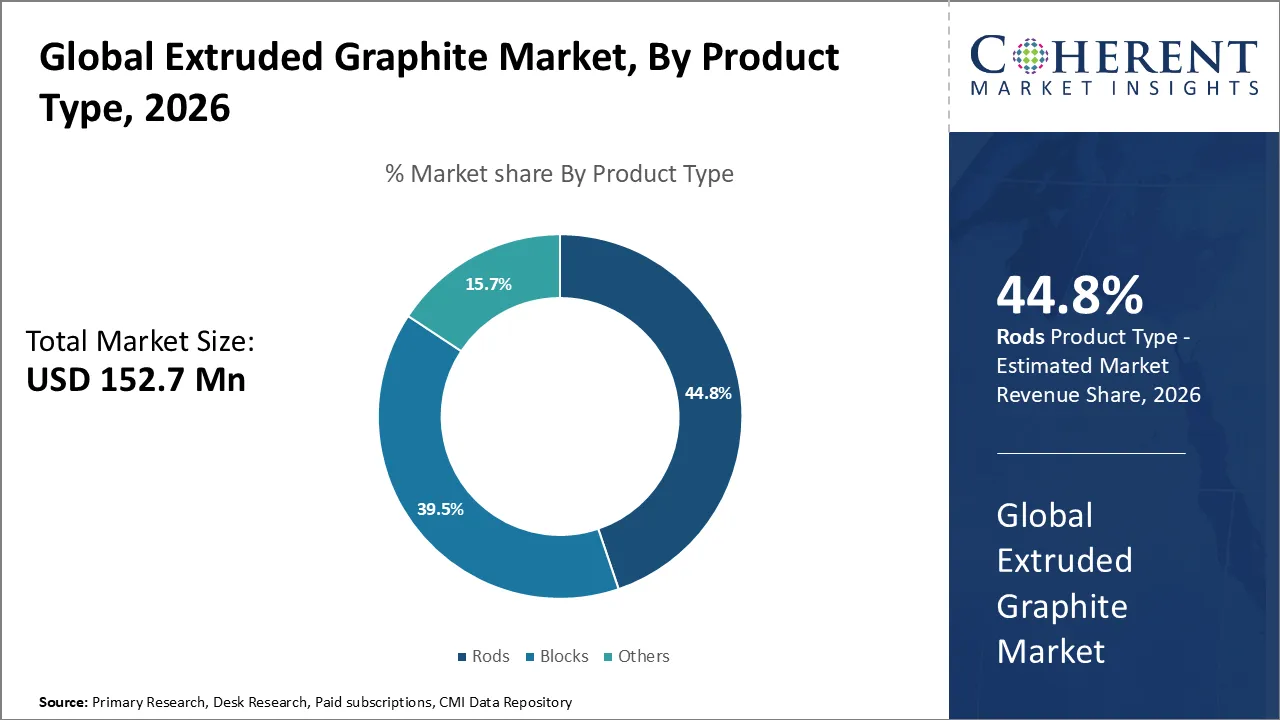
Why are Rods Acquiring the Largest Share?
On the basis of product type, the rods segment is estimated to account for the largest Extruded Graphite Market share of 44.8% in 2026. The segment’s growth is owing to the suitability of the extrusion process for manufacturing long and uniform graphite sections with high thermal and electrical conductivity. Extruded graphite rods are widely applicable in melt treatment, metallurgy, glass processing, refractory manufacturing, and other high-temperature industrial operations.
Mersen’s latest financial results also point to the commercial importance of extruded graphite. Mersen’s Advanced Materials division achieved sales of EUR 319.6 million in the first half of 2026. Mersen’s 2025 Universal Registration Document confirms this business segment produces materials such as extruded graphite, isostatic graphite and insulation felt for high temperature industrial applications.
In June 2026, Mersen announced it would be showcasing its advanced-material solutions at Eurosatory 2026 in Paris, including extruded graphite in addition to isostatic graphite, carbon-carbon composites, pyrocarbon and silicon carbide for challenging aerospace and defense applications.
Why do Electrodes Hold the Largest Market Share?
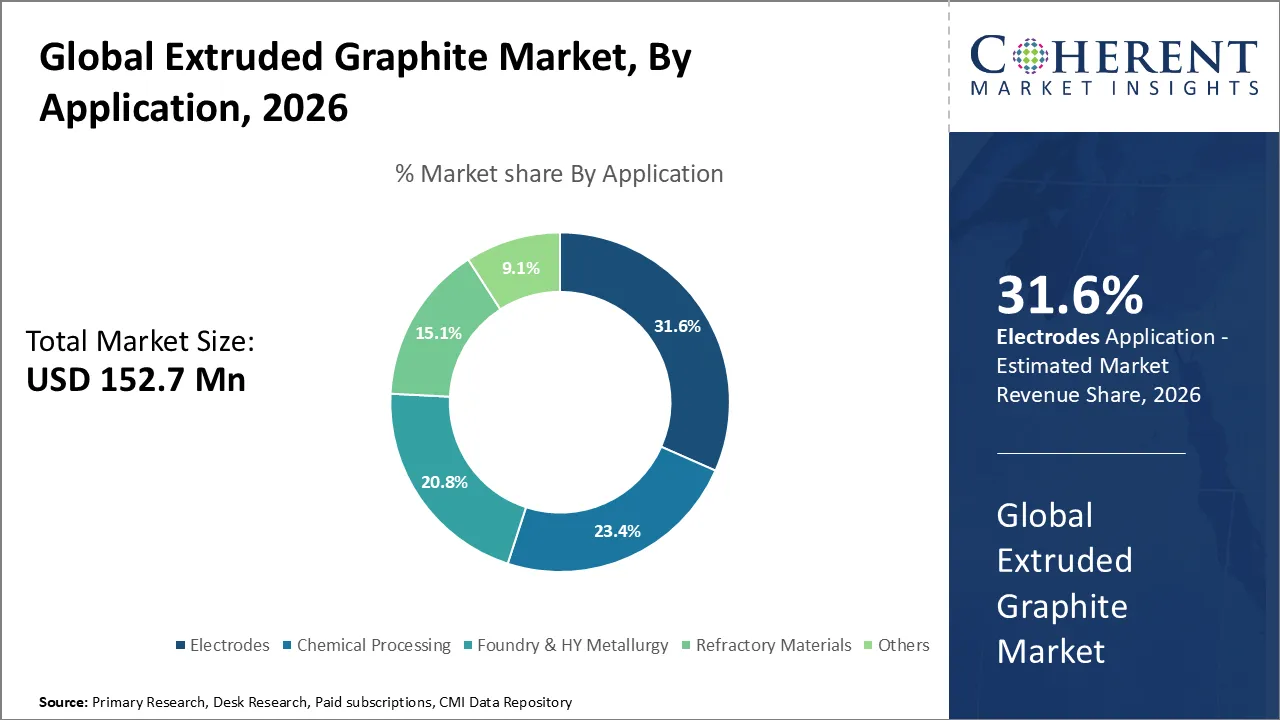
On the basis of application, the electrodes segment is estimated to lead the Extruded Graphite Market with a 31.6% share in 2026. The segment’s growth is owing to graphite’s high electrical conductivity, thermal-shock resistance, and ability to withstand elevated processing temperatures, making extruded graphite suitable for electrode components used in metallurgical and melt-treatment processes.
The transition toward electric steelmaking is providing an additional long-term demand foundation for graphite electrode applications. According to the Global Energy Monitor’s 2025 Global Steel Plant Tracker, global electric arc furnace (EAF) capacity is expected to grow by almost 11% between 2020 and 2025, and projects under development are expected to drive a further 24% increase by 2030.
In July 2026, GrafTech International reported a substantial increase in its graphite electrode operations, with second-quarter sales volume hitting 30.8 thousand metric tons, up 8% year-on-year and 10% sequentially.
Extruded Graphite Market Trends
- The extruded graphite industry is being redefined by the increased focus on production optimization and supply discipline in graphite electrodes. In August 2026, GrafTech said it would shut its Monterrey graphite electrode plant, reducing annual electrode capacity by about 51,000 metric tons, to some 127,000 metric tons from 178,000 metric tons.
- The increasing movement toward higher-value and specialized graphite applications is broadening opportunities beyond conventional metallurgy. In August 2026, SGL Carbon and X-energy agreed to double SGL Carbon’s nuclear-grade graphite manufacturing capacity at its Chedde, France facility. X-energy will provide up to USD 8 million for new equipment and facilities, enabling graphite billet production sufficient for as many as eight Xe-100 reactors annually.
- The rising focus on long-term contracted graphite supply is encouraging manufacturers to invest in dedicated production capabilities. In January 2026, SGL Carbon signed a 10-year supply framework with X-energy and received an initial three-year contract valued at approximately USD 100 million for graphite used in the first commercial Xe-100 project in Texas.
Regional Insights
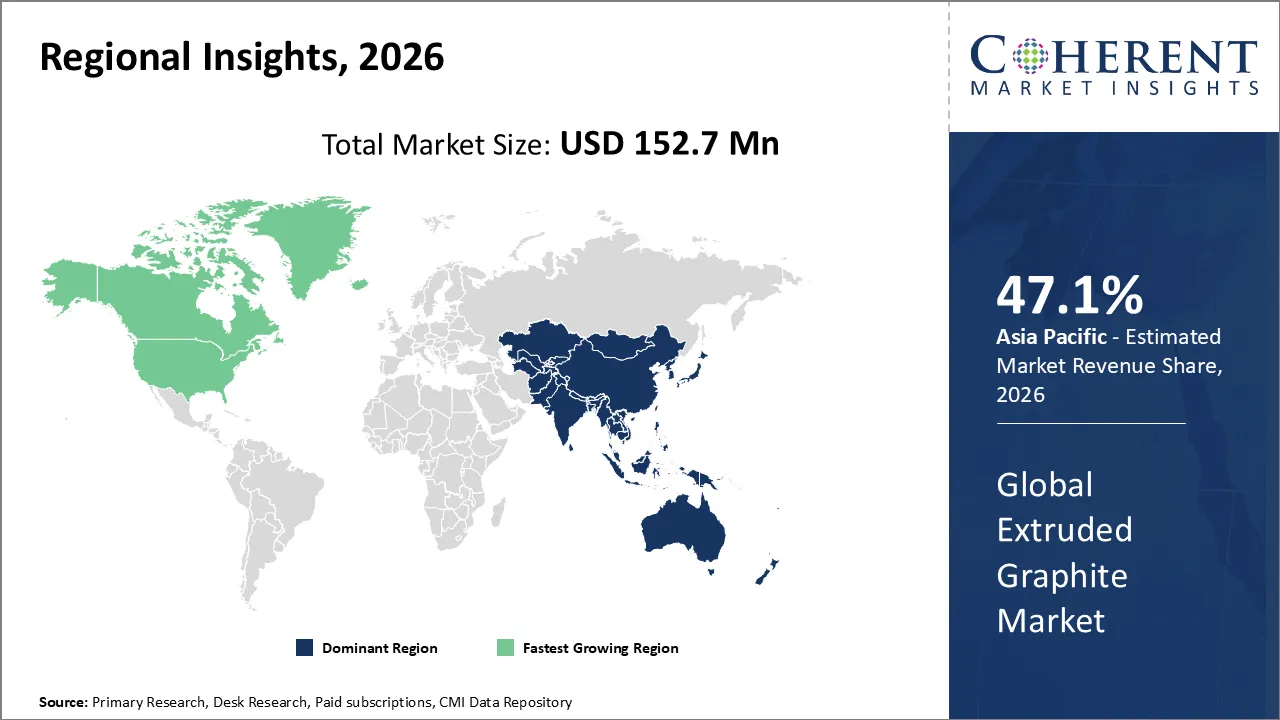
Asia Pacific Dominates Owing to the Large Graphite Manufacturing and Processing Base
The Asia Pacific region is estimated to account for the largest Extruded Graphite Market share of 47.1% in 2026. The region’s dominance is supported by its extensive graphite-electrode manufacturing infrastructure, large-scale carbon and graphite processing capabilities, and established suppliers across China, India, and Japan serving metallurgy and other high-temperature industries.
India-based HEG Limited operates a 100,000 MT-per-year graphite electrode facility equipped with a modern extrusion press, baking furnaces, graphitization systems, and CNC machining capabilities. The company exports around 80% of its production to 30 countries, demonstrating the scale and international reach of Asia Pacific’s extruded graphite manufacturing base. Graphite also accounts for approximately 80% of HEG’s revenue.
North America Extruded Graphite Market Trends
North America is expected to emerge as the fastest-growing region in the Extruded Graphite Market over the forecast period, supported by improving graphite-electrode demand, a highly developed electric-arc-furnace steelmaking industry, and increasing emphasis on domestic graphite supply chains.
The latest company-level data show particularly strong momentum in the U.S. In the second quarter of 2026, GrafTech reported a 29% year-on-year increase in graphite electrode sales volume in the United States, identifying the U.S. as its strongest region for graphite electrode pricing. GrafTech also expects its overall graphite electrode sales volume to increase 5–10% in 2026, with more than 90% of anticipated annual volumes already committed.
According to the American Iron and Steel Institute, U.S. steel mill shipments reached 47.53 million net tons during the first six months of 2026, increasing 5.3% year-on-year, while June 2026 shipments alone increased 8.7% from June 2025.
Strong Steelmaking Base and Critical-Material Security are Supporting the Extruded Graphite Market in the United States
The U.S. Extruded Graphite Market is anticipated to exhibit steady growth during the forecast period, driven by electric steelmaking, high-temperature industrial processing, domestic carbon and graphite manufacturing, and increasing focus on secure graphite supply chains. Extruded graphite is especially useful for electrodes, furnace parts, metallurgical processing and other applications requiring high electrical and thermal conductivity.
According to the American Iron and Steel Institute (AISI), U.S. raw steel production increased 3% in 2025 to approximately 90 million net tons, and domestic steel mill shipments increased 5% in 2025 to approximately 91 million net tons. The scale and continued expansion of the country's steel-processing base support demand for graphite electrodes and other high-temperature graphite components.
In November 2025, the U.S. Department of the Interior included graphite on the final 2025 Critical Minerals List, which contains 60 minerals considered important to U.S. economic and national security.
China Extruded Graphite Market Trends
China is expected to remain one of the most important country markets for extruded graphite, owing to its large domestic graphite-electrode manufacturing base, extensive metallurgical industry, established carbon-material producers, and growing emphasis on higher-value graphite products.
A 2025 U.S. International Trade Commission report noted that East Carbon opened a new manufacturing facility in November 2024, increasing its production capacity by approximately 66%. Such capacity additions support China’s position as a major manufacturing center for graphite electrodes and other extruded graphite products used in metallurgical and high-temperature applications.
Who are the Major Companies in Extruded Graphite Industry
Some of the major key players in Extruded Graphite Market are Beijing Great Wall Co. Ltd., SGL Group, NAC Carbon Products Inc., Cera Materials Inc., Mersen S.A., Fangda Carbon New Material Co. Ltd., GrafTech International Holdings Inc., Graphite India Ltd., Nippon Kornmeyer Carbon Group, Schunk Group, Toyo Tanso Co. Ltd., Tokai Carbon Group, Weiji Carbon–Tech Co., Ltd.
Key News
- In May 2026, Graphite India announced that the first phase of its graphite electrode capacity expansion is expected to be commissioned during FY2027. The company’s capacity utilization had already increased to 104% in Q4 FY2026 compared with 81% in Q4 FY2025, indicating strong utilization of its existing graphite manufacturing assets.
- In November 2025, Toyo Tanso announced that its U.S. subsidiary received an order from X-energy for IG-110 graphite core structural components for four Xe-100 high-temperature gas-cooled reactors planned for Dow’s Texas facility.
Market Report Scope
Extruded Graphite Market Report Coverage
Report Coverage | Details | ||
Base Year: | 2025 | Market Size in 2026: | USD 152.7 Mn |
Historical Data for: | 2020 to 2024 | Forecast Period: | 2026 to 2033 |
CAGR: | 3.9% | 2033 Value Projection: | USD 199.6 Mn |
Geographies covered: |
| ||
Segments covered: |
| ||
Companies covered: | Beijing Great Wall Co. Ltd., SGL Group, NAC Carbon Products Inc., Cera Materials Inc., Mersen S.A., Fangda Carbon New Material Co. Ltd., GrafTech International Holdings Inc., Graphite India Ltd., Nippon Kornmeyer Carbon Group, Schunk Group, Toyo Tanso Co. Ltd., Tokai Carbon Group, Weiji Carbon–Tech Co., Ltd. | ||
Growth Drivers: |
| ||
Restraints & Challenges: |
| ||
Analyst Opinion
- The Extruded Graphite Market has a structurally positive long-term outlook, particularly from the transition toward electric arc furnace (EAF) steelmaking, where extruded graphite electrodes are essential consumables. In its FY 2025-26 industry assessment, HEG reported that more than 100 million tonnes of new greenfield EAF steelmaking capacity has been announced globally. Around 21 million tonnes became operational during 2022-2025, while another 60 million tonnes is expected to come online between 2026 and 2028.
- Recent financial performance among established graphite manufacturers indicates that industrial demand is gradually strengthening despite continued pricing pressure. Graphite India reported FY2026 standalone net sales of INR 2,812 crore, representing growth of 16.2% year-on-year, compared with INR 2,420 crore in FY2025. The improvement provides evidence of recovering commercial activity across graphite electrode and carbon-product markets that represent major outlets for extruded graphite.
- The market is also expected to become increasingly diversified toward higher-value thermal, power-generation, semiconductor, defense, and aerospace applications, reducing dependence on conventional metallurgy over the longer term. SGL Carbon’s Graphite Solutions business generated EUR 234.1 million in sales during H1 2026, up 5.9% year-on-year, while the company’s SGL Growth 2030 strategy specifically targets semiconductors, power generation, defense, and aerospace as future growth areas.
Speak to the analyst
Want personalized insights?
Take the findings above to one of our principal consultants, or have the report rebuilt around the segments, geographies and competitors you actually track.
Market Segmentation
- By Product Type (Revenue, USD Mn, 2021-2033)
- Rods
- Blocks
- Others
- By Application (Revenue, USD Mn, 2021-2033)
- Electrodes
- Chemical Processing
- Foundry & HY Metallurgy
- Refractory Materials
- Others
- By Region (Revenue, USD Mn, 2021-2033)
- North America
- U.S.
- Canada
- Latin America
- Brazil
- Mexico
- Argentina
- Rest of Latin America
- Europe
- Germany
- U.K.
- France
- Italy
- Spain
- Russia
- Rest of Europe
- Asia Pacific
- China
- India
- Japan
- Australia
- South Korea
- ASEAN
- Rest of Asia Pacific
- Middle East
- GCC
- Israel
- Rest of Middle East
- Africa
- South Africa
- Central Africa
- North Africa
- North America
Sources
Primary Research Interviews
- Extruded graphite manufacturers and processors
- Graphite electrode manufacturers
- Carbon and graphite material engineers
- Metallurgy and foundry industry procurement managers
- Electric arc furnace steel producers and plant managers
- Refractory and high-temperature equipment manufacturers
- Chemical processing and melt-treatment equipment suppliers
- Semiconductor and polysilicon industry procurement professionals
- Graphite distributors and industrial material suppliers
- Key opinion leaders (KOLs) in carbon and graphite materials
Databases
- U.S. Geological Survey (USGS) – Mineral Commodity Statistics
- UN Comtrade Database
- U.S. International Trade Commission (USITC) DataWeb
- Eurostat – International Trade and Industrial Production Database
- World Bank
- Organisation for Economic Co-operation and Development (OECD)
- U.S. Census Bureau – International Trade Data
- International Energy Agency (IEA)
Magazines
- Industrial Heating
- Steel Times International
- Aluminium International Today
- Heat Processing
- Foundry Management & Technology
- The Fabricator
Journals
- Carbon
- Journal of Materials Processing Technology
- Materials Chemistry and Physics
- Journal of Nuclear Materials
- Ceramics International
- Metallurgical and Materials Transactions B
- International Journal of Refractory Metals and Hard Materials
Newspapers
- Reuters
- Financial Times
- The Wall Street Journal
- The Economic Times
- Nikkei Asia
- Business Standard
Associations
- World Steel Association
- Association for Iron & Steel Technology (AIST)
- International Aluminium Institute (IAI)
- The Aluminum Association
- European Steel Association (EUROFER)
- American Foundry Society (AFS)
- The Refractories Institute (TRI)
Public Domain Sources
- Company Annual Reports, Investor Presentations, and Earnings Releases
- Company Product Catalogs and Technical Datasheets
- Government Mineral, Trade, and Industrial Production Statistics
- Customs and International Trade Databases
- Environmental and Industrial Regulatory Publications
- Patent Databases such as WIPO, USPTO, and Google Patents
- Publicly Available Steel, Aluminum, Foundry, and Graphite Industry Reports
- Technical Publications from SGL Carbon, Mersen, GrafTech, Graphite India, HEG, Toyo Tanso, Tokai Carbon, and Schunk
Proprietary Elements
- CMI Data Analytics Tool
- Proprietary CMI Existing Repository of Information for the Last 10 Years
Get access to 250+ pages report
Every segment, forecast, competitor profile and data table behind the analysis above — available for instant download.
- ESOMAR Member
- ISO 9001:2015 Certified
- D-U-N-S Registered
- GDPR & CCPA Compliant
Missing comfort of reading report in your local language? Find your preferred language:
Transform your Strategy with Exclusive Trending Reports
Frequently Asked Questions
The Extruded Graphite Market is expected to reach USD 199.6 Mn in 2033, compared with USD 152.7 Mn in 2026.
Major players operating in the global Extruded Graphite Market include Beijing Great Wall Co. Ltd., SGL Group, NAC Carbon Products Inc., Cera Materials Inc., Mersen S.A., Fangda Carbon New Material Co. Ltd., GrafTech International Holdings Inc., Graphite India Ltd., Nippon Kornmeyer Carbon Group, Schunk Group, Toyo Tanso Co. Ltd., Tokai Carbon Group, and Weiji Carbon–Tech Co., Ltd.
The high investment and production costs, volatility in raw material and petroleum coke prices, high energy requirements during graphitization, and supply-chain risks associated with graphite sourcing are the key factors hampering growth of the market. The collateral specifically identifies high production costs and petroleum coke price volatility as major restraints.
The increasing demand for extruded graphite in electric arc furnace steelmaking, growing use in metallurgy and foundry applications, expanding high-temperature industrial processing, and rising use of graphite components in polysilicon manufacturing are boosting market growth.
The Extruded Graphite Market is anticipated to grow at a CAGR of 3.9% between 2026 and 2033.
Among regions, Asia Pacific is expected to account for the largest market share of 47.1% in 2026. The region’s dominance is supported by extensive graphite-electrode manufacturing, large-scale carbon and graphite processing capabilities, and strong industrial activity across China, India, Japan, and South Korea.
Extruded graphite is a synthetic graphite material manufactured through an extrusion process, generally characterized by a coarser grain structure and lower mechanical strength than isostatic graphite, but with comparatively high thermal and electrical conductivity. It is widely suited to demanding high-temperature industrial environments.