

Synthetic Graphite Market Size and Forecast – 2026-2033
The global synthetic graphite market is estimated to be valued at USD 2,197.7 Mn in 2026 and is expected to reach USD 2,886.2 Mn in 2033, exhibiting a compound annual growth rate (CAGR) of 4.0% from 2026 to 2033.
Key Takeaways
- Based on Type, the “Other Types” segment (which includes electrodes and specialty graphite) is expected to lead in 2026 with 66.3% share.
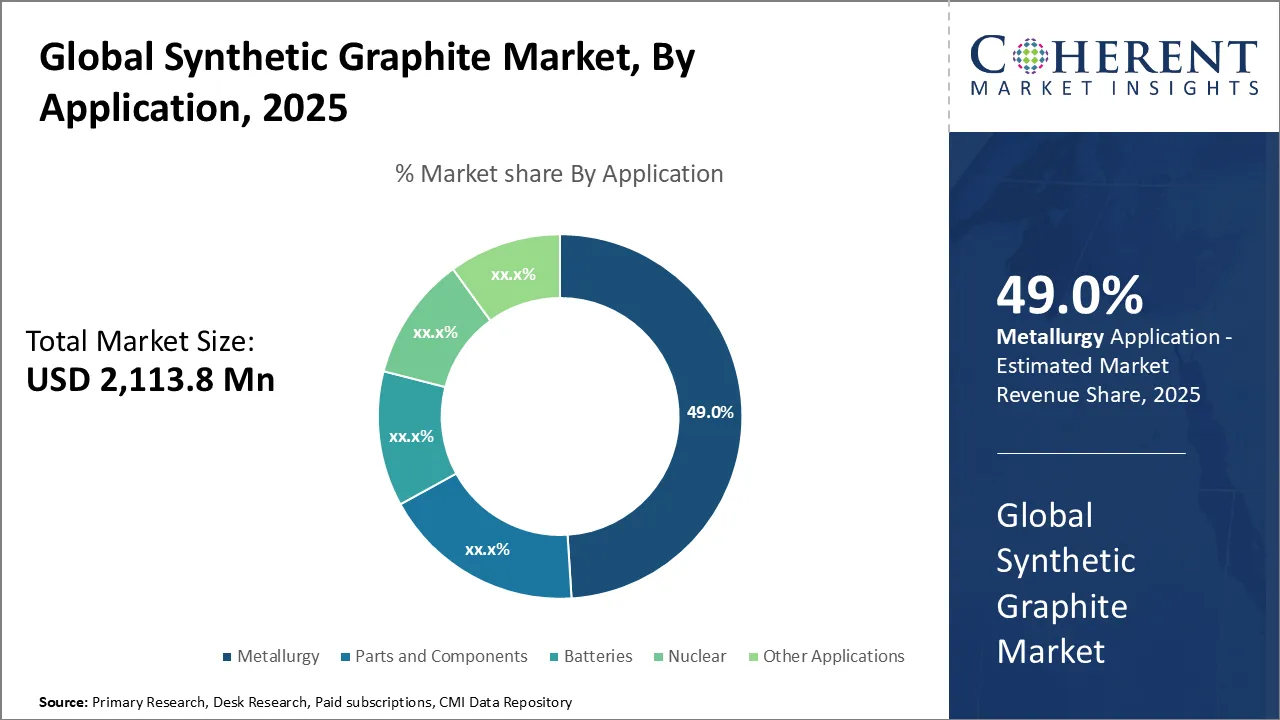
- By Application, the Metallurgy segment is projected to hold the largest share in 2026 with a share of around 50% of the synthetic graphite market.
- Based on Region, the Asia Pacific will lead the global synthetic graphite market with a 55.12% share in 2026.
Market Overview
The growth of synthetic graphite market can be attributed to the increasing demand for graphite from the automotive industry. The market is also expected to benefit from the growing popularity of electric vehicles. Moreover, the rise in the installation of solar power systems is further projected to propel market growth. A large portion of the global synthetic graphite is derived from the production of graphite electrodes. This product is primarily produced using calcined petroleum coke and coal tar pitch as primary raw materials.
Current Events and Its Impact
Current Events | and its impact |
Global Electric Vehicle Revolution and Battery Demand Surge |
|
China's Graphite Export Controls and Supply Chain Disruption |
|
Segmental Insights
- Current Industry Events of 2026
- Market Size Estimation
- Regional Breakdown
- Competitive Landscape
- Customer Intelligence
- Segmental Analysis
- Pricing Analysis
- Key Market Drivers, Challenges & Future Trends
- Customized Insights Section
Synthetic Graphite Market Insights, By Application - Metallurgy Dominates With 50% Market Share
By application, the metallurgy sector is expected to capture the largest share of about 50% in the synthetic graphite market in 2026. The consumption of synthetic graphite in steelmaking-particularly in electric arc furnaces-continues to anchor demand with high thermal stability under extreme operating conditions.
Ongoing industrial growth and a worldwide switch to EAF steel production, which is less carbon-emitting compared to traditional blast furnaces, continue to drive the growth of the metallurgical segment. Synthetic graphite electrodes are indispensable in the process due to their ability to ensure consistent performance with energy efficiency.
For instance, in August 2025, Graphite India Ltd inked an MoU with the Maharashtra government to establish a synthetic graphite anode and electrode plant in Nashik, India.
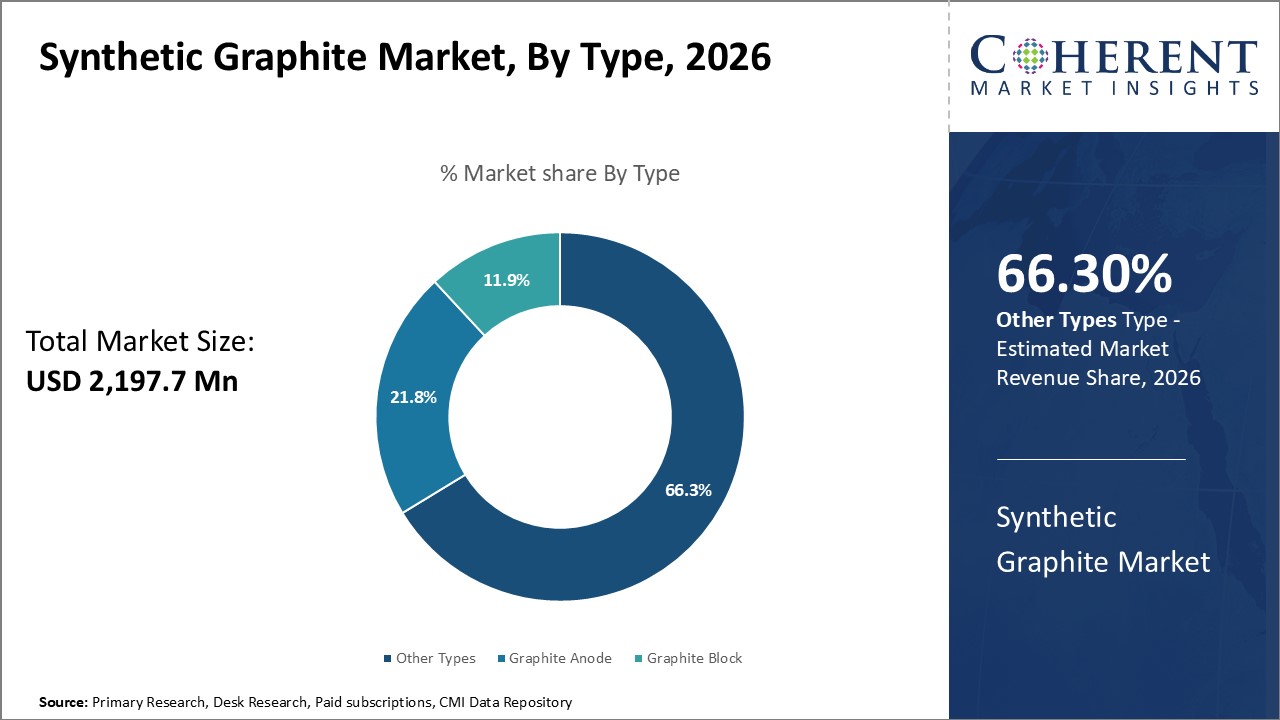
Synthetic Graphite Market Insights, By Type - “Other Types” Segment Leads with Electrodes and Specialty Graphite
By type, the "Other Types" segment, including graphite electrodes and specialty graphite, is anticipated to have 66.3% of the market share by 2026. Excellent thermal conductivity, electrical conductivity, and durability are just some of the reasons why such materials find broad applications in high-temperature and high-performance industries. Due to its versatility, this material is preferred for metallurgical, chemical, and advanced technological applications.
Graphite electrodes play an essential role in EAF steelmaking, which requires high heat resistance. Other specialized applications of graphite include batteries, semiconductors, and aerospace parts; all of these have to be manufactured to a great degree of precision together with material integrity.
For instance, in November 2025, Vianode announced a new synthetic graphite facility in Ontario, designed to produce both anode-grade and specialty graphite materials destined for EV batteries and industrial applications.
Regional Insights
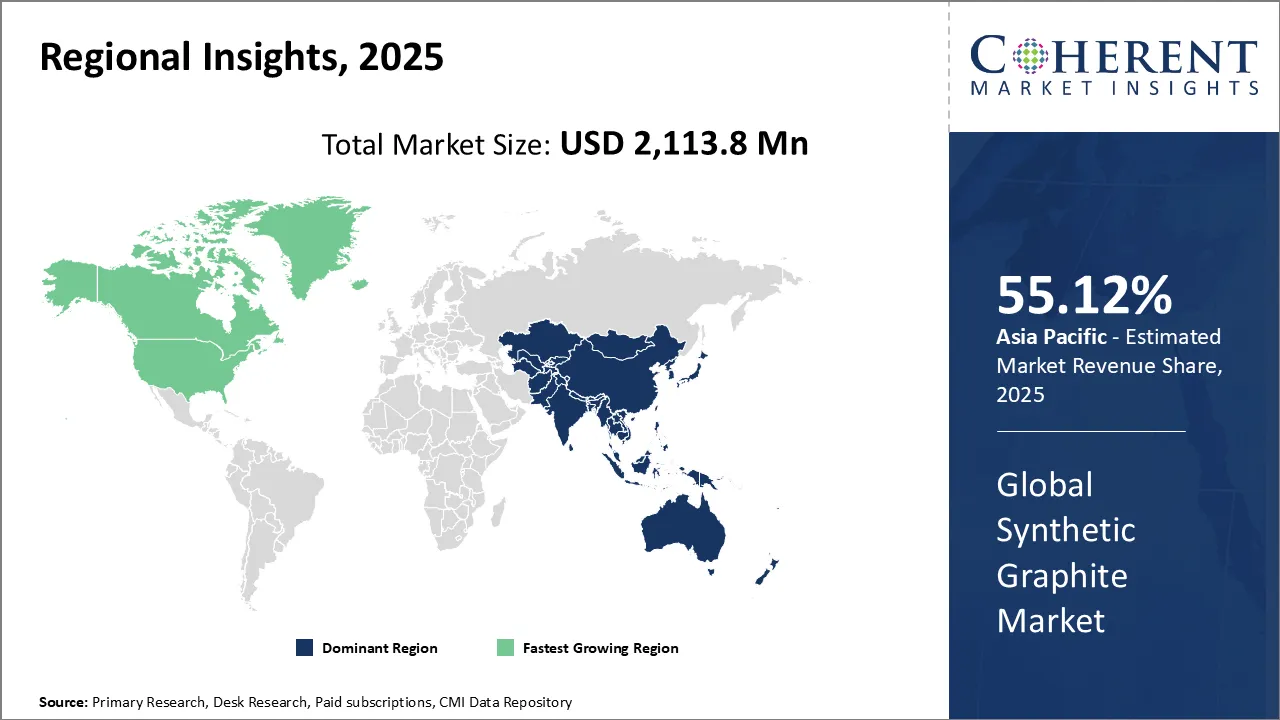
Asia Pacific Synthetic Graphite Market Analysis & Trends
The Asia Pacific is expected to continue its dominance in the synthetic graphite market with 55.12% of the overall market share by 2026, driven by strong demand from metallurgy, energy storage, batteries, and high-performance industrial applications. Large-scale production capacity in countries such as China, Japan, and South Korea is a result of a proper infrastructure for manufacturing, accessibility to raw materials, and advanced technologies to process graphite.
For instance, in October 2026, Epsilon announced to build 30,000-tonne synthetic graphite plant in India by 2026.
North America Synthetic Graphite Market Analysis & Trends
North America is expected to be the fastest-growing region in the synthetic graphite market during 2026. Increasing investments in the manufacturing of EV batteries, renewable energy storage, and strategic initiatives for supply chain localization fuel growth. New production plants for synthetic graphite are being set up to reduce import dependency and adhere to strict industrial standards. The U.S. and Canada are trying to follow sustainable methods of production, such as low-emission graphitization and recycling of used graphite, in agreement with environmental laws.
For instance, in November 2026, Vianode confirmed its plan to build a large-scale, low-emission synthetic anode graphite plant in St. Thomas, Ontario, Canada.
Synthetic Graphite Market Outlook Country-Wise
U.S. Synthetic Graphite Market Trends
The United States is developing its domestic synthetic graphite industry at a fast pace. This supports the growth of electric vehicle industries along with energy storage. New facilities are being set up to scale up production and enhance the local supply chain as a way of reducing dependencies on imports. Demand is driven not just by battery applications, but also by metallurgy, high-temperature industrial processes, and specialty graphite products.
For instance, in January 2026, NOVONIX announced it will develop a new mass‑production synthetic graphite manufacturing plant in the Enterprise South Industrial Park in Chattanooga, Tennessee.
China Synthetic Graphite Market Trends
China continues to be the largest producer of synthetic graphite worldwide, with a fully integrated capability in its production from feedstock processing to anode manufacturing. Chinese companies are leading in the battery anode market, as well as in metallurgical and industrial applications, owing to cost efficiency and large-scale operations. The country's control over the supply chain makes it a strategic player in the global EV and energy storage industries.
Market Report Scope
Synthetic Graphite Market Report Coverage
| Report Coverage | Details | ||
|---|---|---|---|
| Base Year: | 2025 | Market Size in 2026: | USD 2,197.7 Mn |
| Historical Data for: | 2020 To 2024 | Forecast Period: | 2026 To 2033 |
| Forecast Period 2026 to 2033 CAGR: | 4.0% | 2033 Value Projection: | USD 2,886.2 Mn |
| Geographies covered: |
| ||
| Segments covered: |
| ||
| Companies covered: | Asbury Carbons, Beiterui New Material Group Co. Ltd, Shanshan Technology, Shenzhen Sinuo Industrial Development Co. Ltd, Mitsubishi Chemical Corporation, Imerys Graphite & Carbon, Mersen Corporate Services SAS, Graphit Kropfmhl GmbH, Shamokin Carbons, and others | ||
| Growth Drivers: |
| ||
| Restraints & Challenges: |
| ||
Market Dynamics
Synthetic Graphite Market Drivers
Rising Demand from Lithium-Ion Batteries
The adoption of EVs and energy storage systems is increasing the demand for synthetic graphite, one of the major active materials in lithium-ion battery anodes. It is well known for its high purity, consistent structure, and excellent electrical conductivity, which are very important to achieve high energy density and long life cycles. As such, with the expanding sales of EVs and renewable energy storage installations globally, manufacturing investments in synthetic graphite are on the rise to meet the needs of the battery industry.
Increasing demand for high purity synthetic graphite to foster market growth
High purity synthetic graphite is widely used in various industrial applications. The usage of high purity graphite gives good results in the field of industrial manufacturing. In lubrication, conductivity, metallurgy, and other industrial production domains, high purity graphite is widely used. This includes the lithium battery industry, isotropic nuclear graphite industry, artificial diamond industry, military graphite bomb industry, and flexible graphite industry.
Synthetic Graphite Market Opportunities
Growing investment in the field of research and development of graphite is expected to offer significant growth opportunities. For instance, the European Union invested USD 1.3 billion in the Graphene Flagship, a consortium of academic and commercial researchers. The UK government has provided GBP 235 million (USD 353 million) to fund a graphene research center.
Graphene is being increasingly used as a replacement material for silicon, which has started to show its age in the face of extremely rapid technological progress. This is expected to hold potential market opportunities for key players. In the coming next 10-25 years, graphene may replace silicon as the primary material in semiconductors.
Analyst Opinion (Expert Opinion)
The strategic realignment in the synthetic graphite market is driven by the surge in electrification and industrial modernization. The EV transition did not just increase demand for battery anodes but reshaped supply chains and technology adoption.
While industrial applications-like metallurgy-continue to anchor demand, even here firms are moving to more value-added synthetic graphite forms to improve furnace efficiencies and reduce the environmental footprint. Companies such as Graphite India Ltd. have been securing government partnerships for expanding anodes and electrode production for electric arc furnaces, signaling that regulatory alignment and strategic industrial investment are becoming competitive levers.
The market’s competitive dynamics are being shaped by technological sophistication, regional supply chain security, and regulatory pressure. Firms that integrate advanced synthetic routes, secure long-term battery supply contracts, and demonstrate environmental stewardship are establishing strategic moats.
Speak to the analyst
Want personalized insights?
Take the findings above to one of our principal consultants, or have the report rebuilt around the segments, geographies and competitors you actually track.
Synthetic Graphite Industry News
- In April 2025, Shanshan announced the commercialization of a fast-charging synthetic graphite grade coated with single-wall carbon nanotubes (SWCNTs), developed in partnership with OCSiAl.
- In April 2025, Falcon Energy Materials announced a strategic partnership with Shanshan to develop a coated spherical purified graphite (CSPG) anode material plant in Morocco. The term sheet indicates Shanshan will help Falcon qualify its CSPG for customers, leveraging its synthetic-graphite expertise.
- In October 2025, Asbury Carbons signed a definitive agreement to acquire Graphit Kropfmühl GmbH (GK) from AMG. GK operates its own mine (in Germany) and has processing operations in China.
Market Segmentation
- Type Insights (Revenue, USD Mn, 2021 - 2033)
- Graphite Anode
- Graphite Block (Fine Carbon)
- Other Types (Graphite Electrode, etc.)
- Application Insights (Revenue, USD Mn, 2021 - 2033)
- Metallurgy
- Parts and Components
- Batteries
- Nuclear
- Other Applications
- Regional Insights (Revenue, USD Mn, 2021 - 2033)
- North America
- U.S.
- Canada
- Latin America
- Brazil
- Argentina
- Mexico
- Rest of Latin America
- Europe
- Germany
- U.K.
- Spain
- France
- Italy
- Russia
- Rest of Europe
- Asia Pacific
- China
- India
- Japan
- Australia
- South Korea
- ASEAN
- Rest of Asia Pacific
- Middle East & Africa
- GCC Countries
- Israel
- Rest of Middle East & Africa
- North America
- Key Players Insights
- Asbury Carbons
- Beiterui New Material Group Co. Ltd
- Shanshan Technology
- Shenzhen Sinuo Industrial Development Co. Ltd
- Mitsubishi Chemical Corporation
- Imerys Graphite & Carbon
- Mersen Corporate Services SAS
- Graphit Kropfmhl GmbH
- Shamokin Carbons
- Others
Sources
Primary Research Interviews from the following stakeholders
Stakeholders
- Interviews with synthetic graphite manufacturers, battery and anode material producers, electrode and specialty carbon suppliers, EV battery OEMs, steel and metallurgy plant heads, and industrial R&D specialists across major regional markets.
Specific stakeholders
- R&D and innovation heads at leading synthetic graphite and carbon material companies
- Procurement and supply chain managers at EV battery manufacturers and energy storage firms
- Operations and production managers at graphite processing and electrode manufacturing plants
- Sustainability and environmental compliance officers at graphite and battery associations
Process engineers and quality control specialists in metallurgy and steelmaking companies - Procurement and innovation teams from renewable energy and storage companies focusing on advanced graphite solutions
- Technical and project managers in chemical and specialty carbon research centers
Databases
- United Nations Comtrade Database
- World Trade Organization (WTO) Trade Statistics
- Eurostat – Mineral and Industrial Carbon Materials Database
- U.S. Census Bureau – Chemicals and Carbon Products Data
- China Customs Statistics – Graphite and Carbon Exports
- Directorate General of Commercial Intelligence and Statistics (DGCIS), India – Carbon and Graphite Products
- Japan External Trade Organization (JETRO) – Industrial Minerals & Chemicals
- Korea Customs Service Data Portal – Synthetic Graphite
- Food and Drug Administration (FDA) – Battery and Material Contact Safety Data
- Indian Ministry of Commerce & Industry – Carbon and Graphite Export Data
- Environment Agency (UK) – Industrial Carbon and Graphite Recovery Data
Magazines
- Graphite & Carbon Today
- Industrial Minerals
- Electrochemical Energy Review
- Materials Today – Graphite & Carbon Section
- Battery Materials Magazine
- Metallurgy World – Electrodes and Carbon Materials
- Energy Storage News – Anode Materials
- Chemical Engineering & Processing – Carbon & Graphite
- Advanced Materials Insights
- Recycling International – Carbon & Specialty Graphite Section
Journals
- Journal of Applied Electrochemistry
- Carbon (Elsevier)
- Journal of Power Sources – Battery Anode Section
- Electrochimica Acta
- International Journal of Energy Research – Graphite & Carbon Materials Section
- Journal of Cleaner Production – Industrial Carbon & Sustainability
- Materials Science & Engineering – Carbon and Graphite
- Progress in Organic Coatings – Graphite Composites Section
Newspapers
- The Wall Street Journal – Materials & EV Supply Chain
- The Economic Times – Industrial Chemicals & Carbon Materials
- Business Standard – Specialty Chemicals & Graphite
- Financial Times – Battery & Industrial Materials
- Nikkei Asia – Advanced Materials & Graphite Value Chain
- The Hindu Business Line – Minerals and Industrial Carbon
- South China Morning Post – Energy Materials & Graphite
- The Guardian – Sustainability & Industrial Materials
Associations
- International Graphite Association (IGA)
- American Carbon Society (ACS)
- European Carbon Society (ECS)
- Indian Carbon & Graphite Manufacturers Association (ICGMA)
- Sustainable Energy & Battery Materials Coalition
- Industrial Minerals Association – North America
- China Carbon & Graphite Industry Association
- Japanese Carbon Society (JCS)
- Graphite & Carbon Producers Association of Europe
Public Domain Sources
- Ministry of Environment, Forest and Climate Change (MoEFCC), India – Carbon and Industrial Materials Policy
- U.S. Environmental Protection Agency (EPA) – Industrial Material Sustainability Reports
- European Environment Agency (EEA) – Graphite and Industrial Carbon Statistics
- Ministry of Economy, Trade and Industry (METI), Japan – Carbon & Graphite Industry Reports
- Organisation for Economic Co-operation and Development (OECD) – Industrial Materials and Circular Economy Reports
- Central Pollution Control Board (CPCB), India – Industrial Carbon Compliance Data
- European Commission – Industrial Carbon and Graphite Reports
- United Nations Environment Programme (UNEP) – Sustainable Materials Reports
- Reserve Bank of India (RBI) – Industrial Chemical & Carbon Sector Reports
- Department for Promotion of Industry and Internal Trade (DPIIT), India – Carbon & Graphite Initiatives
Proprietary Elements
- CMI Data Analytics Tool, and Proprietary CMI Existing Repository of information for last 8 years.
*Definition: Graphite is a form of carbon that has a high electrical conductivity and can be used in a variety of applications. It is an important raw material for the production of batteries and other electrochemical devices. Moreover, it is also used in the manufacturing of friction products and lubricants.
Get access to 250+ pages report
Every segment, forecast, competitor profile and data table behind the analysis above — available for instant download.
- ESOMAR Member
- ISO 9001:2015 Certified
- D-U-N-S Registered
- GDPR & CCPA Compliant
Missing comfort of reading report in your local language? Find your preferred language:
Transform your Strategy with Exclusive Trending Reports
Frequently Asked Questions
The synthetic graphite market is estimated to be valued at USD 2,197.7 Mn in 2026, and is expected to reach USD 2,886.2 Mn by 2033.
The CAGR of the synthetic graphite market is projected to be 4.0% from 2026 to 2033.
Growing demand for electric vehicles and increasing demand for high purity synthetic graphite are fuelling market.
The Other Types (Graphite Electrode, etc.) segment is the leading component segment in the market.
Increasing preference for natural graphite is the major factors restraining the market.
Asbury Carbons, Beiterui New Material Group Co. Ltd, Shanshan Technology, Shenzhen Sinuo Industrial Development Co. Ltd, Mitsubishi Chemical Corporation, Imerys Graphite & Carbon, Mersen Corporate Services SAS, Graphit Kropfmhl GmbH, Shamokin Carbons, and others