

Korea And Asia Pacific Electric Bus Market Size and Forecast – 2026 to 2033
The Korea and Asia Pacific Electric Bus Market is estimated to be valued at USD 891.6 Mn in 2026 and is expected to reach USD 2,245.8 Mn by 2033, exhibiting a compound annual growth rate (CAGR) of 17.2% from 2026 to 2033.
Key Takeaways
- By Bus Type, City Bus hold the largest market share of 38.8% in 2026 owing to the government policies & incentives.
- By Type, Battery EV Bus expected to hold largest market share of 42.2% in 2026 owing to its government policies & emission targets.
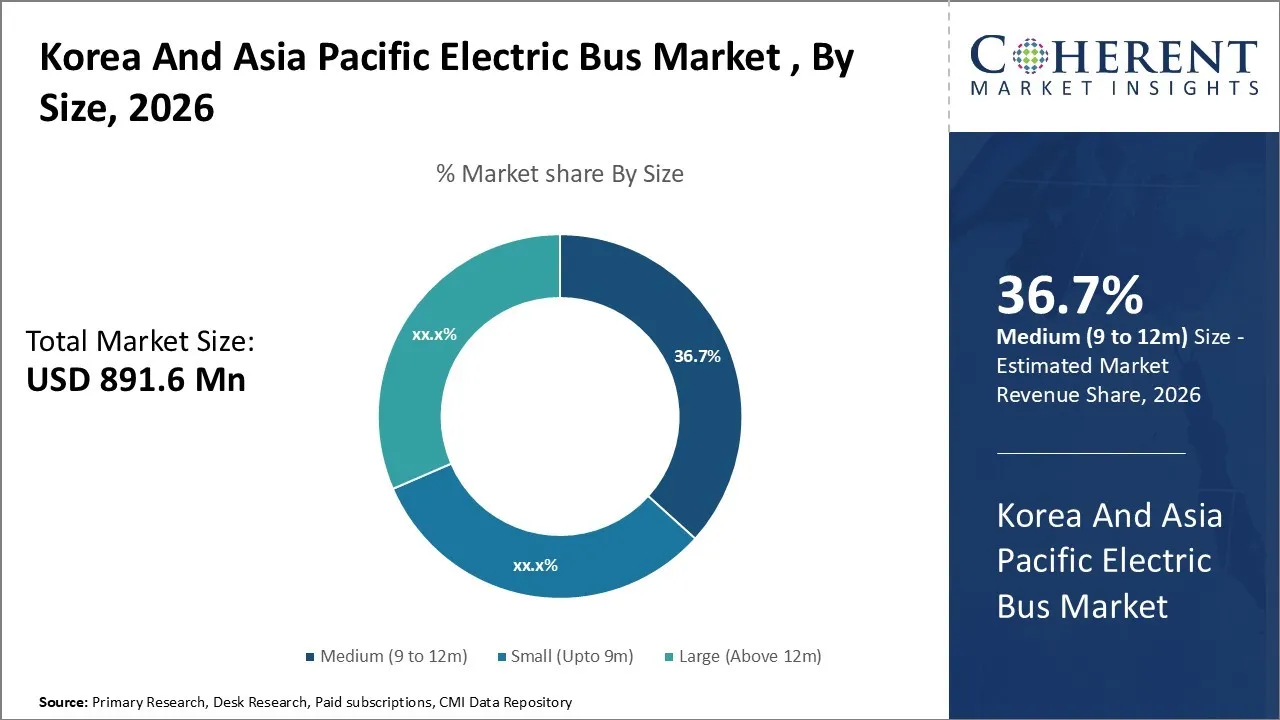
- By Size, Medium (9 to 12m) acquired the prominent market share of 36.7% in 2026 owing to the urban route suitability.
- By Country, China dominates the overall market with an estimated share of 43.3% in 2026 owing to the price competitiveness.
Market Overview
Governments are steadily expanding the South Korea and Asia Pacific electric bus market by implementing strong electrification policies, targeting urban air-quality improvements, and modernizing public transport systems. In South Korea, national green mobility programs and municipal fleet replacement initiatives are actively accelerating the transition from diesel to battery electric and hydrogen buses. Across Asia Pacific, China leads production and deployment, while India, Japan, and Southeast Asian countries are actively boosting adoption through subsidies and infrastructure investments, positioning the region as the global hub of electric bus growth.
Current Events and their Impact on the Korea And Asia Pacific Electric Bus Market
Current Events | Description and its impact |
Geopolitical and Trade Developments |
|
Government Policies and Regulatory Changes |
|
Macroeconomic and Energy Market Factors |
|
Segmental Insights
- Current Industry Events of 2026
- Market Size Estimation
- Regional Breakdown
- Competitive Landscape
- Customer Intelligence
- Segmental Analysis
- Pricing Analysis
- Key Market Drivers, Challenges & Future Trends
- Customized Insights Section
Korea And Asia Pacific Electric Bus Market Insights, By Bus Type: City Bus contribute the highest share of the market owing to its economic and operational benefits.
City Bus hold the largest market share of 38.8% in 2026. Governments and transport authorities are accelerating the growth of city buses in the South Korea and Asia Pacific electric bus market by enforcing strong regulations, advancing climate goals, and reforming urban mobility systems. They are actively electrifying fleets to cut emissions and reduce noise in densely populated cities. Transit agencies are expanding charging infrastructure, adopting improved battery technologies, and leveraging lower operating costs to scale electric bus deployment. At the same time, growing urban populations and smart city programs are increasing demand for clean and efficient public transportation. For instance, in November 2025, Hyundai Motor won a GGGI contract and will supply electric buses to Indonesia, where the local public transport system will operate them.
Korea And Asia Pacific Electric Bus Market Insights, By Type: Battery EV Bus contribute the highest share of the market owing to its battery technology & infrastructure improvements.
Battery EV Bus expected to hold largest market share of 42.2% in 2026. Governments and transport authorities are accelerating the adoption of battery electric buses in South Korea and across the Asia Pacific region by responding to rising fuel costs, enforcing stricter emission standards, and implementing national decarbonization strategies. They are actively funding clean transportation programs and pushing transit operators to replace aging diesel fleets with zero-emission models. Manufacturers are improving battery range, charging speed, and durability to strengthen operational reliability, while cities are investing in charging infrastructure to support cleaner and quieter urban mobility solutions. For instance, during his first visit to Silvassa, India, President Ram Nath Kovind witnessed BYD deliver the city’s first electric bus as part of several new development projects.
Korea And Asia Pacific Electric Bus Market Insights, By Size: Medium (9 to 12m) contribute the highest share of the market owing to its domestic & export market competition.
Medium (9 to 12m) acquired the prominent market share of 36.7% in 2026. Governments and transit agencies are driving the adoption of medium-sized (9 to 12 m) electric buses in South Korea and across the Asia Pacific by focusing on urban routes with moderate passenger volumes. They are actively replacing diesel fleets with mid-sized battery electric buses through fleet modernization programs and environmental regulations. Manufacturers are enhancing battery efficiency, charging infrastructure, and operational reliability to support daily service, while growing urban populations and smart mobility projects are boosting demand for efficient, low-emission buses on key city routes.
Regional Insights
China Electric Bus Market Trends
China dominates the overall market with an estimated share of 43.3% in 2026. Manufacturers, local governments, and transit authorities in China are rapidly advancing the electric bus market by electrifying fleets to tackle urban pollution and meet climate goals. Cities are actively replacing diesel buses with battery electric and hydrogen models, supported by subsidies, policy incentives, and expanding charging infrastructure. Companies are improving battery performance, vehicle range, and smart fleet management to boost reliability and operational efficiency. Domestic production, export programs, and regional partnerships are strengthening China’s leadership and influencing electric bus adoption across Asia and beyond. For instance, in August 2025, Buenos Aires launched its first all-electric bus line in May 2025, running 12 Yangzhou Asiastar buses from China on a two-month trial.
Japan Electric Bus Market Trends
Government bodies and urban transit authorities in Japan are actively advancing the electric bus market by promoting cleaner, low-emission transportation. Cities are replacing diesel buses with battery electric and hydrogen models, supported by incentives, regulations, and investments in charging and refueling infrastructure. Manufacturers are improving vehicle efficiency, battery reliability, and route optimization technologies to meet operational needs. Rising environmental awareness, combined with smart city initiatives and public demand for quieter, eco-friendly transport, is accelerating the adoption of electric buses across Japan’s urban and suburban networks. For instance, in October 2025, Hydrogen fuel cell vehicles offer a viable, zero-emission alternative for many Asian manufacturers, particularly in Japan, using hydrogen to power electric motors. Japan’s Isuzu and Toyota collaborated to produce the first mass-market bus with a commercial focus.
End-User Feedback and Unmet Needs in the Korea And Asia Pacific Electric Bus Market
- Charging Infrastructure Challenges: Operators report that existing charging stations are often insufficiently distributed, leading to route delays and operational planning issues. Long charging times interfere with tight schedules and reduce bus availability. End‑users emphasize the need for faster, more widespread, and reliable charging deployment to support expanded electric bus services across urban and rural networks.
- Vehicle Range and Performance Expectations: Drivers and fleet managers highlight concerns about range variability under real‑world conditions such as heavy passenger loads and extreme weather. Some buses struggle with consistent performance on longer or hilly routes, leading to operational uncertainty. Users desire vehicles that can maintain stable range and performance throughout full-service cycles.
- Maintenance and Service Support: Electric bus operators frequently experience delays in parts availability and technical support from manufacturers. Limited local expertise leads to prolonged downtimes, disrupting daily services. Feedback underscores the need for stronger service networks, quicker spare parts logistics, and enhanced training for technicians to ensure high fleet uptime.
Korea And Asia Pacific Electric Bus Market Trend
Accelerated Adoption Driven by Urban Sustainability Goals
Cities across Korea and the broader Asia Pacific are prioritizing low‑emission public transport to meet air quality and climate commitments. Government policies and municipal plans increasingly favor electric buses as core components of green mobility strategies. This trend is prompting public transit authorities to integrate electric fleets into long‑term transport frameworks. The focus extends beyond purchase incentives to include urban planning that accommodates charging networks, depot redesigns, and electric bus‑friendly infrastructure development.
Expansion of Regional Manufacturing and Localization
Original equipment manufacturers (OEMs) are expanding production footprints within Korea and Asia Pacific markets to reduce reliance on imports and strengthen supply chain resilience. Local assembly, component sourcing, and partnerships with regional suppliers are emerging as competitive priorities. This shift supports faster delivery times, lower logistical barriers, and improved responsiveness to local regulatory and operational requirements. Localization also encourages tech transfer, workforce upskilling, and collaborative innovation between global brands and regional players.
Korea And Asia Pacific Electric Bus Market Opportunity
Development of Charging and Energy Infrastructure
The transition to electric buses opens pathways for expanding charging networks and energy ecosystem services. Opportunities exist for charging infrastructure providers, energy utilities, and smart grid developers to collaborate on depot and on‑route charging solutions. Integration with renewable energy sources and energy storage systems can create value‑added services, such as demand response and load management. Suppliers that offer scalable, interoperable charging platforms and technical support can gain traction as cities and operators modernize infrastructure.
Market Report Scope
Korea And Asia Pacific Electric Bus Market Report Coverage
| Report Coverage | Details | ||
|---|---|---|---|
| Base Year: | 2025 | Market Size in 2026: | USD 891.6 Mn |
| Historical Data for: | 2020 To 2024 | Forecast Period: | 2026 To 2033 |
| Forecast Period 2026 to 2033 CAGR: | 17.2% | 2033 Value Projection: | USD 2,245.8 Mn |
| Geographies covered: |
| ||
| Segments covered: |
| ||
| Companies covered: | ANKAI, Ashok Leyland Limited, BYD Motors Inc., Edison Motors Co., Ltd., FAW Group Corporation, GILLIG LLC, Higer Bus, Hyundai Motor Company, King Long, Nanjing Jinlong Bus Manufacturing Co., Ltd (Sky-well New Energy Automobile Group Co. Ltd), Olectra Greentech Limited, Scania, Tata Motors, Volvo Group, Yutong, Zhongtong Bus Holdings Co., Ltd. | ||
| Growth Drivers: |
| ||
| Restraints & Challenges: |
| ||
Korea And Asia Pacific Electric Bus Market News
- In November 2025, Hyundai Motor supplied County electric buses to launch Bali’s first public e-bus system. Backed by the Korean government, the Ministry of Climate, Energy and Environment and GGGI are piloting the Bali e-mobility project and developing an electric transport roadmap with the Indonesian government.
- In July 2025, Alexander Dennis announced that CLP Power Hong Kong launched the first of four next-generation Enviro500EV zero-emission double-deck buses.
Analyst Opinion (Expert Opinion)
- The Korea and Asia Pacific electric bus market narrative continues to be shaped less by broad industry optimism and more by the stark reality of competitive imbalance and industrial positioning. In South Korea, the domestic industry’s growth trajectory in electric buses has been measurable, with over 3,600 registered electric buses as of 2024 and nearly 13 ,000 electric commercial vehicles including buses and vans distributed by mid‑2025 according to official government deployment records. However, this apparent progress disguises deeper structural challenges.
- A critical fault line in this market lies in the overwhelming dominance of Chinese manufacturers outside domestic borders. Chinese brands such as BYD have come to account for the vast majority of electric bus fleets in emerging markets such as Latin America, where Chinese vehicles represent over 90 % of all electric buses in service. This dominance is not a case of incidental preference but of strategic state‑backed expansion; aggressive pricing and deep subsidy support for Chinese enterprises have undercut competitors across Asia Pacific, a trend echoed by import patterns within Korean cities where Chinese buses’ share of new registrations grew rapidly in the early 2020s.
- Domestic strategic responses illustrate recognition of competitive risk. Recent Korean subsidy reforms now link support to performance metrics such as battery energy density, implicitly favoring homegrown technologies over lower‑cost imports — an important pivot in industrial policy that recalibrates incentives toward higher quality and local value creation. Moreover, Korean OEMs such as Hyundai Motor have pursued selective expansion in Asia Pacific by securing contracts to supply electric buses to urban networks in Indonesia, demonstrating a pragmatic shift from a purely domestic focus to regional ecological transport projects.
Speak to the analyst
Want personalized insights?
Take the findings above to one of our principal consultants, or have the report rebuilt around the segments, geographies and competitors you actually track.
Market Segmentation
- By Bus Type
- City Bus
- Tour/Intercity Bus / Luxury Buses
- School Bus
- By Type
- Trolleybus
- Battery EV Bus
- PHEV/Hybrid Bus
- Hydrogen Fuel Cell
- By Size
- Small (Upto 9m)
- Medium (9 to 12m)
- Large (Above 12m)
- By Region
- China
- India
- Japan
- Australia
- South Korea
- ASEAN
- Rest of Asia Pacific
- Key Players Insights
- ANKAI
- Ashok Leyland Limited, BYD Motors Inc.
- Edison Motors Co., Ltd.
- FAW Group Corporation
- GILLIG LLC
- Higer Bus
- Hyundai Motor Company
- King Long
- Nanjing Jinlong Bus Manufacturing Co. Ltd (Sky-well New Energy Automobile Group Co. Ltd)
- Olectra Greentech Limited
- Scania
- Tata Motors
- Volvo Group
- Yutong
- Zhongtong Bus Holdings Co., Ltd.
Sources
Primary Research interviews
- Fleet managers of public and private bus operators in Korea and Asia Pacific
- Electric bus manufacturers and OEM representatives
- Charging infrastructure providers and energy companies
- Regulatory authorities and transport policymakers
- Local government transport department officials
Databases
- International Energy Agency (IEA) electric mobility datasets
- World Bank Transport & Energy statistics
- United Nations Comtrade Database
- Korea Electric Vehicle Association (KEVA) data
- Asia Pacific Energy Research Centre (APERC) statistics
Magazines
- Electric & Hybrid Vehicle Technology International
- Green Car Journal
- EV World Magazine
- Asia Pacific Transport Magazine
- Sustainable Bus Magazine
Journals
- Journal of Transport Geography
- Transportation Research Part D: Transport and Environment
- Energy Policy Journal
- International Journal of Sustainable Transportation
- Applied Energy Journal
Newspapers
- The Korea Herald – Transport and Energy sections
- The Straits Times – Mobility and Green Transport news
- Nikkei Asia – Automotive and Electric Vehicle coverage
- South China Morning Post – Clean Energy and Transport
- Times of India – Transport & Electric Mobility updates
Associations
- Korea Electric Vehicle Association (KEVA)
- Electric Vehicle Association of Asia Pacific
- International Association of Public Transport (UITP)
- Asia Pacific Urban Transport Association
- Clean Energy Council
Public Domain sources
- Government of Korea Ministry of Land, Infrastructure and Transport reports
- Asia Development Bank (ADB) reports on transport electrification
- OECD Sustainable Transport datasets
- IPCC climate and emission reports
- United Nations Environment Programme (UNEP) electric mobility reports
Proprietary Elements
- CMI Data Analytics Tool
- Proprietary CMI Existing Repository of information for last 8 years
Get access to 250+ pages report
Every segment, forecast, competitor profile and data table behind the analysis above — available for instant download.
- ESOMAR Member
- ISO 9001:2015 Certified
- D-U-N-S Registered
- GDPR & CCPA Compliant
Missing comfort of reading report in your local language? Find your preferred language:
Transform your Strategy with Exclusive Trending Reports
Frequently Asked Questions
The Korea and Asia Pacific Electric Bus Market is estimated to be valued at USD 891.6 Mn in 2026 and is expected to reach USD 2,245.8 Mn by 2033.
The market is expected to witness a CAGR of 17.2% during the forecast period.
Increasing demand for electric buses for public transportation is expected to drive growth of the market during the forecast period.
The city bus segment held the largest market share among bus type in 2033.
China held the largest share in the market in 2033.
Key players operating in the market include ANKAI, Ashok Leyland Limited, BYD Motors Inc., EDISON MOTORS Co., Ltd., FAW Group Corporation, GILLIG LLC, Higer Bus, Hyundai Motor Company, King Long, Nanjing Jinlong Bus Manufacturing Co., Ltd (Sky-well New Energy Automobile Group Co. Ltd), Olectra Greentech Limited, Scania, TATA MOTORS, Volvo Group, YUTONG, Zhongtong Bus Holdings Co., Ltd.