

Automotive Ac Filter Market Size and Share Analysis – Growth Trends and Forecasts (2026-2033)
Automotive Ac Filter Market value is estimated to be valued at USD 4.73 Bn in 2026 and is expected to reach USD 7.02 Bn in 2033, exhibiting a compound annual growth rate (CAGR) of 5.8% from 2026 to 2033.
Key Takeaways
- Based on Sales Channel, Aftermarket segment dominates the global ac filter market with 73% market share. This is due increasing demand for replacement filters in the automotive sector.
- Based on Filter Type, Charcoal Filters segment is expected to witness significant growth due to their ability to provide better air quality and enhance cabin comfort by absorbing odors and pollutants.
- Asia Pacific led the market and accounted for 54% of global revenue in 2026. This is due to development of the automotive sector within the region is expected to be driven by the region's robust manufacturing base as well as by the increasing influence of pro-production government policies in countries such as China and India.
Current Events and its Impact on Automotive Ac Filter Market
Current Events | Description and its impact |
Rise of Smart AC Filters |
|
Blockchain for Filter Authentication |
|
Role of technologies like AI in Automotive AC Filter Market
In the market of automotive air conditioning (AC) filters, technologies such as AI are contributing significantly towards enhanced efficiency, performance, and customer satisfaction. AI-based innovations assist in filter optimization by examining large data sets of vehicle usage patterns, weather conditions, and filter performance. Based on these analyses, manufacturers are able to design filters that capture pollutants and allergens more efficiently while providing improved durability.
AI plays a critical role in predictive maintenance as well. Using data analysis and machine learning algorithms, AI will be able to anticipate when a vehicle's AC filter should be replaced or cleaned out, minimizing downtime and optimizing overall vehicle performance. Sensors coupled with AI systems can track filter conditions in real-time and notify drivers or service centers if the filter is clogged or inefficient.
Also, AI is heightening the specificity of AC filters to individual automobile models and ambiances, delivering improved air quality to drivers and riders. Automated production lines supported by AI are making filter creation more precise to avoid human fault and maximize volume.
Artificial intelligence is fueling innovation in the automotive AC filter industry through enhanced product design, functionality, maintenance procedures, and manufacturing productivity, ultimately enabling a more satisfying experience for consumers as well as cleaner, healthier air in vehicles.
- Current Industry Events of 2026
- Market Size Estimation
- Regional Breakdown
- Competitive Landscape
- Customer Intelligence
- Segmental Analysis
- Pricing Analysis
- Key Market Drivers, Challenges & Future Trends
- Customized Insights Section
Blockchain in the Automotive AC Filter Market
Blockchain technology is set to significantly contribute to the automotive air conditioning (AC) filter industry by bringing greater transparency, traceability, and efficiency along the supply chain. One of the major advantages is that it can build an immutable, distributed ledger of transactions, enabling producers, suppliers, and buyers to monitor the whole lifecycle of AC filters, including production and eventual use. This provides authenticity, quality, and adherence to environmental norms, giving consumers and businesses alike confidence.
Blockchain technology also make the supply chain process easy by eliminating fraud and counterfeiting. With authentic data on the source and manufacturing processes of filters, stakeholders can be sure that the components are up to the required specifications and are not exposed to substandard processes. This is especially important in the automotive sector, where quality filters are vital for vehicle performance and air quality.
Secondly, blockchain facilitates enhanced warranty management and post-sales service. Consumers are able to validate the authenticity and warranty status of their AC filters with ease, simplifying the claims process and enhancing customer satisfaction. In conclusion, blockchain strengthens the efficiency, security, and reliability of the automotive AC filter industry to the advantage of manufacturers, distributors, and end customers by promoting greater trust and responsibility along the supply chain.
Pipeline Analysis for Automotive AC Filter Market
The pipeline of the automotive AC filter market is influenced by a combination of technological innovation, regulatory forces, and changing consumer needs. First, the market has witnessed growth in research and development (R&D) activities aimed at enhancing filter efficiency and durability.
Businesses are committing to the development of smart filters with sensors and AI integration to track air purity and filter condition in real-time, making customers more convenient and creating demand. Integration of ionizers, UV-C purifiers, and other technologies that clean the air into the AC filter systems is another area of ongoing development that targets better air purity in vehicle cabins.
In addition, sustainability continues to be a major catalyst in the pipeline, with companies creating environmentally friendly filters using renewable materials to cater to growing environmental regulations. Increasing customization is also a major driver of the pipeline, with companies aiming to develop filters designed specifically for particular car models and HVAC systems.
Regulatory drivers from a regulatory standpoint include tighter emissions and air quality regulations, especially in Europe, North America, and China. These are forcing the automotive sector to use increasingly sophisticated AC filters. This will drive new technologies and filter introductions at an even faster rate, fueling market growth in the short term. The pipeline reflects ongoing innovation, with focus on cleaner, smarter, and more sustainable solutions.
Global Automotive AC Filter Market Driver:
Need for cleaner air within vehicles
The global automotive AC filter market growth is driven by mounting environmental policies and norms related to vehicle emissions. Car makers are more often installing AC filters as standard accessories on their vehicles with governments and authorities increasingly laying stricter emissions and air quality requirements for vehicles.
For instance, in 2024, Volkswagen introduced a series of new cars featuring advanced multi-stage air filtration systems, such as high-efficiency automotive air conditioner filters meant to comply with tighter global standards for air quality and emissions. Not only do these filters help improve cabin air quality by cleaning out harmful toxins and allergens, but they also help bring the entire vehicle into compliance with tightening environmental standards, particularly in cities with demanding air quality requirements.
Global Automotive AC Filter Market Trends:
- Adaptation of small AC System
Advancement in numerous engineering and emission regulations have been integrated to create innovative, environmentally friendly, and versatile engines. Compact air filter system packaging sizes, higher pollutant separation efficiency, higher pollutant loading performance, and record-breaking temperature performance are required for diesel engines and the automobiles these engines fuel.
- Integration and Customization of cabin AC Filters
Through integration and customization of cabin AC filters, the automobile industry is adapting to market trends. Considering the specific requirements of every vehicle model and make, manufacturers have been designing filters that can be used in specific HVAC systems. The indoor air quality in the automobile can be enhanced by such filters since they can provide better protection against allergens, pollutants, and other detrimental particles.
For instance, in 2024, Toyota launched its new "Clean Air" tech package on many of its car models that included highly adaptable cabin AC filters integrated with ionizers and air purifiers. This system was aimed at specifically catering to the emerging customer need for better air quality inside the car cabin, with a focus on allergens, pollutants, and pathogens.
Segmental Analysis
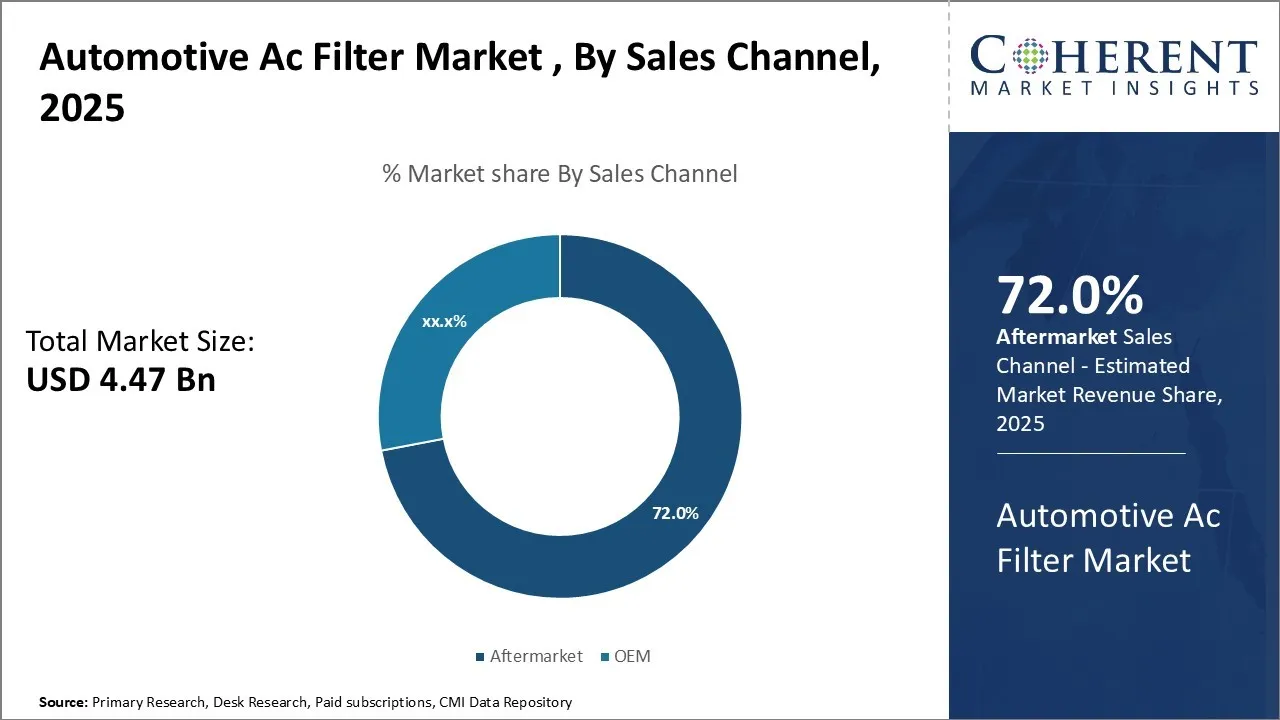
Global Automotive AC Filter Market Insights, by Sales channel
Based on Sales Channel, Aftermarket segment dominates the global ac filter market during the forecast period. The growth is being attributed by growing demand for replacement filters because of wear and tear, increasing consumer awareness, and reduced efficiency.
In addition, growing e-commerce platform and easy availability of wide range aftermarket AC filers will bolster the demand growth of this segment. Consumer are preferring these products due to their wide compatibility and cost-effectiveness. As the result, this segment is continue to make its dominance throughout the forecast period.
Global Automotive AC Filter Market: Regional Insights
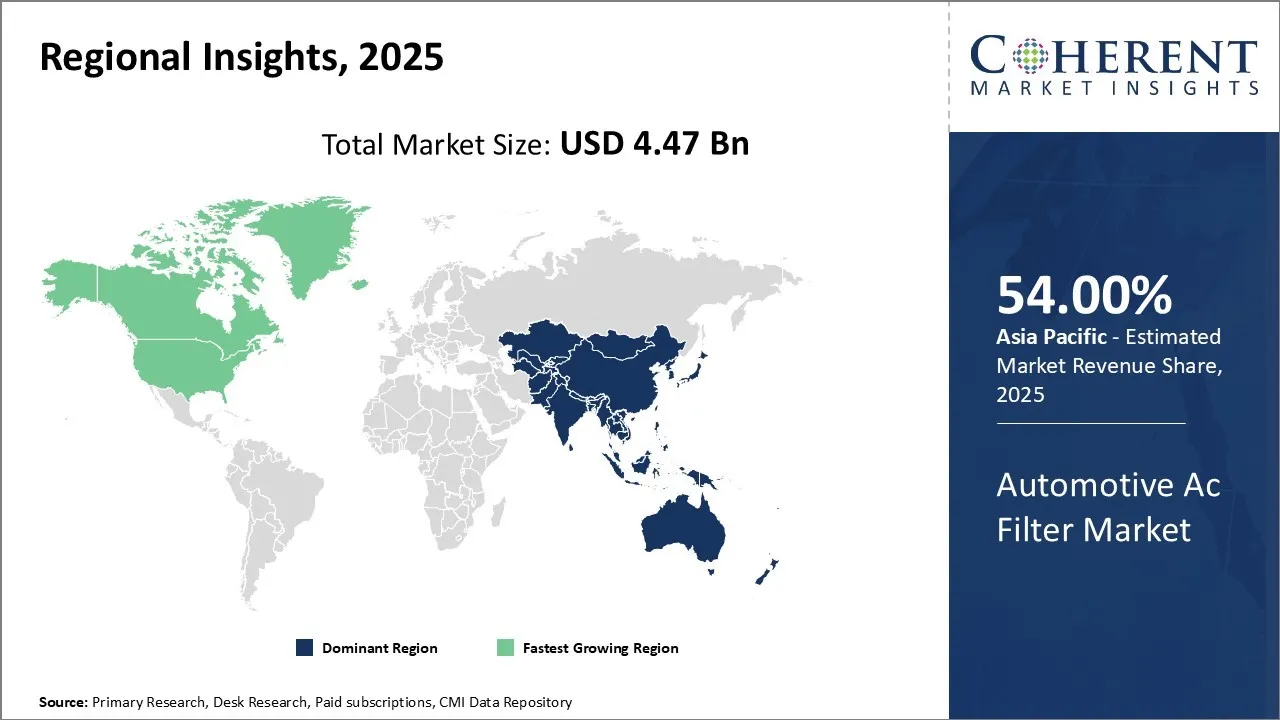
Asia Pacific Automotive AC Filter Market Forecast
Asia Pacific led the global automotive AC filter market in 2026. The growth is driven by the region's robust manufacturing base as well as by the increasing influence of pro-production government policies in countries such as China and India.
Japan is considered to be one of the biggest luxury cars manufacturers in Asia Pacific region. Toyota, Honda, and Nissan are some of the well-known manufacturers in the industry. Throughout the projection period, these conditions are expected to reinvigorate the auto industry and widen the market for air filters.
South Korea is among the technologically advanced automobiles manufacturer in Asia Pacific. This is due to a political conflict with China and financial challenges for small- and medium-sized component makers, the nation's automotive sector is at present going through a weak domestic market. The South Korean government is aggressively investing in both infrastructure and vehicles for the industry to benefit from, and it has established high targets for the sector within the next decade.
Automotive AC Filter Market Dominating Countries
United States Automotive AC Filter Market Analysis and Trend
The United States is a leading country in the global automotive AC filter market because of its vast automotive production base and rigorous environmental regulations. With a robust focus on emissions from vehicles and air quality, consumers and government policies alike expect better air quality in vehicles. Large automakers such as General Motors, Ford, and Tesla are heavily investing in sophisticated air filtration technologies, which further accelerates the need for high-quality AC filters.
Germany Automotive AC Filter Market Analysis and Trend
Germany is a dominant player in the automotive AC filter market due to its position as a hub for luxury automobile manufacturers such as Volkswagen, BMW, Mercedes-Benz, and Audi. Germany is also well-known for having tough emission standards and environmental regulations, which necessitate the demand for sophisticated cabin air filters.
Market Report Scope
Automotive AC Filter Market Report Coverage
| Report Coverage | Details | ||
|---|---|---|---|
| Base Year: | 2025 | Market Size in 2026: | USD 4.73 Bn |
| Historical Data for: | 2020 To 2024 | Forecast Period: | 2026 To 2033 |
| Forecast Period 2026 to 2033 CAGR: | 5.8% | 2033 Value Projection: | USD 7.02 Bn |
| Geographies covered: |
| ||
| Segments covered: |
| ||
| Companies covered: | Mann+Hummel GmbH, Sofegi SpA, Donaldson Company Inc., Robert Bosch GmbH, Denso Corporation, Ahlstrom Corporation, MAHLE GmbH, Freudenberg & Co. KG, Hengst SE & Co. KG, ALCO Filters Ltd., K&N Engineering, Inc., EuroGIELLE s.r.l., ACDelco, The Volvo Group and Airmatic Filterbau GmbH and others | ||
| Growth Drivers: |
| ||
| Restraints & Challenges: |
| ||
Global Automotive AC Filter Market: Key Developments
- In March 2024, Bosch launched the FILTER+pro cabin air filter, an upgraded model from their earlier version. This independently certified filter by OFI CERT in Vienna for its superior capability of filtering allergens as well as reducing germ transmission.
- In April 2024, UFI Filters was named as a finalist at Automotive News PACE Pilot 2025 for its innovative CO₂ evaporator/chiller. This cutting-edge part is created for next-generation vehicles in order to optimize thermal management systems. Though not a cabin air filter in itself, its design is part of the focus on incorporating advanced technologies for better overall vehicle air quality and comfort.
Global Automotive AC Filter Market: Key Companies Insights
Some of the Global Automotive AC Filter Market key players are Mann+Hummel GmbH, Sofegi SpA, Donaldson Company, Inc., Robert Bosch GmbH, Denso Corporation, Ahlstrom Corporation, MAHLE GmbH, Freudenberg & Co. KG, Hengst SE & Co. KG, ALCO Filters Ltd., K&N Engineering, Inc., EuroGIELLE s.r.l., ACDelco, The Volvo Group and Airmatic Filterbau GmbH.
Analyst View
- The Automotive AC Filter Market outlook is influenced by increased health awareness among consumers and increased air quality awareness. It boosts the expectations for sophisticated filtration systems that fight pollutants, allergens, and microbes inside vehicle cabins. This trend is further boosted by urbanization and increasing pollution rates, especially in high-density areas, where cabin air purification becomes a luxury rather than a necessity.
- Technological advancement such as hybrid filter designs and intelligent sensors that track filter performance in real-time will provide an opportunity for growth. The transition towards electric vehicles (EVs) also provides a booster for innovation, with EV HVAC systems needing efficient filters to achieve optimal battery life. Luxury brands are incorporating multi-layer filtration into more premium vehicles, building market niches for manufacturers of high-efficiency particulate air (HEPA) filters.
- Regionally, Asia-Pacific is leading as a result of strong automotive production and favorable policies, although saturation in mature markets of North America and Europe is redirecting focus to aftermarket demand spurred by replacement cycles. Europe's focus on R&D and strict air quality standards makes it a center of premium filter solutions, while economic restraint in some parts of Africa and Latin America moderates’ growth despite incremental gains in demand.
Market Segmentation
- Global Automotive AC Filter Market, By Filter Type (Revenue, USD Bn, 2021 - 2033)
- Particulate
- Charcoal
- Electrostatic
- Global Automotive AC Filter Market, By Vehicle Type (Revenue, USD Bn, 2021 - 2033)
- Passenger Car
- Heavy & light commercial vehicles
- Global Automotive AC Filter Market, By Sales Channel (Revenue, USD Bn, 2021 - 2033)
- Original Equipment Manufacturer (OEM)
- Aftermarket
Regional Insights (Revenue, USD Bn, 2021 - 2033)
- North America
- U.S.
- Canada
- Latin America
- Brazil
- Argentina
- Mexico
- Rest of Latin America
- Europe
- Germany
- U.K.
- Spain
- France
- Italy
- Russia
- Rest of Europe
- Asia Pacific
- China
- India
- Japan
- Australia
- South Korea
- ASEAN
- Rest of Asia Pacific
- Middle East
- GCC Countries
- Israel
- Rest of Middle East
- Africa
- South Africa
- North Africa
- Central Africa
- North America
- Company Profiles:
- Mann+Hummel GmbH
- Sofegi SpA
- Donaldson Company, Inc.
- Robert Bosch GmbH
- Denso Corporation
- Ahlstrom Corporation
- MAHLE GmbH
- Freudenberg & Co. KG
- Hengst SE & Co. KG
- ALCO Filters Ltd.
- K&N Engineering, Inc
- EuroGIELLE s.r.l.
- ACDelco
- The Volvo Group
- Airmatic Filterbau GmbH.
Sources
Primary Research Interviews:
- Manufactures of Automotive HVAC System
- Prominent Suppliers of Automotive Components
- Suppliers of Automotive Aftermarket Services
- Others
Databases:
- IBISWorld Automotive Component Database
- Factiva Global Industry Report on the Automotive Sector
- Others
Magazines:
- Automotive News
- Automotive World
- Aftermarket News
- Others
Journals:
- SAE International Journal of Engines
- Journal of Automotive Engineering and Applications
- International Journal of Vehicle Design
- Others
Newspapers:
- The Wall Street Journal (Automotive Section)
- Financial Times (Transport & Logistics)
- Automotive News Europe
- Others
Associations:
- Society of Automotive Engineers (SAE International)
- Automotive Aftermarket Suppliers Association (AASA)
- International Organization of Motor Vehicle Manufacturers (OICA)
- Others
Public Domain Sources:
- U.S. Department of Energy Vehicle Technologies Office Reports
- European Automobile Manufacturers Association (ACEA) Publications
- World Bank Automotive Industry Sustainability Reports
- Others
Proprietary Elements:
- CMI Data Analytics Tool
- Proprietary CMI Existing Repository of Information for Last 8 Years
*Definition: An automotive AC filter is a air filter in a vehicle helps remove harmful pollutants, including pollen and dust, from the air you breathe within the car. It also prevents bugs, leaves and other debris from clogging up the system.
Get access to 250+ pages report
Every segment, forecast, competitor profile and data table behind the analysis above — available for instant download.
- ESOMAR Member
- ISO 9001:2015 Certified
- D-U-N-S Registered
- GDPR & CCPA Compliant
Missing comfort of reading report in your local language? Find your preferred language:
Transform your Strategy with Exclusive Trending Reports
Frequently Asked Questions
The Automotive Ac Filter Market size is estimated to be valued at USD 4.73 Bn in 2026, and is expected to reach USD 7.02 Bn by 2033.
The Global Automotive AC Filter industry is estimated to surpass US$ 5.9 Billion by 2033.
Some of the prominent Global Automotive AC Filter Market players are Mann+Hummel GmbH, Sofegi SpA, Donaldson Company, Inc., Robert Bosch GmbH, Denso Corporation, Ahlstrom Corporation, MAHLE GmbH, Freudenberg & Co. KG, Hengst SE & Co. KG, ALCO Filters Ltd., K&N Engineering, Inc., EuroGIELLE s.r.l., ACDelco, The Volvo Group and Airmatic Filterbau GmbH.
Asia Pacific is dominating the market, owing to increasing demand for automotive vehicles such as passenger cars and commercial cars in Asia Pacific, coupled with rapid urbanization and industrialization in various emerging economies of Asia Pacific such as India and China.
Increasing automotive production and advancements in the automotive industry are some of the major factors that are expected to propel the growth of the market over the forecast period.
The CAGR of the global Market is projected to be 5.8% from 2026 to 2033.