

Hydroxyapatite Market Analysis & Forecast: 2026-2033
Hydroxyapatite Market is estimated to be valued at USD 2,902.3 Mn in 2026 and is expected to reach USD 4,575.7 Mn in 2033, exhibiting a compound annual growth rate (CAGR) of 6.7% from 2026 to 2033.
Key Takeaways
- According to type, the micro-sized category is anticipated to account for the largest share of 49.1% for the Hydroxyapatite market in 2026.
- According to region, North America also holds the largest market share of 37.83% in Hydroxyapatite market growth by 2026.
- Asia Pacific is considered to be the second largest region with 27.62% by 2026 in Hydroxyapatite market.
- Europe is considered to be the third dominating region with 31.75% in the Hydroxyapatite market by 2026.
Market Overview
The global Hydroxyapatite Market Size fuels due to the increasing demand for orthopedic implants, dental care, and plastic surgery. The market growth is also attributed to increased demand for medical implants, rapid industrialization and urbanization, increase in consumer awareness, and surge in interest as a biomaterial for use in prosthetic applications.
For instance, in December 2024, Himalaya Wellness, a leading herbal and plant-based supplements and personal care brand, is excited to introduce its latest innovation: Himalaya Botanique Whitening+ Hydroxyapatite Peppermint Toothpaste. This new offering pairs a refreshing peppermint flavor with the trusted whitening and enamel-supportive benefits consumers love.
Current Events and Its Impact on the Hydroxyapatite Market
Event | Description and Impact |
Surge in demand for orthopedic and dental implants |
|
Growth in 3D bioprinting and regenerative medicine |
|
Pricing Analysis
Production costs are also impacted by the choice between natural and synthetic sources, with synthetic hydroxyapatite generally being more expensive due to advanced processing and quality controls. Additionally, the growing adoption of hydroxyapatite in regenerative medicine, orthopedics, and dental implants is driving up demand, which can exert upward pressure on prices.
Regional factors, such as healthcare infrastructure and regulatory requirements, further contribute to price differences, with North America and Europe often experiencing higher average prices compared to emerging markets due to advanced technology adoption and higher quality expectations. Overall, the hydroxyapatite market is expected to see steady price growth in the coming years, in line with its expanding applications and consistent demand in the healthcare sector.
- Current Industry Events of 2026
- Market Size Estimation
- Regional Breakdown
- Competitive Landscape
- Customer Intelligence
- Segmental Analysis
- Pricing Analysis
- Key Market Drivers, Challenges & Future Trends
- Customized Insights Section
Segmentation Analysis
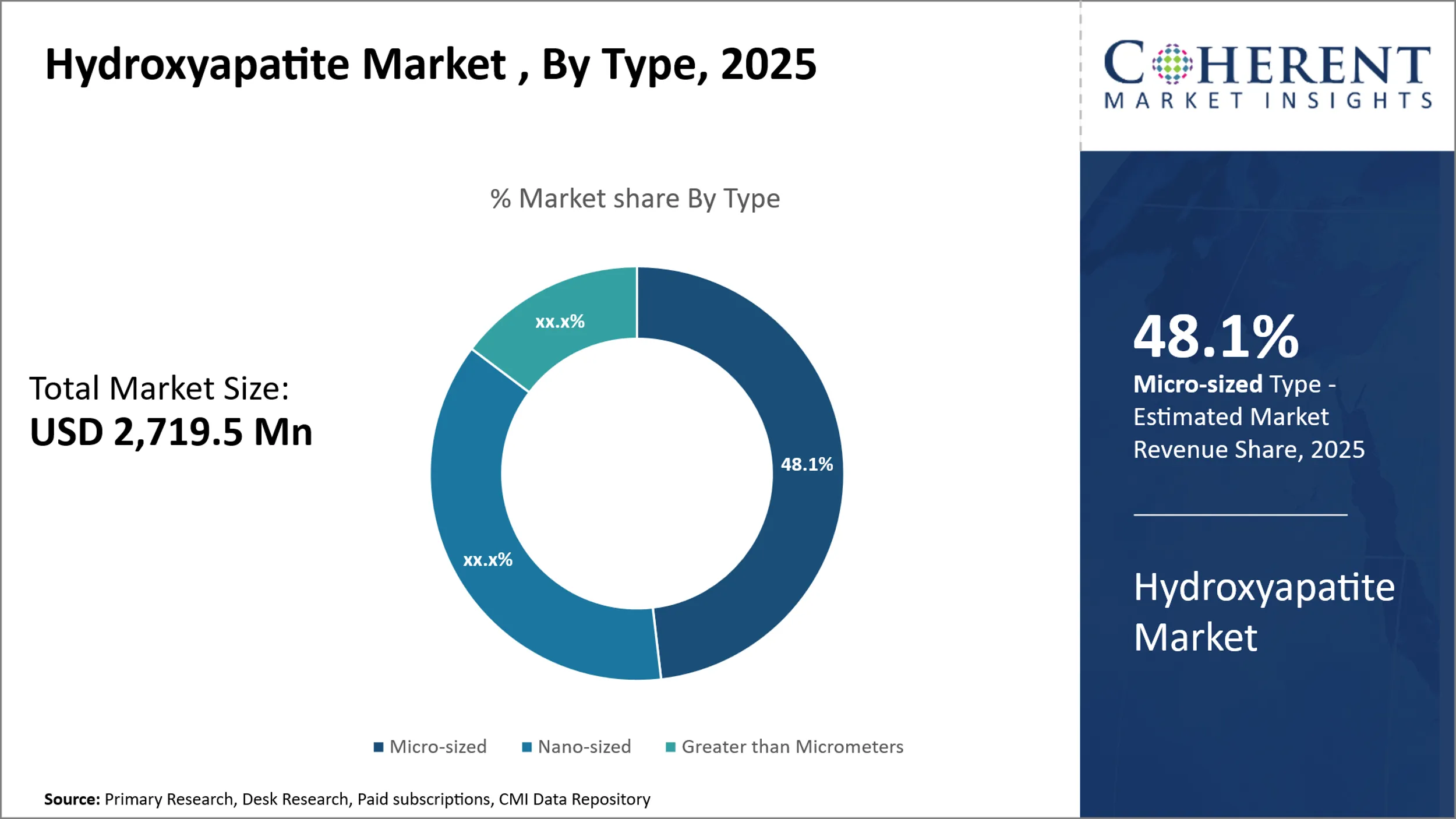
Hydroxyapatite Market Insights, by type
In terms of equipment type, the micro-sized segment is expected to contribute largest share of 49.1% for the Hydroxyapatite market trends in 2026, owing to the growing demand from tissue engineering, drug and gene delivery, orthopedic and dental implant coating, and endodontic treatment like pulp capping.
Nano-sized is also expected to dominate the global market over the forecast period and this is attributed to the growing application in bones and teeth enamel due to its properties, such as bioactivity, biocompatibility, osteoconductivity, non-toxicity, and non- inflammatory nature.
For instance, in December 2022, according to recent article by PubMed Central, Hydroxyapatite (HA) has been widely used as a bone substitute and more recently as a carrier for local delivery of bone targeted drugs. Majority of the approved HA based biomaterials and drug carriers comprise of micrometer sized particulate HA (mHA) or granules and can therefore only be used for extracellular drug release.
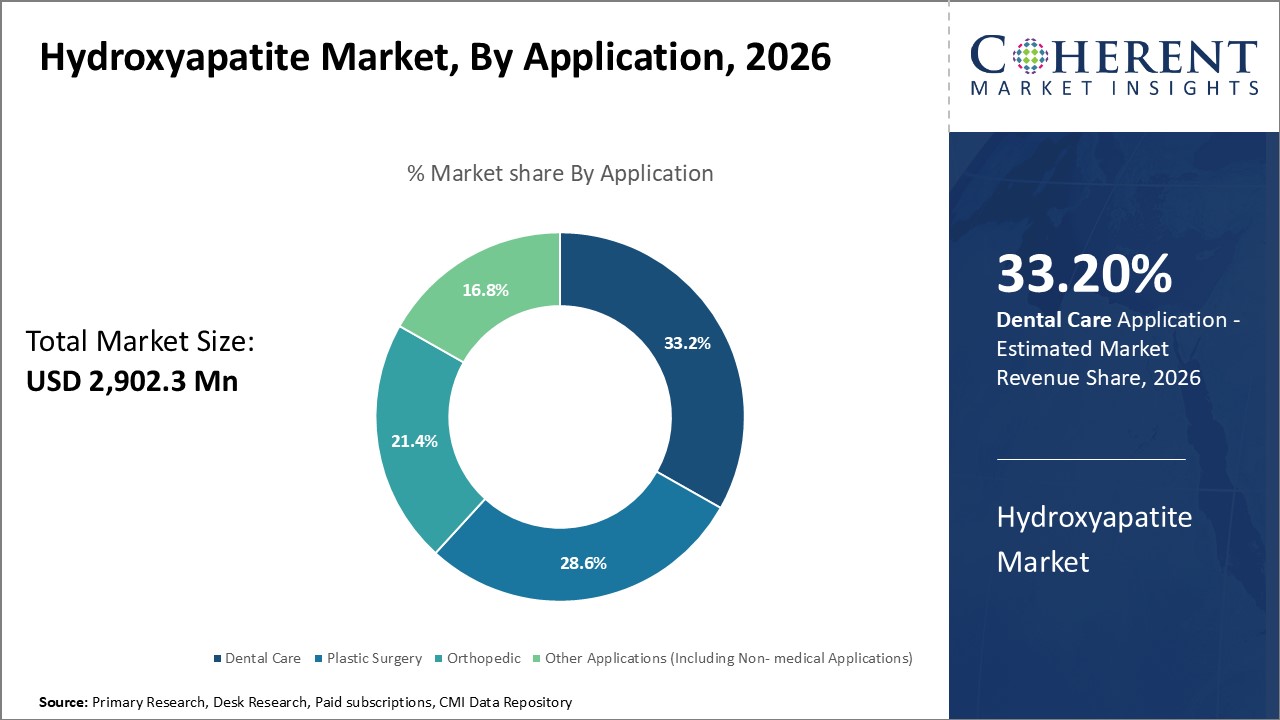
Hydroxyapatite Market Insights, by application
In terms of type, the dental care segment is expected to contribute largest share of the Hydroxyapatite market trends in 2026, and this is attributed to its biocompatible property. Moreover, it is bioactive and non-toxic ceramic that has a close analogy to the inorganic portion of human bone and teeth.
For instance, in November 2024, It is reasonable to presume that the ordinary individual has a good understanding of dentistry when terminology like "enamel layer," "calcium hydroxyapatite," "dental luminosity," and "orthodontic alignment" start to appear in casual conversations. This is the situation with Colgate's latest campaign. The commercial, which was made by WPP@CP, emphasizes the brand's goal of increasing oral health access and awareness in India.
Orthopedic segment is also expected to witness significant growth in the near future. It is the most commonly used bioactive ceramic material in scaffold for bone growth, bone tissue engineering, and bone void fillers for spine surgery and orthopedic.
Regional Insights
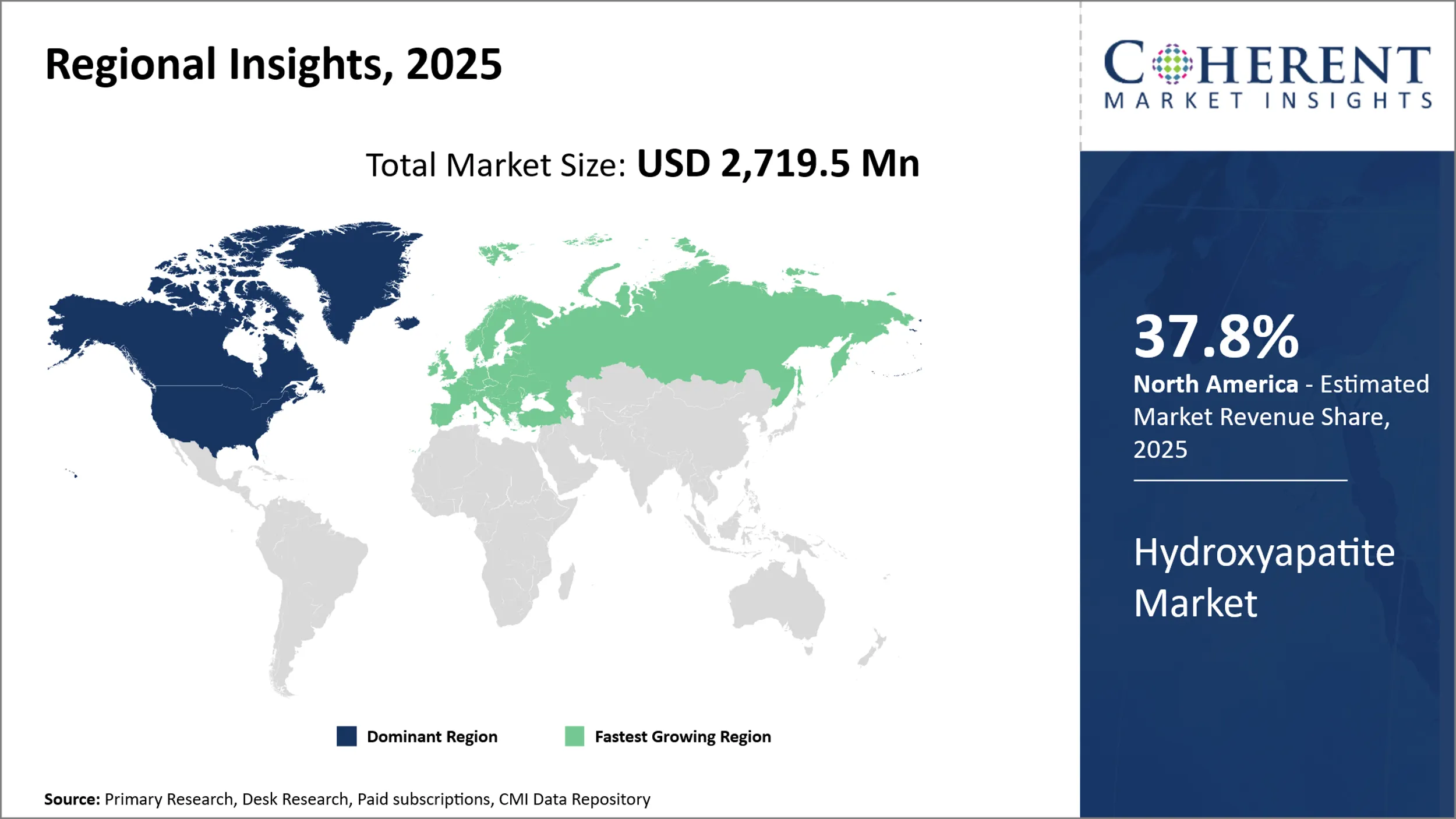
North America Hydroxyapatite Market
Regionally, North America is expected to dominate the global hydroxyapatite market during the forecast period with largest share of 37.83% in 2026. The presence of several key players in this region is anticipated to aid the market growth. In addition, the increase in investment and better healthcare infrastructure are also expected to support growth of the hydroxyapatite market in this region during the forecast period.
Also, growing number of plastic surgeries in the region is again propelling regional market growth. As per the report published by ISAPS in 2020, the country had around 269,514 Breast Augmentation, 242,259 Liposuction, 131,652 Abdominoplasty, 121,302 Breast Lift, and 113,988 Eyelid Surgery.
Asia Pacific Hydroxyapatite Market
Asia Pacific region is anticipated to exhibit a significant growth in the hydroxyapatite market with 27.62% market share in 2026, due to the increasing demand for dental care and plastic surgeries. Additionally, the growing elderly population in this region is predicted to improve the bone-related abnormalities and increase the overall demand for hydroxyapatite. Moreover, the government has encouraged the use of hydroxyapatite-based dental care products to reduce the risk of dental diseases and improve the oral hygiene of people due to increasing prevalence of dental problems.
According to the National Bureau of Statistics of China, in 2019, patients in China received approximately 3.1 million dental implants, showing a growing trend in recent years. It was estimated that over 600 million people in China were suffering from dental problems, yet the diagnosis and treatment rates remained low.
Hydroxyapatite Market Dominating Countries
U.S Hydroxyapatite Market
The U.S. also benefits from significant investment in research and development, fostering innovation in biocompatible materials and supporting the adoption of hydroxyapatite in cutting-edge medical procedures. This dominance is driven by the country's advanced healthcare infrastructure, strong medical device industry, and high consumption in orthopedic and dental applications.
India Hydroxyapatite Market
India is rapidly emerging as a key player in the hydroxyapatite market, propelled by the country’s expanding healthcare sector and rising demand for orthopedic and dental treatments. The growing population, increasing incidence of bone-related disorders, and greater awareness of advanced biomaterials contribute to market growth.
Market Report Scope
Hydroxyapatite Market Report Coverage
| Report Coverage | Details | ||
|---|---|---|---|
| Base Year: | 2025 | Market Size in 2026: | USD 2,902.3 Mn |
| Historical Data for: | 2020 To 2024 | Forecast Period: | 2026 To 2033 |
| Forecast Period 2026 to 2033 CAGR: | 6.7% | 2033 Value Projection: | USD 4,575.7 Mn |
| Geographies covered: |
| ||
| Segments covered: |
| ||
| Companies covered: | APS Materials Inc., Berkeley Advanced Biomaterials (GNI Group Ltd), Bio-Rad Laboratories Inc., CGbio, FLUIDINOVA, Granulab Sdn. Bhd. (KPower Berhad), HOYA Technosurgical Corporation (HOYA Corporation), SANGI CO. LTD, SigmaGraft Biomaterials, Taihei Chemical Industrial Co. Ltd, and Zimmer Biomet | ||
| Growth Drivers: |
| ||
| Restraints & Challenges: |
| ||
Hydroxyapatite Market: Growth Drivers
- Growing demand from prosthetic applications is fostering market growth
Hydroxyapatite is widely used in biomedical applications to coat/form prostheses or implants and as a filling material. Also, increasing healthcare expenditure across developed countries is propelling market growth. According to the journal published by the University of Toronto, Canada spends approximately 11.1% of its GDP on healthcare compared to other high-income countries. The government primarily funds the Canadian healthcare system, with only 30% from the private sector. Health expenditure in Germany in 2021 was EUR 465,707 million.
- Increasing demand from orthopaedic application is augmenting market growth
Orthopaedic implants are used to support a broken or missing bone or joint. Growing prevalence of arthritis, osteoporosis, and other joints related products is also creating demand for orthopaedic devices. According to a recent analysis of the Global Burden of Disease (GBD) data, approximately 1.71 billion people worldwide have musculoskeletal conditions. Osteoarthritis, rheumatoid arthritis, psoriatic arthritis, osteoporosis, osteopenia, and other joint conditions are included in musculoskeletal conditions.
Hydroxyapatite Market: Trends
- Hydroxyapatite is gaining popularity as an additive for dental products
Hydroxyapatite has become a popular additive to dental products. It can remineralize and strengthen teeth, increase fluoride absorption and help prevent cavities. It can also be used in bone grafting procedures to fill bone voids or defects. The benefits of hydroxyapatite include its ability to stimulate bone growth, its osteoinductive properties and the fact that it is nontoxic and biocompatible.
- Synthetic nanocrystalline hydroxyapatite is a growing trend
Synthetic nanocrystalline hydroxyapatite has been shown to have beneficial effects in the restoration and maintenance of tooth enamel. It remineralizes enamel and helps to fight bacteria, while being gentle on the enamel. It is available in a variety of formulations, including toothpastes, mouthwashes, gums, and chewing surfaces. It can also be used as a fertilizer to improve soil quality and water retention. It can be fabricated into nanoparticles or pellets and is slowly released into the soil for long periods of time.
Hydroxyapatite Market: Opportunities
Advent of hydroxyapatite ceramics is expected to offer potential market opportunities. For instance, in September 2018, Bio-Rad Laboratories, Inc., a global marketer of life science research and clinical diagnostic products, announced the launch of two new chromatography media for process protein purification: CHT Ceramic Hydroxyapatite XT Media and Nuvia HP-Q Resin.
Increase in consumer awareness, and surge in interest as a biomaterial for use in prosthetic applications are expected to present significant growth opportunities. Moreover, growing popularity of micro-sized hydroxyapatite is again escalating market growth.
Hydroxyapatite Market: Key Developments
- May 2025, A recent scientific review has spotlighted eggshell-derived hydroxyapatite (E-HAp) as a promising biomaterial in dentistry, opening new frontiers in regenerative dental care. Published in Evidence-Based Dentistry, the review assessed 17 studies and revealed the potential of this bioengineered material in applications like enamel remineralization, tissue regeneration, and bone grafting.
- October 2024, ZEBRA, a pioneering American-made brand known for clean living essentials, proudly announces the launch of its Hydroxyapatite-FREE and Fluoride-FREE toothpaste, redefining the standards for non-toxic oral care. Founded by Jenn Thatcher, ZEBRA emerged from a mother's quest for safer alternatives after her son's brain tumor diagnosis revealed alarming truths about common products.
- December 2024, Himalaya Wellness, a leading herbal and plant-based supplements and personal care brand, has introduced Himalaya Botanique Whitening + Hydroxyapatite Peppermint Toothpaste. The new offering pairs a refreshing peppermint flavor with whitening and enamel-supportive benefits.
Analyst Opinion
- Advancements in biomaterial technology are also a key driver, enabling the development of more biocompatible and effective hydroxyapatite-based products that improve patient outcomes and broaden market adoption.
- The orthopedic segment is also expected to maintain its lead due to high demand for joint replacement and bone regeneration surgeries, while the nano-sized hydroxyapatite segment is anticipated to grow faster owing to superior bioactivity and enhanced bone integration capabilities.
- the growing use of hydroxyapatite in biomedical applications, such as bone grafting and dental implants. A study published in the Journal of Materials Science: Materials in Medicine reported that hydroxyapatite-coated titanium implants showed improved osseointegration and bone formation compared to uncoated implants.
Hydroxyapatite Market: Key Companies
The global hydroxyapatite market is highly competitive. This is attributed to continuous launch of new technologies due to ongoing R &D and efforts by value chain participants. Moreover, key players are adopting various business growth strategies in order to expand their presence on regional as well as global basis. Some of the key players in the global hydroxyapatite market are APS Materials Inc., Berkeley Advanced Biomaterials (GNI Group Ltd), Bio-Rad Laboratories Inc., CGbio, FLUIDINOVA, Granulab Sdn. Bhd. (KPower Berhad), HOYA Technosurgical Corporation (HOYA Corporation), SANGI CO. LTD, SigmaGraft Biomaterials, Taihei Chemical Industrial Co. Ltd, and Zimmer Biomet.
Speak to the analyst
Want personalized insights?
Take the findings above to one of our principal consultants, or have the report rebuilt around the segments, geographies and competitors you actually track.
Market Segmentation:
- Global Hydroxyapatite Market, By Type
- Nano-sized
- Micro-sized
- Greater than Micrometers
- Global Hydroxyapatite Market, By Application
- Dental Care
- Plastic Surgery
- Orthopedic
- Other Applications (Including Non- medical Applications)
- Global Hydroxyapatite Market, By Geography
- North America
- Europe
- Asia Pacific
- Latin America
- Middle East & Africa
- Company Profiles
- APS Materials Inc.
- Berkeley Advanced Biomaterials (GNI Group Ltd)
- Bio-Rad Laboratories Inc.
- CGbio
- FLUIDINOVA
- Granulab Sdn. Bhd. (KPower Berhad)
- HOYA Technosurgical Corporation (HOYA Corporation)
- SANGI CO. LTD
- SigmaGraft Biomaterials
- Taihei Chemical Industrial Co. Ltd
- Zimmer Biomet
Sources
Primary Research interviews:
- R&D heads or product managers at hydroxyapatite manufacturers (e.g., Sigma-Aldrich, Berkeley Advanced Biomaterials, Fluidinova)
- Procurement leads in dental implant and orthopedic device companies (e.g., Straumann, Zimmer Biomet, Stryker)
- Materials scientists or professors specializing in biomaterials and nanotechnology
Databases:
- PubChem (for chemical properties and applications)
- FDA 510(k) or PMA databases (for approved HA-based medical devices)
- European Chemicals Agency (ECHA)
- Scopus or Web of Science (for scientific citations and patent data)
- UN Comtrade
Magazines:
- Biomaterials Forum (published by Society for Biomaterials)
- Medical Design & Outsourcing
- Ceramic Industry Magazine
- Powder Technology International
- BioPharma Dive
- Chemical Engineering Magazine
Journals:
- Biomaterials (Elsevier)
- Journal of Biomedical Materials Research Part A & B
- Materials Science and Engineering: C
- Ceramics International
- Journal of Materials Science: Materials in Medicine
Newspapers:
- The Financial Times (for coverage on medtech and materials companies)
- Business Standard (India – for regional HA producers and pharma use)
- Nikkei Asia (for HA manufacturing in Japan and Korea)
- The Economic Times or Mint (for Indian bioscience and export stories)
- The Wall Street Journal
Associations:
- Society for Biomaterials (SFB)
- American Ceramic Society (ACerS)
- European Society for Biomaterials (ESB)
- ASTM International (for standards related to HA in biomedical devices)
- ISO – Technical Committee 150 for Implants for Surgery
Proprietary Elements:
- CMI Data Analytics Tool, Proprietary CMI Existing Repository of information for last 8 years
*Definition: Hydroxyapatite is a natural mineral that occurs in the body and has similar chemical characteristics to bone. It is therefore an effective bone substitute that can be used to replace or reshape bone lost due to injuries, surgery or osteoporosis.
Get access to 250+ pages report
Every segment, forecast, competitor profile and data table behind the analysis above — available for instant download.
- ESOMAR Member
- ISO 9001:2015 Certified
- D-U-N-S Registered
- GDPR & CCPA Compliant
Missing comfort of reading report in your local language? Find your preferred language:
Transform your Strategy with Exclusive Trending Reports
Frequently Asked Questions
The Hydroxyapatite Market is estimated to be valued at USD 2,902.3 Mn in 2026, and is expected to reach USD 4,575.7 Mn by 2033.
The CAGR of the global Market is projected to be 6.7% from 2026 to 2033.
Growing demand from biomedical applications and orthopedic application are fuelling growth of the market.
The Micro-Sized segment is the leading component segment in the market.
High cost of implants is the major factors restraining growth of the market.
APS Materials Inc., Berkeley Advanced Biomaterials (GNI Group Ltd), Bio-Rad Laboratories Inc., CGbio, FLUIDINOVA, Granulab Sdn. Bhd. (KPower Berhad), HOYA Technosurgical Corporation (HOYA Corporation), SANGI CO. LTD, SigmaGraft Biomaterials, Taihei Chemical Industrial Co. Ltd, and Zimmer Biomet