

Industrial Lubricants Market Size and Share Analysis- 2026 To 2033
The Industrial Lubricants Market size is anticipated to grow at a CAGR of 3.1%, with USD 67.88 Bn in 2026, and is expected to reach USD 84.20 Bn in 2033. The primary drivers are largely defined by the increasing demand for high-performance lubricants in industrial machinery, increasing manufacturing and infrastructure activities, increasing adoption of automated equipment, and the need to reduce friction, wear, heat generation, and equipment downtime. Industrial lubricants are specially formulated products that improve the efficiency, reliability, and performance life of machinery and equipment in various industrial sectors such as manufacturing, automotive, construction, power generation, mining, and more. UNIDO said global manufacturing output grew 1.2% sequentially in the first quarter of 2026, with Asia and the Pacific showing the strongest regional manufacturing expansion.
Key Takeaways
- The mineral oil segment is estimated to account for the largest market share of around 56.5%, in 2026. The growth of segment is attributed to its broad use for heavy duty industrial machinery, proven availability, price competitiveness versus synthetic lubricants and wide application in hydraulic systems, gears, compressors and general manufacturing equipment. UNIDO reported global manufacturing production grew 1.2% quarter-on-quarter in Q1 2026, supporting overall lubricant demand, with higher-technology manufacturing production up 1.9%.
- The hydraulic lubricants segment is expected to lead the lubricant type category with approximately 29.5% in 2026. The segment’s growth is owing to extensive utilization of hydraulic systems in manufacturing machinery, construction equipment, material-handling systems, mining machinery, and other heavy industrial applications. The industrial environment is still favorable, with UNIDO predicting 3.8% global manufacturing growth in 2025 and two major industrial economies, China and India, recording manufacturing production growth of 6.8% and 4.7% respectively.
- The automotive segment is expected to dominate the application category with approximately 31.0% in 2026. The segment’s growth is owing to the extensive requirement for lubricants across automotive and component manufacturing operations, including machining, metalworking, hydraulic equipment, bearings, compressors, and production-line machinery. According to UNIDO’s International Yearbook of Industrial Statistics 2025, medium-high and high-technology industries account for more than half of the manufacturing output in Asia and Oceania and motor vehicles, machinery and equipment, electronics and chemicals are among the important manufacturing industries of the region.
- Asia Pacific is expected to acquire the prominent share of approximately 43.0% in 2026. The region’s growth is owing to its large manufacturing base, continued industrialization, expansion of automotive and machinery production, infrastructure development, and increasing utilization of industrial equipment. According to UNIDO statistics for 2025, Asia and Oceania accounted for 57.2% of the world’s manufacturing value added in 2024 and 47.2% of global exports of manufactured goods.
Market Drivers
Rapid Expansion of Industrial Automation and Machinery is Driving the Industrial Lubricants Market
The rapid growth in industrial automation is leading to an increased use of continuously operating machinery, robotic systems, gearboxes, bearings, hydraulic equipment and automated production lines. Effective lubrication of these systems is required to reduce friction and wear, control operating temperatures, improve equipment reliability and minimize unplanned downtime. Thus, the growing use of automation in automotive, electronics, metalworking, machinery and other manufacturing sectors is helping the demand for industrial lubricants.
According to the International Federation of Robotics (IFR) says 542,000 industrial robots were installed worldwide in 2024, more than twice the number installed a decade ago. Furthermore, the global operational stock of industrial robots grew to around 4.66 million units in 2024, up 9% from the previous year. This growing installed base will increase the number of automated industrial assets needing maintenance, including lubrication of associated mechanical systems.
Growing Focus on Industrial Efficiency and Equipment Reliability is Increasing Lubricant Demand
Industrial operators increasingly emphasize energy efficiency, reliability of equipment, preventive maintenance and longer service life of machinery. Industrial lubricants are critical in achieving these goals by minimizing frictional losses, protecting components against wear and corrosion, controlling heat, and ensuring reliable performance under heavy loads and harsh operating conditions.
According to the International Energy Agency (IEA), industry accounted for nearly 40% of global final energy consumption in 2024. The scale and growing intensity of industrial energy consumption are increasing the importance of efficiency measures across industrial equipment and processes.
Current Events and Their Impact on the Industrial Lubricants Market
Current Event | Description and its Impact |
U.S. EPA Advances National Vessel Discharge Standards under VIDA (2024–2026) |
|
IMO Advances Net-Zero Regulatory Framework for International Shipping (2025–2026) |
|
- Current Industry Events of 2026
- Market Size Estimation
- Regional Breakdown
- Competitive Landscape
- Customer Intelligence
- Segmental Analysis
- Pricing Analysis
- Key Market Drivers, Challenges & Future Trends
- Customized Insights Section
Segmental Insights
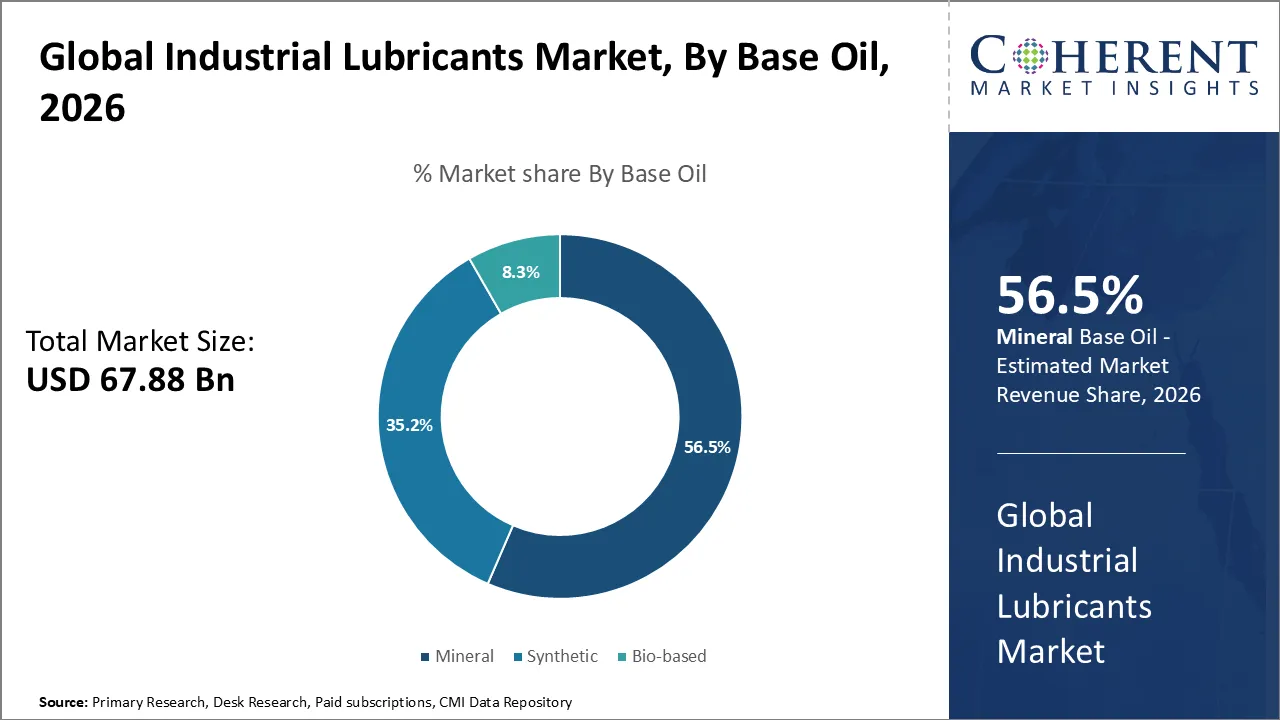
Why is Mineral Oil Acquiring the Largest Share?
On the basis of base oil, the mineral oil segment is projected to account for the largest Industrial Lubricants Market share of approximately 56.5% in 2026. The segment’s dominance is owing to its cost competitiveness, widespread availability, established formulation base, and extensive utilization in hydraulic fluids, gear oils, compressor oils, greases, and general-purpose industrial lubricants.
Saudi Aramco sold 4.5 million tons of base oils worldwide in 2025, including its Group I, Group II and Group III mineral base-oil portfolios. The 1.1 million tons of finished lubricants sold in 2025 also reflects the continuing commercial scale of production of lubricants based on conventional base oils.
In August 2025, ExxonMobil announced plans to launch Group III base stocks manufactured at its Baytown Complex in Texas to the North American market. The company also reached a final investment decision on further expansion of Group III production, with startup expected in 2028.
Why are Hydraulic Lubricants Acquiring the Largest Share?
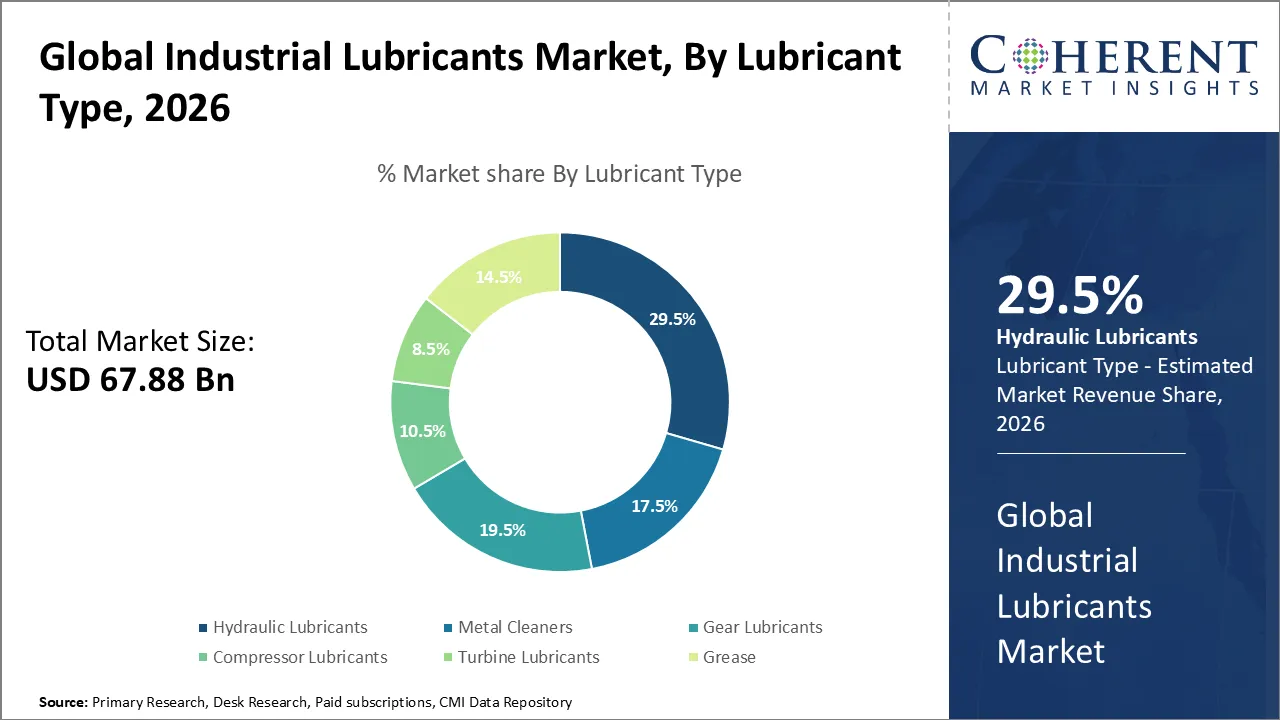
Based on lubricant type, hydraulic lubricants are projected to account for the largest share of the Industrial Lubricants Market, estimated at 29.5% in 2026. The reason for their dominance is the extensive use of hydraulic systems in construction machinery, manufacturing equipment, mining machinery, material-handling equipment, presses, machine tools and other heavy-duty industrial applications.
According to the Committee for European Construction Equipment (CECE), European construction equipment sales increased 4.6% in 2025, while sales of hydraulic attachments increased 9% year-over-year. Road machinery sales also increased 12% during the year.
In April 2026, PETRONAS Lubricants International launched its new flagship industrial lubricants portfolio, the PETRONAS Pro Series. PETRONAS ProHyd is a new series of premium hydraulic fluids for use in high-pressure hydraulic systems with emphasis on wear reduction and operating precision.
Why is Automotive Acquiring the Largest Share?
On the basis of application, the automotive segment is projected to account for the largest Industrial Lubricants Market share of approximately 31.0% in 2026. The segment’s dominance is owing to the substantial use of industrial lubricants throughout vehicle and component manufacturing, including metal forming, machining, stamping, hydraulic presses, industrial robots, bearings, compressors, conveyors, gears, and assembly-line equipment.
According to the International Organization of Motor Vehicle Manufacturers (OICA), global motor vehicle production reached 96.4 million units in 2025, increasing 3.9% from 92.7 million units in 2024. Global vehicle sales simultaneously increased 4.7% to 99.8 million units.
In August 2026, Gulf Oil Lubricants India announced an investment of around INR 55 crore to increase lubricant manufacturing capacity at its Chennai and Silvassa plants by about 70% over the next two years. The expansion is expected to deliver additional capacity to support continued growth across the company’s automotive and industrial lubricant businesses.
Industrial Lubricants Market Trends
- The increasing trend toward high-performance and application specific lubricants that are driving demand for formulations that improve equipment reliability, reduce friction and help longer service intervals. In 2025 Castrol extended its industrial product portfolio with new products such as Hysol SL 20 XBB, Alusol SL 41 XBB, Tribol BW 32, Spheerol SM 00 and Molub-Alloy solutions for metalworking, textiles, sugar mills and steel applications.
- Increasing usage of circular and re-refined base oils is shaping up to be a key sustainability trend for the lubricants industry. Manufacturers are increasingly recovering used lubricants and transforming them into high-quality base stocks. The Tecoil facility of TotalEnergies has production capacity of 50,000 tons of re-refined base oils annually. Regenerated oils are designed to provide properties comparable with high-quality virgin base oils.
- Digital lubricant monitoring and predictive maintenance are increasingly being incorporated into lubrication strategies. Industrial operators are moving away from scheduled lubricant changes toward oil-condition monitoring and data-driven maintenance to monitor wear and optimize lubricant use. ExxonMobil’s next-gen Mobil Serv Cylinder Condition Monitoring uses XRF technology and a cloud-based platform to deliver lubricant-analysis results in minutes, backed by a database of more than 500,000 samples.
Regional Insights
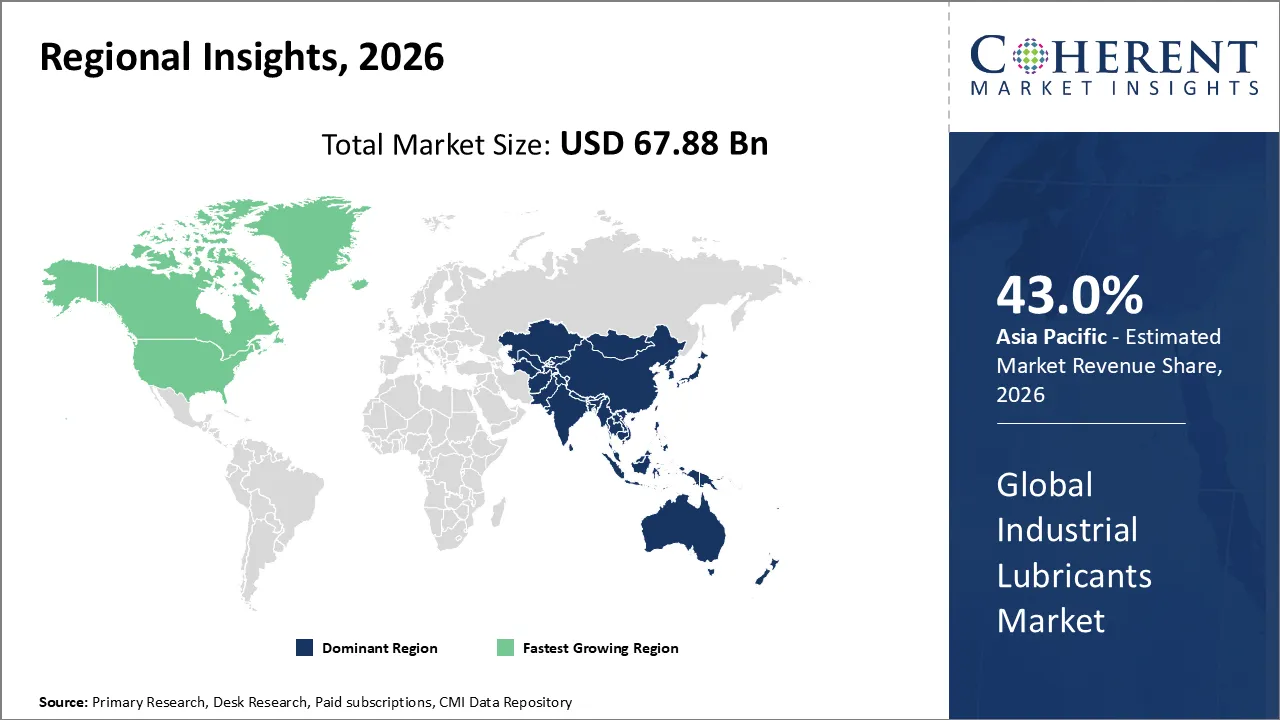
Asia Pacific Dominates Owing to its Large Manufacturing Base and Expanding Industrial Activity
The Asia Pacific region is projected to account for the largest Industrial Lubricants Market share of approximately 43.0% in 2026. The region’s dominance is owing to its extensive manufacturing base, rapid industrialization, large automotive and machinery industries, infrastructure development, and substantial installed base of industrial equipment requiring hydraulic oils, metalworking fluids, gear oils, compressor oils, and greases.
In September 2026, Shell inaugurated and commenced production at a new Grease Manufacturing Plant in Indonesia, with production capacity of up to 12 kilotonnes per year. The facility is located within Shell's Marunda Lubricants Oil Blending Plant complex in Bekasi and is described by the company as one of its largest grease manufacturing plants globally.
North America Industrial Lubricants Market Trends
North America is expected to witness strong growth in the Industrial Lubricants Market over the forecast period. The region’s growth is supported by increasing industrial automation, modernization of manufacturing facilities, advanced machinery adoption, automotive and aerospace production, and growing requirements for high-performance synthetic and specialty lubricants.
The U.S. also maintains a substantial investment base for industrial and manufacturing infrastructure. In July 2026, total construction spending was at a seasonally adjusted annual rate of about USD 2.16 trillion, according to the U.S. Census Bureau. The continuing investment in industrial infrastructure, and the modernization of production facilities and machinery provides an important underlying base of demand for industrial lubrication products.
In February 2026, Canadian manufacturing sales increased 3.6% month-over-month to CAD 71.2 billion, led by an 18.8% increase in transportation equipment, 7.7% growth in machinery, and 4.9% growth in primary metals.
Manufacturing Modernization and Large Installed Industrial Base are Supporting the Industrial Lubricants Market in the United States
The U.S. Industrial Lubricants Market is supported by its large installed base of manufacturing machinery, increasing factory automation, ongoing capital investment, and significant activity in automotive, aerospace, metalworking, construction, energy and advanced manufacturing. Hydraulic fluids, metalworking fluids, gear oils, compressor oils, and greases are essential for these industries to maintain equipment reliability and control friction and wear.
Recent data from the U.S. Federal Reserve showed that total U.S. industrial production in August 2026 was 1.4% higher year-over-year, with the industrial production index reaching 103.1% of its 2017 average. U.S. industrial capacity also kept on growing. Manufacturing capacity expanded at an annualized rate of about 1.0% in Q2 2026.
China Industrial Lubricants Market Trends
China is expected to remain a key growth market for industrial lubricants during the forecast period. Growth is supported by the country’s large manufacturing sector, increasing automation of equipment, expanding machinery and automotive production and rapid adoption of advanced industrial equipment. These developments lead to large requirements of hydraulic oils, gear oils, greases, compressor oils and metalworking fluids.
According to China's National Bureau of Statistics (NBS), manufacturing value added increased 6.1% year-over-year in August 2026, while overall industrial value added increased 5.2%. More lubricant-intensive equipment industries recorded substantially stronger growth: general-purpose machinery manufacturing increased 9.8%, special-purpose machinery 11.4%, automotive manufacturing 8.7%, and railway, ship, aerospace, and other transportation-equipment manufacturing 13.4%.
Who are the Major Companies in Industrial Lubricants Industry
Some of the major key players in Industrial Lubricants Market are British Petroleum Plc, Cargill Incorporated, Chevron, Total S.A., Binol Biolubricants, Conocophilips Company, Exxon Mobil Corporation, Fuchs Lubricants, Sinopec Corporation, Indian Oil Corporation, Miller Oils, Panolin International, Petrobras, Petrochina Company, Renewable Lubricants Inc., Royal Dutch Shell, and Statoil Lubricants.
Key News
- In August 2026, FUCHS announced the grand opening of its new 55,000-square-foot Americas Technology Center in Taunton, Massachusetts. The facility focuses on R&D and technical support for advanced lubrication and tribology solutions, strengthening application-driven lubricant development and customer collaboration across industrial markets in the Americas.
- In March 2026, Cargill opened a new FR3 natural ester dielectric fluid production plant in Gouda, Netherlands, following an investment of approximately USD 30 million. The new plant triples Cargill's European production capacity for FR3 fluid. Cargill said demand is being supported by expansion in electrical infrastructure, data centers, renewable energy, and battery storage.
Market Report Scope
Industrial Lubricants Market Report Coverage
Report Coverage | Details | ||
Base Year: | 2025 | Market Size in 2026: | USD 67.88 Bn |
Historical Data for: | 2020 to 2024 | Forecast Period: | 2026 to 2033 |
CAGR: | 3.1% | 2033 Value Projection: | USD 84.20 Bn |
Geographies covered: |
| ||
Segments covered: |
| ||
Companies covered: | British Petroleum Plc, Cargill Incorporated, Chevron, Total S.A., Binol Biolubricants, Conocophilips Company, Exxon Mobil Corporation, Fuchs Lubricants, Sinopec Corporation, Indian Oil Corporation, Miller Oils, Panolin International, Petrobras, Petrochina Company, Renewable Lubricants Inc., Royal Dutch Shell, and Statoil Lubricants. | ||
Growth Drivers: |
| ||
Restraints & Challenges: |
| ||
Analyst Opinion
- The Industrial Lubricants Market is structurally supported by the continued automation of manufacturing facilities, as increasingly automated production lines require reliable lubrication of gears, bearings, hydraulic systems, compressors, and other continuously operating equipment. According to the International Federation of Robotics (IFR), 542,076 industrial robots were installed globally in 2024, while the operational stock increased 8.9% to 4.66 million units. Metal and machinery industries accounted for 16% of new robot installations, indicating a substantial installed equipment base requiring ongoing lubrication and maintenance.
- Asia’s rapid factory automation is forecast to remain a significant long-term demand driver for industrial lubricants. Asia accounted for 74% of global industrial robot deployments in 2024, with China alone installing a record 295,000 units and representing 54% of global installations, IFR said. The rising deployment of automated machinery in the region is anticipated to propel demand for higher-performance hydraulic fluids, gear lubricants, greases, compressor oils and specialty lubricants that could operate under higher loads and longer service intervals.
- Sustainability and circularity are a growing factor in lubricant formulation and base-oil sourcing, creating opportunities for re-refined, bio-based and longer-life industrial lubricants. Used lubricants collected throughout Europe are regenerated at the Tecoil site of TotalEnergies Lubrifiants into base oils with properties comparable to high-quality virgin base oils. This illustrates how major lubricant producers are integrating used-oil regeneration and circular economy principles into lubricant production, a trend expected to enhance the commercial importance of lower-carbon industrial lubrication solutions.
Speak to the analyst
Want personalized insights?
Take the findings above to one of our principal consultants, or have the report rebuilt around the segments, geographies and competitors you actually track.
Market Segmentation
- By Base Oil (Revenue, USD Bn, 2021-2033)
- Mineral
- Synthetic
- Bio-based
- By Lubricant Type (Revenue, USD Bn, 2021-2033)
- Hydraulic Lubricants
- Metal Cleaners
- Gear Lubricants
- Compressor Lubricants
- Turbine Lubricants
- Grease
- Soap Thickener
- Non-soap Thickener
- Inorganic Thickeners
- By Application (Revenue, USD Bn, 2021-2033)
- Automotive
- Metal Processing
- Construction
- Marine
- Power Plants
- Chemical Processing
- Food Processing
- Industrial
- By Region (Revenue, USD Bn, 2021-2033)
- North America
- U.S.
- Canada
- Latin America
- Brazil
- Mexico
- Argentina
- Rest of Latin America
- Europe
- Germany
- U.K.
- France
- Italy
- Spain
- Russia
- Rest of Europe
- Asia Pacific
- China
- India
- Japan
- Australia
- South Korea
- ASEAN
- Rest of Asia Pacific
- Middle East
- GCC
- Israel
- Rest of Middle East
- Africa
- South Africa
- Central Africa
- North Africa
- North America
Sources
Primary Research Interviews
- Industrial lubricant manufacturers and formulators
- Base oil producers and suppliers
- Lubricant additive manufacturers and technical experts
- R&D and product development heads from lubricant companies
- Industrial machinery and equipment maintenance professionals
- Plant managers and lubrication engineers across manufacturing industries
- Procurement managers from automotive, construction, mining, power generation, and metal processing industries
- Industrial lubricant distributors and channel partners
- Tribology and lubrication specialists
- Key opinion leaders (KOLs) in industrial lubrication and machinery maintenance
Databases
- World Bank
- United Nations Industrial Development Organization (UNIDO)
- International Energy Agency (IEA)
- U.S. Energy Information Administration (EIA)
- U.S. Bureau of Economic Analysis (BEA)
- U.S. Federal Reserve – Industrial Production and Capacity Utilization
- Eurostat
- National Bureau of Statistics of China
Magazines
- Lubes’n’Greases
- Machinery Lubrication
- Tribology & Lubrication Technology (TLT)
- Hydrocarbon Processing
- Plant Engineering
- Manufacturing Today
Journals
- Tribology International
- Wear
- Lubrication Science
- Industrial Lubrication and Tribology
- Journal of Tribology
- Tribology Transactions
- Journal of Cleaner Production
Newspapers
- The Wall Street Journal
- Financial Times
- Reuters
- The Economic Times
- Nikkei Asia
- South China Morning Post
Associations
- Society of Tribologists and Lubrication Engineers (STLE)
- American Petroleum Institute (API)
- Independent Lubricant Manufacturers Association (ILMA)
- Union of the European Lubricants Industry (UEIL)
- International Council on Combustion Engines (CIMAC)
- International Organization of Motor Vehicle Manufacturers (OICA)
- European Automobile Manufacturers’ Association (ACEA)
- International Federation of Robotics (IFR)
Public Domain Sources
- Company Annual Reports and Investor Presentations
- Lubricant Manufacturer Product Catalogs and Technical Data Sheets
- Government Manufacturing and Industrial Production Statistics
- Base Oil Production, Refining, and Capacity Publications
- Environmental and Lubricant Disposal Regulations
- Patent Databases such as WIPO, USPTO, and Google Patents
- Industry Standards and Lubricant Specification Documents
- Company Press Releases on Product Launches, Capacity Expansions, and Technology Developments
- Publicly Available Automotive, Machinery, Construction, Mining, and Power Generation Statistics
Proprietary Elements
- CMI Data Analytics Tool
- Proprietary CMI Existing Repository of Information for the Last 10 Years
Get access to 250+ pages report
Every segment, forecast, competitor profile and data table behind the analysis above — available for instant download.
- ESOMAR Member
- ISO 9001:2015 Certified
- D-U-N-S Registered
- GDPR & CCPA Compliant
Missing comfort of reading report in your local language? Find your preferred language:
Transform your Strategy with Exclusive Trending Reports
Frequently Asked Questions
The Industrial Lubricants Market is expected to reach USD 84.20 Bn in 2033, compared with USD 67.88 Bn in 2026.
Major players operating in the global Industrial Lubricants Market include British Petroleum Plc, Cargill Incorporated, Chevron, Total S.A., Binol Biolubricants, Conocophilips Company, Exxon Mobil Corporation, Fuchs Lubricants, Sinopec Corporation, Indian Oil Corporation, Miller Oils, Panolin International, Petrobras, Petrochina Company, Renewable Lubricants Inc., Royal Dutch Shell, and Statoil Lubricants.
Volatility in base oil and raw material prices and stringent environmental and lubricant disposal regulations are the key factors hampering growth of the market.
Increasing automation and modernization of industrial manufacturing processes and growing demand for high-performance machinery and equipment lubrication are the major factors driving market growth.
The Industrial Lubricants Market is anticipated to grow at a CAGR of 3.1% between 2026 and 2033.
Among regions, Asia Pacific is expected to account for the largest market share in the global Industrial Lubricants Market, with approximately 43.0% share in 2026.
Industrial lubricants are specialized formulations used to reduce friction, wear, and heat generation while improving the efficiency, reliability, and operational life of industrial machinery and equipment.