

Knee Cartilage Repair Market Size and Forecast — 2026 - 2033
The Global Knee Cartilage Repair Market size is estimated to be valued at USD 1.85 billion in 2026 and is expected to reach USD 3.46 billion by 2033, exhibiting a compound annual growth rate (CAGR) of 9.1% from 2026 to 2033.
Overview
The knee cartilage repair market includes a range of products designed to restore damaged cartilage and improve joint function. Key offerings include cell-based therapies such as autologous chondrocyte implantation (ACI) and matrix-induced ACI, which help regenerate cartilage tissue. Surgical products include scaffolds, implants, and fixation devices used to support cartilage repair procedures. Orthobiologics such as platelet-rich plasma (PRP) and stem cell therapies are gaining traction for minimally invasive treatment options. Additionally, debridement and microfracture tools are widely used for stimulating cartilage growth. These products collectively aim to reduce pain, improve mobility, and delay the need for total knee replacement surgeries.
Key Takeaways
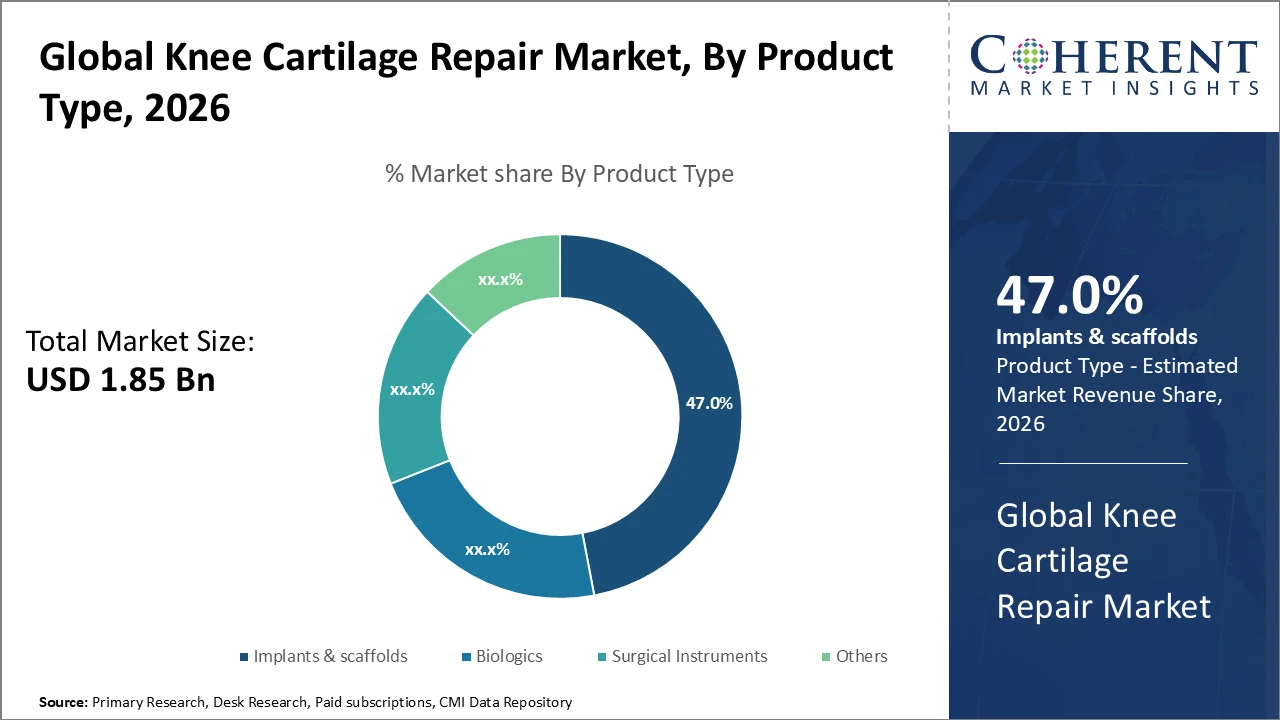
The Implants & Scaffolds segment holds the largest share of the knee cartilage repair market, accounting for nearly half of total industry revenue, driven by continuous technological advancements and strong clinical adoption in cartilage regeneration procedures.
Hospitals remain the leading end-user segment, supported by advanced surgical infrastructure, availability of specialized orthopedic surgeons, and high patient inflow for cartilage repair treatments.
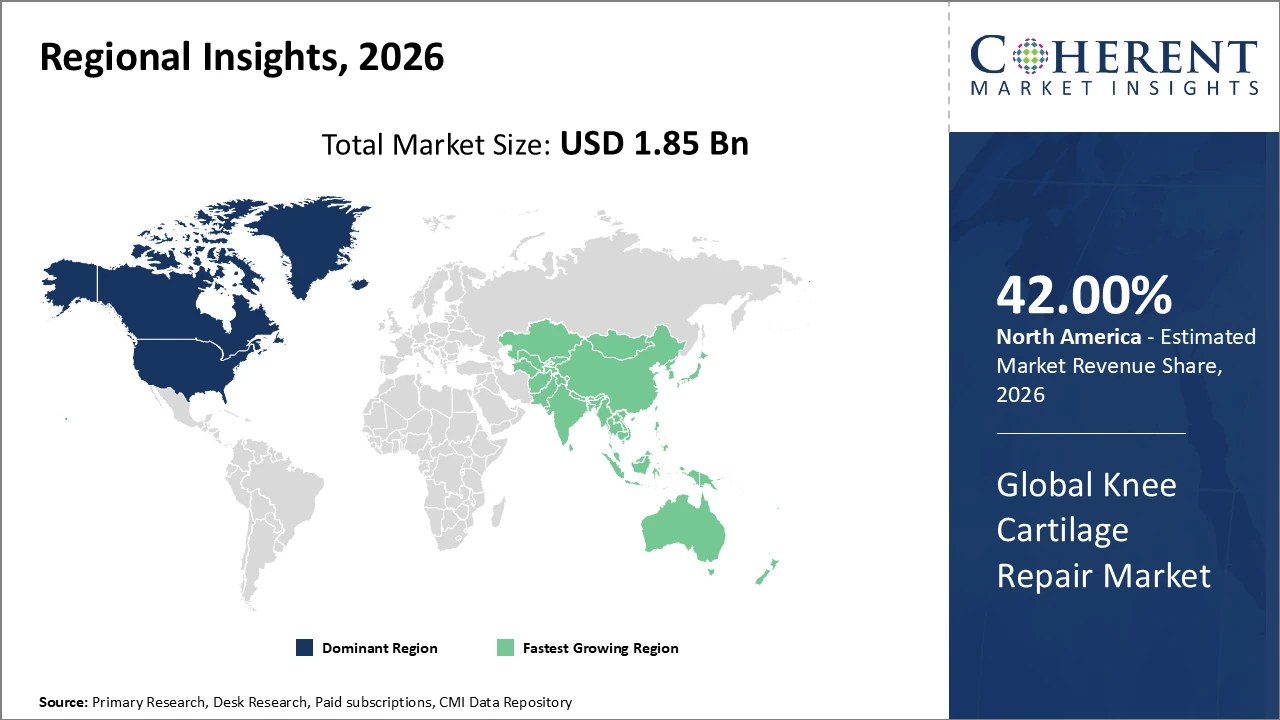
North America dominates the global market share due to well-developed healthcare systems, favorable reimbursement policies, and early adoption of innovative orthopedic technologies.
Asia Pacific is the fastest-growing region, fueled by rising sports-related injuries, increasing geriatric population, and growing healthcare expenditure across emerging economies.
Market expansion is further supported by aggressive strategies from key players, focusing on innovation, product development, and geographic expansion to strengthen their competitive position in high-growth regions.
Knee Cartilage Repair Market Segmentation Analysis
Knee Cartilage Repair Market Insights, By Product Type
Implants & Scaffolds dominate the knee cartilage repair market with a 47% share, supported by advancements in bioresorbable scaffolds and 3D-printed cartilage matrices that improve tissue integration and repair durability. In 2025, companies such as Zimmer Biomet expanded their scaffold product lines, strengthening clinical adoption in orthopedic procedures. Biologics represent the fastest-growing segment, driven by increasing use of stem cell therapies and platelet-rich plasma (PRP), with rising adoption across specialized orthopedic centers in Europe and Asia Pacific after 2024. Surgical instruments used in minimally invasive arthroscopy hold a steady share, while the others category includes emerging solutions such as growth factors and gene-based therapies in early development stages.
Knee Cartilage Repair Market Insights, By Repair Technique
Autologous Chondrocyte Implantation (ACI) holds the largest share in the knee cartilage repair market due to its strong long-term clinical outcomes and effectiveness in treating large cartilage defects. Adoption of ACI procedures increased in 2025, supported by advancements in cell expansion and culturing techniques that improved regeneration efficiency. Matrix-Induced Autologous Chondrocyte Implantation (MACI) is the fastest-growing segment, as its scaffold-based approach enhances cell delivery, accelerates healing, and reduces recovery time, making it increasingly preferred by surgeons since 2024. Microfracture remains widely used for small lesions due to lower cost, while osteochondral autograft transplantation offers immediate repair but is limited by donor site complications. Other emerging techniques currently hold limited market share.
Knee Cartilage Repair Market Insights, By End User
Hospitals dominate the knee cartilage repair market with a 53% share due to advanced infrastructure, skilled orthopedic specialists, and high surgical volumes, with U.S. hospitals alone performing over 40,000 procedures in 2026. Ambulatory Surgical Centers are the fastest-growing segment, supported by the shift toward outpatient care, lower costs, and faster recovery, with procedures rising by 22% between 2024 and 2026. Specialty clinics serve targeted patient groups using advanced and experimental treatments but account for a smaller share. Research institutes contribute to innovation and clinical trials, driving future advancements. The others category, including rehabilitation centers, holds a minor but supportive role in overall market revenue.
Knee Cartilage Repair Market Trends
The knee cartilage repair market is increasingly integrating advanced biomaterials with cellular therapies, with Matrix-Induced Autologous Chondrocyte Implantation (MACI) witnessing around 25% growth between 2024 and 2026 due to improved healing outcomes and surgeon preference.
Technological advancements such as robotic-assisted arthroscopy are enhancing surgical precision and efficiency, reducing operative times by up to 15% in advanced orthopedic centers, particularly in the United States.
There is a clear shift toward minimally invasive and outpatient procedures, with increasing adoption of ambulatory surgical centers to improve patient convenience and reduce healthcare costs.
In the U.S., knee cartilage repair procedures performed in ambulatory settings increased by approximately 20% since 2025, reflecting a broader trend toward decentralized orthopedic care delivery.
Knee Cartilage Repair Market Insights, By Geography
North America Knee Cartilage Repair Market Analysis and Trends
North America dominates the knee cartilage repair market due to its advanced healthcare infrastructure, high healthcare spending, and supportive insurance coverage for regenerative orthopedic procedures. In 2026, the region accounted for over 42% of the global market share, with the United States serving as the primary growth engine. Strong regulatory approvals and well-established reimbursement frameworks further accelerate the adoption of cartilage repair therapies. Leading medical device companies such as Zimmer Biomet and Stryker play a crucial role through continuous product innovation, strategic partnerships with hospitals, and widespread clinical adoption of advanced implants, biologics, and minimally invasive surgical solutions across the region.
Asia Pacific Knee Cartilage Repair Market Analysis and Trends
The Asia Pacific region is experiencing the fastest growth in the knee cartilage repair market, with a CAGR exceeding 11%, driven by rising awareness of advanced orthopedic treatments and a growing incidence of sports-related injuries. Improving healthcare infrastructure in countries such as China, India, and Japan is supporting wider access to cartilage repair procedures. Government initiatives promoting medical tourism and healthcare modernization are attracting investments from global medical device companies, further strengthening market expansion. Additionally, increasing healthcare expenditure, expanding patient pools, and growing adoption of minimally invasive procedures are contributing to rapid regional growth and enhanced market penetration across Asia Pacific.
Knee Cartilage Repair Market Outlook for Key Countries
USA Knee Cartilage Repair Market Analysis and Trends
The U.S. represents the largest revenue contributor in the knee cartilage repair market due to advanced healthcare infrastructure, strong reimbursement systems, and high surgical volumes, with over 50,000 procedures performed in 2026. Widespread adoption of innovative technologies, including robotic-assisted surgeries and minimally invasive arthroscopy, has significantly improved treatment outcomes and efficiency. Leading companies such as Medtronic plc and Smith & Nephew have strengthened their presence by launching advanced scaffold and biologic solutions tailored to clinical needs. Additionally, integration of digital health platforms and data-driven surgical planning tools continues to enhance precision, patient monitoring, and overall market growth in the U.S. orthopedic sector.
Germany Knee Cartilage Repair Market Analysis and Trends
The knee cartilage repair market in Germany is growing steadily due to rising cases of osteoarthritis, sports injuries, and an aging population. The market is characterized by strong adoption of advanced regenerative techniques such as Autologous Chondrocyte Implantation (ACI), Matrix-Induced ACI (MACI), and biologics-based therapies. Germany benefits from a highly developed healthcare system, skilled orthopedic surgeons, and strong reimbursement support under statutory insurance, which accelerates treatment adoption. Increasing preference for minimally invasive and outpatient procedures is also shaping demand. However, high treatment costs and strict regulatory approvals for regenerative therapies remain key challenges, while innovation in scaffolds and cell-based therapies continues to drive market growth.
Analyst Opinion
Increasing procedural volume for Autologous Chondrocyte Implantation (ACI) is significantly driving market growth, with over 35,000 procedures reported in North America in 2025, accounting for around 38% revenue share due to rising clinical acceptance and improved reimbursement support.
Demand for personalized cartilage repair solutions is increasing, with customized scaffolds and hydrogels growing by 28% year-over-year in 2024, reflecting a strong shift toward patient-specific regenerative therapies across Europe and Asia Pacific.
Improved manufacturing efficiencies have led to pricing stabilization, reducing average procedure costs by nearly 5% in 2026 compared to 2024, thereby improving affordability and expanding access in emerging markets.
Advanced biomaterial innovation, including nanofibrillar scaffolds, is expected to capture over 12% of total market revenue by 2026, supported by ongoing clinical trials demonstrating enhanced biomechanical performance and higher adoption in developed regions like the U.S. and Germany.
- Current Industry Events of 2026
- Market Size Estimation
- Regional Breakdown
- Competitive Landscape
- Customer Intelligence
- Segmental Analysis
- Pricing Analysis
- Key Market Drivers, Challenges & Future Trends
- Customized Insights Section
Market Scope
| Report Coverage | Details | ||
|---|---|---|---|
| Base Year: | 2025 | Market Size in 2026: | USD 1.85 billion |
| Historical Data for: | 2020 To 2024 | Forecast Period: | 2026 To 2033 |
| Forecast Period 2026 to 2033 CAGR: | 9.1% | 2033 Value Projection: | USD 3.46 billion |
| Geographies covered: |
| ||
| Segments covered: |
| ||
| Companies covered: | Zimmer Biomet Holdings, Stryker Corporation, DePuy Synthes, Arthrex Inc., Medtronic plc, Smith & Nephew plc, CartiHeal Ltd., CONMED Corporation, Vericel Corporation, Mitek Sports Medicine | ||
| Growth Drivers: |
| ||
Knee Cartilage Repair Market Growth Factors
The expanding geriatric population is a major driver of the knee cartilage repair market, with patients above 60 years accounting for around 42% of all procedures in 2026 due to higher susceptibility to cartilage degeneration. Technological advancements such as 3D bioprinting and advanced scaffold engineering have significantly improved surgical outcomes, increasing clinician adoption of regenerative procedures. Additionally, sports-related knee injuries among younger populations have risen by about 12% globally since 2024, broadening the patient base across hospitals and specialty clinics. Supportive reimbursement frameworks in North America and Europe further enhance affordability and accessibility, boosting overall market penetration and revenue growth.
Knee Cartilage Repair Market Development
In March 2026, researchers at Stanford Medicine reported a potential breakthrough in reversing cartilage loss associated with aging and arthritis. Their study found that injecting a compound that blocks the protein 15-PGDH restored knee cartilage in aged mice and also prevented arthritis following knee injuries similar to ACL tears.
Key Players
Leading Companies of the Market
Zimmer Biomet Holdings
Stryker Corporation
DePuy Synthes
Arthrex Inc.
Medtronic plc
Smith & Nephew plc
CartiHeal Ltd.
CONMED Corporation
Vericel Corporation
Mitek Sports Medicine
Several leading companies in the knee cartilage repair market are pursuing aggressive innovation and expansion strategies to strengthen their competitive positions. Zimmer Biomet expanded its global footprint through strategic acquisitions and the launch of next-generation scaffold materials in 2025, which contributed to a notable increase of around 15% in product revenue. Arthrex has focused on advancing minimally invasive surgical technologies and instrumentation, driving wider adoption across high-volume orthopedic centers, particularly in Europe. Meanwhile, Smith & Nephew strengthened its regenerative medicine portfolio through collaborations with biotech startups in 2024, enhancing its biologics offerings and improving competitiveness in both developed and emerging orthopedic markets.
Knee Cartilage Repair Market Future Outlook
The knee cartilage repair market is expected to witness strong growth driven by rising incidences of sports injuries, osteoarthritis, and an aging global population. Increasing adoption of advanced regenerative therapies such as MACI, stem cell treatments, and biologics will significantly enhance treatment outcomes. Technological advancements including 3D bioprinting, robotic-assisted surgeries, and improved scaffold materials will further shape future procedures. Growing preference for minimally invasive and outpatient treatments will expand accessibility. Additionally, supportive reimbursement frameworks in developed regions and expanding healthcare infrastructure in emerging economies will boost market penetration. Overall, innovation and personalized medicine will define the market’s future growth trajectory.
Knee Cartilage Repair Market Historical Analysis
The knee cartilage repair market has evolved significantly over the past decades, transitioning from traditional surgical techniques to advanced regenerative therapies. Initially, procedures such as microfracture and debridement were widely used due to their simplicity and cost-effectiveness. Over time, the introduction of Autologous Chondrocyte Implantation (ACI) in the 1990s marked a major shift toward cell-based cartilage regeneration. The 2000s and 2010s saw rapid adoption of scaffolds, biologics, and minimally invasive arthroscopic techniques. More recently, advancements in tissue engineering, stem cell therapy, and 3D bioprinting have transformed treatment outcomes, improving cartilage repair efficiency and expanding clinical applications across global healthcare systems.
Sources
Primary Research Interviews:
Orthopedic surgeons, sports medicine specialists, and rehabilitation physicians involved in knee cartilage repair procedures and patient outcomes
Hospital procurement managers, orthopedic department heads, and biomedical engineers responsible for selecting implants, scaffolds, and biologics for cartilage repair
Medical device company executives, regenerative medicine researchers, and R&D engineers working on ACI, MACI, scaffolds, biologics, and tissue engineering solutions
Magazines:
Orthopedics This Week – Updates on knee cartilage repair innovations and surgical advancements
Becker’s Spine Review – Industry news on orthopedic procedures, implants, and regenerative therapies
MedTech Dive – Market trends, product launches, and regulatory updates in orthopedic and cartilage repair devices
Healio Orthopedics – Clinical updates and advancements in sports medicine and cartilage restoration
Journals:
The American Journal of Sports Medicine – Research on cartilage repair techniques, clinical outcomes, and surgical innovations
Cartilage Journal – Studies on cartilage regeneration, tissue engineering, and biomaterials
Journal of Orthopaedic Research – Advancements in implants, scaffolds, and biologics for joint repair
Newspapers:
The Wall Street Journal – Healthcare industry investments and orthopedic device market trends
Financial Times – Global medical technology growth and healthcare infrastructure developments
Reuters Health – Regulatory approvals, clinical trial updates, and medical device news
Bloomberg Healthcare – Market analysis of orthopedic companies and regenerative medicine innovations
Associations:
American Academy of Orthopaedic Surgeons (AAOS) – Clinical guidelines and standards for orthopedic and cartilage repair procedures
International Cartilage Regeneration & Joint Preservation Society (ICRS) – Research and standards in cartilage restoration therapies
Orthopaedic Research Society (ORS) – Scientific research and innovation in musculoskeletal repair technologies
Get access to 250+ pages report
Every segment, forecast, competitor profile and data table behind the analysis above — available for instant download.
- ESOMAR Member
- ISO 9001:2015 Certified
- D-U-N-S Registered
- GDPR & CCPA Compliant
Missing comfort of reading report in your local language? Find your preferred language:
Transform your Strategy with Exclusive Trending Reports
Frequently Asked Questions
Zimmer Biomet, Stryker Corporation, and DePuy Synthes dominate the market, supported by strong product portfolios, continuous innovation, and strategic expansion initiatives.
The market is projected to reach USD 3.46 billion by 2033, driven by increasing adoption of advanced regenerative therapies and rising orthopedic cases.
Hospitals represent the largest and most significant growth segment due to high surgical volumes and advanced orthopedic infrastructure.
Growth will be shaped by biologic-scaffold combinations, robotics-assisted surgeries, and increasing use of minimally invasive regenerative procedures.
The market is highly competitive and innovation-driven, with challenges including high treatment costs, regulatory approvals, and limited penetration in emerging markets.
Companies focus on R&D collaborations, product innovation, acquisitions, and expansion into high-growth regions to strengthen market presence.