

Large Volume Parenteral Market Size and Share Analysis- 2026 To 2033
The Large Volume Parenteral Market size is anticipated to grow at a CAGR of 4.9% with USD 9.25 Bn in 2026 and is expected to reach USD 12.89 Bn in 2033. The primary drivers are defined by the rising prevalence of chronic and acute diseases, increasing hospital admissions, expanding surgical procedures, and growing demand for reliable intravenous therapies. According to WHO, around 16 Bn injections are administered worldwide annually, thereby supporting sustained demand for essential sterile parenteral products. This is also strengthening demand for fluid replacement solutions, therapeutic injections, parenteral nutrition, electrolyte formulations, and large-volume infusion products across various specialized care settings. These include hospitals, clinics, ambulatory centers, emergency departments, and home healthcare services.
Key Takeaways
- The therapeutic injections segment is likely to dominate the market with 46.2% in 2026. The segment’s growth is owing to the demand for intravenous anti-infective, oncology, and critical-care therapies. CDC reports that at least 1.7 million U.S. adults develop sepsis annually, reinforcing demand for rapid intravenous treatment.
- The hospitals segment is set to lead with 58.7% in 2026. The segment’s growth is owing to the high emergency admissions, intensive-care utilization, and continuous intravenous administration.
- North America is expected to acquire the prominent share of 35.4% in 2026. The region’s growth is owing to the advanced hospital infrastructure, high treatment volumes, and substantial healthcare expenditure. CMS reported that U.S. hospital spending reached USD 1,634.7 Bn in 2024, increasing 8.9% year over year.
Segmental Insights
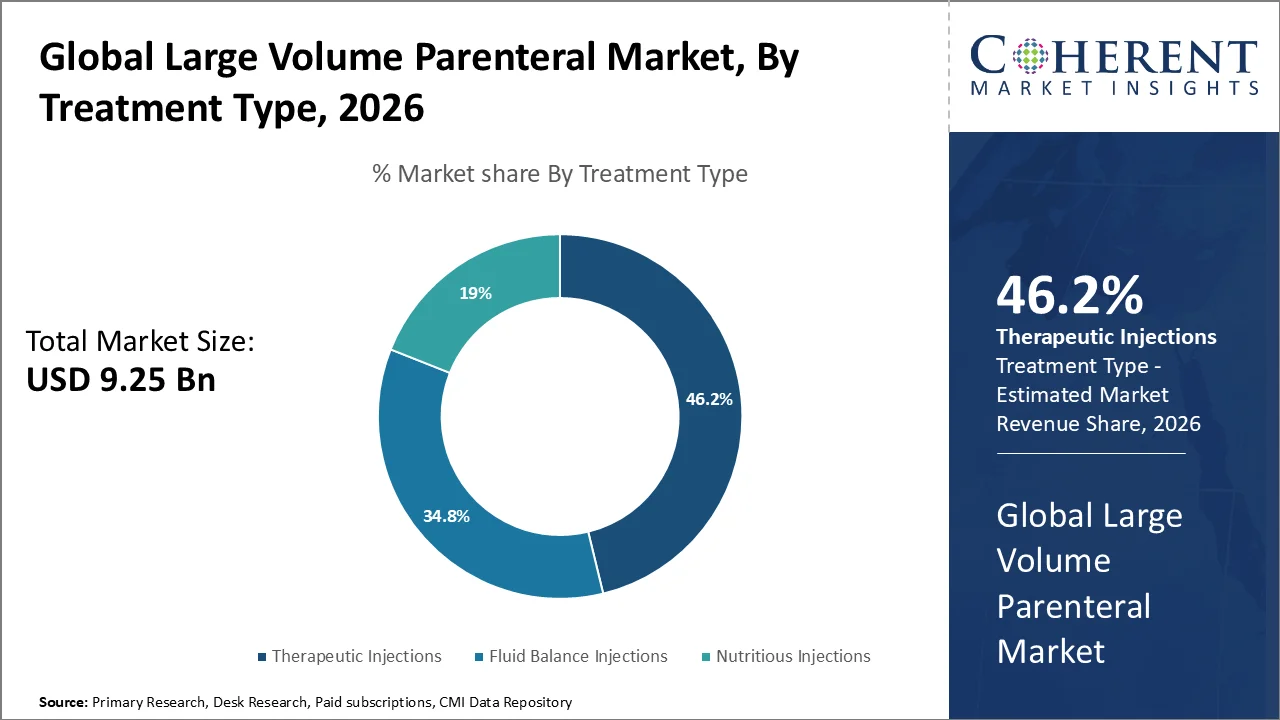
Why is Therapeutic Injections Segment Acquiring the Largest Share?
On the basis of treatment type, the therapeutic injections segment is projected to account for the largest Large Volume Parenteral Market share of 46.2% in 2026. The segment’s growth is owing to the sustained hospital use of large-volume infusion solutions for antibiotics, oncology medicines, cardiovascular drugs, and other therapies requiring intravenous administration.
The National Cancer Institute’s SEER program estimates 2,114,850 new U.S. cancer cases in 2026, supporting demand for infusion-based chemotherapy, biologics, supportive medicines, and compatible parenteral diluents.
In May 2026, the U.S. FDA approved Decnupaz (pivekimab sunirine-pvzy) for adults with blastic plasmacytoid dendritic cell neoplasm. The medicine is administered intravenously every three weeks after reconstitution and dilution.
- Current Industry Events of 2026
- Market Size Estimation
- Regional Breakdown
- Competitive Landscape
- Customer Intelligence
- Segmental Analysis
- Pricing Analysis
- Key Market Drivers, Challenges & Future Trends
- Customized Insights Section
Hospitals hold the Largest Market Share
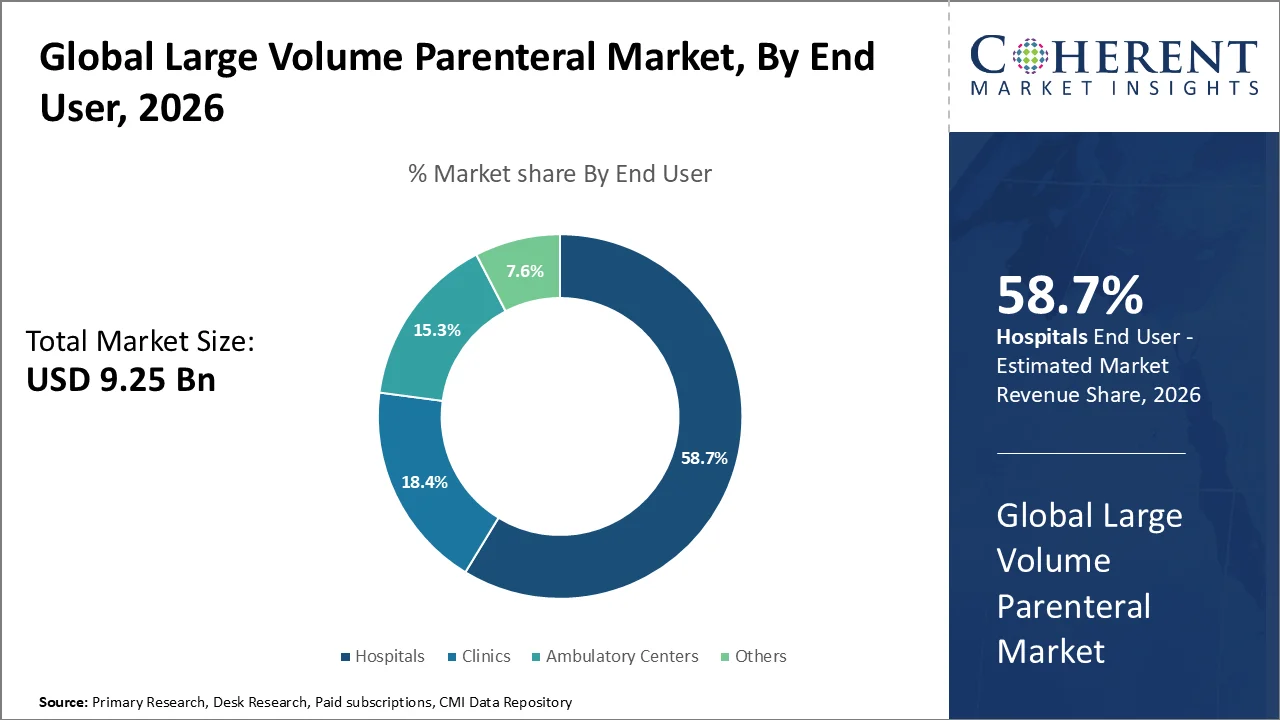
On the basis of end user, the hospitals segment lead with a major 58.7% share in 2026. The growth is owing to the concentration of emergency care, surgical procedures, intensive care, dialysis, oncology treatment, and parenteral nutrition services within hospital settings and departments, all of which require reliable access to high-volume sterile fluids.
CDC data show that 3.1 million emergency visits result in critical-care admission, where continuous administration of fluids, vasopressors, antimicrobials, and nutritional support is frequently required during complex treatment.
A relevant product-development initiative was announced by the U.S. HHS Administration for Strategic Preparedness and Response in June 2025. Two sites were selected to demonstrate Caspian, an automated point-of-care sterile saline manufacturing system designed to reduce the impact of IV-fluid shortages.
Market Drivers
Rising Innovations in Sterile IV Containers are Transforming the Large Volume Parenteral Market in the U.S.
The U.S. market is experiencing increasing adoption of flexible, ready-to-administer intravenous containers designed to improve safety, handling, storage, and pharmacy workflow. Healthcare facilities are gradually moving from conventional glass containers toward lightweight polymer bags that reduce breakage risk and support automated barcode scanning. Manufacturers are also developing premixed therapeutic solutions that minimize bedside manipulation as well as pharmacy-compounding requirements. Premixed bags can reduce the number of preparation steps, support standardized concentrations, and improve inventory control.
In September 2025, B. Braun launched Tromethamine Injection in a 500 mL EXCEL IV Container in the U.S. The flexible container is not made with DEHP, PVC, or natural-rubber latex. The firm stated that the product provides an alternative to existing glass-bottle presentations, which can present handling and breakage risks in pharmacies and at the bedside. The product is manufactured and distributed from the company’s Irvine, California facility.
Localization of LVP Production in Emerging Markets: A Major Breakthrough
Localization of large volume parenteral production is strengthening supply resilience across emerging markets by reducing import dependence, freight exposure, and emergency stock-out risks. Nigeria’s Federal Ministry of Health reported that Phase 2 of the AMA Medical Manufacturing Plant involved a USD 23 million investment to support domestic production of high-quality IV fluids. Separately, the U.S. FDA reported that it helped prevent 330 drug shortages during 2025, while 93 shortages remained ongoing at year-end, thereby highlighting the vulnerability of sterile injectable as well as parenteral supply chains.
In May 2026, the Nigerian Investment Promotion Commission confirmed that Ama Medical Manufacturing Limited’s Kaduna IV-fluid facility was operating advanced European aseptic form-fill-seal technology and pursuing manufacturing partnerships across Africa and the Caribbean.
Current Events and Their Impact on the Large Volume Parenteral Market
Current Event | Description and its Impact |
2025 FDA-Authorized Temporary Importation of IV Fluids in the U.S.
|
|
EU Critical Medicines Act Proposal |
|
Large Volume Parenteral Market Trends
- The rising adoption of balanced crystalloids and tailored electrolyte formulations is supporting the safer fluid resuscitation, perioperative management, and critical-care treatment.
- Advanced automated filling, closed-system manufacturing, and flexible infusion bags is improving the sterility, storage efficiency, transportation, and hospital workflow reliability.
- Manufacturers are expanding regional production capacity and supply-chain redundancy to reduce dependence on concentrated facilities as well as prevent disruptions in essential intravenous-fluid availability.
- The growing hospitalization, surgical procedures, infection treatment, dehydration management, and clinical nutrition requirements are strengthening the demand for saline, dextrose, electrolyte, and parenteral-nutrition solutions. According to the World Health Organization, more than 300 million surgical procedures are performed worldwide annually. This is generating substantial demand for perioperative intravenous fluids, electrolyte replacement, and sterile infusion therapies.
- Supportive reimbursement and home-infusion policies are gradually expanding intravenous treatment beyond hospitals. In 2026, the U.S. Medicare home-infusion benefit continues covering professional services for eligible intravenous or subcutaneous therapies administered through durable-medical-equipment pumps. CMS also finalized a 2.0% payment-rate update for home-infusion therapy services for calendar year 2026, supporting wider access to professionally managed infusion care.
Regional Insights
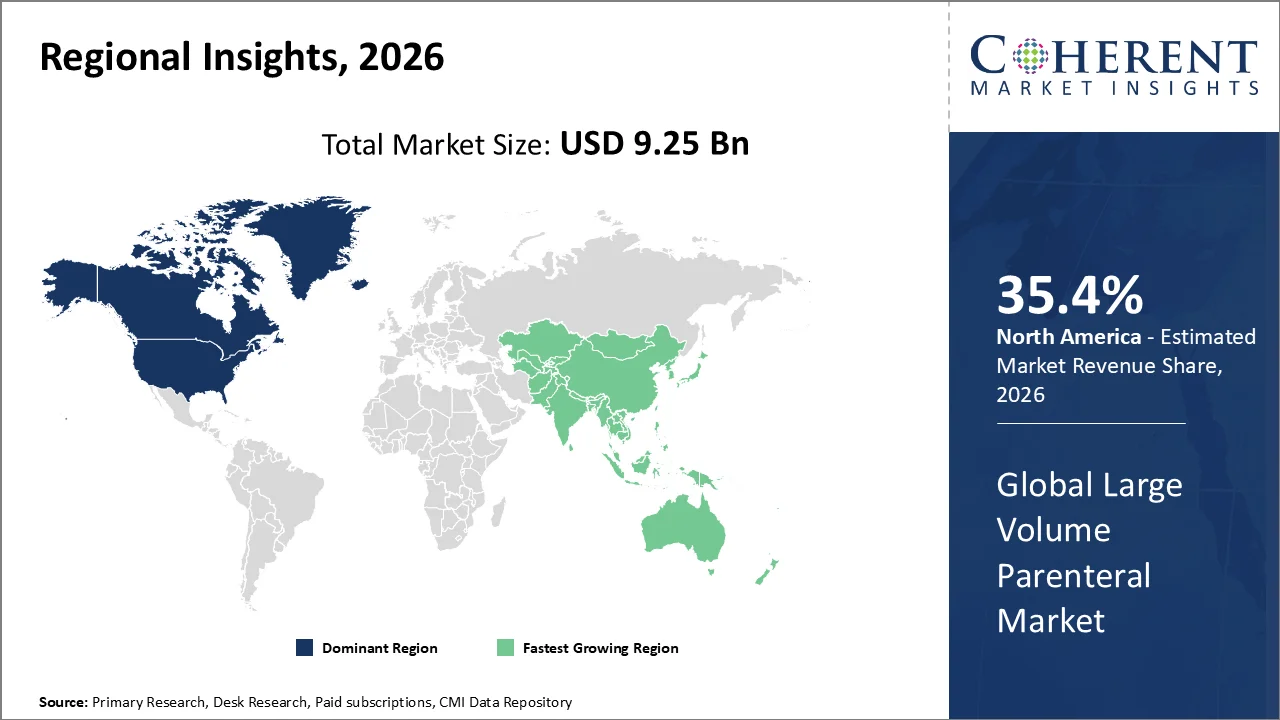
North America Dominates Owing to the High Hospital Utilization and Expansion of Premixed IV Infusion Products
The North America region accounts for 35.4% of the market share in 2026. The region’s growth is owing to the hospital utilization, emergency care volumes, and supply-security initiatives.
AHRQ’s National Inpatient Sample represents more than 33 million U.S. hospitalizations annually, indicating recurring requirement for saline, dextrose, electrolyte, and other high-volume infusion solutions used in surgery, critical care, dehydration, and medication delivery.
In July 2025, B. Braun launched new premixed Heparin Sodium Injection bags. The company introduced 25,000-unit heparin formulations in 250 mL and 500 mL EXCEL IV containers in the U.S. The non-PVC and non-DEHP premixed bags reduce hospital compounding requirements and expand B. Braun’s heparin infusion portfolio.
Asia Pacific Large Volume Parenteral Market Trends
Asia Pacific is expected to witness strong growth in market over the forecast period. The region’s growth is owing to the rising inpatient care, emergency treatment, surgical procedures, and stricter manufacturing oversight.
Australia recorded 12.8 million hospitalisations in 2024–25, indicating substantial recurring demand for saline, dextrose, balanced crystalloids, and other high-volume intravenous solutions used for hydration, perioperative care, electrolyte replacement, and medicine administration.
In August 2025, Life Infusion Pharmaceuticals launched operations at its new intravenous-fluid manufacturing facility in Kinalur, Kerala. The facility produces large volume parenterals using BFS and ISBM technologies, with products ranging up to 1,000 mL like electrolyte, diuretic, anti-infective, and antibiotic infusion solutions.
High Surgical Volumes and IV-Fluid Supply Assurance is Accelerating the Large Volume Parenteral Market in United States
In the United States, the Large Volume Parenteral Market is influenced by the high surgical throughput, routine perioperative hydration, and stronger IV-fluid distribution systems. AHRQ reported 13.5 million in-scope ambulatory surgery encounters in 2023, rising from 12.4 million, which indicates sustained requirements for saline, dextrose, electrolyte, and medication-carrying infusion solutions.
China Large Volume Parenteral Market Trends
China’s Large Volume Parenteral Market is expanding as rising inpatient activity sustains demand for saline, glucose, electrolyte, and therapeutic infusion solutions. China’s National Health Commission reported 311.92 million admissions to medical and health institutions in 2024, up 3.3% from 2023, indicating a broader hospital treatment base requiring reliable intravenous-fluid supply.
Who are the Major Companies in Large Volume Parenteral Industry
Some of the major key players in Large Volume Parenteral Market are Baxter International Inc., Teva Pharmaceutical Industries Limited, Kelun Pharmaceutical Inc., BAG Healthcare GmbH, Hospira, Inc., Patheon Inc., Otsuka Pharmaceutical, Wockhardt Ltd., Southwest Pharmaceutical Co. Ltd., and Cook Pharmica LLC.
Key News
- In July 2026, Otsuka Pharmaceutical Factory America and ICU Medical expanded their partnership through the Otsuka ICU Medical LLC joint venture, announcing an investment of over USD 500 million in North American IV-solution manufacturing. The initiative includes expanding the existing 700,000-square-foot Austin facility and constructing a new 500,000-square-foot plant.
- In June 2026, Fresenius Kabi launched Pedismof across Europe, a ready-to-use, three-chamber bag for pediatric parenteral nutrition. The product combines glucose, amino acids, electrolytes, and SMOFlipid containing fish oil and omega-3 fatty acids. Multiple bag volumes support preterm neonates, infants, children, and adolescents.
- In June 2026, Fresenius opened a medical-nutrition Innovation Center in Bad Homburg, Germany. The center is developing automated pumping systems that compound sterile micro- and macronutrients into patient-specific parenteral-nutrition bags while reducing manual additions.
Market Report Scope
Large Volume Parenteral Market Report Coverage
| Report Coverage | Details | ||
|---|---|---|---|
| Base Year: | 2025 | Market Size in 2026: | USD 9.25 Bn |
| Historical Data for: | 2020 To 2024 | Forecast Period: | 2026 To 2033 |
| Forecast Period 2026 to 2033 CAGR: | 4.9% | 2033 Value Projection: | USD 12.89 Bn |
| Geographies covered: |
| ||
| Segments covered: |
| ||
| Companies covered: | Baxter International Inc., Teva Pharmaceutical Industries Limited, Kelun Pharmaceutical Inc., BAG Healthcare GmbH, Hospira, Inc., Patheon Inc., Otsuka Pharmaceutical, Wockhardt Ltd., Southwest Pharmaceutical Co. Ltd., and Cook Pharmica LLC. | ||
| Growth Drivers: |
| ||
| Restraints & Challenges: |
| ||
Analyst Opinion
- Large volume parenteral demand is anchored in essential care rather than discretionary treatment. CDC recorded 155.4 million U.S. emergency department visits, including 17.8 million resulting in hospital admission, supporting use of saline, glucose, electrolyte, and intravenous solutions across emergency departments and inpatient settings.
- Severe dehydration remains an important demand driver. WHO estimates 1.3 million to 4.0 million cholera cases annually, with severe patients requiring rapid intravenous fluid administration.
- Supply reliability is becoming as important as production scale. Recent IV-fluid disruptions demonstrated that dependence on limited manufacturing sites can rapidly affect hospitals. Consequently, manufacturers are expected to expand regional capacity, qualify backup facilities, diversify raw-material and packaging suppliers, and strengthen inventory systems. These measures will support long-term market growth while creating opportunities for producers offering flexible bag formats, automated filling lines, and resilient distribution networks.
Speak to the analyst
Want personalized insights?
Take the findings above to one of our principal consultants, or have the report rebuilt around the segments, geographies and competitors you actually track.
Market Segmentation
- By Application (Revenue, USD Bn, 2021-2033)
- Fluid Balance Injections
- Therapeutic Injections
- Nutritious Injections
- By End User (Revenue, USD Bn, 2021-2033)
- Hospitals
- Ambulatory centers
- Clinics
- Others
- By Region (Revenue, USD Bn, 2021-2033)
- North America
- U.S.
- Canada
- Latin America
- Brazil
- Mexico
- Argentina
- Rest of Latin America
- Europe
- Germany
- U.K.
- France
- Italy
- Spain
- Russia
- Rest of Europe
- Asia Pacific
- China
- India
- Japan
- Australia
- South Korea
- ASEAN
- Rest of Asia Pacific
- Middle East
- GCC
- Israel
- Rest of Middle East
- Africa
- South Africa
- Central Africa
- North Africa
- North America
Sources
Primary Research Interviews
- Large volume parenteral manufacturers
- Sterile injectable formulation specialists
- Hospital pharmacists
- Pharmaceutical procurement managers
- Intravenous therapy specialists
- Contract development and manufacturing organizations (CDMOs)
- IV solution packaging suppliers
- Regulatory affairs professionals
- Pharmaceutical distributors
- Key opinion leaders (KOLs) in sterile drug manufacturing
Databases
- World Health Organization (WHO)
- U.S. Food and Drug Administration (FDA)
- European Medicines Agency (EMA)
- National Institutes of Health (NIH)
- Centers for Disease Control and Prevention (CDC)
- United Nations Comtrade Database
- Organisation for Economic Co-operation and Development (OECD)
Magazines
- Pharmaceutical Technology
- European Pharmaceutical Review
- Pharma Manufacturing
- Contract Pharma
- Pharmaceutical Processing
Journals
- International Journal of Pharmaceutics
- Journal of Pharmaceutical Sciences
- PDA Journal of Pharmaceutical Science and Technology
- American Journal of Health-System Pharmacy
- European Journal of Pharmaceutics and Biopharmaceutics
Newspapers
- The Wall Street Journal
- Financial Times
- The New York Times
- The Guardian
- The Economic Times
Associations
- Parenteral Drug Association (PDA)
- International Society for Pharmaceutical Engineering (ISPE)
- International Pharmaceutical Federation (FIP)
- European Association of Hospital Pharmacists (EAHP)
- American Society of Health-System Pharmacists (ASHP)
- Pharmaceutical Research and Manufacturers of America (PhRMA)
Public Domain Sources
- Company Annual Reports and Investor Presentations
- Government Health Ministry Publications
- National Drug Regulatory Authority Databases
- Pharmacopoeial Publications and Sterile Manufacturing Guidelines
- Clinical Trial Registries such as ClinicalTrials.gov
- Government Import–Export and Pharmaceutical Production Statistics
- Product Approval, Recall, and Drug Shortage Databases
Proprietary Elements
- CMI Data Analytics Tool
- Proprietary CMI Existing Repository of Information for Last 10 Years
Get access to 250+ pages report
Every segment, forecast, competitor profile and data table behind the analysis above — available for instant download.
- ESOMAR Member
- ISO 9001:2015 Certified
- D-U-N-S Registered
- GDPR & CCPA Compliant
Missing comfort of reading report in your local language? Find your preferred language:
Transform your Strategy with Exclusive Trending Reports
Frequently Asked Questions
The Large Volume Parenteral Market is expected to reach USD 12.89 Bn in 2033.
Major players operating in the global Large Volume Parenteral Market include Baxter International Inc., Teva Pharmaceutical Industries Limited, Kelun Pharmaceutical Inc., BAG Healthcare GmbH, Hospira, Inc., Patheon Inc., Otsuka Pharmaceutical, Wockhardt Ltd., Southwest Pharmaceutical Co. Ltd., and Cook Pharmica LLC.
The aggressive price pressures from government tender caps, strict Extractables and Leachables (E&L) compliance for packaging, and a clinical shift toward subcutaneous drug delivery are the key factors hampering growth of the market.
The rising chronic disease prevalence, an aging global population, and an increasing number of surgical procedures requiring intravenous hydration and nutrition is boosting the demand for Large Volume Parenteral.
The Large Volume Parenteral Market is anticipated to grow at a CAGR of 4.9% between 2026 and 2033.
Among regions, North America is expected to account for a largest market share in the global Large Volume Parenteral Market over the forecast period.
The market outlook remains positive due to rising chronic diseases, increasing surgical volumes, and home-based infusion care.