

Monoethanolamine Market Size and Forecast — 2026-2033
The Global Monoethanolamine Market size is estimated to be valued at USD 1.38 billion in 2026 and is expected to reach USD 1.9 billion by 2033, exhibiting a compound annual growth rate (CAGR) of 5.8% from 2026 to 2033.
Overview
Monoethanolamine is a versatile organic chemical combining alcohol and amine functionalities, commonly used as a gas-treating solvent, pH stabilizer, surfactant ingredient, and chemical intermediate. It plays key roles in detergents, personal-care products, pharmaceutical synthesis, and CO₂ absorption systems in industrial gas treatment.
Key Takeaways
The Gas Treatment application segment dominates the monoethanolamine market, accounting for approximately 43% of total market share, buoyed by expanding oil and gas activities and environmental regulations globally.
Asia Pacific continues to present the fastest growth trajectory, with significant industry trends underway in China and India, driven by enhanced manufacturing capabilities and rising agrochemical demand.
North America maintains a substantial market share due to early adoption of advanced gas treatment technologies and robust industrial growth, supported by major companies driving supply expansion.
Europe’s focus on sustainability and environmental regulations stimulates demand for green-grade monoethanolamine products, positioning it as a key regional contributor to market revenue growth.
Monoethanolamine Market Segmentation Analysis
Monoethanolamine Market Insights, By Product Type
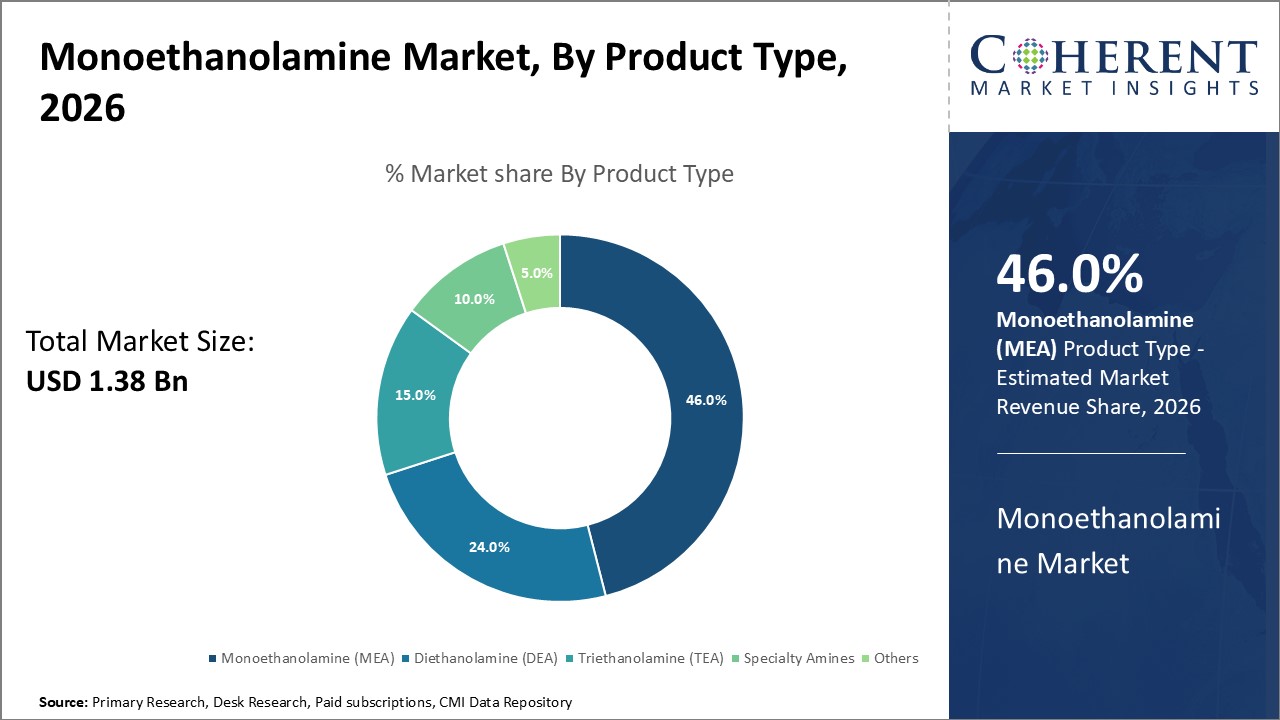
Monoethanolamine dominates the market share at 46%. MEA’s dominance is attributed to its versatile application primarily in gas treatment and agrochemical industries, supported by favorable pricing and availability. The fastest growing subsegment is Specialty Amines, which have witnessed accelerated demand owing to tailored chemical properties suited for niche applications like pharmaceutical intermediates and advanced personal care formulations. Diethanolamine and Triethanolamine also hold significant market positions as secondary amines used in surfactants and emulsifiers.
Monoethanolamine Market Insights, By Application
Gas Treatment remains the largest segment due to the essential role of MEA in removing acid gases from natural gas production and refinery operations. This segment is characterized by steady growth driven by environmental regulations and increasing natural gas output worldwide. Agrochemicals follow as the second-largest segment, reflecting ongoing demand for pesticides where MEA acts as a key intermediate. The fastest growing application is Personal Care, particularly in Asia Pacific, where increasing consumer demand for emulsifiers and pH adjusters in cosmetics spurs expansion.
Monoethanolamine Market Insights, By End-User Industry
The Oil & Gas segment leads due to the widespread use of MEA in acid gas removal and refinery processes, underscoring its critical nature in energy production industries. Agriculture ranks next, powered by agrochemical production growth. The fastest growing end-user sector is Pharmaceuticals, where MEA’s utility as an intermediate for various chemical syntheses is burgeoning, driven by increased healthcare investment and drug manufacturing in emerging economies. Cosmetics & Personal Care and Water Treatment segments also contribute increased demand, integrating MEA into formulations and purification processes pivotal to consumer health and environmental sustainability.
Monoethanolamine Market Trends
The monoethanolamine market is moving decisively towards sustainability-driven innovations and diversification across end-use segments.
The substitution of traditional petrochemical feedstocks with bio-based alternatives launched by manufacturers in 2025 exemplifies this trend.
Additionally, rising demand for advanced gas treatment solutions in North America, driven by stricter emission norms, underpins continuing market expansion.
Emerging usage in CO2 capture reflects the market’s evolving role in combating climate change, exemplified by pilot projects in Europe and Asia Pacific undertaken in 2025.
Monoethanolamine Market Insights, By Geography
Asia Pacific Monoethanolamine Market Analysis and Trends
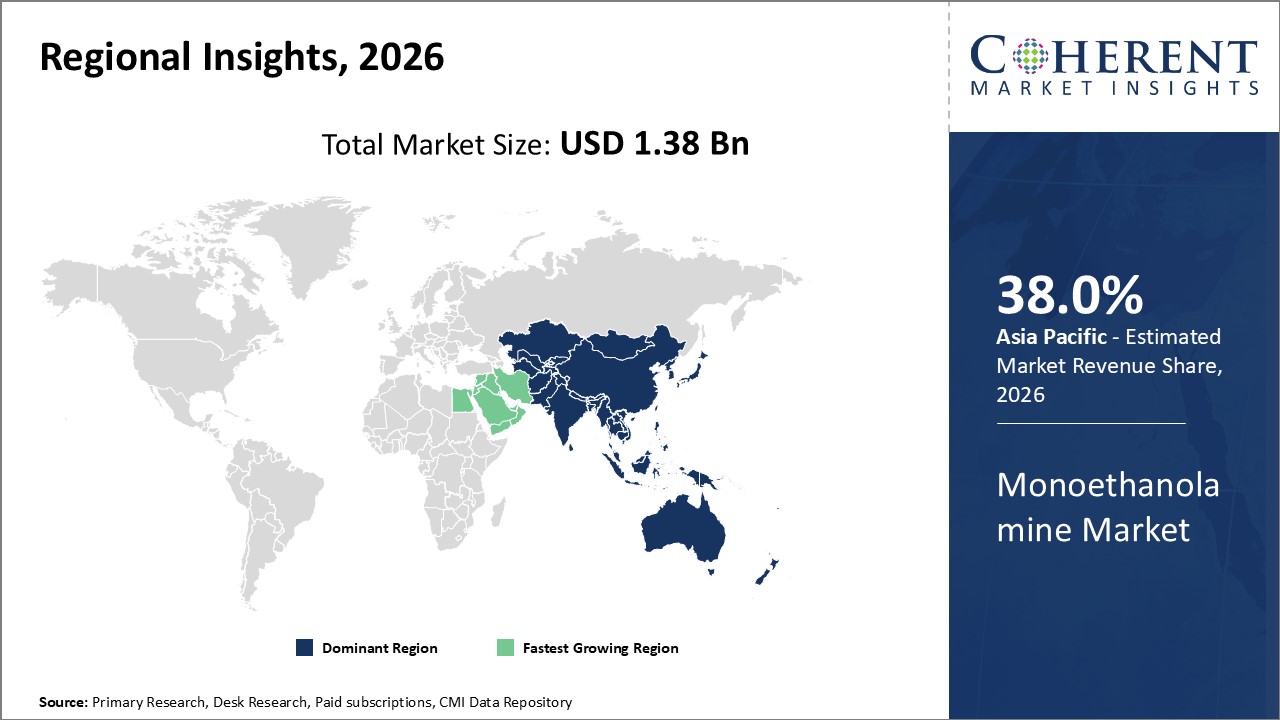
The dominance in the Monoethanolamine market lies with Asia Pacific, which commands over 38% of the market share due to significant industrial growth and government support in countries such as China and India. The robust agrochemical and energy sectors here enhance local market revenue, supported by increasing investments in refining and gas treatment infrastructure.
Middle East & Africa Monoethanolamine Market Analysis and Trends
The Middle East & Africa exhibits the fastest growth with a CAGR above 6.0%, fueled by the region’s expanding oil & gas exploration and adoption of MEA for gas sweetening. Strategic partnerships with international companies and government subsidies spur rapid market expansion.
Monoethanolamine Market Outlook for Key Countries
USA Monoethanolamine Market Analysis and Trends
The USA’s monoethanolamine market is distinguished by high technological adoption, significant R&D investments, and stringent regulatory frameworks encouraging eco-friendly gas treatment solutions. Recent expansions in petrochemical plants, including a 12% increase in MEA production capacity in 2025, led by major U.S. players, underscore strong market fundamentals. The presence of numerous chemical manufacturing hubs in the Gulf Coast region supports robust supply chain infrastructure and fosters competitive market dynamics.
China Monoethanolamine Market Analysis and Trends
China’s market continues to surge, fueled by its vast industrial base and rising agrochemical sector demands. Large-scale capacity expansions by both state-owned and private players in 2025 enhanced the overall market size. Moreover, government initiatives aimed at reducing environmental pollution led to increased utilization of MEA in carbon capture and gas purification applications. This country plays a pivotal role as both a manufacturing powerhouse and a significant consumer in the Asia Pacific, driving global market trends and revenues.
Analyst Opinion
Rising demand from natural gas processing sectors underscores strong supply-side growth. As per recent production capacity expansions announced in 2025 by leading chemical manufacturers in the U.S. and China, output volumes of monoethanolamine surged by over 9%, indicating robust supply market health.
Pricing dynamics have seen moderate fluctuation influenced by feedstock ethylene oxide availability and raw material cost volatility. For instance, a 8% increase in ethylene oxide prices in Q1 2026 contributed to a corresponding rise in monoethanolamine pricing, impacting downstream application costs.
On the demand side, diversified end-user industries such as the agrochemical segment experienced a consumption uptick of approximately 7.8% in 2025 driven by heightened pesticide production, notably for organophosphate formulations, boosting overall market share.
Micro-indicators indicate growing small-scale application in personal care formulations, particularly in Asia Pacific, where monoethanolamine’s role as an emulsifier and pH adjuster expanded by 9% in regional revenue terms in 2025, reflecting significant usage beyond traditional industrial applications.
- Current Industry Events of 2026
- Market Size Estimation
- Regional Breakdown
- Competitive Landscape
- Customer Intelligence
- Segmental Analysis
- Pricing Analysis
- Key Market Drivers, Challenges & Future Trends
- Customized Insights Section
Market Scope
| Report Coverage | Details | ||
|---|---|---|---|
| Base Year: | 2025 | Market Size in 2026: | USD 1.38 billion |
| Historical Data for: | 2020 To 2024 | Forecast Period: | 2026 To 2033 |
| Forecast Period 2026 to 2033 CAGR: | 5.8% | 2033 Value Projection: | USD 1.9 billion |
| Geographies covered: |
| ||
| Segments covered: |
| ||
| Companies covered: | Sasol Limited, LyondellBasell Industries N.V., SABIC, Evonik Industries, Clariant AG, Tata Chemicals, Mitsui Chemicals, Gulf Chemicals & Industrial Oils Co., AkzoNobel N.V., India Glycols Limited. | ||
| Growth Drivers: |
| ||
Monoethanolamine Market Growth Factors
The petrochemical industry's sustained demand for efficient gas treatment solutions remains a primary growth driver. Monoethanolamine’s application in removing acid gases like CO2 and H2S from natural gas and refinery streams is crucial, with sector demand rising by nearly 7% year-over-year in 2025. Regulatory pressure for cleaner fuels and emission control policies globally further bolsters usage. Agricultural sector expansion, especially in emerging economies, drives agrochemical consumption of monoethanolamine for pesticide synthesis, contributing notably to market revenue. Recent data from India and Brazil reflect a 9% and 8.5% growt,h respectively, in agrochemical use involving MEA-based formulations .Technological advancements enabling monoethanolamine blends with enhanced efficacy in personal care and textile processing highlight diversification beyond traditional domains. These innovations opened market growth avenues by 6.1% in 2025 in APAC markets alone.
Monoethanolamine Market Development
In September 2025, BASF SE launched a new alkyl ethanolamines production plant, increasing its global manufacturing capacity by nearly 31%. The expansion was designed to strengthen supply security for key downstream sectors such as coatings, gas treatment, and industrial chemicals, while supporting BASF’s long-term capacity optimization strategy.
In February 2025, BASF SE entered into a strategic partnership with OQEMA AG to broaden the distribution of its ethanolamines portfolio across the United Kingdom. The agreement enhanced market accessibility, improved logistics efficiency, and enabled deeper penetration into specialty chemical segments requiring consistent, high-quality amine supply.
In 2025, Dow Inc. introduced a new line of high-purity monoethanolamine (MEA) formulations tailored specifically for oil and gas applications. The products were engineered to deliver superior gas-sweetening performance while reducing operational emissions, aligning with growing industry demand for cleaner, more efficient process chemicals.
Key Players
Leading Companies of the Market
Sasol Limited
LyondellBasell Industries N.V.
SABIC
Evonik Industries
Clariant AG
Tata Chemicals
Mitsui Chemicals
Gulf Chemicals & Industrial Oils Co.
AkzoNobel N.V.
India Glycols Limited
Companies in this market have been aggressively pursuing expansion and innovation. For example, a leading chemical player expanded its North American manufacturing facility by 16% in 2025 to meet increasing demand in gas treatment applications, resulting in a 11% rise in production capacity. Another notable strategy involved joint ventures between Asian and Middle Eastern players to optimize raw material sourcing, improving cost structures and market penetration in emerging regions. Additionally, several firms have centered their growth strategies around sustainability initiatives—introducing bio-based variants of monoethanolamine to capture eco-conscious market segments.
Monoethanolamine Market Future Outlook
The market is expected to evolve as global decarbonization efforts and clean-energy projects increase adoption of MEA-based CO₂ absorption systems. Continued demand from pharmaceuticals, water treatment, and household chemical production will further support growth. Sustainability pressures may encourage manufacturers to develop more energy-efficient and low-corrosion MEA formulations. Industrialization in Asia, Africa, and the Middle East is anticipated to create new supply and consumption hubs.
Monoethanolamine Market Historical Analysis
Historically, monoethanolamine became widely used due to its versatility as a gas-treating solvent, surfactant ingredient, pH regulator, and chemical intermediate. Demand increased with urbanization, growth in detergent and personal care manufacturing, and expansion of natural gas processing. MEA also became essential in carbon capture and industrial emission control, reinforcing its strategic industrial importance.
Sources
Primary Research Interviews:
Refinery Process Engineers
Gas Treatment Specialists
Industrial Chemical Buyers
Databases:
US EIA Refining Data
ICIS Amine Pricing Database
IMF Trade Statistics
Magazines:
Hydrocarbon Processing
Chemical Engineering
Oil & Gas Journal
Journals:
Journal of Natural Gas Science & Engineering
Fuel Processing Technology
Chemical Engineering Journal
Newspapers:
Reuters (Energy & Chemicals)
The Wall Street Journal (Industry)
BusinessLine (Petrochemicals)
Associations:
American Fuel & Petrochemical Manufacturers (AFPM)
CEFIC
International Energy Agency (IEA)
Get access to 250+ pages report
Every segment, forecast, competitor profile and data table behind the analysis above — available for instant download.
- ESOMAR Member
- ISO 9001:2015 Certified
- D-U-N-S Registered
- GDPR & CCPA Compliant
Missing comfort of reading report in your local language? Find your preferred language:
Transform your Strategy with Exclusive Trending Reports
Frequently Asked Questions
Major market companies include BASF SE, Dow Inc., Huntsman Corporation, and Nouryon, all of which have significant production capacities and innovation-centric growth strategies impacting market share.
The market size is projected to grow from USD 1.38 billion in 2026 to USD 1.9 billion by 2033, reflecting a CAGR of 5.8%, driven by expanded industrial applications and emerging trends.
The oil & gas segment holds the largest growth opportunity, influenced by increasing natural gas production and heightened environmental regulation compliance requirements globally.
The market is shifting towards sustainable production, adoption in carbon capture technology, and expanding agrochemical applications, leading to diversified growth and altered market dynamics.
Competition is characterized by capacity expansions, strategic partnerships, and sustainability initiatives. Key challenges include raw material price volatility and regulatory compliances affecting market revenue.
Strategies include increasing regional footprint via facility expansions, forming joint ventures for supply chain optimization, and launching eco-friendly product variants targeting new consumer segments.