

Narrowband Internet Of Things Chipset Market Size and Forecast — 2026-2033
Overview
Narrowband internet of things is a low power wide area network technology specially developed for IOT devices, which requires small amount of data for long time. According to International Energy Agency (IEA), which works to ensure reliable, affordable, and clean energy for its 29 member countries estimated that, 14 billion network devices will be enabled globally. These devices are connected for cost saving, remote control, and many more.
Moreover, increasing innovation in IOT services and hardware offers an opportunity to generate a new revenue. For example, smart phones and tablets are utilized to control IOT applications, and internet-connected wearable glasses are employed for industrial applications. Therefore, some of the major drivers propelling the worldwide narrowband IOT chipset market are the growing number of IOT devices and IOT innovation.
Narrowband Internet of Things Chipset Market Size and Forecast – 2026 – 2033
The Narrowband Internet of Things Chipset Market size is estimated to be valued at USD 1.46 billion in 2026 and is expected to reach USD 5.77 billion by 2033, exhibiting a compound annual growth rate (CAGR) of 21.7% from 2026 to 2033.
Key Takeaways
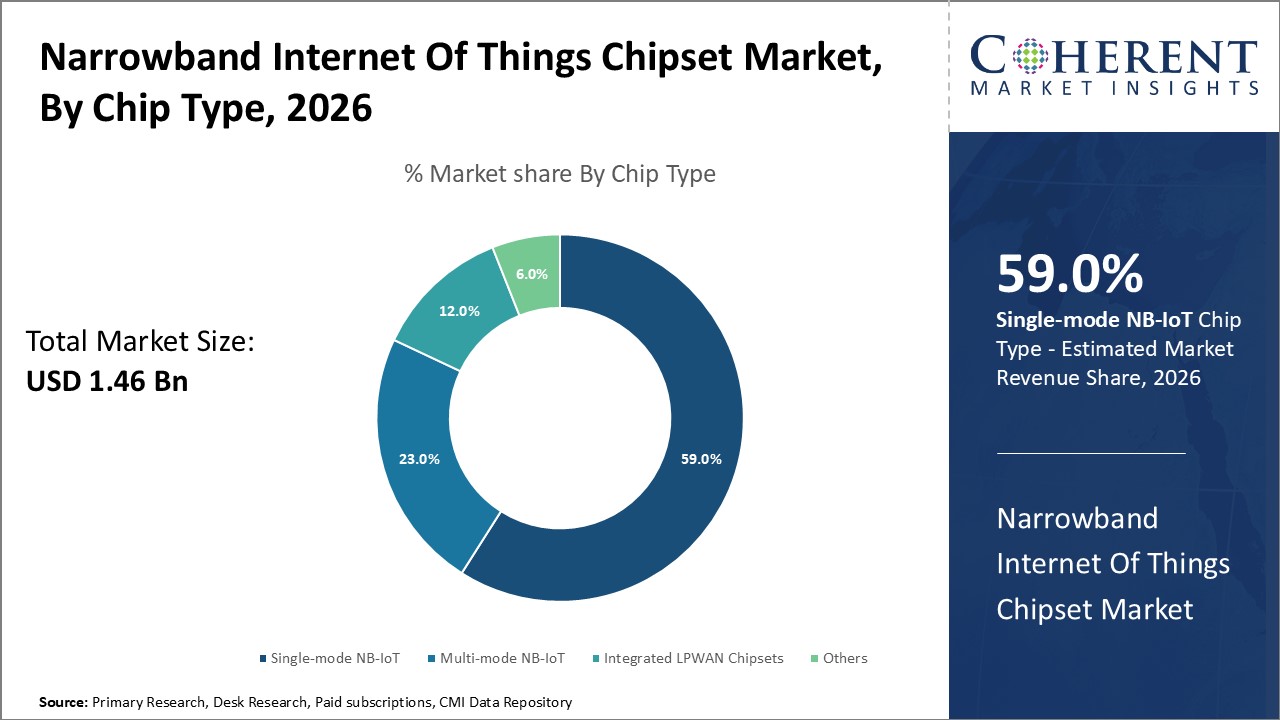
Single-mode NB-IoT chipsets continue to dominate the chip type segment with 59% market share due to their specialized power efficiency and cost advantages.
Smart metering leads the application segment, benefiting from governments’ energy conservation initiatives, contributing over 36% to the industry revenue.
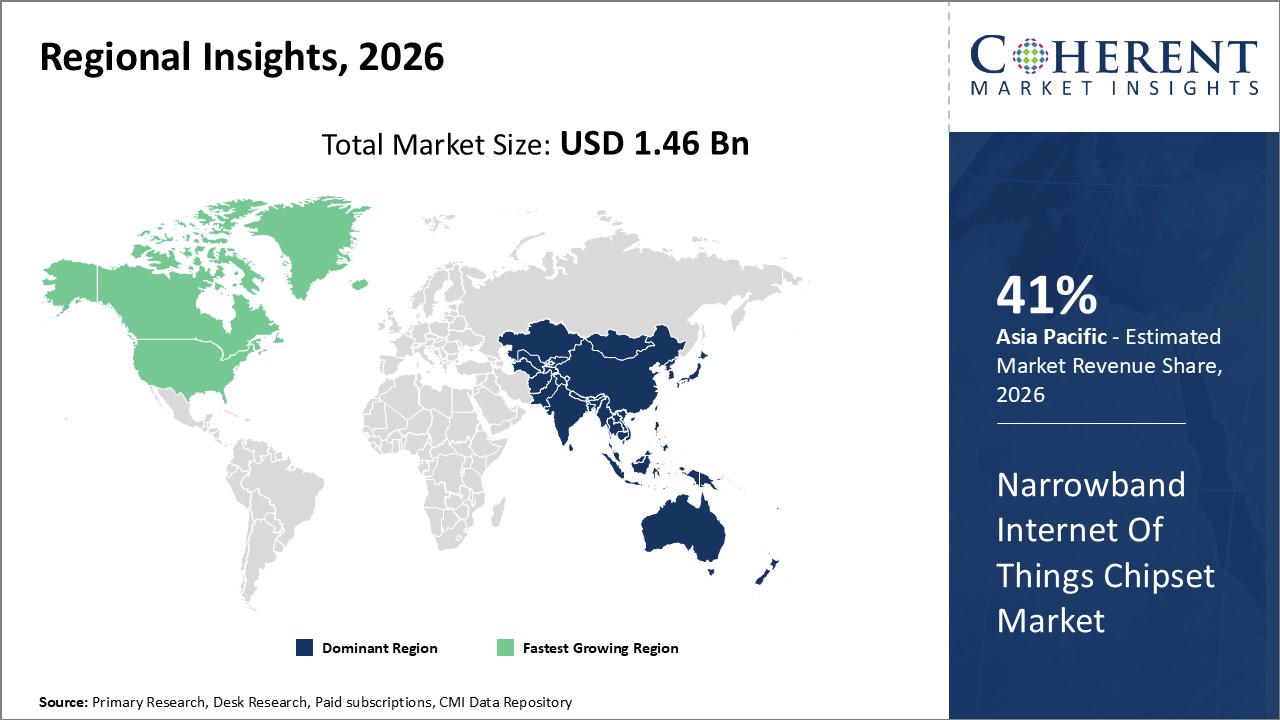
Asia Pacific holds dominance in the regional landscape, accounting for 41% of the Narrowband Internet of Things Chipset market share, driven primarily by China's extensive infrastructure investments.
North America is the fastest-growing market region with a CAGR exceeding 22% due to the integration of NB-IoT chipsets in advanced smart city projects and automotive applications.
Narrowband Internet of Things Chipset Market – Segmentation Analysis
Narrowband Internet of Things Chipset Market Insights, By Chip Type
The market is divided into Integrated LPWAN Chipsets, Multi-mode NB-IoT, Single-mode NB-IoT, and Others based on the type of chip; Single-mode NB-IoT holds the largest market share of 59%. For large-scale deployments in smart metering and agriculture IoT applications, single-mode chipsets are the recommended option because of their economical and optimized power usage. Notably, market revenue growth has been significantly impacted by the quick expansion of single-mode production.
Narrowband Internet of Things Chipset Market Insights, By Application
Regarding applications, the market is split into Smart Metering, Asset Tracking, Smart City & Infrastructure, Wearables, Healthcare, Agriculture, and Others. Smart Metering leads the application segment, driven by global governmental initiatives targeting energy efficiency and utility management. The mass deployment of smart water and gas meters in regions such as Europe accounts for a significant portion of market share.
Narrowband Internet of Things Chipset Market Insights, By End-use Industry
In end-use industries, the market segmentation includes Consumer Electronics, Automotive, Energy & Utilities, Manufacturing, and Others. Consumer Electronics dominate due to the proliferation of connected devices such as wearables and home automation systems powered by NB-IoT chipsets, accounting for a major industry share.
Narrowband Internet of Things Chipset Market Insights, By Geography
Asia Pacific Narrowband Internet of Things Chipset Market Analysis and Trends
Considering a dominant market share of 41%, Asia Pacific is the industry leader for narrowband internet of things chipsets. Strong government backing for smart city projects and infrastructure digitization, particularly in China and India, benefits the area. The market's reach and profitability have been further expanded by the region's rich manufacturing environment and reasonably priced production expenses.
North America Narrowband Internet of Things Chipset Market Analysis and Trends
Due to the early adoption of IoT solutions in smart transportation and healthcare, North America, on the other hand, shows the fastest growth, with a CAGR exceeding 22%. This trend is being driven by aggressive investments by industry leaders like Qualcomm and MediaTek, as well as favorable regulatory frameworks and advanced communication infrastructure in the United States and Canada.
Narrowband Internet of Things Chipset Market Outlook for Key Countries
United States Narrowband Internet of Things Chipsets Market Analysis and Trends
Widespread industrial use of smart city technologies and federal government programs encouraging IoT deployments in public infrastructure are driving the NB-IoT chipset market in the US. By launching multi-mode chipsets tailored for the North American telecom environment, vendors such as Qualcomm have effectively broken into the industry, increasing market revenue by 23% in 2025. Significant company expansion and investment inflows are being driven by the nation's focus on 5G networks and private LTE enablement’s.
China Narrowband Internet of Things Chipsets Market Analysis and Trends
Large government-backed initiatives for environmental monitoring and smart metering are driving the Chinese market, and local chipset manufacturers are benefiting from cost advantages and large manufacturing scale. As of early 2026, there were over 60 million linked devices in China, demonstrating the NB-IoT ecosystem's explosive growth and helping to establish its dominant position in the regional market. China plays a key role in the APAC market story as a result of telecom operators and industry players working together to drive market revenue upward.
Analyst Opinion
Demand-side growth is primarily influenced by expanding industrial IoT applications and the rise in smart city projects, notably in Asia Pacific and Europe, where NB-IoT provides a scalable solution with extended device battery life. For example, nationwide smart metering initiatives in China and Germany saw an increase in NB-IoT chipset uptake by over 30% in 2025, reflecting a direct contribution to market expansion.
Supply-side dynamics reveal aggressive chipset production capacity scaling, with manufacturers increasing monthly output by approximately 26% in early 2026 to meet growing demand across sectors such as healthcare and logistics. The implementation of advanced semiconductor fabrication technologies has enhanced yield rates, positively influencing market revenue.
Pricing strategies are evolving as economies of scale come into effect; average NB-IoT chipset unit prices declined by 13% in 2025 compared to the previous year, enabling broader adoption in cost-sensitive applications like agriculture IoT. This shift is expected to further stimulate market share growth by lowering barriers to entry.
Product innovation focusing on integration capabilities, such as multi-mode support combining NB-IoT with LTE-M, is gaining traction. Manufacturers reporting such advanced chipset functionalities have witnessed a 20% increase in contracts from network providers in North America during 2026, indicating changing market dynamics favoring highly versatile components.
- Current Industry Events of 2026
- Market Size Estimation
- Regional Breakdown
- Competitive Landscape
- Customer Intelligence
- Segmental Analysis
- Pricing Analysis
- Key Market Drivers, Challenges & Future Trends
- Customized Insights Section
Market Scope
| Report Coverage | Details | ||
|---|---|---|---|
| Base Year: | 2025 | Market Size in 2026: | USD 1.46 billion |
| Historical Data for: | 2020 To 2024 | Forecast Period: | 2026 To 2033 |
| Forecast Period 2026 to 2033 CAGR: | 21.7% | 2033 Value Projection: | USD 5.77 billion |
| Geographies covered: |
| ||
| Segments covered: |
| ||
| Companies covered: | Qualcomm Technologies Inc., MediaTek Inc., Sequans Communications S.A., Huawei Technologies Co., Ltd., Sony Corporation, Sierra Wireless Inc., Nordic Semiconductor ASA, Unisoc Communications Inc., STMicroelectronics N.V., Renesas Electronics Corporation | ||
| Growth Drivers: |
| ||
Growth factors
The rapid digital transformation across industries continues to be the foremost growth driver. Increasing urbanization and governmental smart infrastructure investments are accelerating the deployment of NB-IoT chipsets across public utilities and surveillance sectors, especially in Europe and Asia Pacific.
Additionally, enhanced battery life and cost efficiency of NB-IoT chipsets compared to traditional cellular connectivity make them ideal for remote sensing and agricultural monitoring. The burgeoning adoption of 5G and LPWAN integration fuels this market, as advanced connectivity solutions enable high-volume data transmission with minimal power. Moreover, regulatory support such as spectrum allocation for NB-IoT globally is reducing market restraints, paving the way for expanded ecosystem development and market revenue escalation.
Narrowband Internet of Things Chipset Market Development
In February 2025, a multimillion-pound narrowband internet of things (NB-IoT) network that reaches 98% of the UK population has been executed by BT. The goal of the action is to capitalize on the quickly growing IoT industry. The number of connected IoT devices worldwide is predicted to almost double by 2030, rising from 15.14 billion in 2025 to 29.42 billion in the following seven years, according to recent Statista research.
In April 2023, An NB-IoT (Narrowband Internet of Things) chipset designed especially for the Indian market was unveiled by Renesas Electronics Corporation, a leading provider of cutting-edge semiconductor technologies. Designed to function flawlessly on the networks of all major Indian telecommunications operators, the new RH1NS200 is an LTE NB-IoT modem chipset.
Narrowband Internet of Things Chipset Market Trends
The Narrowband Internet of Things Chipset market is witnessing a significant shift toward convergence with 5G technology and edge computing capabilities. The integration of NB-IoT chipsets with edge AI modules is enhancing real-time data processing, which was demonstrated by deployments in logistics and smart manufacturing in 2025, where such solutions reduced operational latency by 25%.
Additionally, the recent trend of modular chipsets allowing firmware updates over-the-air (FOTA) is improving the lifecycle management of IoT devices, with major chip providers releasing updates post-deployment to address security and performance issues. Private network rollouts in industrial zones are also catalyzing market growth, as enterprises seek customized NB-IoT solutions tailored for localized connectivity and data security.
Key Players
Qualcomm Technologies Inc.
MediaTek Inc.
Sequans Communications S.A.
Huawei Technologies Co., Ltd.
Sierra Wireless Inc.
Nordic Semiconductor ASA
Unisoc Communications Inc.
STMicroelectronics N.V.
Renesas Electronics Corporation
Competitive strategies among market companies include Qualcomm’s 2025 launch of multi-mode chipsets that improved power efficiency by 19%, enabling them to secure contracts with major telecom operators in North America. Huawei has invested heavily in R&D tailored toward compact chipset design, strengthening its presence in Asia Pacific’s smart city development programs. MediaTek’s strategy of collaborating with IoT device manufacturers accelerated product integration, resulting in a 16% growth in market share within the consumer electronics segment during 2026.
Future Prospects for the Narrowband Internet of Things Chipset Market
The market for Narrowband Internet of Things (NB-IoT) chipsets has a very bright future owing to the strong adoption across several business verticals and steady expansion into new application areas. It is anticipated that broad deployment in smart city infrastructure, healthcare, agriculture, logistics, and energy management applications will be fueled by continued integration with cutting-edge technologies like 5G and improved security features.
Demand for NB-IoT chipsets will continue to be driven by the growing use of low-power, cost-effective IoT devices, and further advancements in cost and power efficiency will increase accessibility in emerging economies. Furthermore, NB-IoT is positioned as the go-to option for extensive, distant, and vital device networks because to its growing support for deep coverage and dependable connectivity in demanding settings. Competition will increase as market players spend more on R&D and new product creation, which will result in better features and smooth integration across international IoT ecosystems.
Historical Analysis
The Narrowband Internet of Things (NB-IoT) Chipset Market experienced significant growth in recent years, driven primarily by the increasing adoption of IoT devices across various industries such as manufacturing, healthcare, agriculture, and utilities. Initially developed as a cellular technology designed to provide low power consumption and extensive coverage for devices transmitting small data packets intermittently, NB-IoT became essential for applications requiring long battery life and reliable connectivity in challenging environments. Early deployments focused on sectors like smart metering, smart parking, and smart cities, where the need for low-cost, stable, and wide-area connectivity was critical.
Market expansion was supported by advancements in chipset technology that increased power efficiency and reduced costs alongside expanding networks deployed by telecom operators globally. Regional growth trends showed North America leading due to advanced infrastructure and wide industry adoption, followed by strong growth in Europe and rapid adoption in Asia Pacific, fueled by government initiatives and industrial automation. The increasing number of connected IoT devices worldwide reinforced demand for NB-IoT chipsets, positioning the market for continued technological development and broader application reach over time.
Sources
Primary Research interviews:
IoT Module Providers
Telecom Operators
Smart Device Manufacturers
Automotive OEMs (for connected vehicles)
Databases:
World Bank Data
ITU (International Telecommunication Union) Statistics
GSMA Intelligence
Magazines:
Embedded Computing Design
Electronics Weekly
Wireless Week
Journals:
Sensors (MDPI)
International Journal of Communication Systems
Journal of Network and Computer Applications
Newspapers:
The Hindu BusinessLine
Financial Times (Tech & Telecom)
The Wall Street Journal (Technology)
Associations:
3GPP (3rd Generation Partnership Project)
IEEE (Institute of Electrical and Electronics Engineers)
ETSI (European Telecommunications Standards Institute)
Get access to 250+ pages report
Every segment, forecast, competitor profile and data table behind the analysis above — available for instant download.
- ESOMAR Member
- ISO 9001:2015 Certified
- D-U-N-S Registered
- GDPR & CCPA Compliant
Missing comfort of reading report in your local language? Find your preferred language:
Transform your Strategy with Exclusive Trending Reports
Frequently Asked Questions
Leading players include Qualcomm Technologies Inc., MediaTek Inc., Sequans Communications S.A., Huawei Technologies Co., Ltd., Sony Corporation, Sierra Wireless Inc., Nordic Semiconductor ASA, Unisoc Communications Inc., STMicroelectronics N.V., Renesas Electronics Corporation, command a substantial portion of market share through innovation and strategic partnerships.
The market size is anticipated to grow from USD 1.46 billion in 2026 to USD 5.77 billion by 2033, showcasing robust market growth fueled by expanding end-use applications.
The consumer electronics presents the largest growth opportunity given the increasing demand for efficient utility management and energy conservation programs worldwide.
The market trends highlight increasing adoption of 5G-integrated chipsets and edge computing capabilities alongside evolving business growth models focusing on modularity and lifecycle management.
Competition is intense, with players focusing on technology differentiation and production scalability, while challenges include pricing pressure and regulatory compliance across diverse regions.
Strategies frequently include strategic collaborations with telecom operators, R&D investments for multi-mode chipset development, and penetration into vertical-specific IoT applications such as healthcare and agriculture.