

Natural Killer Cells Market Size and Forecast — 2026 - 2033
The Global Natural Killer Cells Market size is estimated to be valued at USD 850 million in 2026 and is expected to reach USD 1,950 million by 2033, exhibiting a compound annual growth rate (CAGR) of 12.5% from 2026 to 2033.
Overview
Natural Killer (NK) cell products are a rapidly evolving segment of cancer immunotherapy, designed to harness the body’s innate immune system to target and destroy malignant or infected cells. These products include autologous and allogeneic NK cell therapies, NK cell lines, and cytokine-induced killer (CIK) cells. They are used in treating various cancers, including leukemia, lymphoma, and solid tumors. Advances in genetic engineering, such as CAR-NK cells, enhance targeting efficiency and persistence. Additionally, NK cell-based products are being explored for infectious diseases. Growing clinical trials and regulatory approvals are driving innovation and expanding their therapeutic applications globally.
Key Takeaways
The Allogeneic NK Cells segment holds the largest share of the market due to its high scalability and strong therapeutic potential
Hematologic Malignancies represent the leading application segment, driven by intensive clinical trial activity and supportive reimbursement policies
North America leads the market, supported by advanced healthcare infrastructure and significant investment in research and development
Asia Pacific is the fastest-growing region, fueled by government initiatives, improving healthcare infrastructure, and increasing disease prevalence, creating strong growth opportunities for market participants
Natural Killer Cells Market Segmentation Analysis
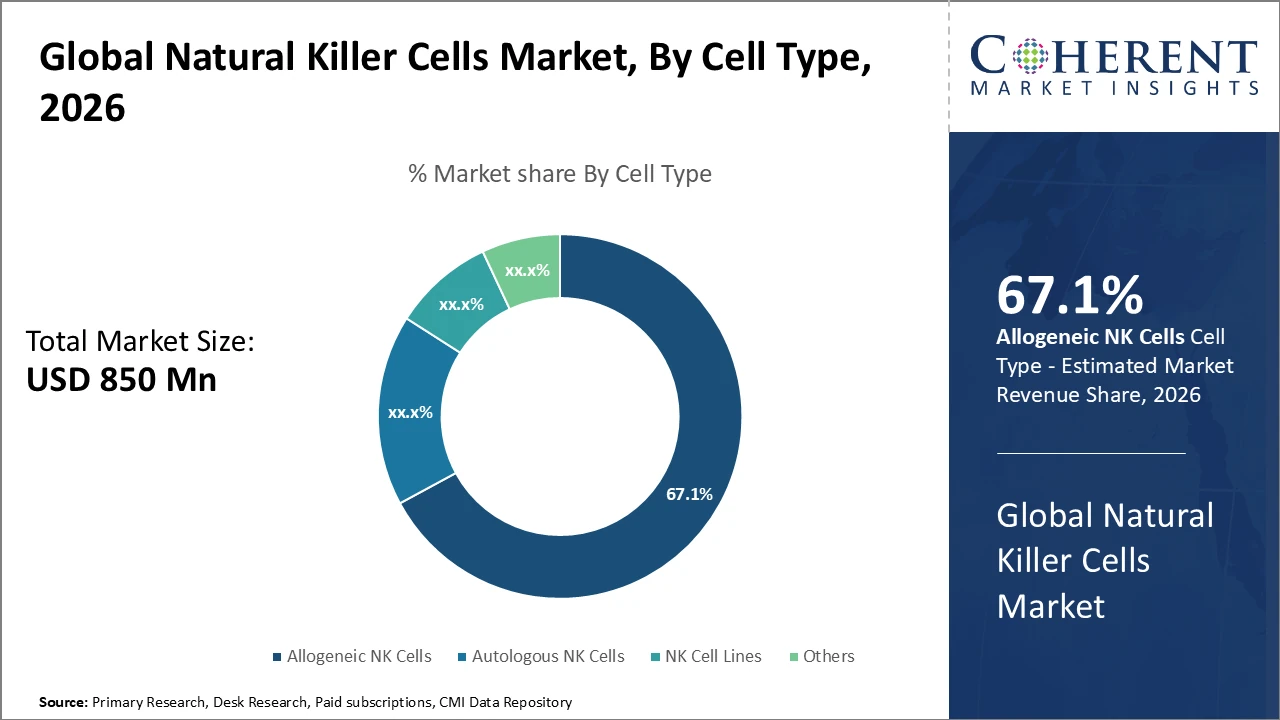
Natural Killer Cells Market Insights, By Cell Type
The Allogeneic NK Cells segment dominates the market with a share of 67.1% due to its scalability, cost-effectiveness, and strong therapeutic potential in treating various diseases. Hematologic malignancies remain the leading application area, driven by increasing clinical trials and supportive reimbursement frameworks that encourage adoption. North America holds the largest market share, supported by advanced healthcare infrastructure, strong research capabilities, and significant funding for innovation. Meanwhile, the Asia Pacific region is experiencing the fastest growth, fueled by rising healthcare investments, government support, expanding medical facilities, and a growing patient population, creating substantial opportunities for companies operating in the Natural Killer Cells market.
Natural Killer Cells Market Insights, By Application
Hematologic malignancies command the dominant market share, driven by significant unmet medical needs and strong clinical success in conditions such as acute myeloid leukemia (AML) and non-Hodgkin’s lymphoma (NHL). This segment not only generates the highest revenue but also exhibits the fastest growth, supported by ongoing regulatory approvals for NK cell therapies. Solid tumors are gaining momentum due to recent advancements that improve NK cell infiltration and efficacy. Infectious diseases represent a niche yet promising segment, particularly with emerging evidence in viral infections and COVID-19 immune response. Autoimmune disorders and other applications remain in early stages, showing gradual but steady growth potential.
Natural Killer Cells Market Insights, By End User
Hospitals and clinics dominate the market due to their central role in administering therapies and providing direct patient access, accounting for the largest share. This segment continues to grow steadily with ongoing infrastructure improvements and increasing integration of NK cell therapies into treatment protocols. Pharmaceutical and biotechnology companies are the fastest-growing end users, driven by rising investments in research, development, and commercialization. Research institutes play a key role in advancing innovation through foundational and translational studies, while contract research organizations support clinical trials and manufacturing.
Natural Killer Cells Market Trends
The Natural Killer Cells market has accelerated significantly due to technological advancements, particularly CAR-NK technology, which has shown improved therapeutic outcomes in recent clinical trials
Clinical studies conducted in 2024 and 2025 have demonstrated enhanced efficacy and safety profiles, boosting confidence in NK cell-based therapies
There is a growing shift toward allogeneic NK cells over autologous types, driven by faster production timelines and broader patient accessibility
Regulatory progress, including a 2025 FDA approval of a next-generation allogeneic NK therapy combined with monoclonal antibodies, has strengthened market growth
The approved therapy reported a 28% increase in treatment response rates, highlighting the potential of innovative NK cell approaches and encouraging further development
Natural Killer Cells Market Insights, By Geography
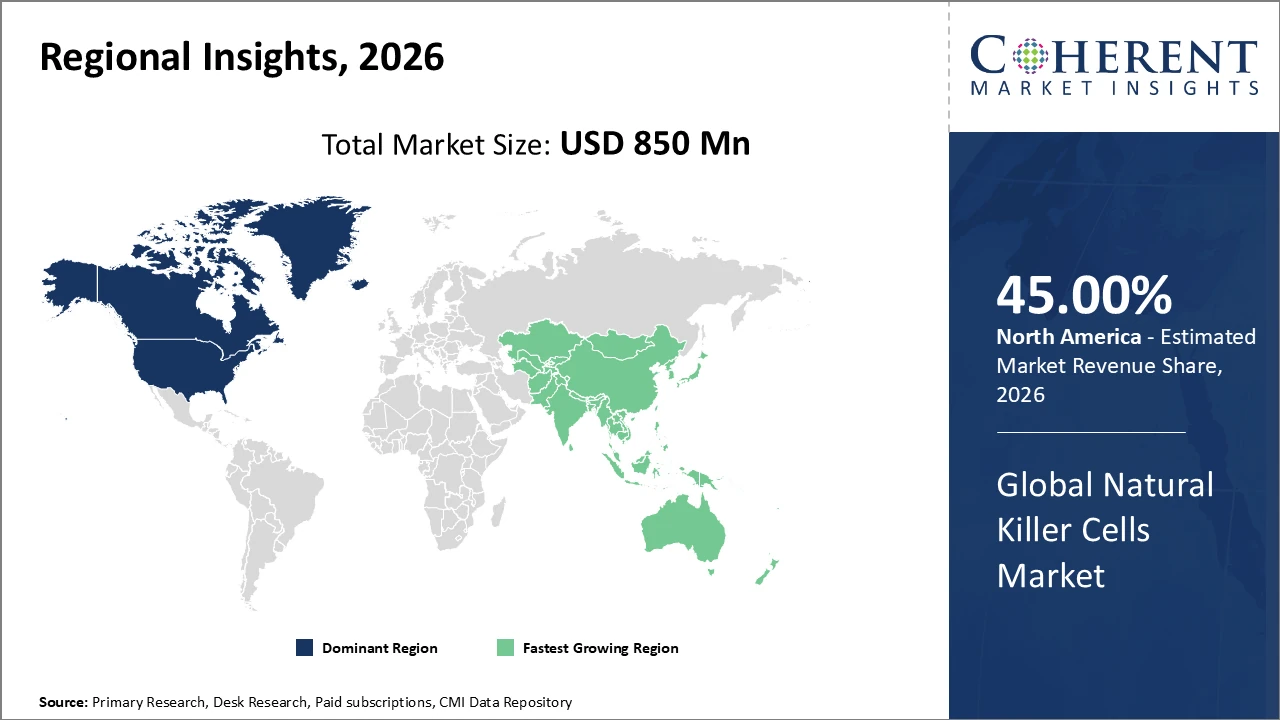
North America Natural Killer Cells Market Analysis and Trends
North America continues to dominate the Natural Killer Cells market, supported by its advanced biotechnology infrastructure, substantial venture capital funding, and well-established regulatory frameworks that facilitate faster approval of cell-based therapies. The region accounted for over 45% of the global market share in 2026, reflecting its strong leadership position. This dominance is further reinforced by the presence of major industry players, extensive research activities, and a high volume of ongoing clinical trials. Additionally, increasing adoption of innovative immunotherapies and strong collaboration between academic institutions and biotech firms contribute to sustained market growth across the region.
Asia Pacific Natural Killer Cells Market Analysis and Trends
The Asia Pacific region is witnessing the fastest growth in the Natural Killer Cells market, with a CAGR exceeding 15%. This growth is driven by rising healthcare expenditure, strong government support, and increasing investments in biotechnology research. The growing incidence of diseases such as cancer further fuels demand for advanced therapies. Emerging economies like India and China are playing a crucial role by actively investing in NK cell technologies. Support from domestic biopharmaceutical companies, along with strategic international collaborations, is accelerating innovation and commercialization. Expanding healthcare infrastructure and improving access to advanced treatments continue to strengthen the region’s overall market potential.
Natural Killer Cells Market Outlook for Key Countries
USA Natural Killer Cells Market Analysis and Trends
The U.S. stands out as a key hub in the Natural Killer Cells market, with over 60% of global NK cell clinical trials conducted within its borders. This leadership is driven by strong research infrastructure and active participation from leading companies such as Fate Therapeutics and NantKwest, which have established advanced manufacturing capabilities. Federal funding initiatives and supportive policies further accelerate innovation and commercialization. Additionally, streamlined regulatory pathways enable faster approval of novel therapies. These factors collectively position the U.S. as the largest contributor to overall market revenue and a major driver of growth and technological advancement in this sector.
Germany Natural Killer Cells Market Analysis and Trends
Germany’s Natural Killer Cells market is gaining momentum, driven largely by increased research and development in immunotherapy and oncology. The market is projected to grow rapidly over the coming years as demand for advanced NK cell therapeutics expands, particularly for cancer applications. Hospitals and specialty clinics are key end‑users, supported by strong clinical networks and collaborations between biotech firms and research institutes. Germany benefits from robust healthcare infrastructure and government support for biotechnology innovation. Technological advancements—such as CAR‑NK and antibody‑dependent approaches—along with rising clinical adoption, are shaping market trends and fueling growth opportunities within the region.
Analyst Opinion
Robust expansion in NK cell production capacity has driven the supply side, with global manufacturing capabilities increasing by over 40% between 2024 and 2026, aided by advanced bioreactor technologies that enhance yield and purity, boosting market share.
Demand-side dynamics show rising adoption in oncology and viral infection therapies, with NK cell clinical trials increasing by 35% in 2025, highlighting interest in hematologic malignancies.
Improved cost-efficiency in cell isolation and expansion reduced the average NK cell therapy dose price by ~15% in 2026 versus 2024, expanding patient accessibility.
Increased R&D investments by key players led to breakthroughs in allogeneic “off-the-shelf” NK cell therapies, improving scalability and reducing treatment complications.
Recent clinical studies report a 25% year-over-year increase in treatment efficacy metrics due to these advancements.
- Current Industry Events of 2026
- Market Size Estimation
- Regional Breakdown
- Competitive Landscape
- Customer Intelligence
- Segmental Analysis
- Pricing Analysis
- Key Market Drivers, Challenges & Future Trends
- Customized Insights Section
Market Scope
| Report Coverage | Details | ||
|---|---|---|---|
| Base Year: | 2025 | Market Size in 2026: | USD 850 million |
| Historical Data for: | 2020 To 2024 | Forecast Period: | 2026 To 2033 |
| Forecast Period 2026 to 2033 CAGR: | 12.5% | 2033 Value Projection: | USD 1950 million |
| Geographies covered: |
| ||
| Segments covered: |
| ||
| Companies covered: | Fate Therapeutics, ImmunityBio, Gamida Cell, Celgene Corporation, Takeda Pharmaceutical, MaxCyte, Kite Pharma, Celyad Oncology, Becton Dickinson, Innate Pharma | ||
| Growth Drivers: |
| ||
Market Growth Factors
The rising prevalence of hematologic cancers and solid tumors is fueling demand for innovative NK cell therapies. In 2025, the pipeline of clinical trials using engineered NK cells expanded by 45%, indicating strong future growth potential. Advances in gene-editing technologies, including CRISPR-Cas9 and CAR-NK platforms, have improved therapeutic efficacy and safety, facilitating faster regulatory approvals and broader adoption. Government support, particularly in the U.S. and China, has boosted market revenue, with public grants increasing by 30% between 2024 and 2026. Additionally, strategic collaborations between biotech companies and healthcare institutions are accelerating commercialization and expanding overall market size.
Natural Killer Cells Market Development
In February 2026, ImmunityBio, Inc. announced the launch of ResQ215B, a Phase 2 clinical trial assessing a novel combination immunotherapy—without chemotherapy or lymphodepletion—for patients with indolent B-cell non-Hodgkin lymphoma, including Waldenström’s Macroglobulinemia.
Key Players
Leading Companies of the Market
Fate Therapeutics
Celgene Corporation
Gamida Cell
ImmunityBio
MaxCyte
Celyad Oncology
Kite Pharma
Takeda Pharmaceutical
Innate Pharma
Becton Dickinson
Competitive strategies in the Natural Killer Cells market are increasingly focused on strengthening allogeneic NK cell platforms. In 2025, Fate Therapeutics acquired a key cell expansion technology startup, enhancing their manufacturing capacity and significantly boosting market revenue in 2026. Likewise, NantKwest pursued strategic partnerships with major pharmaceutical companies, accelerating the development of their clinical pipeline. These collaborations not only expanded their therapeutic offerings but also reinforced their presence in North American and European markets, allowing both companies to capture greater industry share and establish a strong competitive foothold in the rapidly growing NK cell therapy sector.
Natural Killer Cells Market Future Outlook
The future outlook of the Natural Killer Cells market is highly promising, driven by increasing adoption of allogeneic and CAR-NK therapies across oncology and infectious disease applications. Advances in gene editing, cell expansion technologies, and off-the-shelf manufacturing are expected to enhance treatment efficacy, scalability, and accessibility. Expanding clinical pipelines, supportive regulatory frameworks, and growing collaborations between biotech firms and healthcare institutions will accelerate commercialization. Regions such as North America and Asia Pacific are anticipated to lead growth, while emerging markets present new opportunities. Overall, technological innovation, rising disease prevalence, and strategic partnerships are poised to sustain robust market expansion in the coming years.
Natural Killer Cells Market Historical Analysis
The Natural Killer Cells market has experienced significant growth over the past decade, driven by increasing recognition of NK cells’ role in cancer immunotherapy and infectious disease management. Early developments focused on autologous therapies, with limited scalability and high production costs. From 2018 to 2023, technological advancements, including cytokine-induced activation and NK cell line development, expanded therapeutic potential and clinical adoption. Investment in research and clinical trials surged, particularly in hematologic malignancies, establishing proof of efficacy and safety. Regulatory support and collaborations between biotech firms and research institutions further accelerated market expansion, laying the foundation for the current robust pipeline of NK cell-based therapies.
Sources
Primary Research Interviews:
Immunologists, cell therapy research heads, and clinical development executives at biotech and pharmaceutical companies engaged in NK cell–based therapies
R&D managers, translational medicine leads, and clinical operations supervisors in academic medical centers and contract research organizations (CROs) working on NK cell research
Technology providers of NK cell expansion platforms, CAR‑NK manufacturing systems, and immune profiling/bioprocessing technologies
Magazines:
Cell Therapy Today – Advances in NK Cell Immunotherapy and Therapeutic Platforms
BioPharma Dive – Updates on Immune Cell Therapy Development and Commercialization
Pharmaceutical Technology – Bioprocessing and Manufacturing Platforms for NK Cell Products
Journals:
Nature Reviews Immunology – NK Cell Biology, Function, and Therapeutic Potential
Journal for ImmunoTherapy of Cancer – Clinical Investigations and Translational Studies on NK Cell Therapies
Frontiers in Immunology – Innovations in NK Cell Engineering and Immune Modulation
Clinical Cancer Research – Efficacy and Safety Outcomes for NK Cell Therapies in Oncology
Newspapers:
The Wall Street Journal – Biotech Funding, NK Cell Therapy Investments, and Market Disruption
Financial Times – Trends in Cell Therapy Markets and Biopharma Strategic Moves
Business Insider Clinical Trial Updates and Regulatory Developments in Immune Cell Therapies
Associations:
American Association of Immunologists (AAI) – NK Cell Research Standards and Immune Biology Education
Society for Immunotherapy of Cancer (SITC) – Best Practices in NK Cell Immunotherapy Development
International Society for Cell & Gene Therapy (ISCT) – Standards for Clinical Translation and Manufacturing of NK Cell Products
Get access to 250+ pages report
Every segment, forecast, competitor profile and data table behind the analysis above — available for instant download.
- ESOMAR Member
- ISO 9001:2015 Certified
- D-U-N-S Registered
- GDPR & CCPA Compliant
Missing comfort of reading report in your local language? Find your preferred language:
Transform your Strategy with Exclusive Trending Reports
Frequently Asked Questions
The dominant players in the Natural Killer Cells market include Fate Therapeutics, Celgene Corporation, Takeda Pharmaceuticals, and Celgene Corporation, known for their innovative products and extensive clinical pipelines.
The market is projected to reach USD 1,950 million by 2033, growing at a CAGR of 12.5% from 2026 to 2033, driven by breakthroughs in cell therapy and expanding clinical acceptance.
Hospitals and clinics focusing on oncology, particularly hematologic malignancies, represent the largest growth opportunity due to rising NK cell therapy adoption.
Market development trends over the next five years are expected to include a pronounced shift toward allogeneic therapies, integration with immunomodulatory drugs, and increased digitization in manufacturing processes to enhance scalability.
The competitive landscape is highly competitive, emphasizing innovation and alliances. Key challenges include manufacturing costs, regulatory hurdles, and ensuring treatment efficacy.
Common go-to-market strategies include technology acquisitions, strategic partnerships to accelerate clinical trials, and efforts to improve production scalability and reduce costs.