

Non Invasive Diabetes Therapy Market Size and Forecast — 2026 - 2033
The Global Non Invasive Diabetes Therapy Market size is estimated to be valued at USD 3.2 billion in 2026 and is expected to reach USD 7.5 billion by 2033, exhibiting a compound annual growth rate (CAGR) of 12.8% from 2026 to 2033.
Overview
Non-invasive diabetes therapy products aim to manage blood glucose levels without injections or implantable devices. These solutions include transdermal drug delivery systems, external stimulation devices, wearable therapeutic platforms, and novel physiological modulation technologies. The products focus on improving patient comfort, adherence, and long-term disease management. They are often designed to complement or reduce dependence on traditional insulin delivery methods.
Key Takeaways
Transdermal therapy holds the largest segment share at 36%, underscoring its dominance due to high patient compliance and ease of use, with wearable devices leading technology adoption.
Homecare settings rapidly increase market penetration, reflecting demand for patient-centric non invasive solutions supported by telemedicine enhancements.
North America remains the dominant region, collectively accounting for over 40% of market revenue, driven by robust healthcare infrastructure and reimbursement support.
Asia Pacific showcases the highest CAGR owing to rising diabetic population, fast-paced urbanization, and government initiatives fostering innovative therapy adoption.
Non Invasive Diabetes Therapy Market Segmentation Analysis
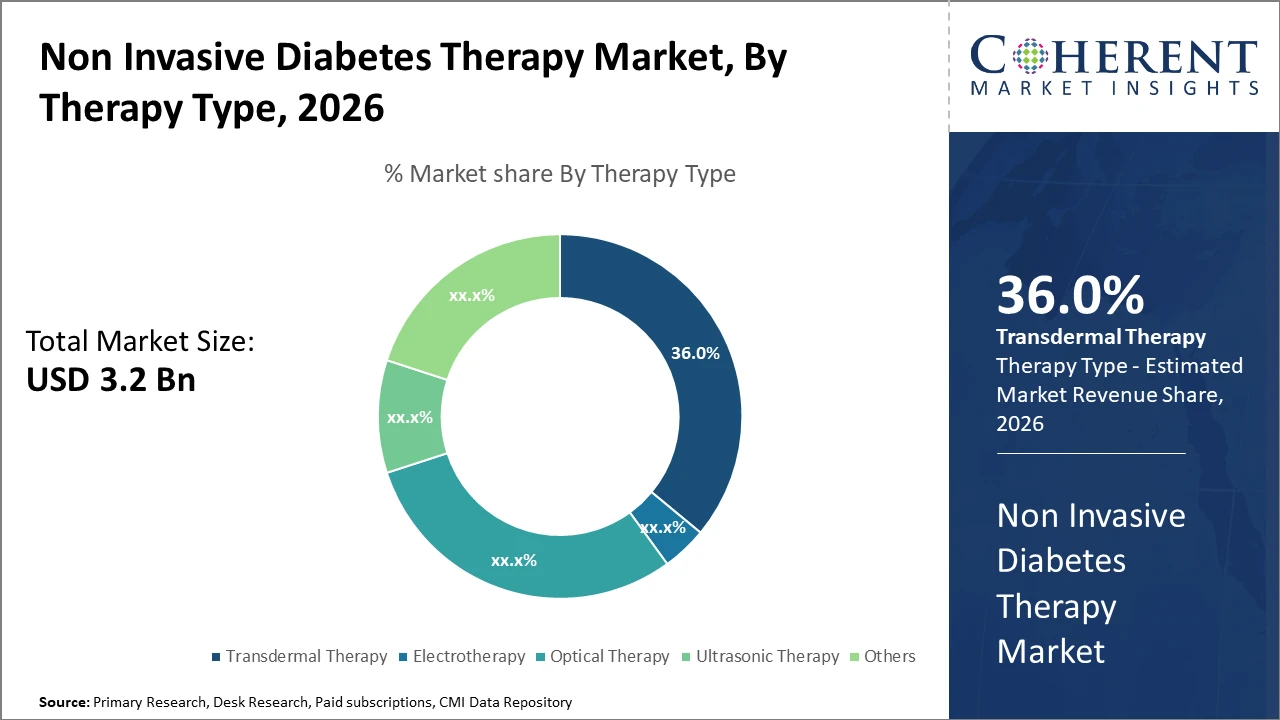
Non Invasive Diabetes Therapy Market Insights, By Therapy Type
Transdermal Therapy dominates the market share. This segment leads due to its noninvasive delivery method, offering steady glucose regulation and high patient adherence. Innovations such as microneedle patches and skin permeation enhancements have further expanded its application. Electrotherapy is the fastest-growing subsegment, attributed to advances in nerve stimulation technologies improving insulin sensitivity and glucose uptake with minimal side effects. Optical Therapy utilizes light-based sensors for noninvasive glucose detection and remains critical in continuous monitoring applications, while Ultrasonic Therapy uses ultrasound waves to modulate glucose metabolism, albeit currently representing a smaller market niche.
Non Invasive Diabetes Therapy Market Insights, By End-User
Homecare Settings presently dominate the market share due to rising patient preference for convenient, self-managed therapy at home. This segment’s growth is buoyed by telemedicine integration and smartphone connectivity, facilitating remote monitoring. Hospitals & Clinics continue to be the key hubs for initial device adoption and clinical validation, ensuring safe and effective application. Specialized Diabetes Treatment Centers contribute customized care regimens using advanced therapies, but at a smaller scale.
Non Invasive Diabetes Therapy Market Insights, By Technology
Wearable Devices are the dominant subsegment with the highest market share, favored for ease of use, continuous monitoring capability, and integration with mobile health platforms. Their usability promotes patient adherence and real-time data collection. Smart Glucose Monitoring Systems represent the fastest-growing subsegment, driven by AI and machine learning applications enhancing predictive analytics and personalized therapy adjustments. Implantable Devices provide long-term monitoring solutions with minimal maintenance but face challenges in invasiveness and patient acceptance. Non-Implantable Devices offer portable, convenient options with moderate clinical adoption.
Non Invasive Diabetes Therapy Market Trends
The non invasive diabetes therapy market demonstrates clear momentum towards digital integration and personalization of therapy regimes.
In 2026, over 35% of new device launches incorporated AI or machine learning-based algorithms, enhancing predictive glucose control and minimizing hypoglycemic events.
The rise of telemedicine facilitated by the post-pandemic healthcare shift significantly increased demand for home-use non invasive devices, reflected in shipment volumes rising by 28% globally in 2025.
Moreover, regulatory agencies in the U.S. and Europe fast-tracked approvals for innovative sensor technologies, enabling the rapid commercialization of ultrasound and optical-based glucose monitoring systems.
These advancements not only enhance patient adherence but also widen the market scope by attracting segments previously unreached with traditional invasive methods.
Non Invasive Diabetes Therapy Market Insights, By Geography
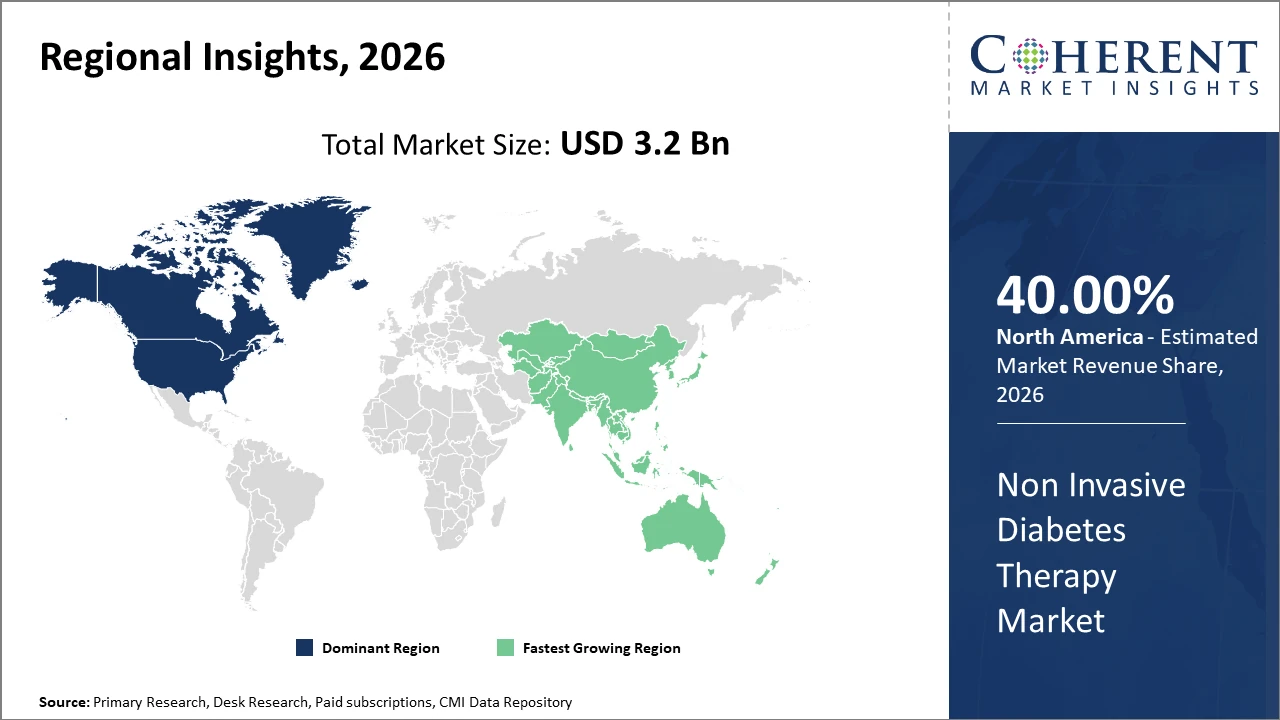
North America Non Invasive Diabetes Therapy Market Analysis and Trends
In North America, the dominance in the non invasive diabetes therapy market stems from advanced healthcare infrastructure, extensive reimbursement frameworks, and a high incidence of diabetes. The U.S. particularly commands a substantial industry share exceeding 40%, bolstered by the presence of several leading market companies like Medtronic plc and Abbott Laboratories. Government initiatives promoting chronic disease management add further impetus, allowing sophisticated therapy devices to penetrate clinical and homecare setups widely.
Asia Pacific Non Invasive Diabetes Therapy Market Analysis and Trends
Meanwhile, the Asia Pacific exhibits the fastest growth with a CAGR surpassing 15%, driven by increasing diabetes prevalence, urbanization, and rising healthcare investments in countries like China and India. Government health programs aimed at expanding diabetes screening and treatment are catalyzing demand, alongside growing consumer awareness and adoption of non invasive therapeutic devices. Regional market players and multinational companies are actively forming collaborations to leverage this market potential.
Non Invasive Diabetes Therapy Market Outlook for Key Countries
USA Non Invasive Diabetes Therapy Market Analysis and Trends
The USA’s market leads globally due to its cutting-edge innovation pipeline and supportive healthcare policies. In 2025, the U.S. accounted for roughly 38% of the global market revenue, fueled by early adoption of wearable glucose monitors and expansion of telehealth services. Major manufacturers headquartered in the U.S. aggressively invested in R&D, exemplified by Johnson & Johnson’s launch of a new optical sensor device projected to capture significant market share by 2027. Strong reimbursement coverage and patient preference for noninvasive therapies further reinforce business growth.
China Non Invasive Diabetes Therapy Market Analysis and Trends
China’s market is rapidly evolving, propelled by soaring diabetes cases estimated at over 140 million, creating an urgent need for alternative therapies. The government’s Healthy China 2030 initiative promotes innovation in digital diabetes management and accelerated approval of medical devices. Market companies are expanding manufacturing and distribution channels, with Chinese firms making notable strides in developing cost-effective electrotherapy options. This expansion, coupled with increasing urban healthcare access and digital health platform integration, positions China as a critical contributor to regional market growth.
Analyst Opinion
One crucial insight from the market analysis is the rising demand-side indicator of home healthcare adoption. In 2025, the proportion of patients opting for home-based glucose monitoring and non-invasive therapy devices increased by nearly 18%, emphasizing convenience and patient-centric care. This shift contributes significantly to the non-invasive diabetes therapy market’s revenue growth and market share expansion globally.
Supply-side factors such as enhanced production capacity of transdermal and biofeedback therapy devices also underpin market growth. Several manufacturers scaled their output by over 20% in 2024, as reported by industry registries, facilitating wider distribution and driving competitive pricing, which in turn boosts market viability and further market penetration in developing regions.
From a microeconomic perspective, the variety of use cases across healthcare providers, including outpatient diabetes clinics and telemedicine services, has expanded. In 2026, clinical adoption of optical and ultrasonic glucose monitoring increased 15%, indicating growing trust in non-invasive modalities as reliable patient management tools.
Nano-size indicators reflect ongoing improvements in sensor technology particularly in non-enzymatic biosensors for real-time glucose monitoring. Research published in 2025 highlighted a 22% enhancement in sensitivity, reducing false positives and increasing clinical acceptance. Market revenue benefits directly from these technological refinements, influencing market growth strategies among key market companies.
- Current Industry Events of 2026
- Market Size Estimation
- Regional Breakdown
- Competitive Landscape
- Customer Intelligence
- Segmental Analysis
- Pricing Analysis
- Key Market Drivers, Challenges & Future Trends
- Customized Insights Section
Market Scope
| Report Coverage | Details | ||
|---|---|---|---|
| Base Year: | 2025 | Market Size in 2026: | USD 3.2 billion |
| Historical Data for: | 2020 To 2024 | Forecast Period: | 2026 To 2033 |
| Forecast Period 2026 to 2033 CAGR: | 12.8% | 2033 Value Projection: | USD 7.5 billion |
| Geographies covered: |
| ||
| Segments covered: |
| ||
| Companies covered: | Johnson & Johnson, Dexcom, Inc., Senseonics Holdings, Inc., Nipro Corporation, Roche Diabetes Care, Insulet Corporation, Tandem Diabetes Care, Inc., Ascensia Diabetes Care, Omron Healthcare, Biofourmis, iRhythm Technologies | ||
| Growth Drivers: |
| ||
Non Invasive Diabetes Therapy Market Growth Factors
The non-invasive diabetes therapy market growth is primarily propelled by rising diabetes prevalence worldwide, with the International Diabetes Federation reporting over 460 million diagnosed cases in 2025. Another key driver is the increasing adoption of wearable technology integrating glucose monitoring with lifestyle management applications, which saw a 25% increase in end-user uptake in 2026. Technological advancements such as improved sensor accuracy, wireless connectivity, and miniaturization of devices also contribute to expanding therapy options. Additionally, favorable reimbursement policies and government initiatives targeting chronic disease management in developed and developing countries encourage market players to sharpen their growth strategies, contributing to a competitive market ecosystem and accelerating market revenue.
Non Invasive Diabetes Therapy Market Development
In August 2025, Signos launched its Glucose Monitoring System, becoming the first FDA-cleared over-the-counter (OTC) glucose monitoring solution specifically positioned for weight management. The system integrates Dexcom’s Stelo sensor with Signos’ AI-driven digital platform to help users understand how lifestyle factors such as diet, stress, sleep, and physical activity influence glucose patterns and metabolic health, enabling personalized, data-backed weight management strategies without a prescription.
In October 2025, Afon Technology, a British medical device company, advanced Glucowear™ into final-stage clinical trials, marking a major milestone for completely non-invasive, wrist-worn continuous glucose monitoring. The wearable is designed to deliver real-time glucose insights without needles or skin penetration, offering a pain-free alternative that could significantly expand adoption among people with diabetes and metabolic health concerns.
In January 2025, Tandem Diabetes Care received expanded FDA approval for an updated Control-IQ® algorithm, enhancing its automated insulin delivery capabilities. The update leverages real-time continuous glucose monitoring (CGM) data to automatically adjust basal insulin delivery and deliver correction boluses, further improving glycemic control while reducing the daily management burden for people with diabetes.
Key Players
Leading Companies of the Market
Johnson & Johnson
Dexcom, Inc.
Senseonics Holdings, Inc.
Nipro Corporation
Roche Diabetes Care
Insulet Corporation
Tandem Diabetes Care, Inc.
Ascensia Diabetes Care
Omron Healthcare
Biofourmis
iRhythm Technologies
Several leading companies have strategically invested in partnerships and innovations to reinforce their market position. For instance, Medtronic expanded its portfolio through the acquisition of wearable biosensor startups in 2025, accelerating product development cycles. Abbott Laboratories successfully launched a new generation of optical glucose monitors in 2024, capturing significant market share in North America. Johnson & Johnson adopted value-based pricing models in emerging markets, significantly enhancing business growth in the Asia Pacific region.
Non Invasive Diabetes Therapy Market Future Outlook
The future of the non-invasive diabetes therapy market is expected to be shaped by convergence between digital health, wearable technology, and advanced biomedical engineering. Innovations in continuous monitoring, transdermal delivery, and neuromodulation are likely to enhance treatment effectiveness and patient adherence. Integration with mobile health platforms and data analytics will support personalized therapy and real-time disease management. As healthcare systems increasingly emphasize preventive care and patient-centric solutions, non-invasive diabetes therapies are expected to gain wider clinical acceptance and play a key role in long-term diabetes management strategies.
Non Invasive Diabetes Therapy Market Historical Analysis
The non-invasive diabetes therapy market emerged in response to the long-standing challenges associated with invasive glucose monitoring and insulin administration. Traditional diabetes management relied heavily on finger-prick testing and injections, which often resulted in poor patient compliance and reduced quality of life. Early non-invasive approaches faced technological barriers related to accuracy, reliability, and physiological variability. However, advancements in biosensing technologies, wearable devices, and bioelectrical modulation have gradually improved the feasibility. Growing global diabetes prevalence and increasing patient preference for painless, convenient treatment options encouraged continued investment and research into non-invasive therapeutic solutions.
Sources
Primary Research Interviews:
Endocrinologists
diabetes researchers
digital health developers
biomedical engineers
wearable device specialists
Databases:
International Diabetes Federation Data
WHO Diabetes Statistics
NIH Research Data
ClinicalTrials.gov
Magazines:
Diabetes Technology & Therapeutics
Medical Device Network
Digital Health Today
Healthcare IT News
MedTech Insight
Journals:
Diabetes Car
Journal of Diabetes Science and Technology
The Lancet Diabetes & Endocrinology
Sensors Journal
IEEE Biomedical Engineering
Newspapers:
Reuters Health
Financial Times (Health)
The Guardian (Health)
The New York Times (Science)
Bloomberg Healthcare
Associations:
International Diabetes Federation
American Diabetes Association
Endocrine Society
WHO
IEEE Engineering in Medicine
Get access to 250+ pages report
Every segment, forecast, competitor profile and data table behind the analysis above — available for instant download.
- ESOMAR Member
- ISO 9001:2015 Certified
- D-U-N-S Registered
- GDPR & CCPA Compliant
Missing comfort of reading report in your local language? Find your preferred language:
Transform your Strategy with Exclusive Trending Reports
Frequently Asked Questions
Key market companies include Medtronic plc, Abbott Laboratories, Johnson & Johnson, Dexcom, Inc., and Roche Diabetes Care, all of which adopt aggressive innovation and growth strategies.
The market size is projected to grow from USD 3.2 billion in 2026 to USD 7.5 billion by 2033, reflecting a CAGR of 12.8%.
Homecare settings present the largest growth opportunity due to increasing adoption of at-home glucose monitoring and therapy devices integrated with telehealth.
Emerging trends include AI-integrated devices, remote patient monitoring expansion, and adoption of novel therapy modalities such as ultrasound and electrotherapy patches.
The market features intense competition among innovative technology providers balancing pricing and clinical efficacy, with key challenges including regulatory approvals and device accuracy.
Leading market companies employ strategic partnerships, acquisitions, localized pricing models, and focus on integrating digital health solutions to expand market share and revenue.