

Ophthalmic Diagnostics Equipment Market Size and Trends: 2026-2033
Ophthalmic diagnostics equipment market is estimated to be valued at USD 3,178 Mn in 2026 and is expected to reach USD 4,848 Mn by 2033, exhibiting a compound annual growth rate (CAGR) of 6.2% from 2026 to 2033.
Key Takeaways
- Based on Product Type, the Optical Coherence Tomography (OCT) segment is expected to lead the market with 28% share in 2026, due to high adoption for retinal imaging and advanced diagnostics.
- Based on End User, Hospitals are expected to lead the market with 48% share in 2026, due to the presence of advanced diagnostic facilities and large patient volume.
- Based on Region, North America is set to lead the ophthalmic diagnostics equipment market with 40% share in 2026. While, Asia Pacific is anticipated to be the fastest growing region.
Market Overview
Growing prevalence of eye-related disorders, a rapidly aging population, and rising awareness regarding the early diagnosis of eye-related disorders are fueling the demand for ophthalmic diagnostic equipment. The adoption of advanced technologies such as Optical Coherence Tomography, fundus cameras, and corneal topography systems is increasing at a substantial rate in hospitals and ambulatory surgical centers. Companies are also making efforts to introduce innovative diagnostic solutions with improved accuracy, portability, and user-friendly designs. In addition, the growth of the healthcare infrastructure, the increasing number of eye care centers, and government efforts to promote eye health are also contributing to the growth of the market.
Current Events and their Impacts on the Ophthalmic Diagnostics Equipment Market
Current Events | and its impact |
Aging Global Demographics and Rising Eye Disease Prevalence |
|
US-China Trade Relations and Supply Chain Disruptions |
|
How is product innovation driving growth in ophthalmic diagnostics equipment?
- Improvements in imaging technology include the use of fundus cameras with higher resolution and faster scanning, and optical coherence tomography (OCT).
- Portability and Compact Systems: Creation of point-of-care diagnostic systems that are portable, handheld, or mobile-friendly.
- AI and Software Integration: AI algorithms are integrated to automatically detect diabetic retinopathy, glaucoma, and retinal diseases.
- Current Industry Events of 2026
- Market Size Estimation
- Regional Breakdown
- Competitive Landscape
- Customer Intelligence
- Segmental Analysis
- Pricing Analysis
- Key Market Drivers, Challenges & Future Trends
- Customized Insights Section
Segmental Insights
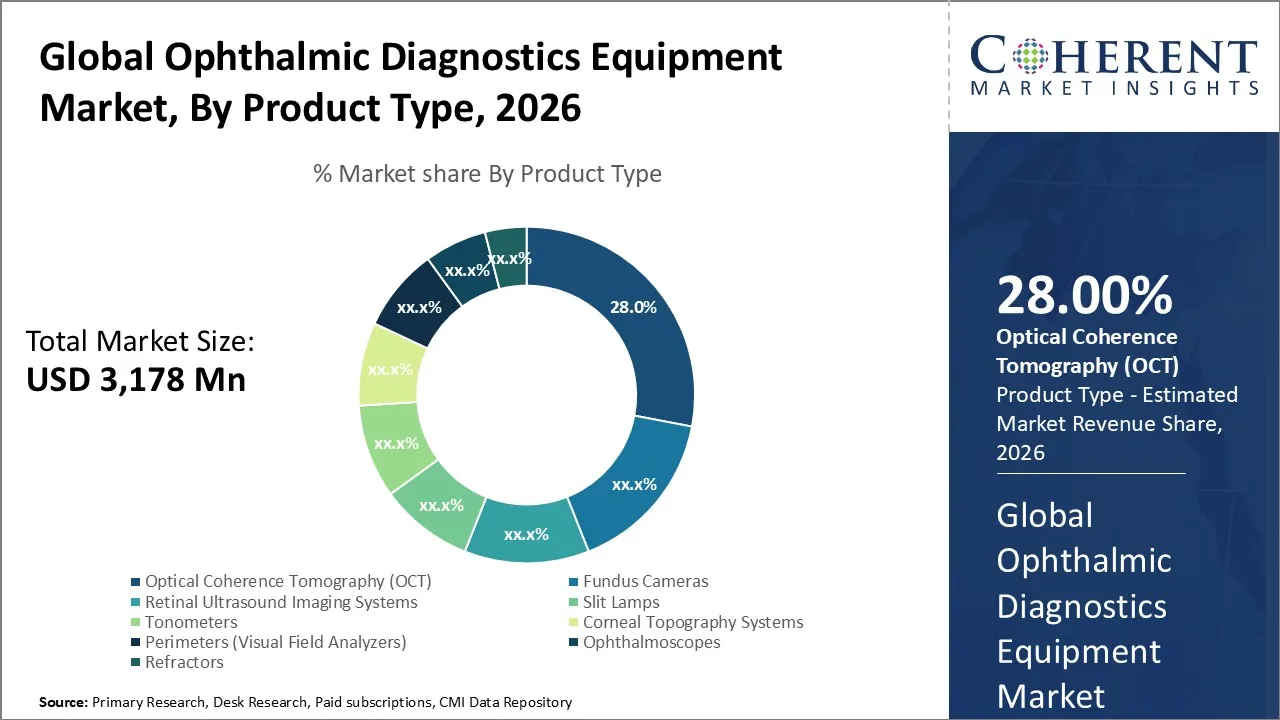
Ophthalmic Diagnostics Equipment Market Insights, By Product Type – OCT leads due to high adoption in retinal imaging
Based on product type, the Optical Coherence Tomography (OCT) market is anticipated to hold the largest market share of 28% in 2026. This is because the high-resolution imaging capabilities and sophisticated diagnostic functionalities of OCT devices make them more suited for use in hospitals and specialty care centers. The demand for OCT devices is being fueled by the increasing incidence of eye disorders and the need for rapid and accurate diagnosis.
For instance, in June 2024, NIDEK CO., LTD. unveiled RS 1 Glauvas Optical Coherence Tomography system, an innovative OCT solution that offers high-speed scanning performance (up to 250 kHz), large and deep area scanning, and deep learning analysis capabilities to support the analysis of large amounts of data in high-volume clinical environments.
Ophthalmic Diagnostics Equipment Market Insights, By End User – Hospitals dominate due to advanced facilities and patient volume
By end user, the hospital segment is anticipated to hold the largest market share of 48% in 2026. This is because hospitals are the primary users of ophthalmic diagnostic devices due to the availability of advanced diagnostic facilities and specialized ophthalmology departments.
For instance, in July 2025, the Regional Institute of Ophthalmology (RIO) at the Indira Gandhi Institute of Medical Sciences (IGIMS) in Patna introduced advanced services in ophthalmology, such as the wide field fundus camera with angiography and the ultrasound sonography unit, to improve the diagnosis and treatment of glaucoma and other eye diseases.
Regional Insights
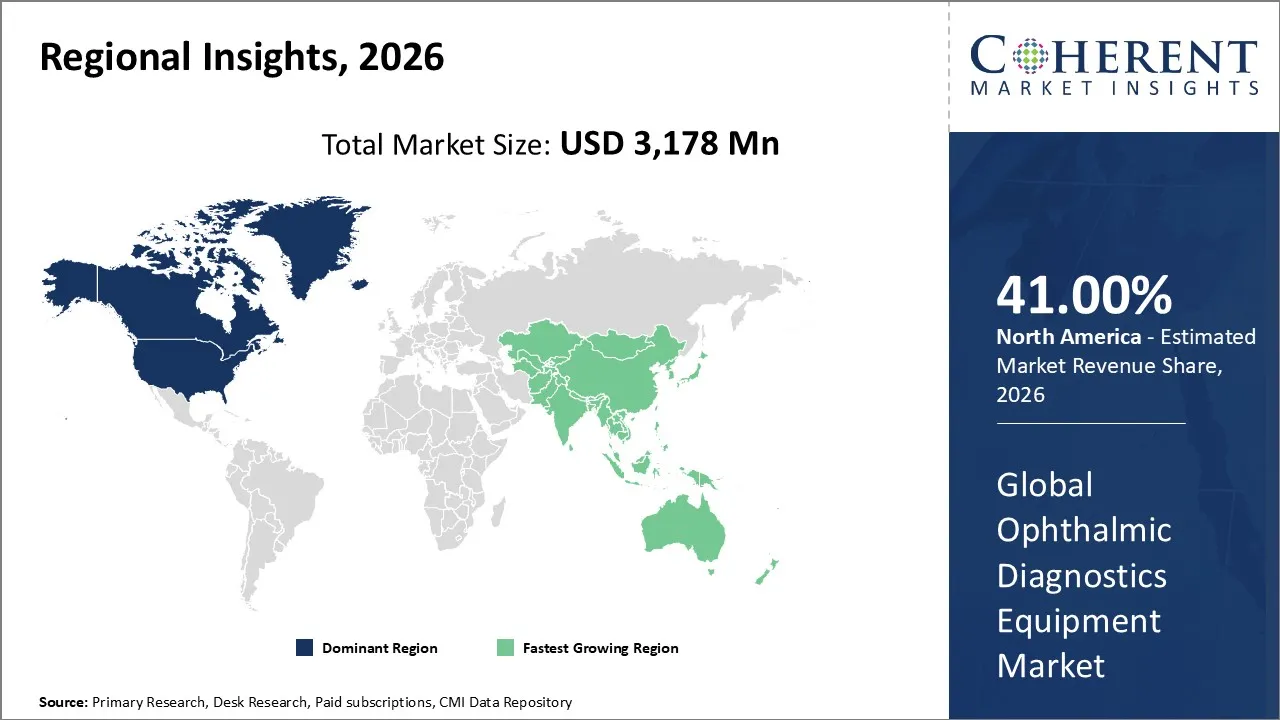
North America Ophthalmic Diagnostics Equipment Market Analysis & Trends
North America is projected to hold the foremost market position in the ophthalmic diagnostics equipment market in 2026, with a market share of 40%. The North American market for ophthalmic diagnostics equipment is growing because the healthcare system is well-developed, new diagnostic tools like OCT and fundus cameras are being used more and more, and hospitals are getting bigger with specialized ophthalmology departments.
For instance, in June 2024, Mayo Clinic expanded its ophthalmology center in Rochester, Minnesota, by adding advanced OCT and wide-field fundus camera systems to enhance early detection of retinal disorders and glaucoma.
Asia Pacific Ophthalmic Diagnostics Equipment Market Analysis & Trends
The Asia Pacific market is anticipated to be the fastest-growing market in the ophthalmic diagnostics equipment market, owing to the increasing healthcare modernization, awareness about eye diseases, and investments in eye care infrastructure in countries such as China, India, and Japan. The rising number of hospitals and government enterprises to promote eye health are driving the demand for advanced diagnostic equipment.
For instance, in December 2025, the LV Prasad Eye Institute in India launched a new wing for the diagnosis of eye disorders using OCT, fundus cameras, and corneal topography systems to increase accessibility to quality eye care.
Ophthalmic Diagnostics Equipment Market Outlook for Key Countries
Is the U.S. ophthalmic diagnostics market growing due to advanced healthcare infrastructure and high procedure volumes?
The U.S. market for ophthalmic diagnostics equipment is expected to have a bright future owing to the presence of a highly advanced healthcare infrastructure, a large number of procedures for eye care, and a high rate of acceptance of innovative imaging equipment such as OCT and fundus cameras. The North American market accounted for over 41% of the total ophthalmic devices market.
For instance, in November 2025, Evoq Technologies announced the FDA registration and U.S. commercial launch of its dark adaptation test device designed specifically for inherited retinal diseases (IRDs).
Is China driving ophthalmic diagnostics growth with healthcare modernization and screening initiatives?
The Chinese market for ophthalmic diagnostic equipment is growing at a fast pace as a part of the overall expansion in the Asia Pacific region, owing to the innovation of the healthcare sector, a huge patient base, and government initiatives for vision care. Screening programs, particularly for diabetic retinopathy, are generating a huge demand for fundus cameras, OCT scanners, and tele-ophthalmology solutions.
For instance, in June 2025, ZEISS Medical Technology announced that its CLARUS 700 ultra‑widefield retinal imaging system received approval from China’s National Medical Products Administration (NMPA).
Market Report Scope
Ophthalmic Diagnostics Equipment Market Report Coverage
| Report Coverage | Details | ||
|---|---|---|---|
| Base Year: | 2025 | Market Size in 2026: | USD 3,178 Mn |
| Historical Data for: | 2020 To 2024 | Forecast Period: | 2026 To 2033 |
| Forecast Period 2026 to 2033 CAGR: | 6.2% | 2033 Value Projection: | USD 4,848 Mn |
| Geographies covered: |
| ||
| Segments covered: |
| ||
| Companies covered: | Notal Vision, Inc., Topcon Corporation, Bausch + Lomb, ZEISS International, Ellex, Quantel Medical, Nidek Co., Ltd., Haag-Streit Group, Halma plc., Coburn Technologies Inc., and Kowa Company Ltd. | ||
| Growth Drivers: |
| ||
| Restraints & Challenges: |
| ||
Ophthalmic Diagnostics Equipment Market Driver
Rising prevalence of eye disorders and aging population
The need for cutting-edge ophthalmic diagnostic tools is being driven by the increase in eye diseases like cataracts, age-related macular degeneration, diabetic retinopathy, and glaucoma in China. OCT, fundus cameras, and tonometers are among the solutions that hospitals, clinics, and eye care facilities are increasingly implementing to enable early detection and improve patient outcomes as the Chinese population ages and awareness of eye health continues to grow.
Ophthalmic Diagnostics Equipment Market Opportunity
Adoption of AI-assisted diagnostic technologies and domestic innovation
The market presents great opportunities with the emergence of AI-assisted diagnostic tools, advanced OCT technology, and high-resolution fundus cameras. Local Chinese firms are trying to develop cost-effective solutions that can compete with imported products. In addition, software platforms that combine AI analytics for retinal disease diagnosis provide opportunities to improve the accuracy and efficiency of diagnosis.
Analyst Opinion (Expert Opinion)
- The market for ophthalmic diagnostic equipment is undergoing a paradigm shift due to the growing need for early detection and precision ophthalmology. Hospitals and eye care centers are increasingly adopting high-resolution retinal imaging and diagnostic equipment to detect the subtlest signs of glaucoma, diabetic retinopathy, and age-related macular degeneration, which were not possible to detect with the earlier technology.
- AI-based diagnostic systems are shifting from research environments to real-world applications, helping ophthalmologists quickly and correctly interpret imaging results. AI-based diagnostic systems are becoming a necessity in high-volume practices, helping experts optimize efficiency while preserving the quality of diagnosis.
- Another major contributing factor is the integration of tele-ophthalmology solutions with diagnostic imaging. By integrating AI-assisted imaging solutions with tele-consultation solutions, hospitals and clinics can provide screening services to remote areas, thus improving the early diagnosis of retinal and other eye disorders.
Speak to the analyst
Want personalized insights?
Take the findings above to one of our principal consultants, or have the report rebuilt around the segments, geographies and competitors you actually track.
Top Strategies Followed by Ophthalmic Diagnostics Equipment Market Players
- Established players focus on innovation and clinical integration. Leading companies like ZEISS, Topcon, and Nidek, are investing heavily in R&D to enhance the resolution of imaging, AI-assisted diagnosis, and workflow integration. They are also working to improve the technologies of OCT, fundus cameras, and tonometers to increase the accuracy and speed of diagnosis.
- Mid-level players compete on cost-effectiveness while keeping quality high. These companies use regional manufacturing facilities, optimize their manufacturing processes, and set up scalable supply chains to give mid-tier hospitals and community clinics diagnostic equipment that doesn't cost too much.
- Niche diagnostic solutions are the focus of small-scale brands. Some of them concentrate on tele-ophthalmology solutions, portable imaging devices, or AI-powered software for early disease detection. These businesses can gain recognition and adoption by serving underserved markets, like outpatient clinics or rural clinics. To increase their reach, they might collaborate with nearby medical facilities, academic institutions, or healthcare networks; some might even use mobile diagnostic tools or cloud-based analytics.
Emerging Startups in the Ophthalmic Diagnostics Equipment Market
- Innovative startups are working on developing AI-assisted diagnostic tools. AI-assisted OCT and fundus imaging solutions are being developed by companies like TowardPi Medical and MIAS Technologies to help with the automatic detection of AMD, glaucoma, and diabetic retinopathy.
- Emphasis on cost-effective and accessible solutions. Numerous startups have created compact, portable devices that can be utilized in rural clinics and community hospitals. This is accomplished by reducing the size, complexity, and cost of the devices.
- Integration of tele-ophthalmology and niche solutions. Additionally, startups are using telemedicine platforms and remote diagnostic solutions to address the unmet needs of niche populations. For instance, ophthalmologists can remotely assess patients' retinal health by using AI and cloud-based imaging solutions to screen patients in remote areas.
Ophthalmic Diagnostics Equipment Industry News
- In July 2025, Topcon Healthcare, a division of Topcon Corporation, announced that it had bought Intelligent Retinal Imaging Systems (IRIS), a U.S.-based cloud-based retinal screening technology with AI-assisted diagnostics. This made connected eye care and early disease detection stronger in both primary and eye care settings.
- In October 2025, NIDEK Inc. announced distribution of the Medmont Meridia™ Vantage advanced topographer to U.S. ophthalmologists and optometrists, expanding diagnostic offerings through enhanced scleral imaging and dry eye analysis tools.
Market Segmentation
- Product Type Insights (Revenue, USD Mn, 2026 - 2033)
- Fundus Cameras
- Retinal Ultrasound Imaging Systems
- Refractors
- Slit Lamps
- Perimeters
- Ophthalmoscopes
- Tonometer
- Optical Coherence Tomography (OCT)
- Corneal Topography Systems
- End User Insights (Revenue, USD Mn, 2026 - 2033)
- Hospitals
- Clinics
- Ambulatory Surgical Centers
- Regional Insights (Revenue, USD Mn, 2026 - 2033)
- North America
- U.S.
- Canada
- Latin America
- Brazil
- Argentina
- Mexico
- Rest of Latin America
- Europe
- Germany
- U.K.
- Spain
- France
- Italy
- Russia
- Rest of Europe
- Asia Pacific
- China
- India
- Japan
- Australia
- South Korea
- ASEAN
- Rest of Asia Pacific
- Middle East
- GCC Countries
- Israel
- Rest of Middle East
- Africa
- South Africa
- North Africa
- Central Africa
- North America
- Key Players Insights
- Notal Vision, Inc.
- Topcon Corporation
- Bausch + Lomb
- ZEISS International
- Ellex
- Quantel Medical
- Nidek Co., Ltd.
- Haag-Streit Group
- Halma plc.
- Coburn Technologies Inc.
- Kowa Company Ltd
Sources
Primary Research Interviews
- Ophthalmic Diagnostics Equipment Manufacturers & Brand Managers
- Product Designers & R&D Heads in Ophthalmic Devices
- Hospital & Clinic Procurement Managers
- Ophthalmologists, Optometrists & Eye Care Specialists
- Medical Device Distributors & Suppliers
- Laboratory & Imaging Center Managers
- Regulatory Affairs & Compliance Experts
- Others
Databases
- PubMed
- ClinicalTrials.gov
- U.S. FDA & NMPA Device Databases
- ScienceDirect
- Scopus
- Web of Science
- Others
Magazines
- Ophthalmology Times
- Ophthalmology Management
- Review of Ophthalmology
- Ophthalmology Times Europe
- EyeWorld
- Others
Journals
- Ophthalmology
- American Journal of Ophthalmology
- British Journal of Ophthalmology
- Investigative Ophthalmology & Visual Science
- Journal of Cataract & Refractive Surgery
- Others
Newspapers
- The New York Times – Health Section
- The Wall Street Journal – Health & Technology Section
- Reuters Health
- Bloomberg News – Medical Devices & Healthcare
- Financial Times – Healthcare & Technology Section
- Others
Associations
- American Academy of Ophthalmology (AAO)
- Association for Research in Vision and Ophthalmology (ARVO)
- International Council of Ophthalmology (ICO)
- European Society of Cataract & Refractive Surgeons (ESCRS)
- World Health Organization (WHO) – Eye Care Division
- Others
Public Domain Sources
- U.S. FDA Device Approval & Registration Database
- China NMPA Medical Device Approvals
- Clinical Guidelines & Publications from AAO & ARVO
- WHO – Vision and Eye Health Reports
- Government Health Ministry Publications (U.S., China, EU)
- Others
Proprietary Elements
- CMI Data Analytics Tool
- Proprietary CMI Existing Repository of Information for the Last 8 Years
Get access to 250+ pages report
Every segment, forecast, competitor profile and data table behind the analysis above — available for instant download.
- ESOMAR Member
- ISO 9001:2015 Certified
- D-U-N-S Registered
- GDPR & CCPA Compliant
Missing comfort of reading report in your local language? Find your preferred language:
Transform your Strategy with Exclusive Trending Reports
Frequently Asked Questions
The Ophthalmic Diagnostics Equipment Market is estimated to be valued at USD 3,178 Mn in 2026, and is expected to reach USD 4,848 Mn by 2033.
The CAGR of the Ophthalmic Diagnostics Equipment Market is projected to be 6.2% from 2026 to 2033.
Increasing prevalence of eye disorders such as glaucoma, diabetic retinopathy, and age-related macular degeneration (AMD), growing adoption of advanced diagnostic technologies like OCT and fundus imaging, and rising awareness of eye health are the major factors driving market growth.
High cost of advanced ophthalmic diagnostic devices, regulatory hurdles in some regions, and lack of trained professionals in certain markets are major factors limiting market growth.
Notable players include Notal Vision, Inc., Topcon Corporation, Bausch + Lomb, ZEISS International (Carl Zeiss Meditec), Ellex, Quantel Medical, Nidek Co., Ltd., Haag-Streit Group, Halma plc., Coburn Technologies Inc., and Kowa Company Ltd.
North America and Asia-Pacific are leading regions, driven by high adoption rates, increasing prevalence of eye diseases, and expanding healthcare infrastructure.
The adoption of AI-assisted diagnostic technologies, development of cost-effective domestic solutions, tele-ophthalmology integration, and expansion of early disease screening programs present significant opportunities for growth.