

Optical Coatings Market Analysis & Forecast: 2026-2033
Optical Coatings Market is estimated to be valued at USD 17.96 Bn in 2026 and is expected to reach USD 27.55 Bn in 2033, exhibiting a compound annual growth rate (CAGR) of 6.3% from 2026 to 2033.
Key Takeaways
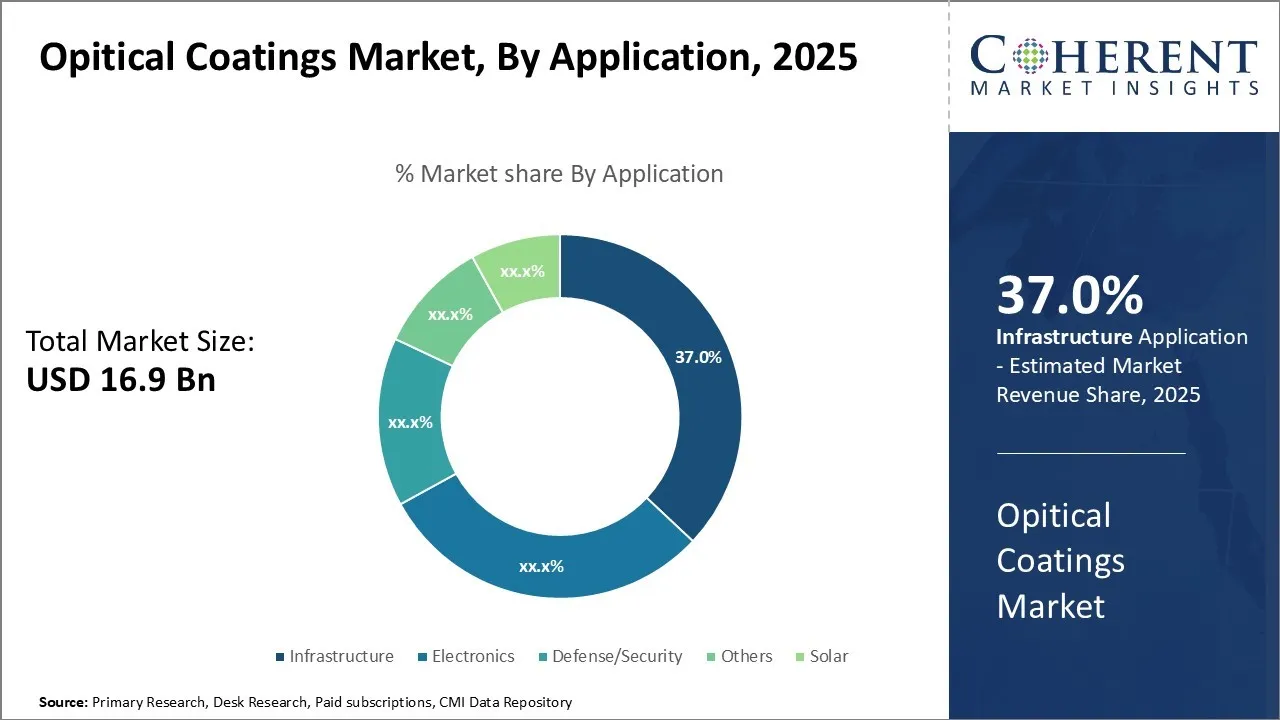
- By Application, The Infrastructure Segment is projected to lead the global optical coatings market with a 38% share in 2026, fuelled by increasing adoption of coated glass and optical components in smart buildings, urban development, and energy-efficient construction.
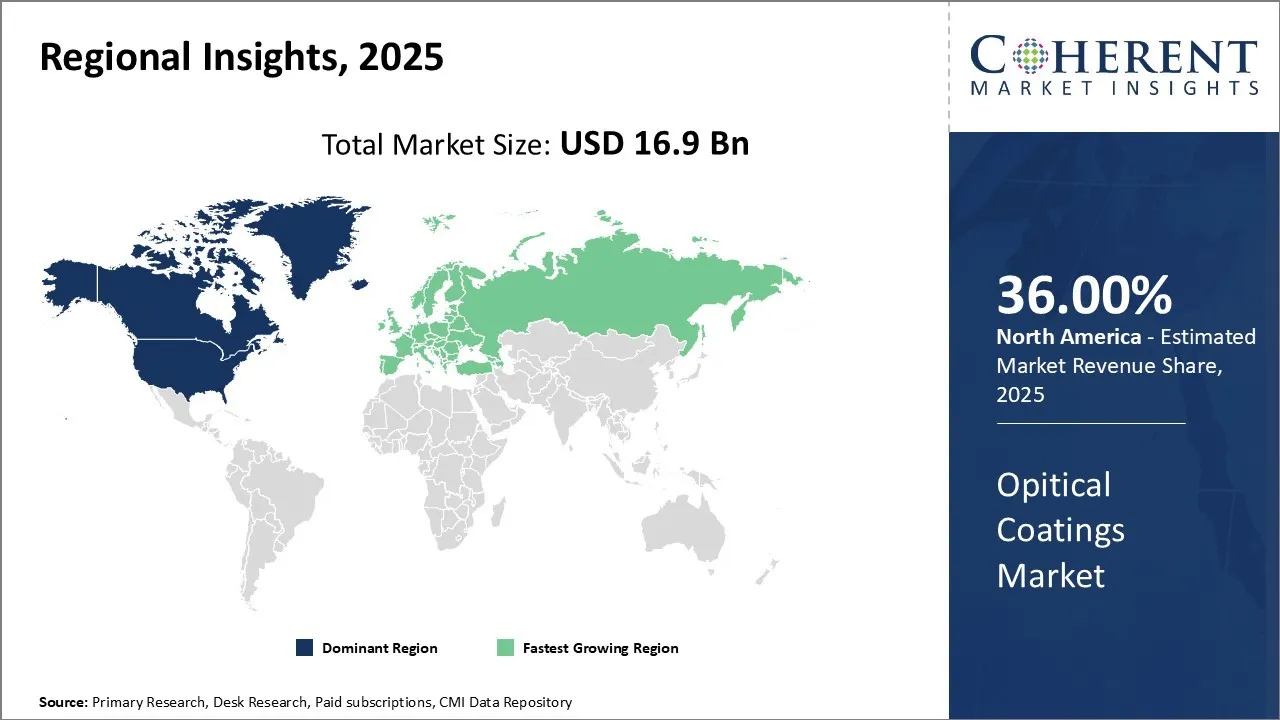
- North America is expected to maintain a leading position in the global optical coatings market, with an estimated 36% share in 2026.
Market Overview
The global Optical Coatings Market is witnessing strong growth, driven by rising demand for energy-efficient materials, high-performance optics, and advanced display technologies. Optical coatings are widely used across industries such as consumer electronics, automotive, aerospace, and infrastructure. These coatings enhance light transmission, reduce reflection, and improve durability.
Current Events and its Impact on the Optical Coatings Market
Current Event | Description and its impact |
Growing Demand for Energy-Efficient Infrastructure |
|
Advancements in Optical Coating Technologies |
|
Rising Investment in Advanced Automotive Technologies |
|
Pricing Analysis Optical Coatings Market
The pricing dynamics of the optical coatings market are influenced by factors such as raw material costs, technological complexity, application type, and production scale. High-performance coatings, including anti-reflective, mirror, and filter coatings, command premium prices due to their precision engineering and specialized formulations involving materials like titanium dioxide, silicon dioxide, and fluorides.
Prices also vary by substrate type and deposition technique vacuum deposition and sputtering methods tend to be more expensive due to equipment and labour intensity. Additionally, pricing is impacted by end-use industry demands; aerospace and defence applications often require stringent quality standards, resulting in higher costs compared to commercial or consumer electronics.
Regional manufacturing capabilities and supply chain efficiency further affect price competitiveness, with North America and Asia Pacific offering cost advantages through economies of scale and technological innovation. As demand for energy-efficient and durable optical coatings grows, particularly in solar, automotive, and smart devices, price variations are expected to remain significant.
- Current Industry Events of 2026
- Market Size Estimation
- Regional Breakdown
- Competitive Landscape
- Customer Intelligence
- Segmental Analysis
- Pricing Analysis
- Key Market Drivers, Challenges & Future Trends
- Customized Insights Section
Role of Advanced Technology Optical Coatings Market
Advanced technology plays a pivotal role in shaping the growth and innovation within the optical coatings market. Cutting-edge deposition techniques such as ion beam sputtering, atomic layer deposition (ALD), and advanced vacuum coating systems enable the production of ultra-thin, highly uniform coatings with superior optical properties and durability. These technologies enhance precision in layer thickness control, improve adhesion, and reduce defects, which is crucial for high-performance applications in aerospace, defence, telecommunications, and medical devices.
Additionally, advancements in nanotechnology and materials science have led to the development of multifunctional coatings, such as anti-reflective, anti-fog, and self-cleaning layers, which enhance product performance across a variety of environments. Integration of AI and machine learning in coating design and process optimization further accelerates innovation by enabling predictive modelling and real-time quality control. As industries demand higher optical efficiency, durability, and environmental resistance, advanced technologies continue to drive market competitiveness and product differentiation.
Optical Coatings Market Trends
- Increasing demand for smartphones
Growing smartphones market is expected to drive the market growth of optical fibres due to increasing penetration of the internet across the globe. For instance, in 2022, International Telecommunication Union, stated that, 66% of the global population or 5.3 billion people are using internet. Thus, growing penetration of smartphones around the globe is expected to propel the market growth of optical coatings as it is used in display coating of smartphones.
In April 2025, Reuters reported that Corning forecast its Q2 core sales would exceed Wall Street estimates, driven by strong demand for its optical fibre and connectivity products used in AI data centres and 5G network expansion. This highlights robust investment in advanced optical components relying on high-performance coatings.
- Continuous technological advancements and expansion
Technological advancements in the field of optical deposition techniques and fabrications is expected to drive the market growth. For instance, in April 2023, Abrisa Industrial Glass (AIG), a division of Abrisa Technologies, now has the largest U.S.-based technical glass inventory after the major advancement, making it possible for the company to respond quickly, select the best materials to meet the growing demand for U.S.-based manufacturing, reduce logistical costs, and manage unstable global glass supply chains without stress.
In June 2025, Digitimes Asia reported that Morrison, a Taiwanese precision-coating specialist, listed on an emerging stock market. Morrison is the first company in Asia to mass-produce 8‑inch optical coatings using semiconductor-grade lithography processes a milestone for regional capabilities in optical coating technologies.
Opportunities in the Optical Coatings Market
- Consumer adopting smart televisions
Increasing adoption of smart televisions among consumer due to the improving lifestyle and increasing disposable income of the consumers. The growing trend of wearing smart watches among young population is also expected to drive the market growth. Growing semiconductor industry, coupled with the technological advancements are further expected to drive the market growth of optical coatings.
Segmental Insights
Optical Coating Market Insights, By Application
The infrastructure segment is projected to lead the global optical coatings market with a commanding 38.0% share in 2026, fuelled by the widespread adoption of coated glass and optical components in smart buildings, energy-efficient construction, and urban infrastructure projects.
Optical coatings such as anti-reflective, low-emissivity (low-E), and solar control coatings play a critical role in enhancing building energy performance, improving daylight transmission, and extending the durability of architectural glass in harsh environmental conditions.
Governments across regions are actively promoting sustainable urban development through green building certifications, carbon neutrality goals, and energy-efficiency regulations. These initiatives are accelerating the use of advanced optical coatings in commercial, residential, and institutional structures. Additionally, the rising demand for climate-adaptive materials in infrastructure design including smart windows and building-integrated photovoltaics is further strengthening the segment’s dominance in the optical coatings market.
Regional Insights
North America Optical Coatings Market Trends and Analysis
North America is expected to maintain a leading position in the global optical coatings market, with an estimated 36.00% share in 2026. This regional dominance is supported by strong demand from the construction, aerospace, and defence sectors. The United States, in particular, is witnessing substantial investments in high-tech infrastructure, smart city projects, and solar energy installations all of which rely heavily on precision optical coatings to enhance durability, improve energy efficiency, and ensure optimal performance.
Furthermore, the presence of advanced manufacturing capabilities, state-of-the-art R&D facilities, and key coating technology providers such as PPG Industries and DuPont bolsters the region’s competitive edge. Regulatory emphasis on clean energy, coupled with government incentives for green building technologies, continues to accelerate the adoption of innovative optical coatings across a wide range of applications including telecommunications, automotive, and electronics.
Optical Coatings Market Dominating Countries
United States and Canada
The United States is a dominant player in the global optical coatings market, driven by strong demand across critical sectors such as aerospace, defence, construction, and renewable energy. Substantial investments in smart city infrastructure, solar power installations, and high-performance optical systems have intensified the need for advanced coating technologies.
The country benefits from a robust ecosystem of leading manufacturers, including PPG Industries and DuPont, along with a well-established network of R&D institutions and technology start-ups focused on material innovation. Regulatory support for clean energy solutions and building efficiency continues to accelerate market growth, positioning the U.S. at the forefront of optical coatings innovation and adoption.
Canada complements this leadership with a strategic focus on sustainable development and advanced manufacturing. The country is actively investing in green infrastructure, renewable energy projects, and smart technologies that rely on high-performance optical coatings for optimal efficiency and longevity.
Canadian companies are increasingly adopting cutting-edge coating technologies to enhance the performance of solar panels, architectural glass, and optical devices used in telecommunications and defence. Federal and provincial initiatives promoting clean energy and energy-efficient building practices are further strengthening Canada’s role as a key contributor to North America’s optical coatings market expansion.
Market Report Scope
Optical Coatings Market Report Coverage
| Report Coverage | Details | ||
|---|---|---|---|
| Base Year: | 2025 | Market Size in 2026: | USD 17.96 Bn |
| Historical Data for: | 2020 To 2024 | Forecast Period: | 2026 To 2033 |
| Forecast Period 2026 to 2033 CAGR: | 6.3% | 2033 Value Projection: | USD 27.55 Bn |
| Geographies covered: |
| ||
| Segments covered: |
| ||
| Companies covered: | 3M Precision Optics, Ophir Optronics, Ltd., PPG Industries, Janos Technology, Inc., Abrisa Technologies, Denton Vacuum, LLC, JDS Uniphase Corporation, Inrad Optics, Newport Corporation, and Optical Coatings Japan | ||
| Growth Drivers: |
| ||
| Restraints & Challenges: |
| ||
Analyst Viewpoint – Optical Coatings Market
- The global optical coatings market is driven by the rising demand for high-performance optical solutions across industries such as consumer electronics, automotive, aerospace, and renewable energy. The increasing need for energy-efficient, durable, and multifunctional coatings is a key factor propelling market growth.
- Experts emphasize the strong uptake of anti-reflective and protective coatings in solar panels, display technologies, and advanced optical instruments, citing their role in improving energy output and visual clarity. The shift toward smart technologies and electric vehicles further amplifies demand for innovative optical coating materials.
- North America remains a dominant market, supported by advanced manufacturing capabilities, robust R&D infrastructure, and investments in smart city and defence projects. Simultaneously, Asia Pacific is witnessing rapid expansion due to large-scale electronics production, infrastructural growth, and increasing consumer demand.
- Looking forward, analysts expect breakthroughs in nan coating technologies, AI-driven process optimization, and sustainable coating materials to shape the market’s next phase, enhancing performance, cost efficiency, and eco-compatibility.
Optical Coatings Market: Key Development
- In May 2025, At the May 2025 Optical Interference Coatings Conference in Tucson, Lidaris showcased advanced photo-thermal common-path interferometry methods for assessing laser-induced damage thresholds in optical coatings, offering valuable insights for high-power and defense-grade applications.
- In June 2024, TriNANO Technologies launched a nanocoating for solar panels that boosts energy output by up to 4% through combined light-trapping, anti-reflective, and self-cleaning effects.
- In May 2024, Buhler Leybold Optics introduced new solvent-free coaters for architectural glass achieving a 22% improvement in energy efficiency and reducing VOC emissions.
Market Segmentation
- Global Optical Coatings Market, By Product Type (Revenue, USD Bn, 2021 - 2033)
- Anti-reflective Coatings
- Filter Coatings
- Transparent Electrodes
- Reflective Coatings
- Others
- Global Optical Coatings Market, By Application (Revenue, USD Bn, 2021 - 2033)
- Electronics
- Defense/Security
- Infrastructure
- Solar
- Others
- Global Optical Coatings Market, By Region (Revenue, USD Bn, 2021 - 2033)
- North America
- U.S.
- Canada
- Latin America
- Brazil
- Argentina
- Mexico
- Rest of Latin America
- Europe
- Germany
- U.K.
- Spain
- France
- Italy
- Russia
- Rest of Europe
- Asia Pacific
- China
- India
- Japan
- Australia
- South Korea
- ASEAN
- Rest of Asia Pacific
- Middle East
- GCC Countries
- Israel
- Rest of Middle East
- Africa
- South Africa
- North Africa
- Central Africa
- North America
- Company Profiles
- 3M Precision Optics
- Ophir Optronics, Ltd.
- PPG Industries
- Janos Technology, Inc.
- Abrisa Technologies
- Denton Vacuum, LLC
- JDS Uniphase Corporation
- Inrad Optics
- Newport Corporation
- Optical Coatings Japan
Sources
The Stakeholders Consulted
- Product development managers and materials engineers in optics and photonics
- Manufacturers and suppliers of optical coating equipment and materials
- R&D heads from optical and nanotechnology laboratories
- Regulatory bodies and environmental compliance advisors (optics and chemicals)
- Research institutions focused on materials science and surface engineering
- Government agencies supporting electronics, defense, and solar infrastructure
- End-users across sectors such as aerospace, defense, electronics, automotive, and solar energy
Databases Opened
- U.S. Patent and Trademark Office (USPTO) – Optical Coating Innovations
- National Renewable Energy Laboratory (NREL) – Solar and Coating Technologies
- European Commission – Advanced Materials and Coating Technologies
- Ministry of Electronics & IT (India) – Semiconductor and Display Ecosystem Data
- World Bank Open Data – Manufacturing & High-tech Exports
Magazines & Trade Publications
- Photonics Spectra
- Laser Focus World
- Coatings World
- Advanced Materials & Coatings News
- Display Daily – Optical Display Technology Section
- Semiconductor Digest – Coatings for Chips and Optics
Scientific and Industry Journals
- Applied Optics
- Thin Solid Films
- Journal of Vacuum Science & Technology A
- Optical Materials Express
- Journal of Coatings Technology and Research
- Surface and Coatings Technology
Newspapers & Media Outlets
- The Wall Street Journal – Technology & Electronics
- Bloomberg – Advanced Materials and Manufacturing
- Reuters – Defense and Photonics Market Updates
- The Economic Times – Electronics & Specialty Chemicals
- Business Standard – High-tech Manufacturing and R&D
Associations and Regulatory Bodies
- Optical Society (Optica)
- SPIE – The International Society for Optics and Photonics
- ASTM International – Committee D01 on Paint and Related Coatings
- Bureau of Indian Standards (BIS) – Optics and Glass Division
- European Optical Society (EOS)
- U.S. Environmental Protection Agency (EPA) – Coating Emissions Standards
Public Domain Sources
- U.S. Energy Information Administration (EIA) – Solar and Electronics Manufacturing
- European Commission – Horizon Europe Materials & Coatings Programs
- National Center for Biotechnology Information (NCBI) – Optical Biosensors & Coatings
- World Bank – High-Tech and Industrial Performance Metrics
- International Renewable Energy Agency (IRENA) – Optical Films in Solar PV
Proprietary Research Elements
- CMI Data Analytics Tool
- Proprietary CMI Repository of Market Data (covering past 8 years)
- CMI Expert Interviews and Transcripts (focused on optical coatings, advanced materials, and end-user trends in aerospace, defense, and solar energy)
*Definition: Optical coating is deposition of thin layers of films that create interference effects, in order to enhance reflection and transmission properties of an optical system. Optical coatings enhances optical functions, and provide protection to eye from harsh environmental conditions. These coatings are manufactured by using rare earth materials, oxides, and metals.
Get access to 250+ pages report
Every segment, forecast, competitor profile and data table behind the analysis above — available for instant download.
- ESOMAR Member
- ISO 9001:2015 Certified
- D-U-N-S Registered
- GDPR & CCPA Compliant
Missing comfort of reading report in your local language? Find your preferred language:
Transform your Strategy with Exclusive Trending Reports
Frequently Asked Questions
The Optical Coatings Market size is estimated to be valued at USD 17.96 Bn in 2026, and is expected to reach USD 27.55 Bn by 2033.
Global optical coatings market is estimated to surpass USD 27.55 Bn by 2033, exhibiting a CAGR of 6.3% between 2026 and 2033.
Growing market of smartphones and increasing demand for reflective coatings in green buildings for heat retention and reducing consumption of energy are the main factors to drive the market growth.
The CAGR of the Optical Coatings industry is projected to be 6.3% from 2026 to 2033.
Key Companies are 3M Precision Optics, Ophir Optronics, Ltd., PPG Industries, Janos Technology, Inc., Abrisa Technologies, Denton Vacuum, LLC, JDS Uniphase Corporation, Inrad Optics, Newport Corporation, and Optical Coatings Japan.
The fluctuating price of raw materials that are used in coatings can hinder the market growth during the forecast period.
Common materials for optical coatings include metal oxides like titanium dioxide (TiO₂), silicon dioxide (SiO₂), and aluminum oxide (Al₂O₃), as well as metals such as silver and aluminum for reflective layers.