

Paper Coating Materials Market Size and Forecast – 2026 to 2033
The Paper Coating Materials Market is anticipated to grow at a CAGR of 4.1% with USD 1.8 Bn in 2026 and is expected to reach USD 2.6 Bn in 2033. Increasing demand for premium packaging, labels, magazines, and specialty paper products is driving the Paper Coating Materials Market. According to our research, luxury packaging industry is estimated to surpass USD 25.71 Bn in 2033.
Key Takeaways
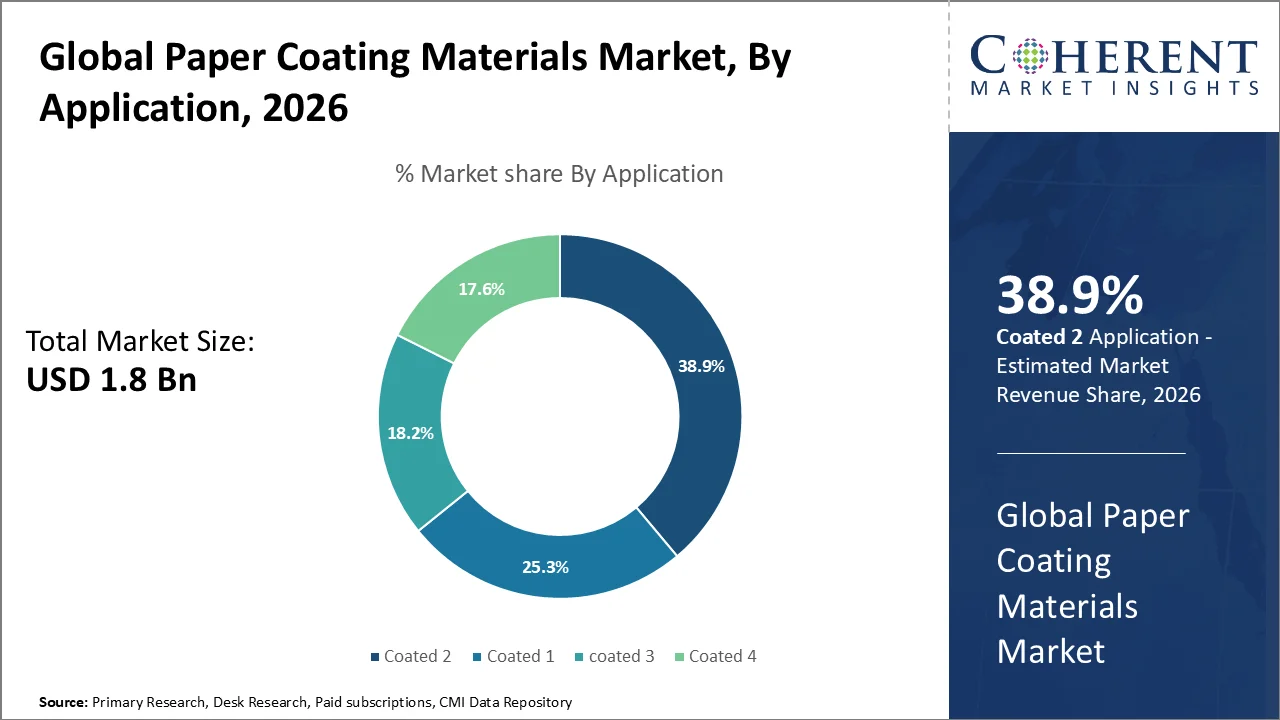
- Coated 2 hold the largest market share of 38.9% in 2026 owing to the rapid growth in packaging and e-commerce.
- Starch expected to hold largest market share of 37.9% in 2026 owing to its growing demand for sustainable coating materials. Starch and its derivatives are widely used in the paper industry because they are biodegradable, readily available, and cost-effective.
- Printing acquired the largest market share of 41.1% in 2026 owing to the growing demand for high-quality printed materials.
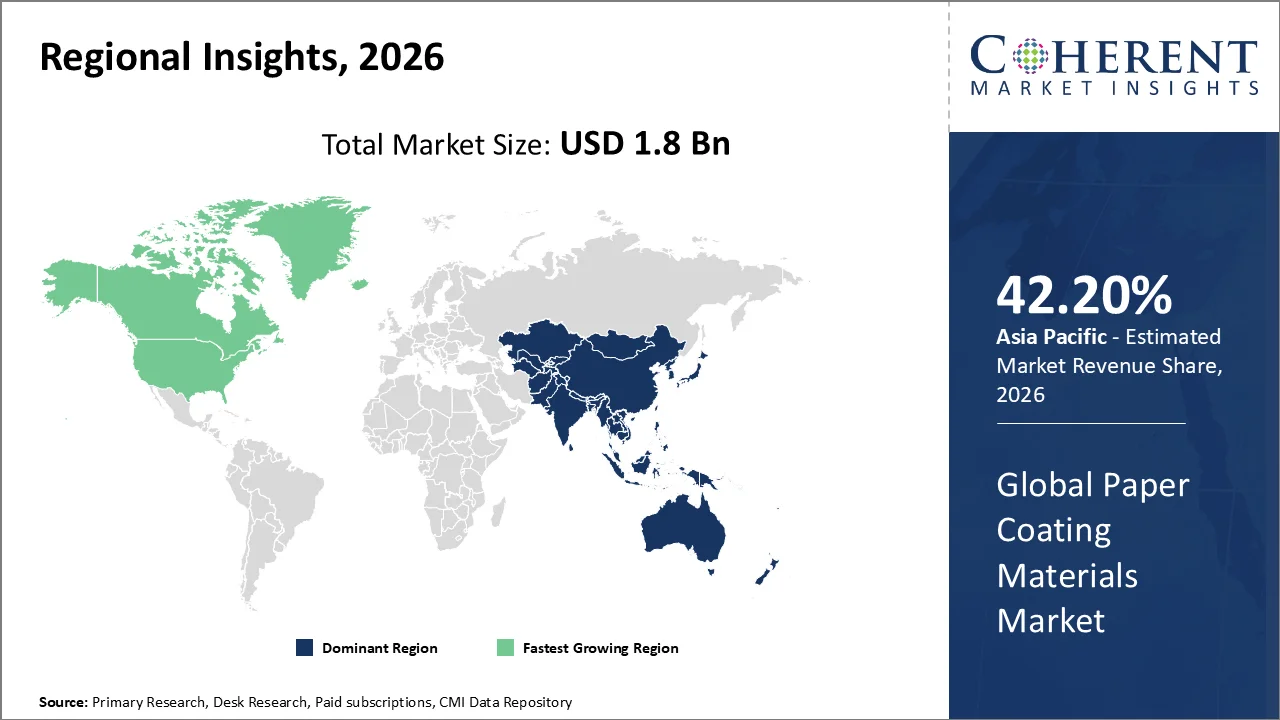
- Asia Pacific is expected to acquire the dominant share of 42.2% in 2026 owing to its rapid expansion of the packaging industry. According to the India Brand Equity Foundation, the Indian paper industry maintained strong demand in FY 2025–26, with IPMA member mills achieving 5,208 thousand tonnes of production against an installed capacity of 5,368 thousand tonnes, representing 97.01% capacity utilization.
Current Events and Their Impact on the Paper Coating Materials Market
Current Event | Description and its Impact |
EU Deforestation Regulation (EUDR) moves toward implementation for wood and paper products |
|
EU regulatory pressure on food-contact paper and board materials |
|
Segmental Insights
- Current Industry Events of 2026
- Market Size Estimation
- Regional Breakdown
- Competitive Landscape
- Customer Intelligence
- Segmental Analysis
- Pricing Analysis
- Key Market Drivers, Challenges & Future Trends
- Customized Insights Section
Why is Coated 2 Acquiring the Largest Market Share?
Coated 2 hold the largest market share of 38.9% in 2026. Coated 2 in the Paper Coating Materials Market benefits from rising demand for high-quality coated papers across commercial printing, publishing, magazines, catalogs, brochures, and premium promotional materials. Manufacturers use coatings to enhance surface smoothness, brightness, opacity, gloss, and ink receptivity, producing sharper images and more vibrant colors. Increasing demand for attractive printed products and premium packaging further drives adoption. Advances in coating formulations and printing technologies improve printability and surface performance, while manufacturers develop more sustainable coating solutions to address environmental concerns and evolving customer preferences. For instance, BASF expanded its certified biomass balance (BMB) additives portfolio with three new products—Dispex AA 4145 MB, Rheovis PU 1333 MB, and Rheovis HS 1169 MB—helping architectural coating manufacturers reduce product carbon footprints while maintaining high performance.
Starch expected to hold largest market share
Starch expected to hold largest market share of 37.9% in 2026 owing to its replacement of petroleum-based binders. Starch drives the Paper Coating Materials Market through its affordability, broad availability, biodegradability, and effective binding properties. Paper manufacturers incorporate starch into coatings to enhance rheology, surface strength, smoothness, brightness, opacity, and printability. Growing demand for renewable and sustainable materials encourages manufacturers to replace petroleum-based binders with starch-based alternatives. Innovations in starch modification, bio-latex, and starch-based nanocomposites are also expanding starch applications in coated paper and paperboard, especially across printing, packaging, and functional coating applications.
Which End User segment dominates the market?
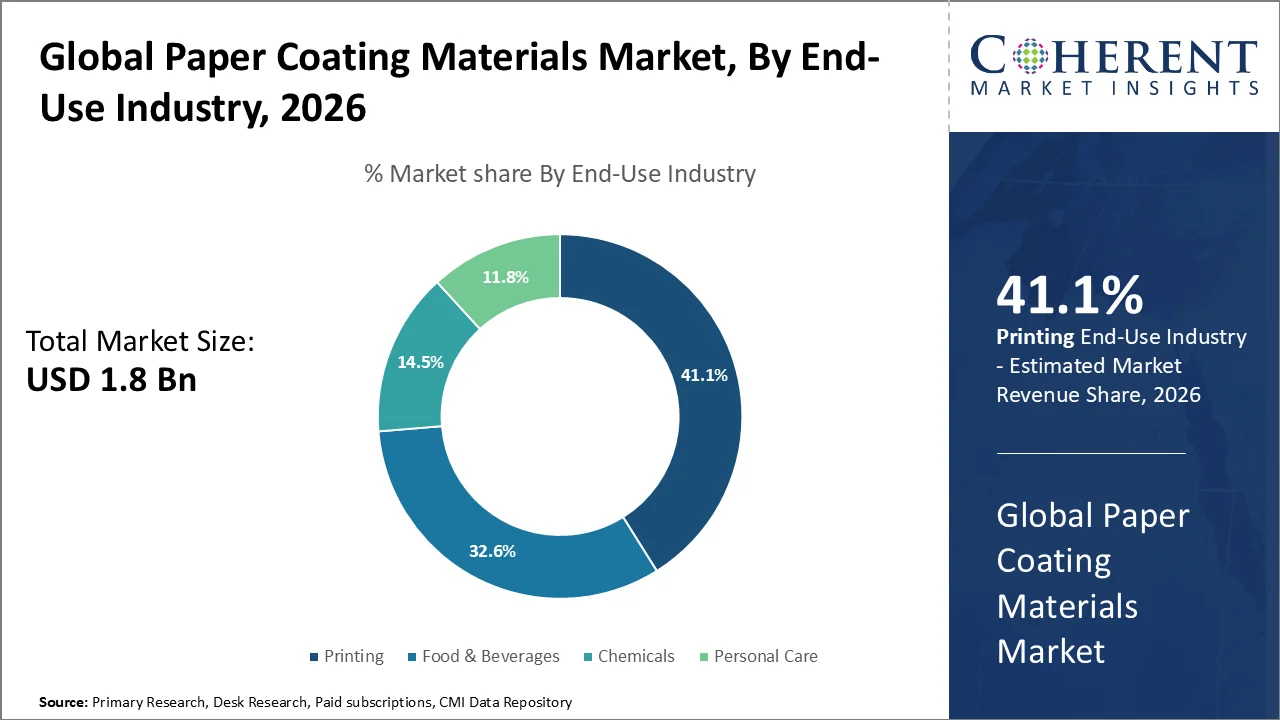
Printing acquired the largest market share of 41.1% in 2026. Printing in the Paper Coating Materials Market benefits from rising demand for high-quality printed materials with enhanced smoothness, gloss, brightness, opacity, and color reproduction. Manufacturers apply paper coatings to produce sharper images, improve ink holdout, and maintain consistent print quality across magazines, catalogs, brochures, labels, and premium packaging. Increasing demand for visually appealing branding and advertising materials further boosts coated paper consumption. Advances in coating formulations and digital-printing technologies improve print performance, while manufacturers adopt sustainable coating solutions to address evolving environmental requirements. In August 2026, MM Board & Paper has expanded its sustainable paper-based portfolio with MM POLAR PLUS, a machine-finished bleached kraft paper available in 40, 45, and 50 g/m² grades for food and non-food applications.
Paper Coating Materials Market Trends
- Rising adoption of recyclable barrier coatings is driven by the need to provide moisture, grease, oxygen, and aroma resistance while maintaining the recyclability of paper-based packaging. This trend is supported by the strong recycling performance of paper packaging: 83.1% of paper and cardboard packaging was recycled in the EU-27 in 2022, the highest recycling rate among major packaging materials.
- Growing demand for water-based and bio-based coating technologies reflects manufacturers’ efforts to replace conventional coating systems with lower-impact, renewable, and repulpable alternatives. In Europe, the paper recycling chain completed an average of four recycling cycles per fibre in 2024, reinforcing the importance of coating formulations that remain compatible with established recycling processes.
- Advances in sustainable coating formulations are increasingly focused on achieving higher barrier performance with lower coating weights and improved processing efficiency. The importance of recycling-compatible formulations is reinforced by the scale of existing paper recovery systems: the U.S. recycled approximately 46 million tons of paper in 2024, with a paper recycling rate of 60–64% and a cardboard recycling rate of 69–74%.
Regional Insights
Asia Pacific dominates owing to shift from plastic toward paper-based packaging
Asia Pacific is expected to acquire the dominant share of 42.20% in 2026. Asia Pacific drives the Paper Coating Materials Market through rapid industrialization, urbanization, and expanding packaging industries across China, India, Japan, and Southeast Asia. Growing e-commerce, food delivery, FMCG, and retail sectors are increasing demand for coated paper and paperboard packaging. India’s quick-commerce market reached approximately USD 7–8 billion in FY2025, growing at a 110–130% CAGR during 2021–25, and is projected to reach USD 65–70 billion by 2030, accounting for nearly half of incremental e-retail growth. Consumers increasingly prefer attractive and sustainable packaging, encouraging manufacturers to adopt advanced coatings. Strong regional paper production capabilities and investments in coating technologies further support market development. Government initiatives that promote recyclable packaging and reduce plastic consumption are also pushing manufacturers to develop sustainable, high-performance paper coating solutions.
North America Paper Coating Materials Market Trends
Rising demand for sustainable and recyclable packaging drives the North America paper coating materials market, especially across food, e-commerce, consumer goods, and pharmaceutical applications. Plastic-reduction initiatives encourage manufacturers to develop advanced barrier coatings that deliver moisture, grease, and oxygen resistance. Growing demand for premium labels and high-quality printed materials further strengthens the market by requiring better gloss, smoothness, and printability. Meanwhile, digital printing advancements and the development of bio-based formulations, water-based coatings, and innovative coating technologies continue to foster product development and create new market opportunities. CJ Biomaterials has launched PHACT CB0504A, an all-PHA compound for extrusion paper coatings, certified by TUV Austria for home, industrial, and marine biodegradability. BPI certification is underway.
China Paper Coating Materials Market Trends
China’s paper coating materials market benefits from the rapid growth of e-commerce, packaging, and consumer goods industries, which drive demand for coated paper and board with better printability, durability, and barrier properties. Food and beverage manufacturers increasingly require moisture- and grease-resistant packaging, further boosting coating material demand. Environmental regulations and initiatives to reduce plastic waste encourage manufacturers to develop recyclable and bio-based coatings. Technological advancements, expanding domestic paper production, demand for premium packaging, and strong export-oriented manufacturing also create new opportunities for market growth. In March 2026, Henkel launched Loctite Liofol CS 7106 RE, a cold-seal solution for barrier-coated paper packaging that enables reliable production of recyclable packs without heat exposure.
United States Paper Coating Materials Market Trends
The United States paper coating materials market is primarily driven by growing demand for sustainable packaging across food, beverage, healthcare, consumer goods, and e-commerce sectors. Consumers and manufacturers increasingly favor recyclable, fiber-based alternatives to plastic, encouraging companies to adopt advanced barrier coatings. E-commerce growth and demand for premium packaging further boost the need for coatings that enhance durability, printability, gloss, and moisture resistance. Moreover, companies are advancing digital printing technologies and developing water-based, bio-based, and PFAS-free formulations, which promote product innovation and strengthen market growth. Clearwater Paper launched Circa, a coated recycled board (CRB) line for folding cartons and carriers in the U.S., developed in collaboration with Greenpaper using 100% recycled fiber.
Who are the Major Companies in Paper Coating Materials Industry
Some of the major key players in Paper Coating Materials are Kernow Coatings, DuPont, Zigma International, Michelman Inc, Omya AG, BASF SE, Imerys SA, Dow Chemicals, Navbharat Industries, Penford Corporation and Archroma.
Key News
- In May 2026, Lecta launched EraCup Natural Pure, a renewable solid bleached board for paper cups that combines barrier performance with efficient manufacturing as an alternative to plastic-coated materials.
Market Report Scope
Paper Coating Materials Market Report Coverage
| Report Coverage | Details | ||
|---|---|---|---|
| Base Year: | 2025 | Market Size in 2026: | USD 1.8 Bn |
| Historical Data for: | 2020 To 2024 | Forecast Period: | 2026 To 2033 |
| Forecast Period 2026 to 2033 CAGR: | 4.1% | 2033 Value Projection: | USD 2.6 Bn |
| Geographies covered: |
| ||
| Segments covered: |
| ||
| Companies covered: | Kernow Coatings, DuPont, Zigma International, Michelman Inc, Omya AG, BASF SE, Imerys SA, Dow Chemicals, Navbharat Industries, Penford Corporation and Archroma. | ||
Analyst Opinion
- Sustainability is no longer a branding choice in paper coatings — it is becoming a specification requirement. The United States consumes more than 80 million tons of paper and paperboard annually, while packaging represents the largest end-use segment. In my view, this scale gives coating suppliers a major opportunity to replace conventional plastic-based barriers with recyclable, water-based, and bio-based coating systems, particularly in foodservice and flexible packaging applications.
- Food and beverage packaging will remain the strongest proving ground for high-performance paper coatings. The U.S. Food and Drug Administration reports that food-contact substances must meet stringent safety requirements, making barrier performance against grease, moisture, oxygen, and chemicals critical. Suppliers that can combine these functional properties with repulpability and recyclability will gain a clear competitive advantage over commodity coating producers.
- The regulatory push against PFAS is accelerating a technology reset across the U.S. paper industry. The FDA has determined that grease-proofing PFAS substances are no longer authorized for use in food-contact paper and paperboard packaging in the United States. From an analyst perspective, this is more than a compliance issue: it is forcing converters and coating manufacturers to redesign formulations and creating attractive opportunities for fluorine-free barrier technologies.
- Water-based and dispersion coatings are positioned to outperform traditional solutions where recyclability matters most. Major packaging producers are increasingly developing fiber-based formats designed for existing paper-recycling systems. I expect coating suppliers that can deliver strong barrier performance without compromising fiber recovery to capture disproportionate demand, because packaging converters cannot afford to sacrifice either shelf-life protection or end-of-life recyclability.
- Performance will ultimately separate winners from followers. Paper coatings must increasingly provide multiple functions simultaneously, including printability, heat resistance, grease resistance, moisture protection, and compatibility with high-speed converting equipment. In my opinion, the market will reward suppliers that engineer multifunctional coatings rather than simply offer “green” formulations, because sustainability claims without adequate packaging performance will not achieve broad commercial adoption.
Speak to the analyst
Want personalized insights?
Take the findings above to one of our principal consultants, or have the report rebuilt around the segments, geographies and competitors you actually track.
Market Segmentation
- By Application (Revenue, USD Bn, 2021-2033)
- Coated 1
- Coated 2
- Coated 3
- Coated 4
- By Material (Revenue, USD Bn, 2021-2033)
- Starch
- PCC
- GCC
- Kaolin Clay
- Wax
- SB latex
- Talc
- Titanium Dioxide
- By End-Use industry (Revenue, USD Bn, 2021-2033)
- Food & Beverages
- Printing
- Chemicals
- Personal Care
- By Region (Revenue, USD Bn, 2021-2033)
- North America
- U.S.
- Canada
- Latin America
- Brazil
- Mexico
- Argentina
- Rest of Latin America
- Europe
- Germany
- U.K.
- France
- Italy
- Spain
- Russia
- Rest of Europe
- Asia Pacific
- China
- India
- Japan
- Australia
- South Korea
- ASEAN
- Rest of Asia Pacific
- Middle East
- GCC
- Israel
- Rest of Middle East
- Africa
- South Africa
- Central Africa
- North Africa
- North America
Sources
Primary Research interviews
- Interviews with paper manufacturers, paper coating material producers, coating formulators, pigment and binder suppliers, chemical suppliers, and distributors.
- Discussions with procurement managers, production managers, R&D specialists, technical managers, and plant-level coating specialists.
- Interviews with printing and packaging converters, coated paper and paperboard users, and end-use industry representatives.
- Primary inputs from industry experts regarding coating material demand, formulation trends, pricing dynamics, raw material availability, production capacity, technology adoption, and application trends.
- Validation interviews with regional market participants to cross-check market estimates, supply-demand conditions, and competitive developments.
Databases
- U.S. Census Bureau and U.S. International Trade Commission trade databases.
- UN Comtrade database for international trade statistics.
- Eurostat databases for European production, trade, and industrial statistics.
- OECD statistical databases.
- World Bank databases for macroeconomic and industrial indicators.
- FAOSTAT databases for forestry, pulp, paper, and related raw-material statistics.
- National statistical offices and government industrial databases.
- Patent and chemical-substance databases relevant to paper coating materials, pigments, binders, additives, and barrier-coating technologies.
- Industry production, trade, import-export, capacity, and consumption databases.
Magazines
- Paper Technology International.
- Paper360°.
- Pulp & Paper Canada.
- Paper Industry World.
- Packaging Europe.
- PrintWeek.
- Coatings World.
- Ink World.
- Industry publications covering pulp, paper, printing, packaging, coatings, chemicals, and specialty materials.
- Technical trade magazines covering paper coating technologies, coating formulations, pigments, binders, additives, barrier coatings, and sustainable materials.
Journals
- TAPPI Journal.
- Journal of Coatings Technology and Research.
- Nordic Pulp & Paper Research Journal.
- BioResources.
- Journal of Applied Polymer Science.
- Progress in Organic Coatings.
- Industrial & Engineering Chemistry Research.
- ACS Environmental Au.
- Journal of Materials Science.
- Surface and Coatings Technology.
- Packaging Technology and Science.
- Journal of Cleaner Production.
- Academic publications covering paper coating pigments, binders, additives, barrier coatings, surface modification, rheology, drying, printability, recyclability, and coating performance.
Newspapers
- Financial Times.
- The Wall Street Journal.
- The Economic Times.
- Business Standard.
- Reuters.
- Bloomberg.
- The Times of India.
- Regional and national business newspapers covering pulp and paper, chemicals, packaging, manufacturing, trade, investments, and environmental regulations.
Associations
- Technical Association of the Pulp and Paper Industry (TAPPI).
- Paper Industry Technical Association (PITA).
- Indian Paper Manufacturers Association (IPMA).
- Confederation of European Paper Industries (CEPI).
- American Coatings Association (ACA).
- International Organization for Standardization (ISO), particularly ISO/TC 6 – Paper, board and pulps.
- Pulp and Paper Products Council and other relevant industry bodies.
- National paper, packaging, coatings, chemical, and printing associations across key geographic markets.
Public Domain sources
- U.S. government publications and statistical releases.
- U.S. Environmental Protection Agency (EPA) publications and regulatory information.
- European Commission and Eurostat publications.
- European Chemicals Agency (ECHA) public information.
- U.S. International Trade Commission trade statistics.
- UN Comtrade international trade statistics.
- World Bank and OECD economic indicators.
- FAO publications and forestry/paper-sector statistics.
- National government ministries and departments covering chemicals, industry, environment, forestry, trade, and manufacturing.
- Publicly available company annual reports, sustainability reports, investor presentations, regulatory filings, and product documentation.
- Public patent databases and published patent applications.
- Publicly available technical papers, conference proceedings, academic publications, and university research.
- Publicly accessible standards, regulatory documents, environmental assessments, and technical guidance documents.
Proprietary Elements
- CMI Data Analytics Tool
- Proprietary CMI Existing Repository of information for last 10 years
Get access to 250+ pages report
Every segment, forecast, competitor profile and data table behind the analysis above — available for instant download.
- ESOMAR Member
- ISO 9001:2015 Certified
- D-U-N-S Registered
- GDPR & CCPA Compliant
Missing comfort of reading report in your local language? Find your preferred language:
Transform your Strategy with Exclusive Trending Reports
Frequently Asked Questions
Paper coating materials are pigments, binders, polymers, additives, and other functional substances applied to paper or paperboard to improve properties such as smoothness, brightness, printability, gloss, durability, and resistance to moisture, grease, and gases.
Major materials include calcium carbonate, kaolin clay, titanium dioxide, starch and modified starch, latex binders, polymers, waxes, and functional additives.
Packaging is the leading application. Demand comes from corrugated boxes, folding cartons, labels, foodservice packaging, and other paper-based formats requiring attractive surfaces and functional barriers.
Barrier coatings allow paper and paperboard to resist moisture, grease, water vapor, oxygen, and other substances.
Sustainability is pushing manufacturers toward water-based, bio-based, recyclable, and repulpable coating technologies.