

Plywood Market Size and Trends Forecast: 2026 - 2033
The plywood market is estimated to be valued at USD 70.12 Bn in 2026 and is expected to reach USD 111.86 Bn by 2033, exhibiting a compound annual growth rate (CAGR) of 6.9% from 2026 to 2033.
Key Takeaways of the Plywood Market
- By product type, the softwood plywood segment is expected to contribute the highest share of the market with 46.1% in 2026.
- In application, the construction segment is estimated to contribute the highest market share of 50.9% in 2026.
- North America has emerged as the dominant region in the global plywood market with 40. 7% share in 2026.
- The Asia Pacific region has emerged as the fastest growing market over the forecasted period.
Market Overview
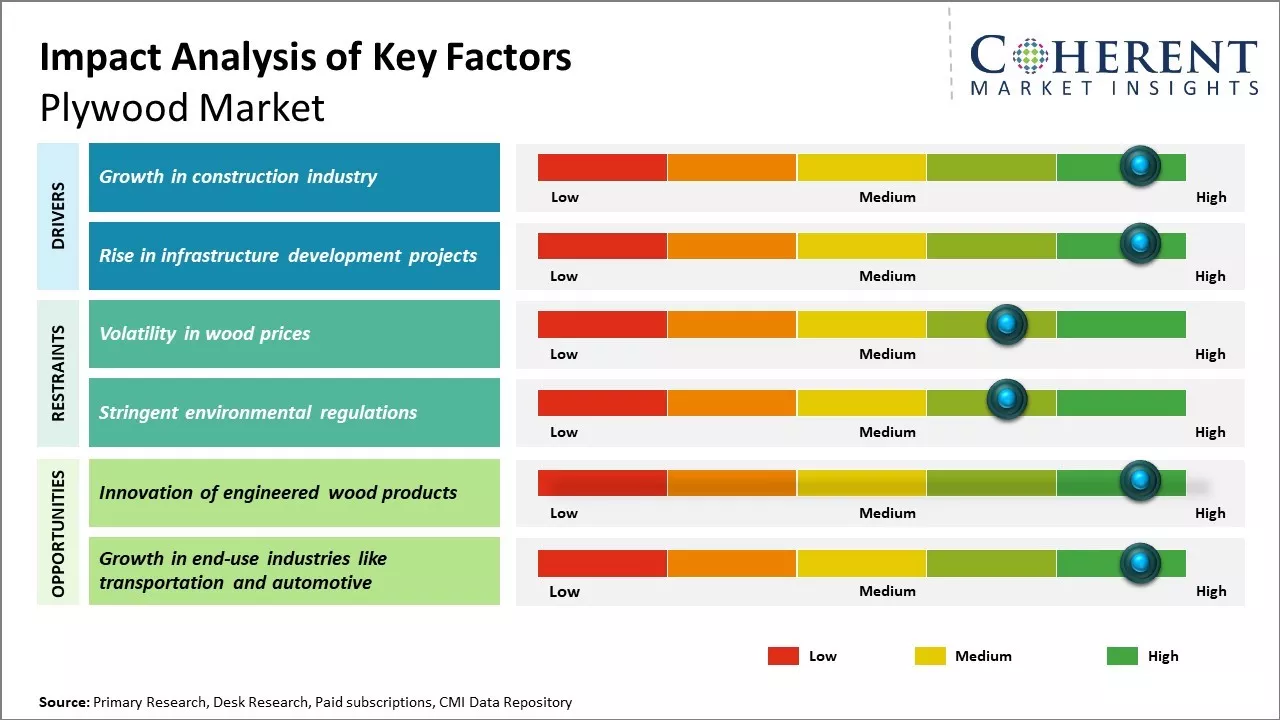
The construction industry remains the major driver of demand for plywood worldwide. Rising residential and commercial construction activities in emerging economies will boost the consumption of plywood for applications such as concrete formwork, wall, and flooring.
However, stringent environmental regulations pertaining to deforestation may act as a restraint. Growing preference of engineered wood over conventional wood products among builders and contractors also poses a challenge.
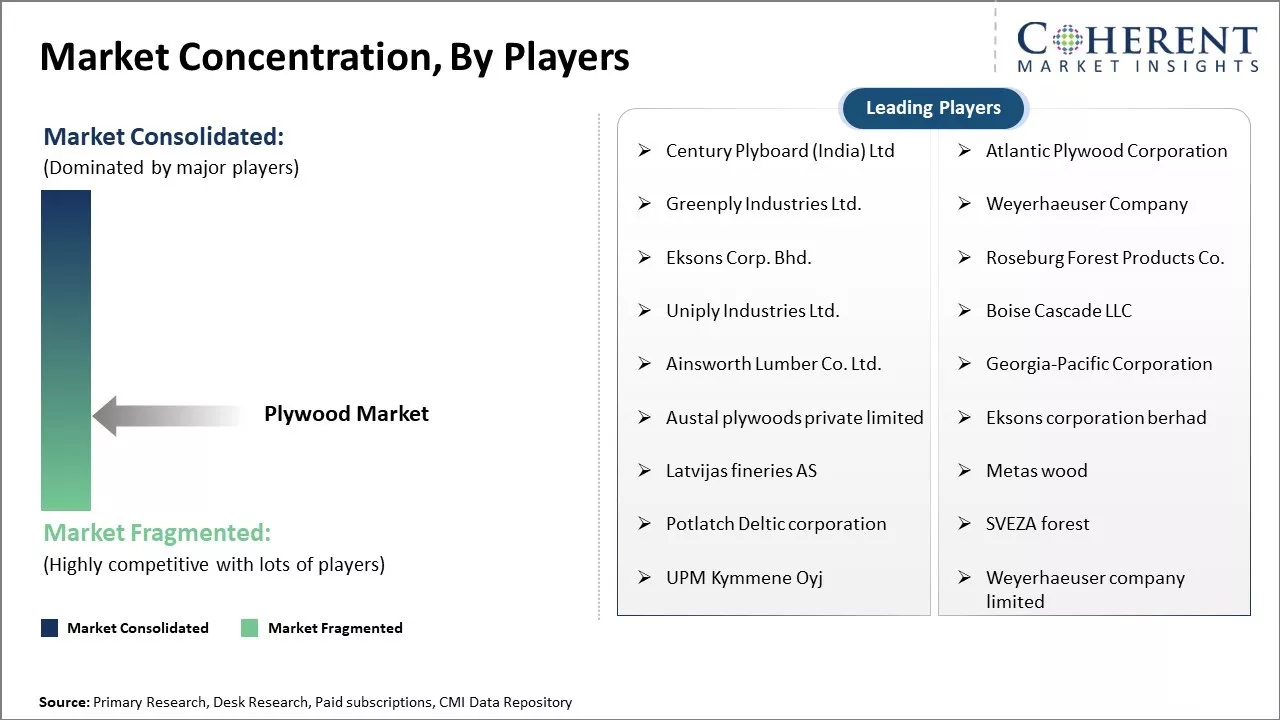
Market Concentration and Competitive Landscape
Current Events and their Impact on the Plywood Market
Current Events | Description and its impact |
U.S. Lumber Market Dynamics and Regulatory Shifts |
|
Section 232 investigation into timber imports |
|
- Current Industry Events of 2026
- Market Size Estimation
- Regional Breakdown
- Competitive Landscape
- Customer Intelligence
- Segmental Analysis
- Pricing Analysis
- Key Market Drivers, Challenges & Future Trends
- Customized Insights Section
Market Trends
Growing Construction and Infrastructure Development
The global surge in construction and infrastructure development is significantly driving demand for plywood a versatile material widely used in structural applications, furniture manufacturing, and interior finishes. Rapid urbanization, especially in emerging economies, is fueling the need for residential, commercial, and industrial buildings, thereby increasing plywood consumption.
For instance, according to a June 2024 forecast by Oxford Economics, the global volume of construction activity is projected to grow by USD 4.2 trillion over the next 15 years, supported in part by the expansion of the green economy.
Segmental Insights
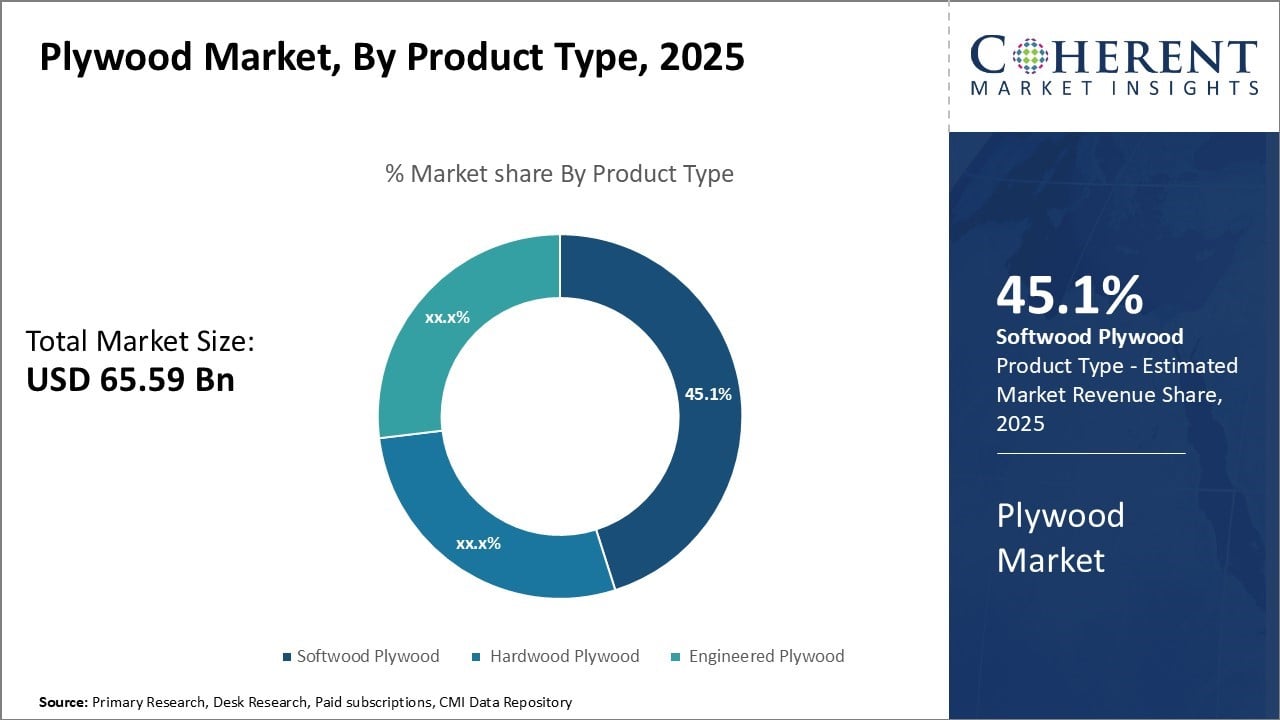
Plywood Market Insights, By Product Type: Wide Applicability and Cost-Effectiveness
In terms of product type, softwood plywood is expected to contribute 46.1% share of the market in 2026. Softwood plywood holds the largest share in the global plywood market due to its extensive usage in construction applications.
Softwood trees such as pine, spruce and fir are most commonly used for producing plywood as they have straight grains and are more uniformly arranged compared to hardwood trees, making them ideal for construction purposes. Softwood plywood sheets are reasonably priced, lightweight and offer sufficient strength and rigidity for use as concrete formwork, flooring substrates, and roof sheathing. They can withstand environmental stresses like moisture and commonly used in load-bearing structures like walls and floors.
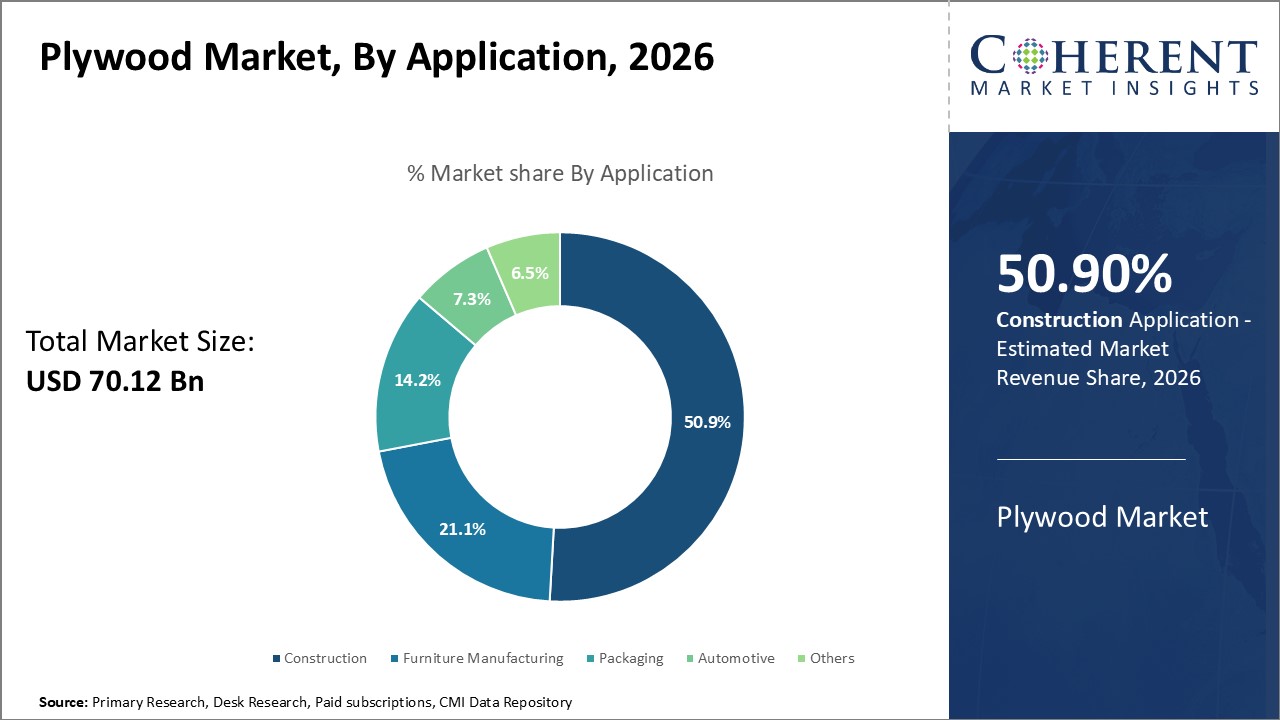
Plywood Market Insights, By Application: Extensive End-Use Applications
Construction is expected to contribute 50.9% share of the global plywood market in 2026. The construction industry dominated the global plywood market in terms of consumption.
Plywood finds multifaceted applications in construction such as concrete formwork, flooring, roof sheathing, wall panels, and modular construction among others. It serves as an economical substrate material for flooring installations in commercial, industrial, and residential projects. Plywood also acts as an air and vapor barrier in roof constructions and resists wind uplift, saving on additional supporting structures.
Emerging Innovations in the Plywood Market
- The Automation and Digitization of Production Lines
- Modern plywood plants increasingly employ robotics, artificial intelligence (AI), and machine learning (ML) for precision cutting, assembly, and quality control. These technologies minimize human error, improve consistency in sheet thickness and bonding quality, and reduce waste. Automated veneer peeling machines and hot pressing systems equipped with real-time monitoring ensure plywood sheets meet higher strength and durability standards while optimizing material usage.
- Advancements in Adhesive Technology
- Advancements in adhesive technology, particularly the use of formaldehyde-free and low-emission resins, have improved the safety and environmental profile of plywood products. The shift to non-toxic, eco-friendly adhesives such as Soy-based resins and other bio-resins addresses growing health and environmental concerns. These adhesives not only reduce hazardous emissions but also enhance water resistance and bonding strength, expanding the usage of plywood in moisture-exposed environments such as coastal construction and marine applications.
Impacts of Artificial Intelligence (AI) on the Plywood Market
Artificial Intelligence (AI) is progressively reshaping numerous traditional industries, and the plywood market is no exception. From enhancing manufacturing processes to optimizing supply chains and product innovation, AI is driving efficiency and value across the plywood sector.
- Roseburg Forest Products developed an AI-powered design tool that assists architects and builders in selecting optimal plywood materials based on project specifications, environmental impact, and cost considerations. The AI solution processes multiple data points, such as load requirements, climate conditions, and usage scenarios, to recommend plywood grades and treatments tailored for each application. This innovation empowers users to make informed decisions, resulting in better structural performance, reduced material waste, and lower lifecycle costs.
- Georgia-Pacific, a leading global manufacturer of wood products, has adopted AI-driven analytics to monitor and manage its manufacturing systems. By leveraging machine learning algorithms and sensor data from their production lines, the company can predict equipment failures before they occur, minimize waste, and maintain consistent product quality. This integration of AI into core operational processes exemplifies how traditional plywood producers are transforming into data-centric enterprises to remain competitive and sustainable.
Key Unmet Needs in the Plywood Market
- Sustainability and Material Sourcing Challenges
- Example: Shortages of FSC-certified plywood in contrast with growing demand for eco-friendly construction materials.
- Explanation: KOLs (e.g., UPM, Greenply) face limited access to sustainably sourced timber due to resource depletion and strict certification requirements.
- Impact: Higher production costs, brand reputation risks, and constrained market expansion.
- Fulfillment Strategy: Collaborate with reforestation initiatives (e.g., Metsä Group’s biodiversity programs) to stabilize timber supply chains while meeting sustainability standards.
- Regulatory Complexity Across Regions
- Example: Compliance with divergent standards like EU’s Ecolabel vs. US CARB regulations, increasing administrative burdens.
- Explanation: KOLs such as Weyerhaeuser or Georgia-Pacific must navigate fragmented policies, explaining quality assurance and certification processes.
- Impact: Operational inefficiencies, delayed market entry, and margin erosion.
- Fulfillment Strategy: Partner with third-party compliance firms to streamline audits and certification processes.
Regional Insights
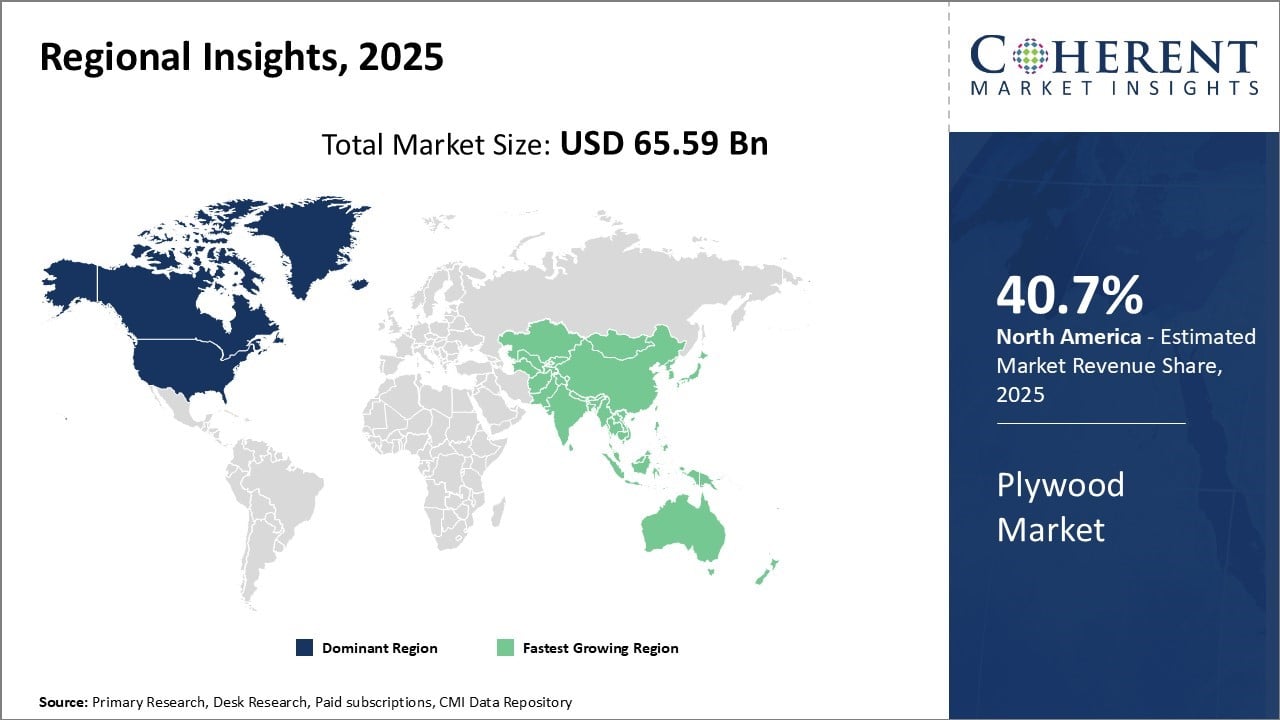
North America Plywood Market Analysis and Trends
North America continues to lead the global plywood market, with the region projected to hold an estimated 40.7% market share in 2026. This dominance is fueled by sustained demand across both residential and non-residential construction sectors, particularly in the United States. The U.S. plays a pivotal role due to its expansive housing market and concentration of major building material manufacturers.
For instance, according to the United Nations Economic Commission for Europe (UNECE), U.S. hardwood plywood imports rebounded in the first half of 2024, rising 32.3% to 1.397 million cubic meters. However, exports continued to decline during the same period, falling by 8.7%.
Asia Pacific Plywood Market Analysis and Trends
The Asia Pacific region has rapidly emerged as the fastest-growing plywood market globally over the forecast period, driven by accelerated urbanization and large-scale infrastructure development in developing nations. Countries such as China and India are key drivers, supported by their large population bases and robust GDP growth. The ongoing expansion of the real estate sector, alongside government-led initiatives promoting residential and commercial construction, has significantly boosted plywood consumption across the region.
For instance, according to FDM Asia, China’s plywood imports reached 735,000 cubic meters between January and October 2024—an increase of over 700%. Imports from Vietnam and Sweden surged by nearly 4,700% and 350%, respectively, during the same period. Additionally, imports from Indonesia rose by 30%, underscoring rising demand and shifting trade dynamics in the region.
Plywood Market Outlook for Key Countries
China Plywood Market Analysis and Trends
China is the largest plywood market globally, propelled by its expansive construction and furniture manufacturing industries. Rapid urbanization, large-scale government infrastructure projects, and a booming real estate sector continue to drive strong plywood demand. China serves as both a significant producer and importer of plywood, sourcing raw materials and finished products from countries such as Indonesia, Vietnam, and Sweden to satisfy its domestic requirements.
For instance, according to Commission Implementing Regulation, an official Journal of the EU 2026, hardwood plywood imports to China increased by 16% overall, peaking in 2022 with a 32% rise compared to 2021. Although import volumes dipped in 2023, they showed signs of recovery during the latest investigation period, reflecting ongoing market fluctuations and demand resilience.
India Plywood Market Analysis and Trends
India’s plywood market is experiencing robust growth, due to rising urbanization, increasing disposable incomes, and government initiatives aimed at affordable housing development. The furniture and interior decoration sectors are expanding rapidly, making plywood a preferred material for durability and versatility. Domestic production is strong, but India also relies on imports, particularly from Southeast Asian countries, to fulfill growing demand.
U.S. Plywood Market Analysis and Trends
The U.S. holds a key position in the global plywood market, with steady demand from residential and commercial construction, as well as furniture manufacturing. The U.S. market is characterized by high-quality standards and a preference for hardwood plywood. Imports complement domestic production, with key suppliers including Canada and Southeast Asia. Innovations in sustainable and engineered wood products also drive market growth.
In February 2026, Malaysia’s exports of hardwood plywood to the U.S. jumped by 41 per cent to 91,392 cubic meters (cu m) in 2024 compared to 2023.
Indonesia Plywood Market Analysis and Trends
Indonesia is a major plywood producer and exporter, benefiting from vast tropical timber resources and a well-established manufacturing industry. The country supplies plywood to global markets, especially China, Japan, and the U.S. Indonesian plywood is favored for its competitive pricing and adherence to sustainability certifications, making it a critical player in the international plywood supply chain.
Pricing Analysis of the Plywood Market
Category | Price Range (USD) |
Furniture Manufacturers Commercial & Decorative | 10 - 25 |
Construction Contractors Film Faced, Structural | 30 - 45 |
Marine & Boat Builders Marine Grade BWP | 24 - 35 |
Retail Customers Commercial MR Grade | 8 - 15 |
Interior Designers Decorative Laminated Plywood | 18 - 30 |
Market Report Scope
Plywood Market Report Coverage
| Report Coverage | Details | ||
|---|---|---|---|
| Base Year: | 2025 | Market Size in 2026: | USD 70.12 Bn |
| Historical Data for: | 2020 To 2024 | Forecast Period: | 2026 To 2033 |
| Forecast Period 2026 to 2033 CAGR: | 6.9% | 2033 Value Projection: | USD 111.86 Bn |
| Geographies covered: |
| ||
| Segments covered: |
| ||
| Companies covered: | Century Plyboard (India) Ltd, Atlantic Plywood Corporation, Greenply Industries Ltd., Weyerhaeuser Company, Eksons Corp. Bhd., Roseburg Forest Products Co., Uniply Industries Ltd., Boise Cascade LLC, Ainsworth Lumber Co. Ltd., Georgia-Pacific Corporation, Austal plywoods private limited, Eksons corporation berhad, Latvijas fineries AS, Metas wood, Potlatch Deltic corporation, SVEZA forest, UPM Kymmene Oyj, and Weyerhaeuser company limited | ||
| Growth Drivers: |
| ||
| Restraints & Challenges: |
| ||
Plywood Industry News
- In February 2025, Georgia-Pacific announced the continuous investment in its plywood mill located in Prosperity, South Carolina through USD 14 million worth of upgrades and improvements to mill operations. This aims to upgrade the existing boiler, which will increase fuel efficiency, reduce environmental impact, and help boost the local economy through the jobs the project will create during the renovation.
- In January 2025, Latvijas Finieris launched an adhesive for birch plywood production in which lignin partially replaces phenol, and Riga ECOlogical birch plywood products have been available on the market for several years.
- In April 2025, Sveza participated in the leading trade event for the woodworking and furniture industries in the MENA region — the Dubai WoodShow. The represented a wide range of birch plywood solutions for construction, furniture manufacturing, interior design, and decorative applications.
- In May 2025, Weyerhaeuser Company announced it has reached an agreement to sell its lumber mill in Princeton, British Columbia, to the Gorman Group, a family-owned wood products manufacturer headquartered in West Kelowna, B.C. The purchase price is approximately USD 120 million in cash, which includes Weyerhaeuser's manufacturing facility, all associated timber license assets in British Columbia.
Analyst View
- The plywood market is witnessing significant momentum driven by expanding construction activities and rising demand for furniture and interior decoration. Increasing urbanization and rising disposable incomes in emerging economies are propelling the adoption of plywood as a preferred material due to its durability, versatility, and aesthetic appeal.
- Additionally, sustainable forestry management and growing preference for eco-friendly wood products are positively influencing market growth. However, fluctuations in raw material prices and availability, coupled with competition from alternative materials such as MDF and particleboard, pose challenges to the market expansion.
- Opportunities lie in innovations like waterproof and fire-resistant plywood, which are enhancing product applications in commercial and residential sectors. The growth of modular construction and prefabricated buildings also presents potential avenues for plywood usage.
- From a regional perspective, North America emerges as the fastest-growing region due to booming real estate developments in countries. Government initiatives supporting infrastructure and affordable housing are further catalyzing plywood demand in this region.
- Overall, market players focusing on product diversification, value-added features, and efficient supply chain management are well-positioned to capitalize on emerging trends and overcome challenges. The evolving consumer preference toward green building materials and technological advancements will be critical factors shaping the market’s future landscape.
Market Segmentation
- Product Type Insights (Revenue, USD Bn, 2021 - 2033)
- Softwood Plywood
- Hardwood Plywood
- Engineered Plywood
- Application Insights (Revenue, USD Bn, 2021 - 2033)
- Construction
- Furniture Manufacturing
- Packaging
- Automotive
- Others
- Regional Insights (Revenue, USD Bn, 2021 - 2033)
- North America
- U.S.
- Canada
- Latin America
- Brazil
- Argentina
- Mexico
- Rest of Latin America
- Europe
- Germany
- U.K.
- Spain
- France
- Italy
- Russia
- Rest of Europe
- Asia Pacific
- China
- India
- Japan
- Australia
- South Korea
- ASEAN
- Rest of Asia Pacific
- Middle East & Africa
- GCC Countries
- Israel
- Rest of Middle East & Africa
- Key Players Insights
- Century Plyboard (India) Ltd.
- Atlantic Plywood Corporation
- Greenply Industries Ltd.
- Weyerhaeuser Company
- Eksons Corp. Bhd.
- Roseburg Forest Products Co.
- Uniply Industries Ltd.
- Boise Cascade LLC
- Ainsworth Lumber Co. Ltd.
- Georgia-Pacific Corporation
- Austal plywoods private limited
- Eksons corporation berhad
- Latvijas fineries AS
- Metas wood
- Potlatch Deltic corporation
- SVEZA forest
- UPM Kymmene Oyj
- Weyerhaeuser company limited
Sources
Primary Research Interviews
- Plywood manufacturers and production executives
- Wood supply chain and logistics managers
- E-commerce platform representatives and digital marketplace operators
- Construction industry professionals and contractors
- Others
Magazines
- Wood & Wood Products Magazine
- Panel World Magazine
- Construction Specifier Magazine
- Building Products Digest
- Others
Journals
- Forest Products Journal
- Wood and Fiber Science Journal
- Construction and Building Materials Journal
- Others
Newspapers
- The Wall Street Journal
- Financial Times
- Wood Markets Monthly
- Construction Dive
- Others
Associations
- Engineered Wood Association (APA)
- International Wood Products Association (IWPA)
- Plywood Association of India (PAI)
- Hardwood Plywood & Veneer Association (HPVA)
- Others
Public Domain Sources
- U.S. Census Bureau - Manufacturing Statistics
- FAO (Food and Agriculture Organization) Forestry Statistics
- International Trade Centre (ITC) Market Analysis
- Government forestry department publications
- Others
Proprietary Elements
- CMI Data Analytics Tool – Plywood Market
- CMI Existing Repository of Information for the Last 8 Years
*Definition: The plywood market involves the production and sale of plywood. Plywood is a type of engineered wood made by gluing layers of thin wood veneers together with their grains rotated for added strength. It is widely used in construction for applications like flooring, roof decking, sheathing, and furniture. The plywood market serves various end-use industries including construction, packaging, and shipping.
Get access to 250+ pages report
Every segment, forecast, competitor profile and data table behind the analysis above — available for instant download.
- ESOMAR Member
- ISO 9001:2015 Certified
- D-U-N-S Registered
- GDPR & CCPA Compliant
Missing comfort of reading report in your local language? Find your preferred language:
Transform your Strategy with Exclusive Trending Reports
Frequently Asked Questions
The plywood market is estimated to be valued at USD 70.12 Bn in 2026, and is expected to reach USD 111.86 Bn by 2033.
The CAGR of the plywood market is projected to be 6.9% from 2026 to 2033.
Growth in construction industry and rise in infrastructure development projects are the major factors driving the growth of the plywood market.
Volatility in wood prices and stringent environmental regulations are the major factors hampering the growth of the plywood market.
In terms of product type, softwood plywood is estimated to dominate the market revenue share in 2026.
Century Plyboard (India) Ltd, Atlantic Plywood Corporation, Greenply Industries Ltd., Weyerhaeuser Company, Eksons Corp. Bhd., Roseburg Forest Products Co., Uniply Industries Ltd., Boise Cascade LLC, Ainsworth Lumber Co. Ltd., Georgia-Pacific Corporation, Austal plywoods private limited, Eksons corporation berhad, Latvijas fineries AS, Metas wood, Potlatch Deltic corporation, SVEZA forest, UPM Kymmene Oyj, and Weyerhaeuser company limited are the major players operating in the global plywood market.
North America is expected to lead the plywood market in 2026.