

Powered Catamaran Market Size and Share Analysis - Growth Trends and Forecasts (2026 - 2033)
The Powered Catamaran Market is anticipated to grow at a CAGR of 4.9% with USD 1,692.7 Mn share in 2026 and is expected to reach USD 2,350.2 Mn in 2033. The Powered Catamarans Market is expanding as demand rises for stable, spacious, and efficient vessels in leisure, coastal transport, and commercial segments, driven by technology upgrades like hybrid propulsion, advanced navigation, and lightweight hulls. Supporting broader marine manufacturing activity, the U.S. Census Bureau’s March 2026 M3 report, published on May 4, 2026, showed new orders for manufactured goods increased by 1.5 % month‑on‑month to $630.4 billion, while shipments rose by 1.4 %, indicating resilient industrial demand that benefits catamaran production and related marine equipment sectors. This trend aligns with solid manufacturing momentum as reported by official data.
(Source: U.S. Census Bureau)
Key Takeaways
- Recreational Powered Catamarans is expected to account the largest share of 48.6% in 2026, driven by growth in water-based tourism & marine leisure and technological advances supporting recreational use. In 2026, the U.S. Coast Guard launched the 2026 National Recreational Boating Safety Survey to collect state‑level data on how many people boat and the types of vessels they use, reflecting official tracking of recreational boat use including powered pleasure craft. Additionally, the U.S. Coast Guard 2026 National Recreational Boating Safety Survey reported a significant increase in recreational boating participation, with millions of U.S. households engaging in powered boat activities in 2026, highlighting the segment’s leading role in the overall powered catamaran market. (Source: U.S. Coast Guard's Boating Safety Division; uscgboating.org)
- Tourism & leisure will dominate with 57.0% in 2026, supported by growing coastal and marine tourism activity. Powered catamarans are highly suitable for beach destinations, island resorts, ferry-linked tourism, diving tours, whale-watching, and sunset cruises. The EU Blue Economy Report 2025 stated that coastal tourism is the dominant sector in the EU Blue Economy, with more than 1.4 billion nights spent in coastal tourist accommodation in 2023, up 6.4% from the previous year.
- North America is expected to acquire the dominant share of 37.4% in 2026. North America has a well-developed recreational boating industry with millions of registered boats. According to the National Marine Manufacturers Association (NMMA), January 2026, there were over 12 million registered recreational boats in the U.S., with powerboats comprising a significant portion, supporting catamaran adoption.
Segmental Insights
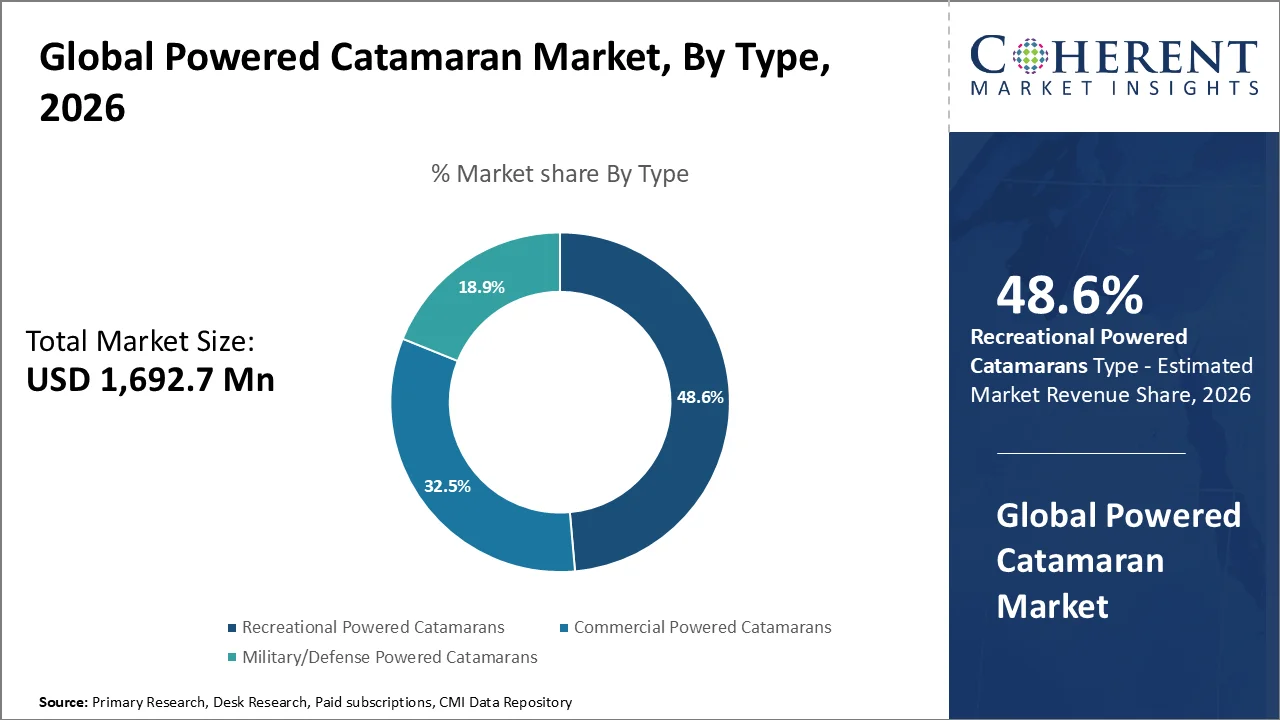
Why is Recreational Powered Catamarans Acquiring the Largest Market Share?
Recreational Powered Catamarans is projected to account for the largest share of cognitive systems spending in 2026, representing approximately 48.6% of the total volume. The Recreational Powered Catamarans segment dominates due to high consumer participation in leisure boating and marine recreation, which drives unit demand, vessel usage, and aftermarket spending. For instance, according to the data published by the National Marine Manufacturers Association, in 2026, recreational boating remains a large economic sector with an estimated 30 million recreational boats globally and the U.S. industry generating ≈ US$230 billion in annual economic impact, supporting over 812,000 jobs and more than 36,000 businesses. Approximately 85 million Americans go boating each year, underlining strong participation. Although new powerboat retail unit sales were down ~9 % through early 2026, steady participation and diverse leisure activities sustain long‑term demand for recreational catamarans in charter, tourism, and private use.
- Current Industry Events of 2026
- Market Size Estimation
- Regional Breakdown
- Competitive Landscape
- Customer Intelligence
- Segmental Analysis
- Pricing Analysis
- Key Market Drivers, Challenges & Future Trends
- Customized Insights Section
Tourism & Leisure holds the Largest Market Share
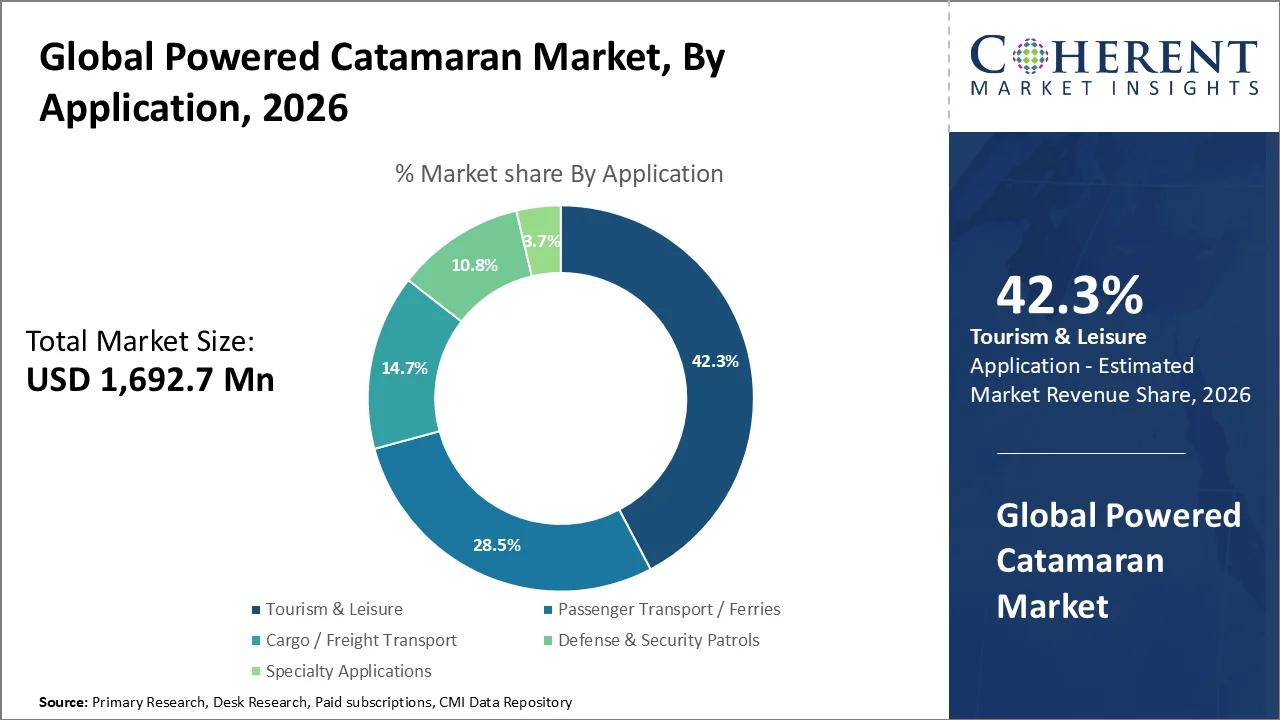
Tourism & leisure dominate the market, accounting for a significant 42.3% share in 2026, because powered catamarans are highly suitable for coastal sightseeing, island transfers, sunset cruises, diving trips, whale-watching, luxury charters, resort shuttles, and short-distance leisure ferry services. Their twin-hull structure provides better stability, wider deck space, higher passenger comfort, and smoother ride quality than many monohull boats, making them attractive for tourism operators. Coastal and marine tourism creates consistent demand for vessels that can carry passengers comfortably for short leisure trips. The EU Blue Economy Report 2025 stated that coastal tourism is the dominant sector in the EU Blue Economy, with more than 1.4 billion nights spent in coastal tourist accommodation in 2023, up 6.4% from the previous year.
Additionally, tourism operators are expanding marine experiences as global travel demand improves. UN Tourism, published in January 2026, reported that international tourist arrivals increased 4% in 2025 and projected international tourism to grow by 3%–4% in 2026, supporting higher demand for coastal leisure boating and charter services.
Market Drivers
Rising marine tourism and charter boating
Rising marine tourism and charter boating has driven the powered catamaran market growth over the forecast period. Growth in coastal tourism, island travel, luxury charters, day cruises, and water-based leisure activities is increasing demand for stable and spacious powered catamarans. UN Tourism reported that international tourist arrivals grew by 4% in 2025, showing continued recovery in global travel demand. Rising marine tourism and charter boating directly increase demand for powered catamarans because these vessels offer stability, spacious decks, comfort, and passenger capacity that monohull boats often cannot match. Coastal destinations, islands, and waterfront resorts increasingly rely on catamarans for sightseeing tours, private charters, diving excursions, and day trips, making them the vessel of choice for operators. According to the UNWTO World Tourism Barometer, published January 2026, international tourist arrivals grew 4% in 2025, reaching 1.52 billion, showing continued expansion in global travel. Higher tourist volumes and leisure activity directly translate into increased catamaran orders for rental, charter, and commercial leisure use, boosting the market.
(Source: UN Tourism; UNWTO)
Expansion of recreational boating
Expansion of recreational boating can significantly drive the powered catamaran market growth because increased participation and usage of pleasure craft encourage demand for diverse vessel types, including powered catamarans, which are valued for stability, comfort, and leisure performance. For instance, in 2026, the U.S. Coast Guard launched the 2026 National Recreational Boating Safety Survey (NRBSS) to collect comprehensive state‑level data on how many people are boating, what types of boats they use, and how often they go on the water, reflecting a nationwide rise in recreational boating activity and the importance of tracking vessel use across motorboats and other watercraft. This government initiative underscores official recognition of expanding recreational boating engagement, which supports greater market uptake of popular leisure vessels like powered catamarans by private owners, charter operators, and tourism stakeholders. The recreational boating industry continues to support demand for premium and multi-purpose boats. In the U.S., recreational boating generates around US$230 billion in annual economic impact and supports more than 812,000 jobs, indicating a strong boating ecosystem.
Riding the Waves of Innovation: How Technology is Revolutionizing the Powered Catamaran Market
Increasing technology advancement and new launch in the powered catamaran market has created significant opportunity for the global powered catamaran market growth over the forecast period. The Powered Catamaran Market is being transformed by cutting-edge technology and innovative design. Hybrid and electric propulsion systems reduce fuel costs and emissions, meeting growing eco-conscious demand, while advanced hull materials and lightweight composites improve speed, stability, and durability. Integrated digital navigation, joystick docking, and smart monitoring systems enhance safety, operational efficiency, and passenger comfort. These innovations appeal to luxury charters, recreational tourism, ferry operators, and offshore service providers. Supportive policy frameworks, such as the IMO’s 2026 GHG strategy, further accelerate adoption, positioning technologically advanced catamarans as the preferred choice for modern maritime operations.
For instance, in February 2026, Aquila Catamarans introduced the all‑new 45 Sport power catamaran at the Miami International Boat Show 2026. This sport‑oriented model features advanced double‑stepped hull technology, high performance with speeds above 50 mph, and a social aft cockpit designed for leisure, day charters, and family boating. Its bold styling, improved connectivity features, and entertainment‑focused layout reflect innovation in powered catamaran design aimed at both recreational and charter markets.
Current Events and Their Impact
Current Event | Description and its Impact |
U.S. Ferry Electrification Funding Accelerates Low-Emission Vessel Procurement |
|
Sydney Approves First Locally Built Electric Ferry Trial |
|
Global Tourism Recovery Supports Marine Leisure and Charter Demand |
|
U.S. Manufacturing Orders Improve Vessel Supply Chain Sentiment |
|
Powered Catamaran Market Trends
- Surge in Recreational Boating Demand - Recreational boating continues to expand, driving demand for powered catamarans in leisure and charter segments. In 2026, North America remains the largest market with over 12 million registered recreational boats and strong participation. High disposable income and growing tourism create continuous orders for leisure vessels.
- Shift Toward Eco‑Friendly Propulsion - Hybrid and electric propulsion systems are increasingly integrated into new catamarans, driven by environmental awareness and regulatory support. In 2026, several ferry operators and charter services are adopting low-emission vessels to comply with clean energy mandates and reduce fuel consumption.
- Expansion in Marine Tourism & Charter Fleets - Powered catamarans are favored for tourism and charter use due to stability, spacious decks, and passenger comfort. Growing coastal tourism, island excursions, and day trips are pushing operators to expand fleets and introduce vessels capable of high-speed and safe leisure operations.
- Customization & Premium Feature Integration - Manufacturers are offering luxury interiors, advanced navigation systems, and digital connectivity to meet consumer demand for personalized experiences. Recreational and charter-oriented catamarans increasingly feature entertainment decks, smart control systems, and premium cabins, expanding market appeal.
- Technology‑Driven Hull and Material Innovation - Innovations in lightweight composites, advanced hull designs, and digitally integrated systems improve vessel efficiency, stability, and onboard performance. Shipyards globally are investing in composite hulls and energy-efficient materials to enhance fuel efficiency, reduce maintenance, and improve passenger experience.
Regional Insights
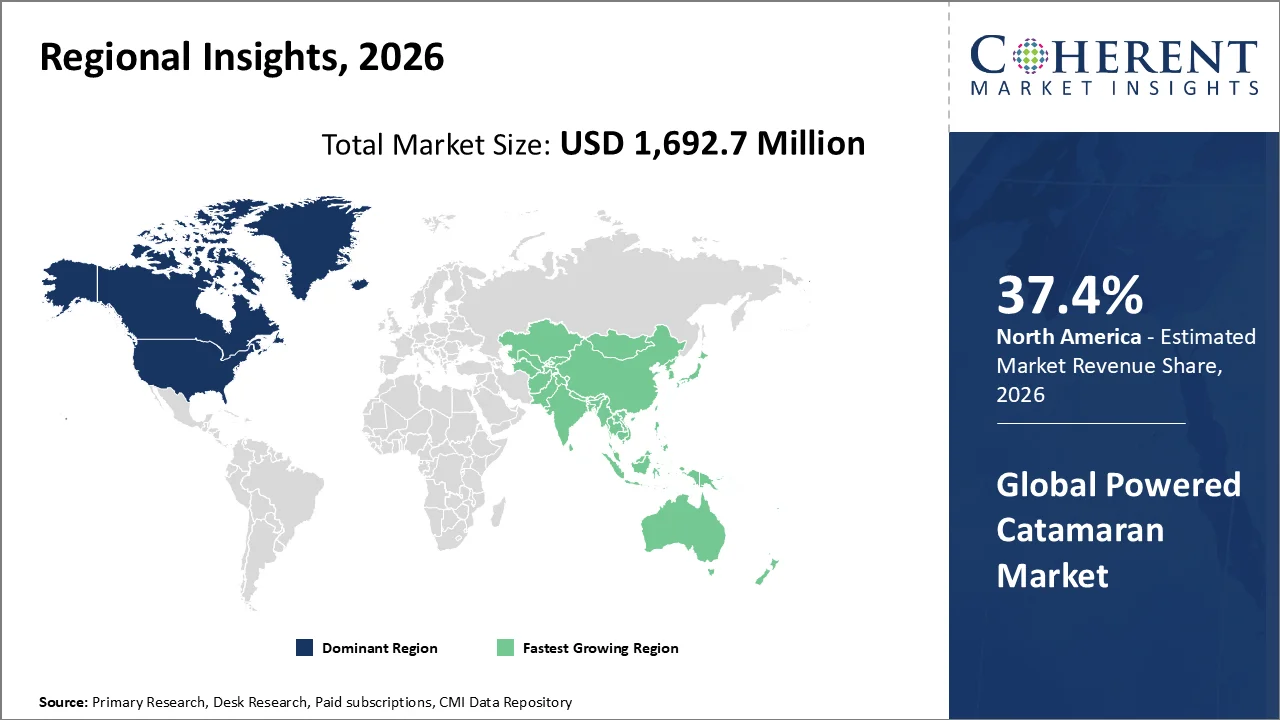
North America dominates owing to Well-Established Recreational Boating Culture
North America account 37.4% market share in 2026, supported by well-established recreational boating culture and advanced marina and port infrastructure. The U.S. and Canada have a long history of recreational boating, with millions of households participating annually. In 2026, the U.S. Coast Guard’s 2026 National Recreational Boating Safety Survey (NRBSS) reported continued high engagement in powered boat usage, highlighting a stable and mature market. Strong demand exists for leisure, charter, and tourism-oriented vessels, including powered catamarans. The U.S. Coast Guard actively monitors vessel safety and recreational boating participation, creating consumer confidence in powered catamaran ownership. Safety guidelines, licensing, and clear environmental regulations encourage adoption of modern, eco-efficient vessels.
Additionally, in 2026, the U.S. Coast Guard launched the National Recreational Boating Safety Survey (NRBSS), which will interview over 50,000 households across all 50 states and the District of Columbia to collect detailed data on how many people go boating, what types of boats they use, and how often they go boating the first such comprehensive survey since 2018. This reflects a significant effort by an official regulatory body to monitor and understand recreational boating activity at scale in 2026.
Asia Pacific Powered Catamaran Market Trends
The Asia-Pacific region is poised to be as the fastest-growing region through 2026-2033, driven by expanding marine tourism, rising disposable income, and favorable geographic conditions. Growing adventure tourism, leisure water sports, and luxury yacht demand in countries such as China, India, and Southeast Asia have accelerated adoption. Government initiatives promoting water tourism, marinas, and port infrastructure further support growth. For instance, in 2026, ICOMIA reported that Asia Pacific accounted for a significant share of global leisure marine revenue, with recreational boating and charter demand strongly influenced by regional tourist activity. Additionally, data from NOAA and the U.S. Coast Guard 2026 reports show sustained increases in recreational vessel registrations and activity in Asia-linked international markets, indicating robust participation and market potential.
Su Lin Cheah from ICOMIA notes Asia’s strategic coastal position between the Pacific and Indian Oceans, fuelling demand for leisure vessels like powered catamarans. Regional participation is further indicated by the 2026 launch of the U.S. Coast Guard’s National Recreational Boating Safety Survey (NRBSS), which will collect detailed data on boating activity patterns, underscoring growing interest in recreational boating that informs global demand trends.
Advanced Marina and Port Infrastructure is Accelerating the Powered Catamaran Market Demand in United States
The U.S. dominates North America Powered Catamaran Market due to a mature recreational boating culture, high disposable income, and extensive coastal and inland waterways. Strong participation in leisure boating is evidenced by over 12 million registered recreational boats in 2026, with powerboats comprising the majority. Government programs, infrastructure development, and tourism support, such as the U.S. Coast Guard’s National Recreational Boating Safety Survey (2026), enable safe, year-round operations. Advanced manufacturing, innovation in hull design and hybrid/electric propulsion, and established charter services further strengthen U.S. leadership, attracting private buyers, luxury charters, and commercial operators.
(Source: NMMA)
China Powered Catamaran Market Trends
China dominates the Asia Pacific Powered Catamaran Market due to its rapidly growing middle class, high disposable income, and expanding domestic marine tourism. Coastal cities and island destinations, such as Hainan and Guangdong, attract recreational boating, charter services, and luxury yacht demand. Government initiatives supporting water tourism, marina construction, and coastal infrastructure further stimulate vessel adoption. According to ICOMIA 2020, China accounted for a significant portion of Asia Pacific leisure marine activity. In 2026, official port and coastal activity reports from China Maritime Safety Administration (CMSA) indicate rising passenger and recreational vessel registrations, highlighting strong market growth.
Who are the Major Companies in Powered Catamaran Market
Some of the major key players in Powered Catamaran Market are Sunreef Yachts, Spirited Designs, Leopard Catamarans, Lagoon Catamaran, Fountaine Pajot, Matrix Yachts, Voyage Yachts, TomCat Boats, Robertson and Caine, Gemini Catamarans, WorldCat, Outremer Yachting, Scape Yachts, Seawind Group Holdings Pty Ltd, Alumarine Shipyard, Pedigree Cat, Inc., Farrier Marine, Catahai Co. Ltd, and Alibi Catamarans.
Key News
- In February 2026, Aquila Catamarans launched the all‑new Aquila 45 Sport power catamaran at the Miami International Boat Show. The model features advanced double‑stepped hull technology, bold contemporary styling, and a large entertainment‑focused aft cockpit with flip‑down hull terraces extending beam and social space, enhancing speed and onboard comfort. This launch reflects industry focus on performance and recreation.
- In May 2026, Pioneer Yachts announced the solar‑electric PY60 catamaran for autonomous cruising. Scheduled to debut at the 2026 Cannes Yachting Festival, the PY60 emphasizes solar‑electric propulsion and long‑range cruising capability, highlighting the push toward renewable propulsion and autonomous operation.
- In May 2026, Bering Yachts launched the first hull of its aluminium explorer catamaran, the BC60. Designed for extended range and remote access, the BC60 combines robust aluminium construction with a shallow draft for expedition cruising, illustrating innovation in materials and design for adventure applications.
- In April 2026, VisionF Yachts introduced its VISIONF 65 catamaran entering the mid‑size powered segment. This innovative 18.88 m model emphasizes stability, volume, and long‑stay comfort, with an expansive flybridge and advanced energy management systems incorporating solar support and battery capacity to reduce generator usage.
Market Report Scope
Powered Catamaran Market Report Coverage
| Report Coverage | Details | ||
|---|---|---|---|
| Base Year: | 2025 | Market Size in 2026: | USD 1,692.7 Mn |
| Historical Data for: | 2020 To 2024 | Forecast Period: | 2026 To 2033 |
| Forecast Period 2026 to 2033 CAGR: | 4.9% | 2033 Value Projection: | USD 2,350.2 Mn |
| Geographies covered: |
| ||
| Segments covered: |
| ||
| Companies covered: | Sunreef Yachts, Spirited Designs, Leopard Catamarans, Lagoon Catamaran, Fountaine Pajot, Matrix Yachts, Voyage Yachts, TomCat Boats, Robertson and Caine, Gemini Catamarans, WorldCat, Outremer Yachting, Scape Yachts, Seawind Group Holdings Pty Ltd, Alumarine Shipyard, Pedigree Cat ,Inc., Farrier Marine, Catahai Co. Ltd, and Alibi Catamarans. | ||
Analyst Opinion
- The powered catamaran market is evolving beyond a luxury or recreational niche, becoming a strategic investment for charter operators, ferry services, and tourism enterprises seeking efficiency, safety, and enhanced passenger experiences. Innovations in hybrid/electric propulsion, lightweight composites, and advanced navigation systems are driving adoption. According to Incat Crowther, 2026, over 30% of new mid-size catamarans launched in Asia Pacific and North America incorporated hybrid propulsion or energy-saving hull designs, reflecting industry-wide confidence in technology-enabled efficiency.
- Tourism and leisure remain key adoption drivers. Rising demand for coastal charters, adventure tourism, and island-hopping excursions is accelerating fleet expansions. The U.S. Coast Guard National Recreational Boating Safety Survey 2026 reported over 12 million recreational vessels registered, with a growing portion in powercatamaran configurations for multi-day and high-capacity excursions, demonstrating strong market reliance on passenger-oriented vessels.
- Commercial ferry operations are increasingly integrating powered catamarans for efficiency and reduced operational costs. Eurostat 2026 data shows that European short-distance ferry passenger volumes grew 3.8% YoY, encouraging operators to invest in stable, low-draft twin-hull vessels to accommodate high passenger throughput while meeting fuel efficiency and emission requirements.
- Industry leaders are prioritizing sustainability and advanced propulsion technologies. IMO 2026 updated GHG emission reduction strategies for international shipping, and several U.S. and EU-based ferry operators are commissioning low-emission catamarans, driving technology integration, fleet modernization, and long-term capital allocation toward environmentally friendly vessels.
- Asia Pacific is emerging as the fastest-growing regional market. Governments in China, India, and Southeast Asia are investing in marinas, coastal infrastructure, and tourism promotion. According to ICOMIA 2026, Asia Pacific accounted for a substantial portion of global leisure marine activity, positioning the region as a hub for powered catamaran production, adoption, and innovative technology trials.
Speak to the analyst
Want personalized insights?
Take the findings above to one of our principal consultants, or have the report rebuilt around the segments, geographies and competitors you actually track.
Market Segmentation
- By Type (Revenue, USD Mn, 2021- 2033)
- Recreational Powered Catamarans
- Commercial Powered Catamarans
- Military/Defense Powered Catamaran
- By Application (Revenue, USD Mn, 2021- 2033)
- Tourism & Leisure
- Passenger Transport / Ferries
- Cargo / Freight Transport
- Defense & Security Patrols
- Specialty Applications (Survey, Research, Rescue)
- Global Powered Catamaran Market, By Region: (Revenue, USD Mn, 2021- 2033)
- North America
- U.S.
- Canada
- Latin America
- Brazil
- Mexico
- Argentina
- Rest of Latin America
- Europe
- Germany
- U.K.
- France
- Italy
- Spain
- Russia
- Rest of Europe
- Asia Pacific
- China
- India
- Japan
- Australia
- South Korea
- ASEAN
- Rest of Asia Pacific
- Middle East
- GCC
- Israel
- Rest of Middle East
- Africa
- South Africa
- Central Africa
- North Africa
- North America
- Competitive Landscape
- Sunreef Yachts
- Spirited Designs
- Leopard Catamarans
- Lagoon Catamaran
- Fountaine Pajot
- Matrix Yachts
- Voyage Yachts
- TomCat Boats
- Robertson and Caine
- Gemini Catamarans
- WorldCat
- Outremer Yachting
- Scape Yachts
- Seawind Group Holdings Pty Ltd
- Alumarine Shipyard
- Pedigree Cat,Inc.
- Farrier Marine
- Catahai Co. Ltd
- Alibi Catamarans.
Sources
Primary Research Interviews
- Discussions with fleet operators, charter companies, and tourism service managers to understand vessel adoption challenges, fleet expansion strategies, operational efficiency, and customer preferences for recreational and commercial catamarans.
- Insights from catamaran manufacturers, naval architects, and marine engineers on technological advancements, hull design innovations, hybrid/electric propulsion integration, and performance optimization for safety, speed, and fuel efficiency.
- Interviews with maritime consultants, industry analysts, and regulatory experts to evaluate market trends, competitive landscape, regional adoption patterns, and the impact of emission and safety regulations on fleet investments.
- Conversations with government and port authorities, maritime infrastructure planners, and commercial ferry operators to assess policy incentives, infrastructure readiness, port accessibility, and investment factors influencing adoption of powered catamarans.
Databases
- U.S. Coast Guard Boating Statistics Database
- NOAA Office of Coast Survey / National Oceanographic Data
- Eurostat Maritime Transport Database
- UN Comtrade / USITC HTS 8903
- Australian Maritime Safety Authority (AMSA) Vessel Registration Database
Magazines
- Yachting Magazine
- Boat International
- Professional BoatBuilder Magazine
- Maritime Executive
- Boating Industry Magazine
Journals
- Journal of Marine Science and Engineering (MDPI)
- Ocean Engineering (Elsevier)
- Applied Ocean Research (Elsevier)
- Journal of Coastal Research
- Marine Technology Society Journal
Newspapers
- The New York Times – Boating / Technology Section
- Financial Times – Maritime and Shipping Section
- The Guardian – Maritime Technology & Leisure Section
- Wall Street Journal – Transportation / Technology Section
- South China Morning Post – Marine & Tourism Section
Associations
- International Council of Marine Industry Associations (ICOMIA)
- National Marine Manufacturers Association (NMMA)
- European Boating Industry (EBI)
- Royal Institution of Naval Architects (RINA)
- American Waterways Operators (AWO)
Public Domain Sources
- IMO (International Maritime Organization) Policy and GHG Reports
- EPA and CARB Marine Emission Reports
- EU FuelEU Maritime Policy Documents
- U.S. Coast Guard Vessel Registration & Safety Reports
- UNWTO & National Tourism Boards
- Company Annual Reports
Proprietary Elements
- CMI Data Analytics Tool, Proprietary CMI Existing Repository of information for last 10 years
Get access to 250+ pages report
Every segment, forecast, competitor profile and data table behind the analysis above — available for instant download.
- ESOMAR Member
- ISO 9001:2015 Certified
- D-U-N-S Registered
- GDPR & CCPA Compliant
Missing comfort of reading report in your local language? Find your preferred language:
Transform your Strategy with Exclusive Trending Reports
Frequently Asked Questions
The Powered Catamaran Market is expected to reach USD 2,350.2 Million in 2033.
Limited marina and berthing infrastructure and strict emission and sustainability regulations are the major factors hampering the growth of the powered catamaran market.
Rising marine tourism and charter boating and expansion of recreational boating are the key factors driving the growth of the global powered catamaran market.
The Powered Catamaran Market is anticipated to grow at a CAGR of 4.9% between 2026 and 2033.
Among regions, North America is expected to account for a largest market share in the global Powered Catamaran Market over the forecast period.
A powered catamaran is a twin-hull vessel propelled by engines, designed for stability, speed, and efficiency. Unlike a monohull, it has two parallel hulls, reducing rolling motion and increasing deck space. This design improves passenger comfort, fuel efficiency, and load distribution, making it ideal for recreational, commercial, and ferry applications.
Powered catamarans are used for leisure cruising, luxury charters, island hopping, diving trips, sightseeing, and fishing tours in recreation. Commercially, they serve as passenger ferries, commuter vessels, and transport boats. Tourism operators rely on them for adventure tourism, water sports excursions, and multi-day charter services, benefiting from stability and capacity.