

Light Vehicle Cabin Ac Filters Market Analysis and Forecasts: (2026-2033)
The light vehicle cabin Ac filters market is anticipated to grow at a CAGR of 5.4% with USD 3,922.5 Mn share in 2026 and is expected to reach USD 5,560.1 Mn in 2033. Rising air pollution & health concerns (according to the data published by the World Health Organization in the 2024, 99% of the world’s population lived in places not meeting its air-quality guidelines , and ambient air pollution was linked to 4.2 million premature deaths in 2019), growing awareness of In-cabin air quality, and rapid growth of electric vehicles (EVs) is the major factors driving the growth of the market.
Key Takeaways
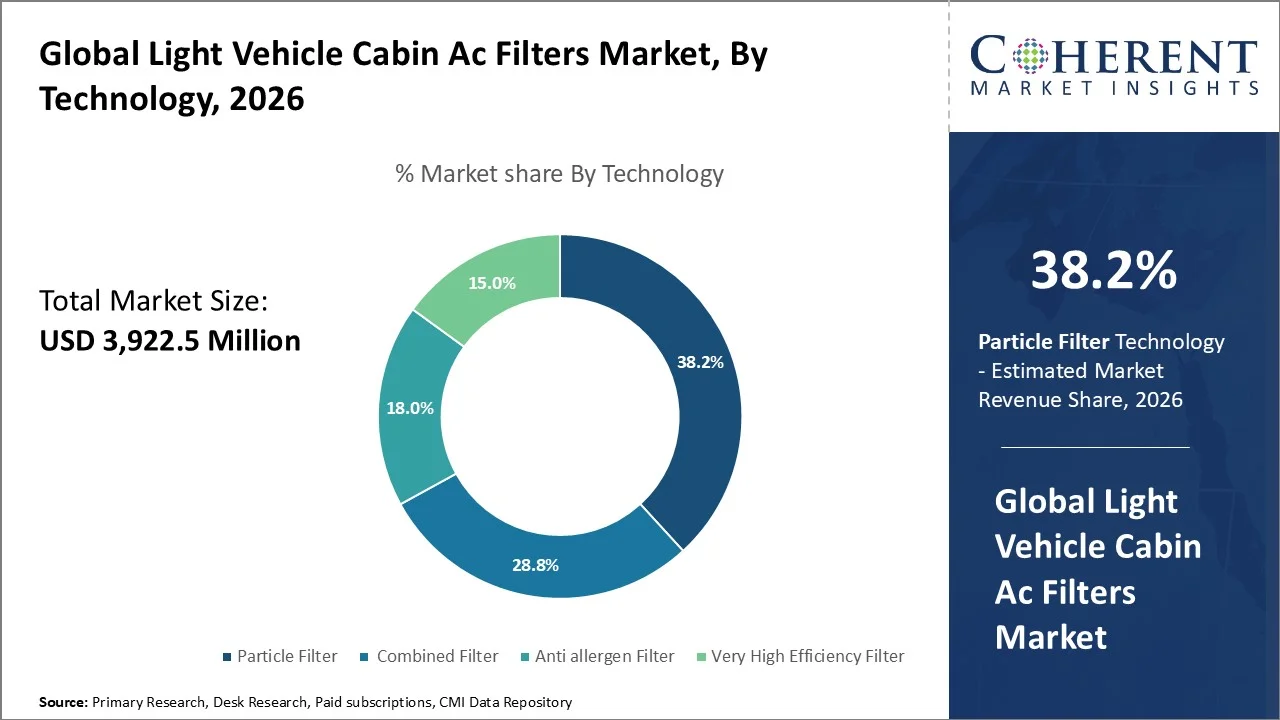
- Particle Filter is expected to account the largest share of 38.2% in 2026, driven by the rapid its cost-effectiveness and broad adoption in entry‑level and mid‑range vehicles. These filters trap larger particulate matter (PM10/PM2.5) which are associated with health risks such as respiratory irritation and deeper lung penetration, as highlighted by the CDC’s emphasis on PM2.5 harms.
- Based on sales channel, OEM (Original Equipment Manufacturer) will dominate with 40.0% in 2026, because most light vehicles come factory‑fitted with these filters and maintain replacement routines through authorized services. OEMs typically account for the largest channel share reflecting the strong integration of filters in vehicle production. For instance, Toyota’s 2026 Camry, where the official vehicle page lists “dual zone automatic climate control with air filter” as a built-in feature, showing that cabin filtration is integrated at the factory level rather than added later.
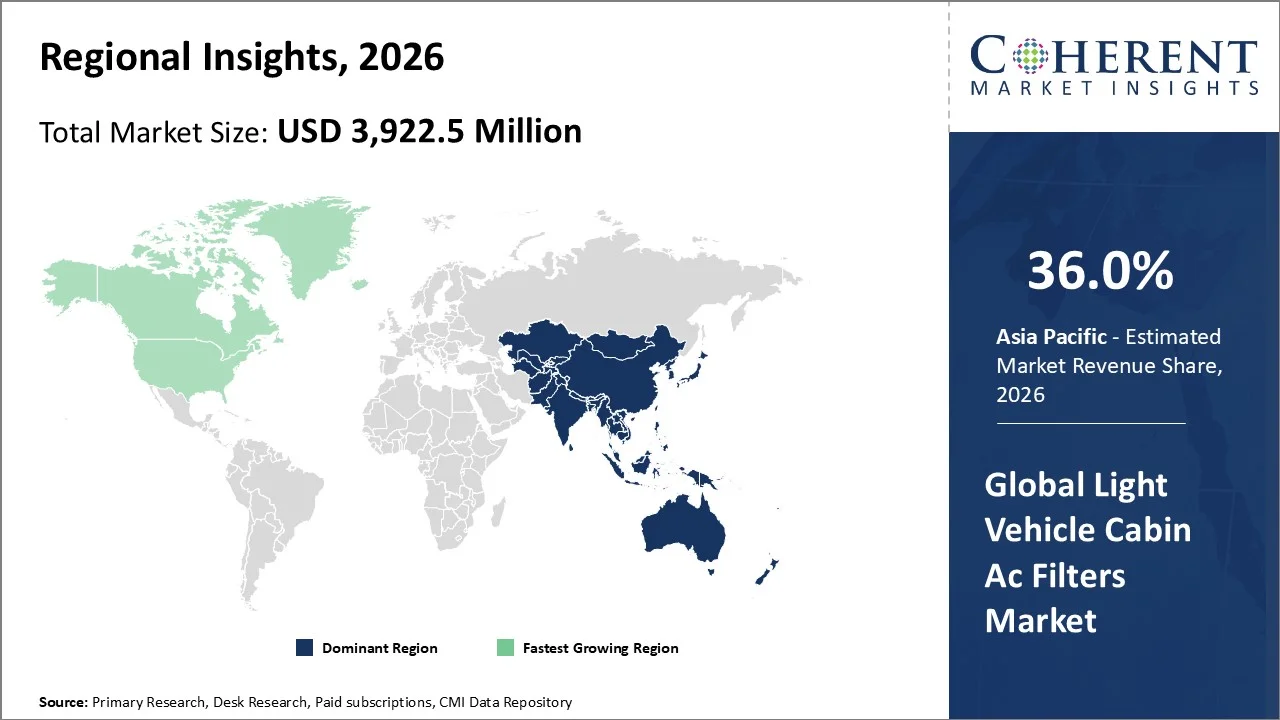
- Asia Pacific is expected to acquire the dominant share of 36.0% in 2026, attributed to rapid adoption of air quality standards in passenger vehicles and high vehicle production volumes (exceeding 50 million units annually), rapid adoption of cabin air quality features, and urban pollution challenges that heighten demand for effective in‑vehicle filtration. The region captures the largest share of the global market, led by strong demand in China, India, and Japan and increasing awareness of air pollution issues. According to data issued by the Society of Indian automotive Manufacturers (SIAM), the automotive industry recorded its highest-ever annual sales in FY26, with volumes jumping 10.4% year over year to 28.27 million units, powered by a robust recovery in the second half and improving consumer mood.
Segmental Insights
Why is Particle Filter Acquiring the Largest Market Share?
Particle Filter is projected to account for the largest share of light vehicle cabin Ac filters in 2026, representing approximately 38.2% of the total volume. Particle filters efficiently capture dust, pollen, soot, and PM2.5 particles, which are the most common in-cabin pollutants. This makes them the baseline filtration solution required in almost all vehicles. Its dominance reflects both OEM adoption and robust aftermarket demand as consumers prioritize basic particulate removal with affordable replacement options. Increasing public awareness of in‑vehicle air quality and health concerns is prompting both OEMs and consumers to choose filters that effectively mitigate common airborne contaminants such as dust and pollen, which are major sources of discomfort and respiratory irritation. rising urbanization and vehicle production globally especially in Asia Pacific where millions of light vehicles are produced yearly ensure continued high volumes of particulate filters being installed in new vehicles and replaced periodically in the aftermarket.
For instance, in October 2025, JSW MG Motor India Pvt Ltd, automobile company, revealed that all models in its portfolio will come equipped with PM 2.5 cabin air filtration systems as standard, reflecting a broader industry emphasis on protecting occupants from fine particulates and airborne contaminants. These systems are designed to trap up to ~95–99 % of particles such as dust, pollen, soot, and smoke, highlighting OEM responsiveness to air quality concerns and consumer health priorities.
- Current Industry Events of 2026
- Market Size Estimation
- Regional Breakdown
- Competitive Landscape
- Customer Intelligence
- Segmental Analysis
- Pricing Analysis
- Key Market Drivers, Challenges & Future Trends
- Customized Insights Section
OEM (Original Equipment Manufacturer) holds the Largest Market Share
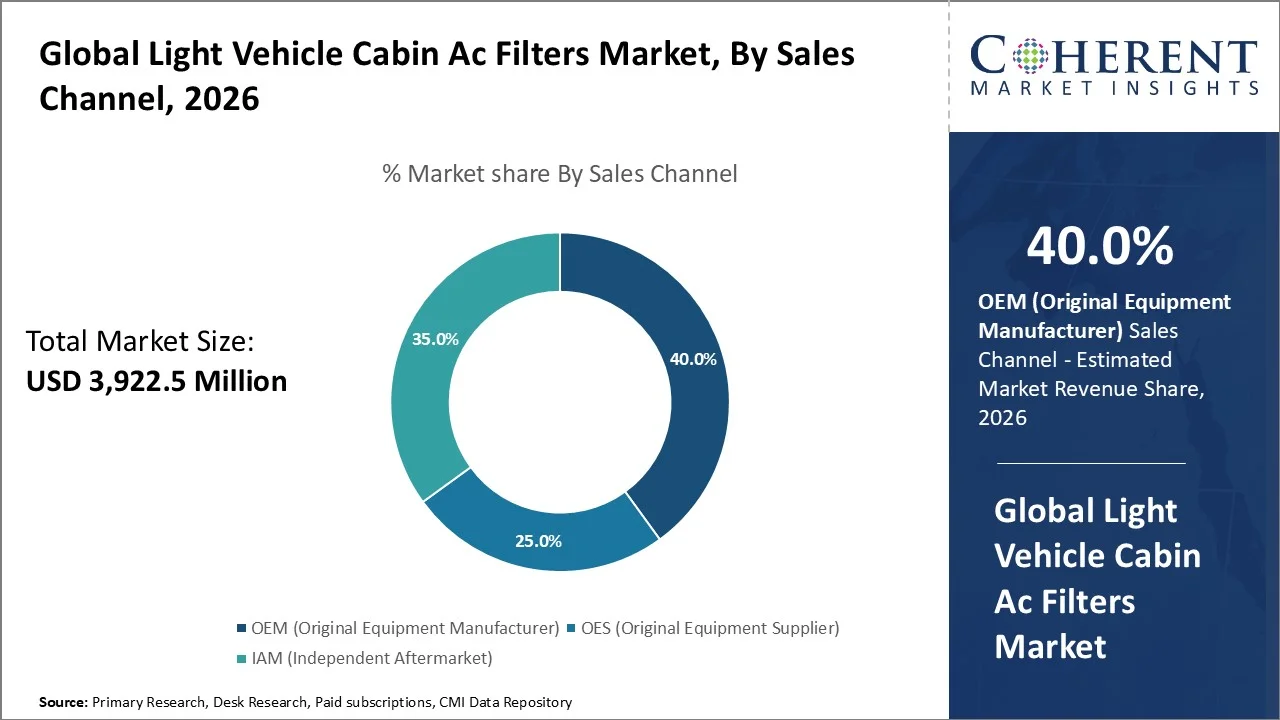
Based on Sales Channel, OEM (Original Equipment Manufacturer) dominate the market, accounting for a significant 40.0% share in 2026, owing to standardization and quality assurance, high global vehicle production, and direct integration during vehicle manufacturing. As OEMs are required to comply with strict regional air quality and emissions laws as part of the vehicle's type-approval procedure, they lead in sales. In order to ensure compliance with regulatory performance and passenger comfort standards, automakers frequently demand high-performance filtration solutions from supplier partners (such as MANN+HUMMEL, Bosch, Denso, etc.). This gives OEMs a structural advantage over aftermarket channels that sell replacement parts after production. OEMs (Original Equipment Manufacturers) dominate because cabin air filters are factory‑installed as standard components in virtually all new light vehicles.
For instance, Hyundai’s 2026 IONIQ 6 N catalog includes a micro-air filter, fine dust sensor, air cleaning mode, and after-blow function. This supports OEM channel dominance, as automakers are embedding cabin air-quality systems directly into vehicle design while WHO continues to state that 99% of the global population breathes air exceeding guideline limits.
Growing Allergy and Respiratory Sensitivity Among Consumers
Increasing allergy and respiratory sensitivity among consumers has estimated to drive the growth of the market in the near future. Higher allergy prevalence is pushing consumers toward better cabin filtration, especially in urban and high-pollen environments.
For instance, in January 2026, according to the data published by the Centers for Disease Control and Prevention, 25.2% of American adults experienced a seasonal allergy in 2024, which highlights the need for filters that can collect pollen and other fine irritants. Tesla's 2026 owner paperwork, which states that its HEPA filter is very good at eliminating pollutants, allergens, bacteria, pollen, mold spores, and viruses with activated carbon also handling odors and gases is a clear example of a 2026 original source.
Shift toward premium and high-efficiency filtration technologies is transforming the Light Vehicle Cabin Ac Filters Market
A shift toward more advanced filtration systems, moving beyond basic particle filters has created significant opportunity for the light vehicle cabin Ac filters market growth. This shift is not only about volume growth but also about improving the filter mix to include premium and high-efficiency technologies. As consumers and automakers place more emphasis on air quality, cabin filters are evolving from simple particle filters to sophisticated systems capable of filtering finer particulates (PM1 and PM2.5) and other harmful airborne elements. Technologies such as activated carbon, nanofiber, and HEPA (High-Efficiency Particulate Air) filters are becoming more prevalent due to their superior filtration capabilities.
For instance, in April 2026, MANN‑FILTER, a globally recognized automotive filtration brand by MANN+HUMMEL, has introduced its CUK 2026 cabin air filter, engineered to significantly improve vehicle interior air quality. The new filter offers drivers and passengers better protection by combining activated carbon technology with high-performance particle capture. The CUK 2026 model, which is intended for light passenger cars, effectively blocks up to 95% of fine particulate matter (PM2.5), which includes dust, pollen, and soot. It also captures dangerous gases and aromas that can enter through the HVAC system, such as sulfur dioxide, ozone, and nitrogen oxides. By removing nearly 90% of offensive odors and adsorbing gaseous contaminants, the activated carbon layer improves overall cabin comfort and adds an additional layer of protection.
With rising concerns over urban air pollution and passengers’ demand for cleaner, healthier in‑car environments, the introduction of the CUK 2026 reflects the industry's broader shift toward premium filtration technologies that go beyond basic particle filtering to address gaseous pollutants and odors.
Current Events and Their Impact on the Light Vehicle Cabin Ac Filters Market
Current Event | Description and its Impact |
Alignment of Cabin Air Filtration with Broader Air Quality Policy Goals |
|
Regulatory Push in High‐Pollution Urban Regions |
|
Light Vehicle Cabin Ac Filters Market Trends
- Shift toward high-efficiency filtration (HEPA & multi-layer filters): There is growing adoption of HEPA and advanced multi-layer filters that can capture ultra-fine particles (PM2.5 and smaller). These filters are increasingly used as premium features in modern vehicles. For instance, in Tesla’s official owner manuals updated in 2026, the company states that its medical-grade HEPA filter is extremely effective at removing pollution, allergens, bacteria, pollen, mold spores, and viruses, while the secondary filtration system contains activated carbon to remove a broad spectrum of odors and gases. This shows how premium vehicles are shifting from basic particle filtration to multi-layer, high-efficiency cabin purification systems.
- Rising demand for smart and sensor-based filters: New systems integrate air quality sensors and smart monitoring, enabling real-time detection of pollutants. Filters can now auto-adjust or notify users for replacement, improving user experience. For instance, Hyundai’s official 2026 IONIQ 5 N and 2026 IONIQ 6 N brochures highlight a micro air filter, fine dust sensor, air cleaning mode, and after-blow function. Volvo also states on its official vehicle pages that cabin PM2.5 levels can be monitored by an optical sensor, and the system can automatically react to outside pollutants. This reflects the market shift toward sensor-led, intelligent filtration systems.
Hyundai
- Increasing focus on in-cabin air quality & health: Consumers are becoming more aware that vehicle cabin air can be more polluted than outside air, boosting demand. Health concerns (allergies, respiratory issues) are pushing adoption of better filtration systems. For instance, according to the World Health Organization, over 99% of people on the planet reside in areas where air pollution levels are higher than recommended, and in January 2026, the CDC reported that 25.2% of adult Americans had a seasonal allergy. The demand for improved cabin air conditioning filters is being supported by these official health indicators, which are increasing consumer focus on cleaner in-cabin air, particularly for allergy-sensitive and urban users.
- Growth of electric vehicles (EVs) influencing filter innovation: EVs are using advanced HVAC and air purification systems, making cabin filters a key differentiation feature. Specialized filters are being designed specifically for EV platforms.
- Adoption of eco-friendly and sustainable materials: Manufacturers are shifting toward biodegradable and recyclable filter materials. Sustainability is becoming a major focus in product design and innovation. On 12 March 2026, Freudenberg Filtration officially launched micronAir neo, stating that the cabin air filter contains up to 60% recycled and renewable materials, is PFAS-free, and is produced at a site powered by 100% green electricity. This is a strong example of how sustainability is becoming a core product-development theme in cabin air filtration.
Regional Insights
Asia Pacific dominates owing to Rising Urbanization and Growing Middle-Class Population
Asia Pacific account 36.0% market share in 2026, supported by high vehicle production and sales, rising urbanization and pollution and growing middle-class population. Urbanization rates in the region are accelerating, with cities like Beijing, New Delhi, and Tokyo experiencing high levels of air pollution. According to the World Health Organization (WHO), over 90% of urban residents in Asia live in areas where air pollution exceeds safe levels. This has led to increasing consumer awareness regarding air quality, directly influencing the demand for high-performance cabin filters that can trap pollutants such as particulate matter (PM2.5), which are harmful to health.
The growth of electric vehicles (EVs) in Asia Pacific, especially in China and Japan, is another key factor driving the demand for specialized cabin air filtration systems. EVs often incorporate advanced HVAC systems, which include specialized filters for ensuring a clean cabin environment. As per China’s New Energy Vehicle (NEV) policy, the country aims to have 20% of vehicle sales be electric by 2026, which will further fuel the demand for high-performance filters designed for EV cabins. Asia Pacific, particularly countries like China, India, and Japan, has some of the largest vehicle manufacturing markets in the world. In 2026, China alone is expected to account for over 30% of global automotive production, as per data from the International Organization of Motor Vehicle Manufacturers (OICA). This high production volume naturally leads to higher demand for cabin AC filters as they are essential components in vehicle assembly.
North America Light Vehicle Cabin Ac Filters Market Trends
The North America region is poised to be as the fastest-growing region through 2026-2033, owing to advanced automotive manufacturing and technology, strict environmental regulations & health concerns, and well-established aftermarket. North America, particularly the U.S. and Mexico, is home to some of the world’s largest automotive manufacturers, such as General Motors, Ford, Fiat Chrysler Automobiles, and Tesla. These companies are highly skilled at making cars and coming up with new ideas, such adding innovative cabin air filtration systems to fulfill customers' needs for clean air. In 2026, Tesla’s commitment to high-efficiency HEPA filters in its vehicles, including its Model S and Model X, demonstrates the region’s leadership in premium, technology-driven cabin air quality systems. Tesla also reflects North America’s premium filtration trend, as its official vehicle support and upgrade materials continue to highlight HEPA-based cabin air filtration in applicable models. The adoption of electric vehicles (EVs) is linked to real‑world reductions in air pollution, which in turn elevates demand for improved cabin air filtration as EVs increasingly become a preferred choice in North America. A 2026 study by Keck School of Medicine of USC shows that in communities with more EVs, nitrogen dioxide (NO₂) levels dropped measurably reinforcing consumer and regulatory focus on clean air, including inside vehicles. For instance, for every 200 new zero‑emission vehicles added in part of California, NO₂ levels decreased by ~1.1%, showing measurable improvement in local air quality.
Largest OEM Installation Base & Air-Quality and Health Concerns Strengthen the Value Proposition is Accelerating the Light Vehicle Cabin Ac Filters Market Demand in China
The China light vehicle cabin Ac filters market dominates Asia Pacific mainly because it combines the world’s largest light-vehicle production base with the fastest scale-up in EVs, strong policy support for new vehicle demand, and very visible OEM focus on in-cabin air purification. Cabin-filter market-share data itself is usually proprietary, but these official indicators strongly explain China’s leadership by volume. China’s vehicle production and sales create the biggest first-fit cabin-filter opportunity. Official data showed China produced 34.531 million vehicles and sold 34.4 million in 2025, and it remained the world’s largest auto market for the 17th consecutive year. That directly supports higher OEM cabin filter demand than any other country. China’s NEV market is large enough to accelerate adoption of higher-value filters such as HEPA, activated carbon, PM2.5, and intelligent purification systems. Official data showed China’s New Energy Vehicle (NEV) production reached 16.626 million units and sales 16.49 million units in 2025, while the country had 20.092 million charging facilities by end-2025. That scale gives automakers a strong reason to use cabin air quality as a differentiating feature. China still provides policy support that keeps EV and passenger-vehicle sales elevated. The State Council said NEVs bought in 2026–2027 receive a halved purchase tax, with up to 15,000 yuan of tax exemption per passenger vehicle. More vehicle sales mean more factory-installed cabin filters and a larger replacement base later.
U.S. Light Vehicle Cabin Ac Filters Market Trends
U.S. has become the biggest player in the North America light vehicle cabin Ac filters market in 2026. Large vehicle fleet and production base in the U.S. country has significantly driven the growth of the light vehicle cabin Ac filters market in the North America region. The U.S. has the largest vehicle fleet in North America, with over 270 million vehicles on the road as of 2026. This extensive fleet creates both significant demand for OEM-installed filters in new vehicles and a robust aftermarket for replacement filters. The country also remains a major global producer of light vehicles, with key automotive manufacturers like General Motors, Ford, Toyota, and Tesla producing millions of vehicles annually, all of which require cabin air filters. For instance, Tesla made about 1.5 million electric cars in 2025, each with high-end filtering systems. This increased demand for advanced cabin AC filters in the U.S.
The U.S. Environmental Protection Agency (EPA) and other regulatory agencies have set strict regulations about car emissions. This has indirectly led to the use of high-performance cabin air filters. The Clean Air Act and CARB (California Air Resources Board) guidelines need these filters to make sure that the air quality and health standards are met. These rules often say that cars must have technologies that work well to cut down on indoor air pollution. The 2026 U.S. EPA regulations require automakers to implement more stringent air quality standards in vehicles, indirectly pushing for better cabin filtration.
Who are the Major Companies in Light Vehicle Cabin Ac Filters Market
Some of the major key players in Light Vehicle Cabin Ac Filters Market are ACDelco, Ahlstrom Corporation, Airmatic Filterbau GmbH, ALCO Filters Ltd., Denso Corporation, Donaldson Company, Inc., EuroGIELLE S.r.l., Freudenberg & Co. KG, Hengst SE & Co. KG, K&N Engineering, Inc., MAHLE GmbH, Mann+Hummel GmbH, Robert Bosch GmbH, Sogefi SpA, Valeo SA
Key News
- In April 2026, VinFast Auto India, a branch of the worldwide electric car maker VinFast, revealed the introduction of the brand-new VF MPV 7 for Indian clients. The launch is VinFast's third new product in a year, showing that the company is serious about extending its presence in India's fast-growing electric vehicle sector. The VF MPV 7 seats seven people comfortably, with a theater-style seating arrangement and a very roomy third row. This is because space is the most important thing for Indian families with several generations. It has a wheelbase of 2,840 mm and can hold up to 1,240 liters of stuff, making it easy to carry bags, everyday necessities, and the demands of family life.
- In February 2026, Denso, a company focused on developing automotive technology, revealed the introduction of the new ClearAir+ cabin air filter range. A DENSO ClearAir+ is made to do more than just filter air. It will make these symptoms much better and also lower the effects of air pollution in general. This is because it is very beneficial at filtering out small particles like pollen, allergies, bacteria, and viruses. This means that the air in the cabin is clean, which makes driving more comfortable.
Market Report Scope
Light Vehicle Cabin Ac Filters Market Report Coverage
| Report Coverage | Details | ||
|---|---|---|---|
| Base Year: | 2025 | Market Size in 2026: | USD 3,922.5 Mn |
| Historical Data for: | 2020 To 2024 | Forecast Period: | 2026 To 2033 |
| Forecast Period 2026 to 2033 CAGR: | 5.4% | 2033 Value Projection: | USD 5,560.1 Mn |
| Geographies covered: |
| ||
| Segments covered: |
| ||
| Companies covered: | ACDelco, Ahlstrom Corporation, Airmatic Filterbau GmbH, ALCO Filters Ltd., Denso Corporation, Donaldson Company, Inc., EuroGIELLE S.r.l., Freudenberg & Co. KG, Hengst SE & Co. KG, K&N Engineering, Inc., MAHLE GmbH, Mann+Hummel GmbH, Robert Bosch GmbH, Sogefi SpA, Valeo SA | ||
Analyst Opinion
- The light vehicle cabin Ac filters market benefits from one of the strongest demand structures in the automotive supply chain: every new light vehicle creates an OEM installation opportunity first, and then a recurring aftermarket replacement cycle later. ACEA reported that global car production rose 4.2% to 78.7 million units in 2025, while Asia accounted for 62.1% of total output. On the replacement side, MAHLE recommends cabin filter replacement every 15,000 km or at least once a year, and Tesla’s official maintenance guidance includes periodic replacement of cabin and HEPA filters in applicable vehicles. This makes the category structurally recurring rather than purely discretionary.
- The Light Vehicle Cabin Ac Filters Market is moving beyond a low-value HVAC replacement category and becoming a cabin-health category. That shift looks durable, not temporary. The World Health Organization estimates that ambient air pollution caused 4.2 million premature deaths in 2019, while the U.S. EPA states that PM2.5 poses the greatest health risk because these particles can travel deep into the lungs and even enter the bloodstream. In my view, this health backdrop is steadily increasing willingness among automakers and consumers to prioritize better cabin filtration performance over simple low-cost replacement.
- One of the best ways to raise the value of this industry is through premiumization. DENSO asserts that its carbon cabin air filters remove 25% more pollutants than regular particle filters. JSW MG Motor India says that all of its MG models come with PM 2.5 air filters, and the MG Hector comes with a PM 2.5 air purifier with an AQI monitor. My view is that this is exactly how the category will expand margins: not only through more vehicles, but through a richer product mix of activated-carbon, PM-focused, and higher-efficiency filtration systems positioned as visible comfort-and-health features.
- Asia Pacific should remain the core volume engine for the Light Vehicle Cabin Ac Filters Market because it combines the world’s largest vehicle production base with the heaviest real-world exposure to urban air-pollution concerns. ACEA’s latest report shows Asia accounted for 62.4% of global car production in 2025, and World Health Organization notes that 89% of ambient air-pollution-related premature deaths occur in low- and middle-income countries, with the greatest burden in the South-East Asia and Western Pacific regions. In my view, that overlap between production concentration and pollution exposure will keep Asia Pacific central to both OEM fitment growth and replacement demand.
Speak to the analyst
Want personalized insights?
Take the findings above to one of our principal consultants, or have the report rebuilt around the segments, geographies and competitors you actually track.
Light Vehicle Cabin Ac Filters Market Segmentation
- By Technology
- Particle Filter
- Combined Filter
- Anti-allergen Filter
- Very High Efficiency Filter
- By Sales Channel
- OEM (Original Equipment Manufacturer)
- OES (Original Equipment Supplier)
- IAM (Independent Aftermarket)
- Global Light Vehicle Cabin Ac Filters Market, By Region
- North America
- U.S.
- Canada
- Latin America
- Brazil
- Mexico
- Argentina
- Rest of Latin America
- Europe
- Germany
- U.K.
- France
- Italy
- Spain
- Russia
- Rest of Europe
- Asia Pacific
- China
- India
- Japan
- Australia
- South Korea
- ASEAN
- Rest of Asia Pacific
- Middle East
- GCC
- Israel
- Rest of Middle East
- Africa
- South Africa
- Central Africa
- North Africa
- North America
Sources
Primary Research Interviews
- Interviews with OEMs, HVAC engineers, and automotive manufacturers to discuss filter adoption, integration challenges, and regulatory impacts on air quality standards.
- Insights from filter suppliers and material scientists on advancements in HEPA, activated carbon, and electrostatic filters for improving cabin air quality.
- Discussions with industry analysts and air quality experts to evaluate trends in consumer demand, regulatory changes, and the role of EVs in shaping filtration needs.
- Conversations with OEMs, maintenance services, and aftermarket suppliers to assess investment, performance issues, and the influence of health awareness on filter adoption.
Databases
- U.S. Environmental Protection Agency (EPA)
- IBISWorld
Magazines
- Automotive News
- Car and Driver
- Vehicle Technology Magazine
- Environmental Protection Magazine
- Automotive World
Journals
- Journal of Automotive Engineering
- Environmental Science & Technology
- Journal of Aerosol Science
- Journal of Air & Waste Management Association
- Indoor Air Journal
Newspapers
- The Wall Street Journal
- The New York Times
- USA Today
- The Guardian
- Financial Times
Associations
- Society of Automotive Engineers (SAE)
- International Society of Indoor Air Quality and Climate (ISIAQ)
- California Air Resources Board (CARB)
- European Automobile Manufacturers Association (ACEA)
- American Lung Association (ALA)
Public Domain Sources
- U.S. Environmental Protection Agency (EPA) Reports
- European Commission Transport & Environment Policy Documents
- California Air Resources Board (CARB) Regulations
- National Institute of Standards and Technology (NIST) Reports
- Automotive Manufacturer Annual Reports
Proprietary Elements
- CMI Data Analytics Tool
- Proprietary CMI Existing Repository of information for last 10 years
Get access to 250+ pages report
Every segment, forecast, competitor profile and data table behind the analysis above — available for instant download.
- ESOMAR Member
- ISO 9001:2015 Certified
- D-U-N-S Registered
- GDPR & CCPA Compliant
Missing comfort of reading report in your local language? Find your preferred language:
Transform your Strategy with Exclusive Trending Reports
Frequently Asked Questions
The Light Vehicle Cabin Ac Filters Market is expected to reach USD 5,560.1 Million in 2033.
Major players operating in the global Light Vehicle Cabin Ac Filters Market include ACDelco, Ahlstrom Corporation, Airmatic Filterbau GmbH, ALCO Filters Ltd., Denso Corporation, Donaldson Company, Inc., EuroGIELLE S.r.l., Freudenberg & Co. KG, Hengst SE & Co. KG, K&N Engineering, Inc., MAHLE GmbH, Mann+Hummel GmbH, Robert Bosch GmbH, Sogefi SpA, Valeo SA
Fitment and servicing complexity across vehicle models and Low consumer awareness and low maintenance priority are the major factors hampering the growth of the light vehicle cabin Ac filters market.
Growing allergy and respiratory sensitivity among consumers and rising demand of advanced & efficient technology are the two major factors driving the growth of the global light vehicle cabin Ac filters market.
The Light Vehicle Cabin Ac Filters Market is anticipated to grow at a CAGR of 5.4% between 2026 and 2033
Among regions, Asia Pacific is expected to account for a largest market share in the global Light Vehicle Cabin Ac Filters Market over the forecast period.