

Automotive Engineering Services Market Size and Trends
The Global Automotive Engineering Services Market is expected to be valued at USD 145.90 Bn in 2026 and reach USD 291.56 Bn by 2033, exhibiting a compound annual growth rate (CAGR) of 10.4% from 2026 to 2033.
Key Takeaways of the Global Automotive Engineering Services Market
- Based on Vehicle Type, the passenger vehicles segment is expected to lead the market, holding a 67.4% share in 2026, driven by consumer preference for Personal Mobility.
- On the basis of Service Type, the designing segment is projected to dominate with a share of 31.4% in 2026 due to its Strategic Importance.
- On the basis of Region, Europe is expected to lead the market with a share of 44.1% in 2026. Asia Pacific, holding a share of 23.4% in 2026, is projected to be the fastest-growing region.
Market Overview
The increasing demand for electric and autonomous vehicles, combined with rising consumer expectations for enhanced safety, performance, and connectivity, is significantly propelling the global automotive engineering services market growth. Original Equipment Manufacturers (OEMs) are increasingly outsourcing engineering tasks to specialized service providers to accelerate product development cycles and reduce time-to-market. Moreover, stringent emissions regulations and sustainability goals are pushing the adoption of electric powertrain solutions, further boosting the need for advanced engineering capabilities across the automotive value chain.
Current Events and Their Impact on the Automotive Engineering Services Market
Current Events | Description and its impact |
Technological Innovations and Adoption |
|
Regulatory Shifts in Major Markets |
|
Regional Industrial Policies |
|
Market Expansion Catalysts |
|
End Use Application for Automotive Engineering Services Market
- Powertrain & After-Treatment Systems: Involves designing, developing, and testing engines, hybrid systems, and electric drive systems. Key focus areas include improving fuel efficiency, meeting emission standards (like BS-VI and Euro 7), and managing engine temperature.
- Vehicle & Body Engineering: Covers engineering work for the vehicle frame, structure, doors, and interiors. Includes making the vehicle lighter (using materials like aluminum and composites), simulating crash tests, and reducing noise and vibrations.
Electrical, Electronics & Embedded Systems: Involves developing electronic control units (ECUs), driver-assistance systems, entertainment systems, and vehicle communication features (like V2X). Demand is rising due to the shift toward electric and self-driving vehicles. - Advanced Driver-Assistance Systems (ADAS) & Autonomous Vehicles: Includes combining sensor data, developing control software, and running simulations for self-driving technology. Also involves tasks like object detection, vehicle positioning, map creation, and safety testing.
- Current Industry Events of 2026
- Market Size Estimation
- Regional Breakdown
- Competitive Landscape
- Customer Intelligence
- Segmental Analysis
- Pricing Analysis
- Key Market Drivers, Challenges & Future Trends
- Customized Insights Section
End-user Feedback and Unmet Needs in the Automotive Engineering Services Market
End-user Feedback
- Rising Demand for Complete Vehicle Development: Automakers and major suppliers are increasingly depending on engineering service providers for full development of vehicles, especially in electric vehicles (EVs), advanced driver-assistance systems (ADAS), and software-defined vehicles (SDVs). Clients are generally satisfied with firms that offer complete services from concept to final testing.
- Worries About Data Safety and IP Protection: Even as more research and development work is outsourced, automakers remain concerned about protecting their important software and technology, especially in areas like embedded systems and self-driving features.
- Need for Flexible Working Models: Clients are asking for more flexible ways of working together, such as outcome-based contracts or agile teams. Many are unhappy with fixed-price or time-based models that don’t allow for quick changes or innovation.
Unmet Needs
- Better Coordination of Hardware and Software Development: There is a clear gap in providers who can closely link mechanical, electrical, and software development. This is very important for EV platforms and digital dashboard systems.
- Low Readiness for Model-Based Development: While automakers are adopting new methods like model-based systems engineering (MBSE), many service partners are not yet ready with the right tools or skilled teams. This slows down the use of digital twins and computer-based design.
- Stronger Focus on Cybersecurity from the Start: As vehicles become more connected, automakers need partners who can build in strong cybersecurity from the beginning. However, many providers still cannot meet the required standards such as ISO/SAE 21434.
Role of Artificial Intelligence (AI) in the Automotive Engineering Services Market
Artificial Intelligence (AI) is playing an increasingly pivotal role in the automotive engineering services market by driving innovation, efficiency, and automation across various stages of vehicle development and production. AI technologies are being leveraged to enhance design optimization, predictive maintenance, quality control, and autonomous driving capabilities. By processing vast amounts of data in real time, AI enables smarter decision-making and supports the development of advanced driver-assistance systems (ADAS), improved fuel efficiency, and enhanced user experiences.
For instance, in February 2025, Stellantis partnered with French tech startup Mistral AI to integrate cutting-edge artificial intelligence solutions throughout its vehicles, engineering processes, and manufacturing operations. This collaboration underscores the growing reliance on AI to accelerate product development cycles, increase manufacturing precision, and deliver next-generation mobility solutions.
Segmental Insights
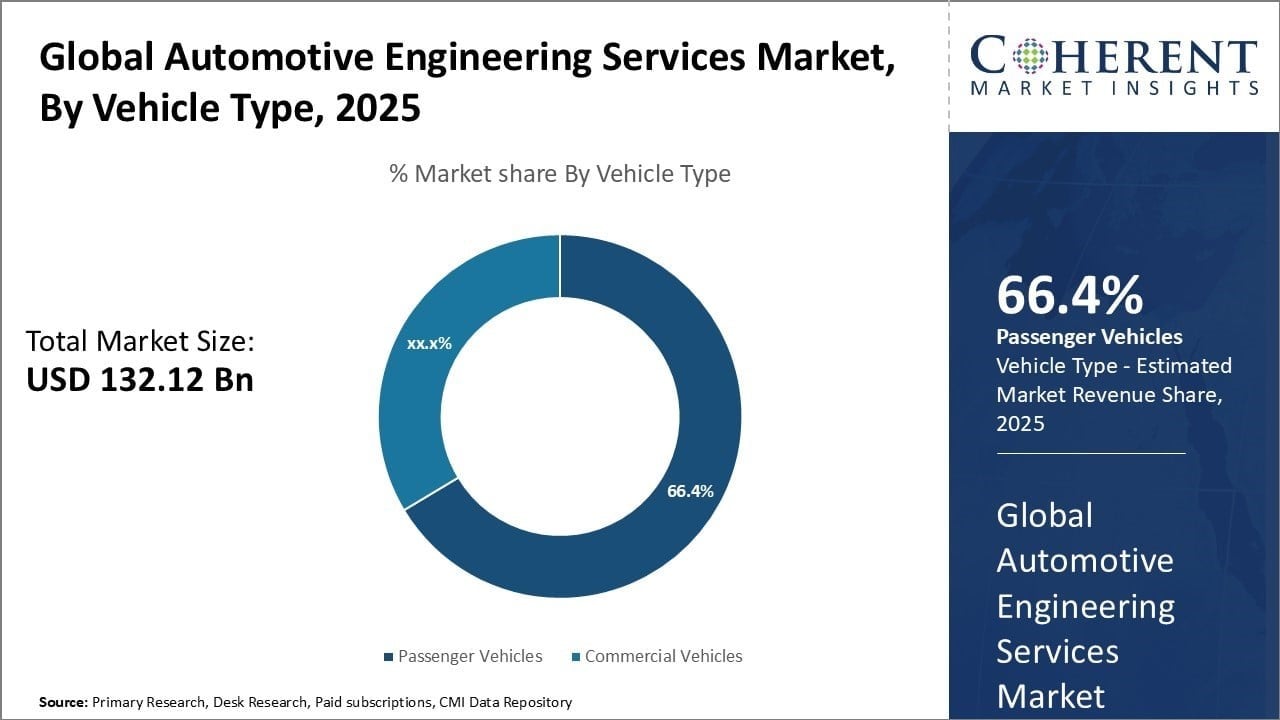
Automotive Engineering Services Market Insights, by Vehicle Type
The passenger vehicles segment dominates the market due to the Passenger Vehicles leading due to Consumer Preference for Personal Mobility
The passenger vehicles segment is expected to hold the dominant share of 67.4% in terms of vehicle type in 2026. Rising disposable income and changing lifestyle among consumers have significantly increased their spending on personal vehicles for commuting. Consumer preference for passenger vehicles is driven by the need for flexibility and personal space that their own vehicles offer. The developing transportation infrastructure in emerging markets is also enabling increased vehicle ownership.
Countries like India and China are experiencing rapid urbanization, which is augmenting the demand for passenger vehicles for intra-city travel. For instance, Passenger vehicle sales in India surpassed4 million units in 2024-2025. The ambitious smart city projects in these regions are facilitating better road connectivity and driving infrastructure growth. The evolving consumer needs in terms of features, design, and driving experience are compelling automakers to focus on new model launches and upgrades in the passenger vehicle segment. This is further accelerating the automotive engineering services market share.
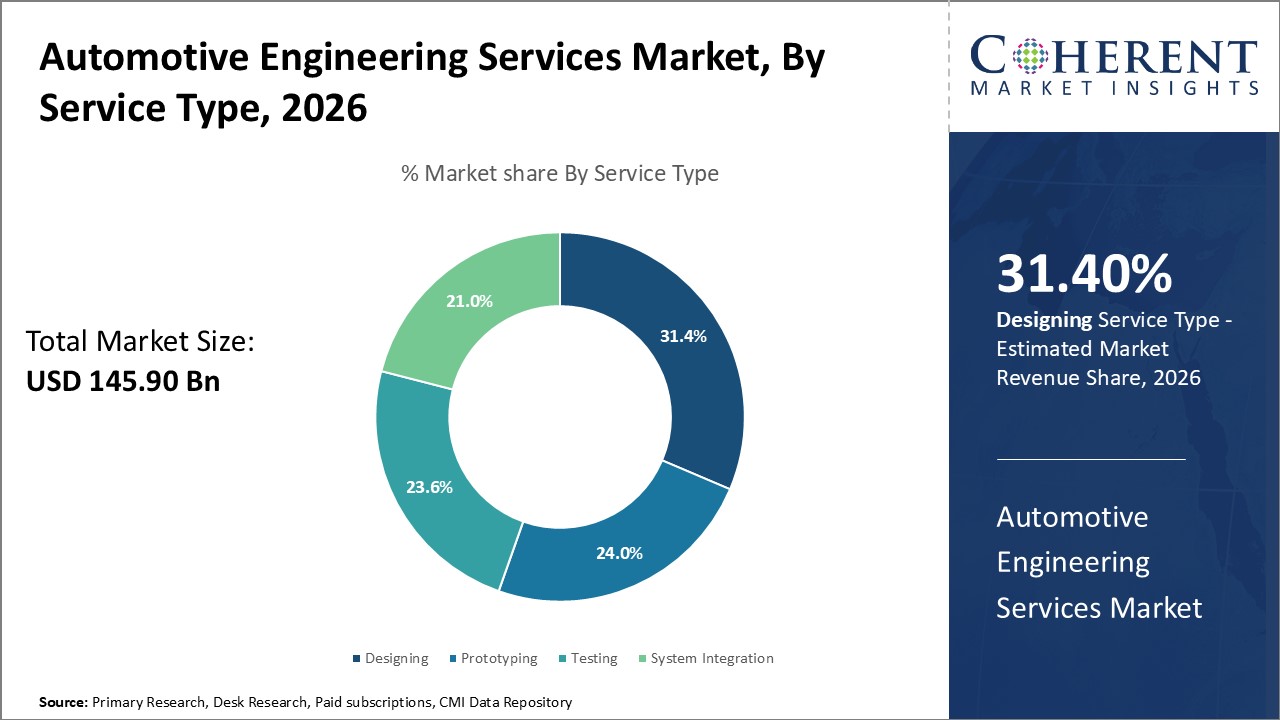
Automotive Engineering Services Market Insights, by Service Type
The designing segment dominates the market due to Its Strategic Importance
Of all the service types in the market, designing is expected to account for the major revenue share of 31.4% in 2026. Effective design lays the foundation for an automotive product by determining key attributes like performance, safety, quality, and functionality right from the conceptualization stage. It has a significant influence on the overall development timeline as well as the costs of a vehicle. Hence, OEMs rightly consider design engineering as a core competence. Evolving regulatory safety and emission norms also compel frequent revisions in vehicle design. Advanced design capabilities are imperative to integrate stringent compliance and deliver feature-rich models within package constraints.
With growing expectations around design aesthetics, automakers rely on expert design consultancies. Emerging technologies like connected vehicles, autonomous driving, and electrification pose tremendous design challenges that in-house teams might not be equipped to address. Outsourcing design engineering to specialized firms helps OEMs access relevant expertise and solutions.
Regional Insights
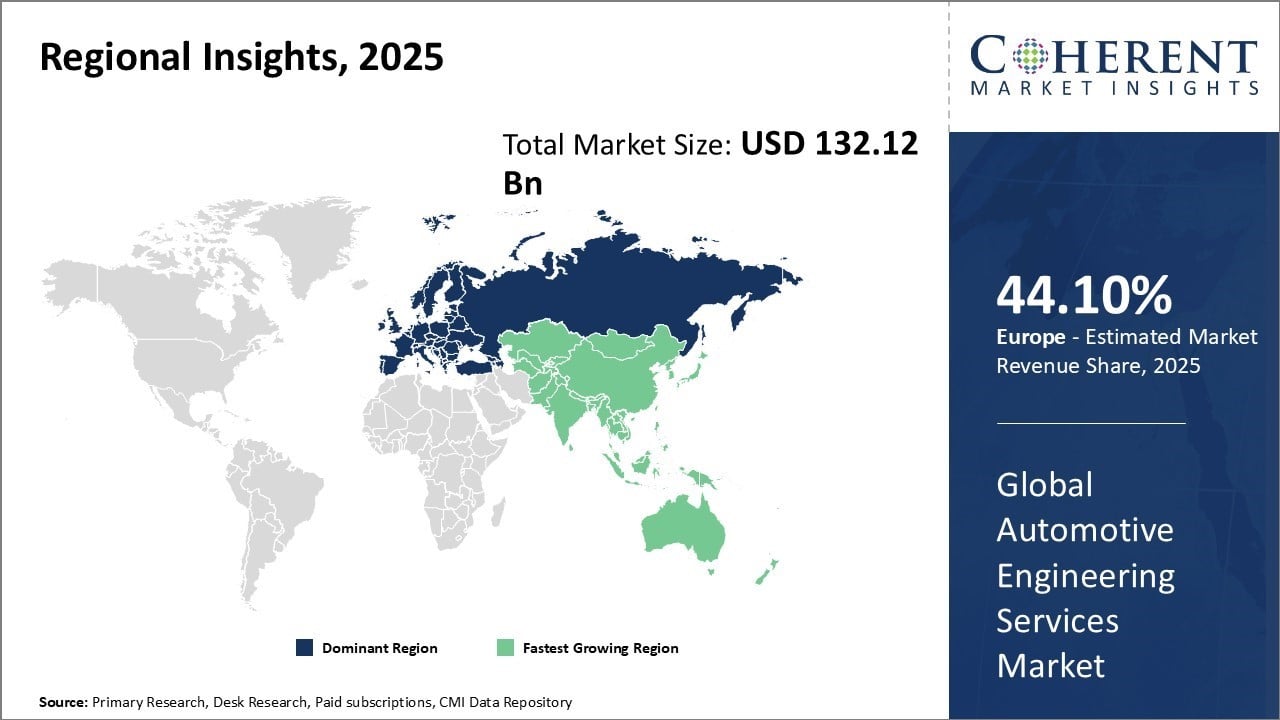
Europe Automotive Engineering Services Market Trends
Europe is expected to hold a share of 44.10% in 2026 and dominate the automotive engineering services market. The lead can be attributed to the presence of major established automakers like Volkswagen, Mercedes-Benz, BMW, and Renault-Nissan. These companies have made significant investments in R&D capabilities over the years, focusing on connectivity, electrification, and autonomous driving technologies.
Additionally, a favorable regulatory environment promoting green vehicles and a strong manufacturing industry have supported the growth of automotive engineering services in the region. Key players like AVL List GmbH, Ricardo Plc, and AKKA Technologies have established Europe-focused operations to leverage these opportunities. For instance, in June 2026, Tata Consultancy Services (TCS) launched three new hubs in Europe to expand its Software-Defined Vehicles (SDV) segment. It has set up two automotive delivery centers in Germany and one engineering center in Romania.
Asia Pacific Automotive Engineering Services Market Trends
The Asia Pacific region, holding a share of 23.4% in 2026, is expected to exhibit the fastest growth in the automotive engineering services market. Rapid economic development, increasing disposable incomes, and rising vehicle ownership in emerging economies like China and India are driving the modernization of the automotive industry. Local automakers are investing heavily in new model development and upgrading manufacturing infrastructure. This is propelling the demand for engineering consultancy, design/development outsourcing, and testing services from international as well as regional service providers. Japan-based firms, such as Mitsubishi Motors R&D, Subaru Corporation, and DENSO, also contribute significantly to the engineering needs of the Asia Pacific automotive engineering services market.
For instance, HORIBA MIRA, a global leader in automotive engineering, has launched its vehicle engineering and consultancy services through HORIBA India, consolidating its offerings in the region. This is further proliferating the automotive engineering services market share in APAC region.
U.K. Automotive Engineering Services Market Trends
The U.K. automotive engineering services market is led by highly specialized consultancies including Ricardo Plc, and FEV Group. They aid in technology development, focusing on engine downsizing, emissions control, and alternative fuels for both local and global auto brands. The country's advanced R&D infrastructure and engineering talent make it an attractive hub for product development and design/validation projects outsourced by international automakers. For instance, GKN Automotive launched an Advanced Research Centre in the UK to accelerate the development of electrified vehicles. This is further proliferating the automotive engineering services market share in UK.
Japan Automotive Engineering Services Market Trends
Japan is characterized by strong collaboration between leading automakers like Toyota, Honda, and their key suppliers that invest heavily in next-gen technologies. Engineering giants, such as Denso, Aisin Group, and Magna PT, provide diversified solutions across electronic systems, Advanced Driving Assistance System (ADAS), and lightweight components. Consolidation trends continue as players explore synergies to develop modular platforms and new mobility solutions aimed at global markets. For instance, Sumitomo Corporation, based in Japan, partnered with Tech Mahindra to create SCTM Engineering, a joint venture focused on providing automotive engineering services.
Market Players, Key Development, and Competitive Intelligence
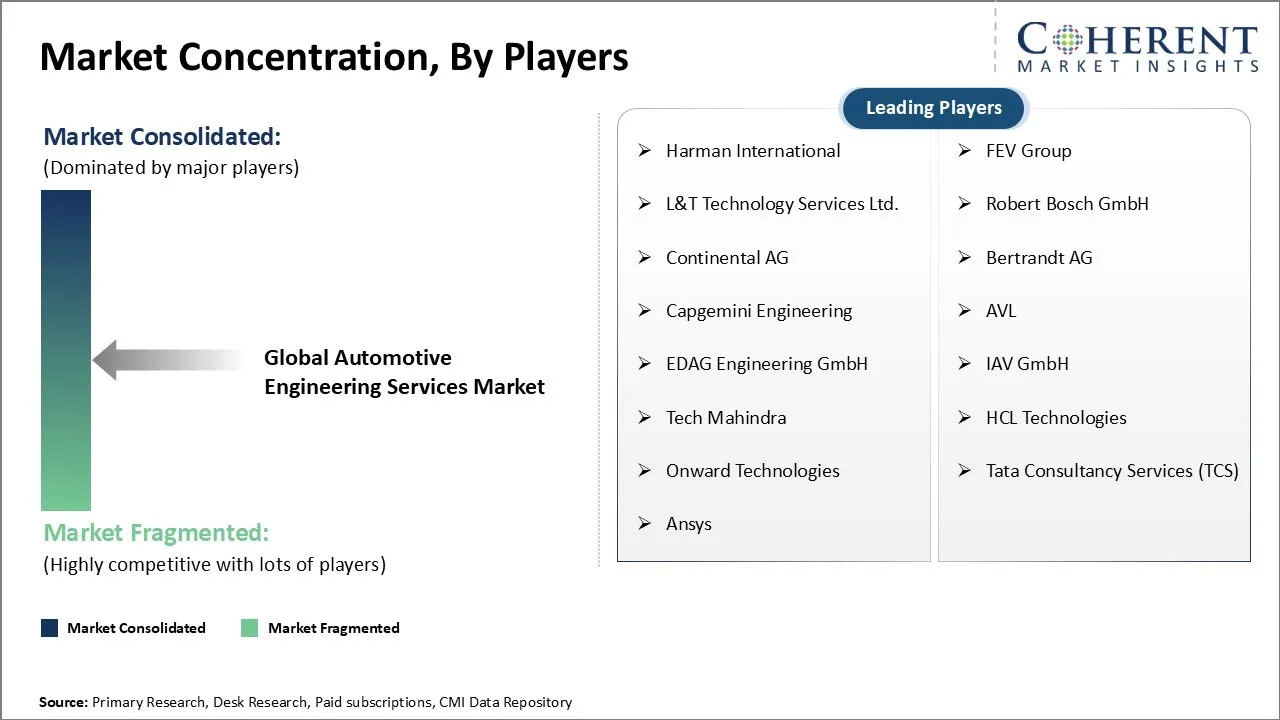
Key Developments
- In July 2025, Qualcomm announced to host its first Snapdragon Auto Day in India in Delhi. With features like context-aware vehicle solutions powered by AI, the event seeks to make Indian roads safer.
- In June 2025, Volvo Cars chose HCLTech as a strategic supplier for engineering services, highlighting the growing collaboration between automotive companies and technology providers.
- In March 2025, Continental Engineering Services (CES) showcased its latest in electrification, connectivity, and automation at the VECS 2025 conference.
- In June 2023, Tata Elxsi formed a strategic partnership with Cultos Global to integrate an NFT Token mechanism for a driver reward program and has also launched 'TETHER' for Tata Motors' connected vehicle platform.
- In July 2023, HCLTech, a global technology company, acquired Germany-based automotive engineering company, ASAP Group, for USD 276.41 million (EUR 251 million).
- In December 2022, Tata Consultancy Services (TCS), a provider of IT services, and Ansys, a developer of engineering simulation software, signed an MoU to utilize engineering simulation software for advancements in electric vehicle technology.
Market Report Scope
Automotive Engineering Services Market Report Coverage
| Report Coverage | Details | ||
|---|---|---|---|
| Base Year: | 2025 | Market Size in 2026: | USD 145.90 Bn |
| Historical Data for: | 2020 To 2024 | Forecast Period: | 2026 To 2033 |
| Forecast Period 2026 to 2033 CAGR: | 10.4% | 2033 Value Projection: | USD 291.56 Bn |
| Geographies covered: |
| ||
| Segments covered: |
| ||
| Companies covered: | Harman International, FEV Group, L&T Technology Services Ltd., Robert Bosch GmbH, Continental AG, Bertrandt AG, Capgemini Engineering, AVL, EDAG Engineering GmbH, IAV GmbH, Tech Mahindra, HCL Technologies, Onward Technologies, Tata Consultancy Services (TCS), and Ansys | ||
| Growth Drivers: |
| ||
| Restraints & Challenges: |
| ||
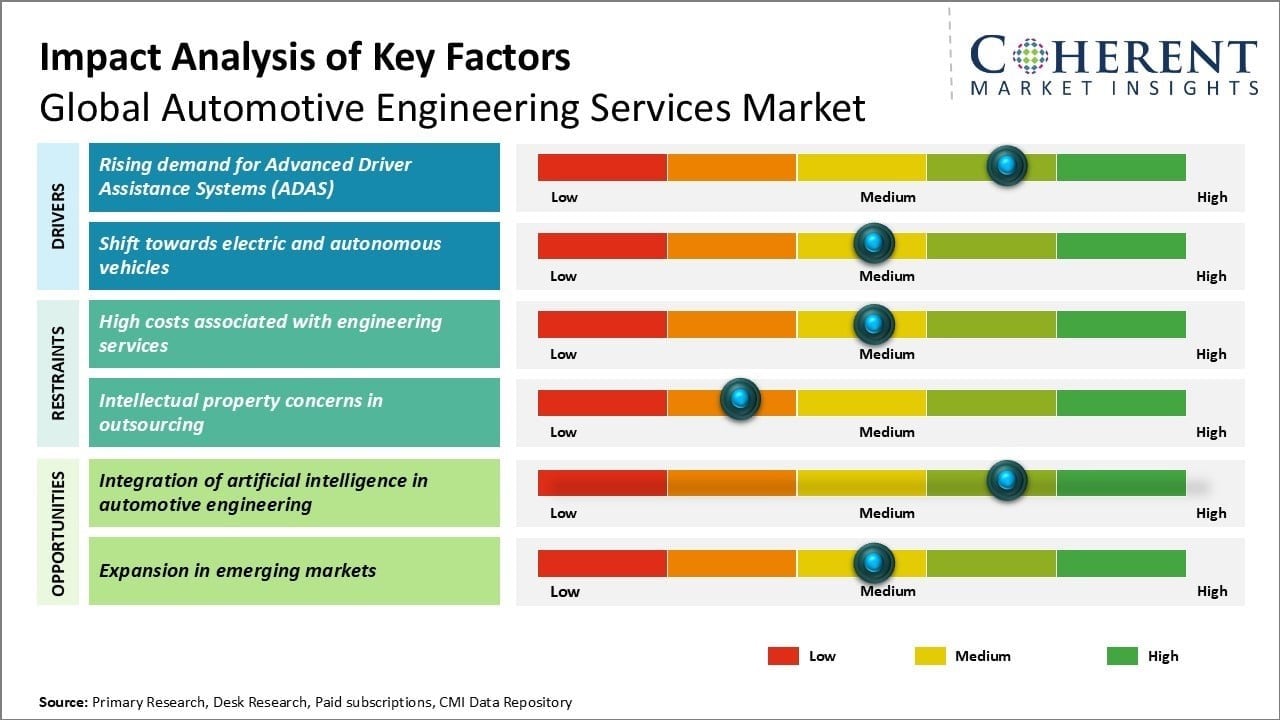
Automotive Engineering Services Market Driver - Rising Demand for Advanced Driver Assistance Systems (ADAS)
The global automotive engineering services industry is witnessing rising demand for vehicles equipped with Advanced Driver Assistance Systems (ADAS). ADAS technology includes various active and passive systems that either provide a warning to the driver or automatically apply brakes to avoid collisions and assist drivers in several ways. With the constantly declining prices of sensors and other electronic components, automakers are increasingly integrating ADAS features such as adaptive cruise control, lane departure warning, blind spot monitoring, park assist, and other semi-autonomous driving functions across their model lines.
The concept of self-driving vehicles is also gaining traction with major automakers actively testing fully autonomous vehicles equipped with sophisticated ADAS. Stiffer safety and emission regulations, particularly in developed markets, are further catalyzing the adoption of ADAS. Rapid infrastructure development, especially 5G networks, will also aid the deployment and functionalities of ADAS technology going forward. Greater focus on active and passive safety is expected to drive robust demand for ADAS, which, in turn, will fuel the automotive engineering services market demand.
Automotive Engineering Services Market Opportunity - Integration of Artificial Intelligence in Automotive Engineering
The growing integration of artificial intelligence and machine learning tools in automotive design and engineering processes presents significant opportunities for growth in the market. AI can help automate repetitive tasks, thus reducing manhours and costs substantially. It also helps simulate real-world conditions virtually for testing new vehicle concepts without the need for expensive physical prototypes. This helps compress the development cycles and time-to-market. Moreover, AI-driven virtual prototyping tools allow for designing electric and autonomous vehicles efficiently. As self-driving becomes mainstream, AI will play a bigger role in areas like sensor calibration, mapping, and navigation. The data generated from connected vehicles can be analyzed using AI to enhance safety and performance over time.
Analyst Opinion (Expert Opinion)
- Car makers and major suppliers are increasingly handing over key research and development work to outside partners, not just to save money, but to manage growing complexity. Today, over 65% of global automotive R&D happens outside the carmakers’ facilities. This trend is driven by the rise of electric vehicles (EVs), advanced driver-assistance systems (ADAS), and software-defined vehicles (SDVs). Long-term deals like Tata Technologies’ partnerships with JLR and VinFast show that outsourced engineering has become a central part of how automakers innovate — this is about collaboration, not just hiring help.
- Many long-standing engineering service providers still focus heavily on engines and vehicle structures — areas that are losing value as technology advances. Today, around 40% of a car’s value comes from electronics and software (Roland Berger, 2023). Providers who don’t quickly build expertise in areas like embedded software, AUTOSAR, wireless updates (OTA), and digital modeling will fall behind. Fast-moving, tech-savvy firms like KPIT and FEV.io are already gaining ground by focusing on these high-growth areas.
- Sending engineering work overseas — especially to India and Eastern Europe — is no longer only about saving money. It’s also about managing risks and ensuring there’s backup talent when things go wrong. For instance, the war in Ukraine forced many companies to quickly move ADAS software development to India in just a few months. Firms with teams in multiple countries and secure digital systems for remote work are now the top choice for global carmakers, offering reliability, not just lower cost.
Speak to the analyst
Want personalized insights?
Take the findings above to one of our principal consultants, or have the report rebuilt around the segments, geographies and competitors you actually track.
Market Segmentation
- Vehicle Type Insights (Revenue, USD Bn, 2021 - 2033)
- Passenger Vehicles
- Commercial Vehicles
- Service Type Insights (Revenue, USD Bn, 2021 - 2033)
- Designing
- Prototyping
- Testing
- System Integration
- Regional Insights (Revenue, USD Bn, 2021 - 2033)
- North America
- U.S.
- Canada
- Latin America
- Brazil
- Argentina
- Mexico
- Rest of Latin America
- Europe
- Germany
- U.K.
- Spain
- France
- Italy
- Russia
- Rest of Europe
- Asia Pacific
- China
- India
- Japan
- Australia
- South Korea
- ASEAN
- Rest of Asia Pacific
- Middle East
- GCC Countries
- Israel
- Rest of Middle East
- Africa
- South Africa
- North Africa
- Central Africa
- North America
- Key Players Insights
- Harman International
- FEV Group
- L&T Technology Services Ltd.
- Robert Bosch GmbH
- Continental AG
- Bertrandt AG
- Capgemini Engineering
- AVL
- EDAG Engineering GmbH
- IAV GmbH
- Tech Mahindra
- HCL Technologies
- Onward Technologies
- Tata Consultancy Services (TCS)
- Ansys
Sources
Interviews from the following stakeholders
Stakeholders
- Interviews with automotive R&D directors, product engineering heads, vehicle program managers, powertrain system designers, E/E architecture leads, ADAS and autonomous systems engineers, procurement managers, and business development executives involved in the design, testing, validation, and deployment of ICE, hybrid, and electric vehicle platforms across OEMs, Tier 1 suppliers, and engineering service providers.
Databases
- Eurostat – Automotive Product Trade and R&D Statistics
- UN Comtrade – International Trade Data for Vehicle Components and Engineering Exports
- OECD – Automotive R&D Spending and Employment Metrics
- ACEA (European Automobile Manufacturers’ Association) – Vehicle Production, Innovation & Regulatory Trends
- IHS Markit – Automotive Technology Adoption & Supplier Landscape
- SIAM (Society of Indian Automobile Manufacturers) – R&D Trends and Vehicle Production Data
- JAMA (Japan Automobile Manufacturers Association) – Global Engineering Benchmarking
- U.S. Bureau of Labor Statistics – Automotive Engineering Employment and Productivity
- World Bank – Infrastructure Investment and Automotive Industrialization Data
- Ministry of Heavy Industries (India) – Automotive R&D Incentives and Electric Mobility Programs
Magazines
- Automotive Engineering (SAE International)
- Autocar Professional
- Automotive News
- Vehicle Electronics
- Engineering & Technology Magazine
- Design News – Automotive Systems Section
- The Engineer – Mobility & Transport Focus
- Automobil Industrie (Germany)
- Autotech Review
Journals
- SAE International Journal of Passenger Cars – Mechanical Systems
- IEEE Transactions on Intelligent Vehicles
- International Journal of Automotive Technology
- Journal of Vehicle Engineering and Technology
- Transportation Research Part C Emerging Technologies
- International Journal of Automotive Engineering
- Vehicle System Dynamics
Newspapers
- The Economic Times – Auto & Mobility Section
- Business Standard – Automotive R&D and EV Transition Coverage
- The Hindu BusinessLine – Vehicle Technology and Supplier Ecosystem
- Reuters – Global Automotive Supply Chain and R&D Trends
- Financial Times – Automotive Strategy and Electrification Insights
Associations
- SAE International (Society of Automotive Engineers)
- FISITA (International Federation of Automotive Engineering Societies)
- ACMA (Automotive Component Manufacturers Association of India)
- ARAI (Automotive Research Association of India)
- NHTSA (National Highway Traffic Safety Administration) – U.S. Vehicle Safety Guidelines
- UNECE – World Forum for Harmonization of Vehicle Regulations (WP.29)
- OICA (International Organization of Motor Vehicle Manufacturers)
- European Association of Automotive Suppliers (CLEPA)
Public Domain Sources
- Ministry of Road Transport and Highways (India) – Vehicle Engineering Policies and Safety Norms
- U.S. Department of Transportation – Advanced Vehicle Engineering Programs
- European Commission – Mobility Innovation and Engineering Services Policies
- Department for Business and Trade (UK) – Automotive Engineering and R&D Investment Reports
- International Energy Agency (IEA) – Electric Vehicle Engineering Metrics and Infrastructure Data
- Ministry of Heavy Industries (India) – FAME Scheme Engineering Guidelines
- NITI Aayog – Automotive Innovation and Localisation Reports
Proprietary Elements
- CMI Data Analytics Tool, and Proprietary CMI Existing Repository of information for last 8 years
Get access to 250+ pages report
Every segment, forecast, competitor profile and data table behind the analysis above — available for instant download.
- ESOMAR Member
- ISO 9001:2015 Certified
- D-U-N-S Registered
- GDPR & CCPA Compliant
Missing comfort of reading report in your local language? Find your preferred language:
Transform your Strategy with Exclusive Trending Reports
Frequently Asked Questions
The global automotive engineering services market is expected to be valued at USD 145.90 Bn in 2026 and reach USD 291.56 Bn by 2033.
The CAGR of the global automotive engineering services market is projected to be 10.4% from 2026 to 2033.
Rising demand for advanced driver assistance systems (ADAS) and a shift towards electric and autonomous vehicles are the major factors driving the growth of the global automotive engineering services market.
High costs associated with engineering services and intellectual property concerns in outsourcing are the major factors hampering the growth of the global automotive engineering services market.
In terms of vehicle type, the passenger vehicles segment is estimated to dominate the market revenue share in 2026.
Harman International, FEV Group, L&T Technology Services Ltd., Robert Bosch GmbH, Continental AG, Bertrandt AG, Capgemini Engineering, AVL, EDAG Engineering GmbH, IAV GmbH, Tech Mahindra, HCL Technologies, Onward Technologies, Tata Consultancy Services (TCS), and Ansys are the major players.
Europe is expected to lead the global automotive engineering services market in 2026, holding a share of 44.1%.