

Sandwich Panels Market Size and Forecast – 2026 to 2033
The Sandwich Panels Market is anticipated to grow at a CAGR of 8.2% with USD 13.7 Bn in 2026 and is expected to reach USD 21.1 Bn in 2033. Rising demand for energy-efficient buildings, rapid urbanization, and expanding cold storage and logistics sectors drive the Sandwich Panels Market. According to our research, the US cold industry is estimated to surpass USD 105 Bn by 2033.
Key Takeaways
- Aluminum holds the largest market share of 42.2% in 2026, driven by growth in construction and infrastructure. Its demand is supported by the global construction industry, which is projected to exceed USD 15 trillion by 2030, while aluminum remains a preferred material due to its high strength-to-weight ratio and corrosion resistance.
- Mineral Wool is expected to hold the largest market share of 37.7% in 2026, supported by stringent fire safety regulations. Mineral wool panels can withstand temperatures above 1,000°C and are widely adopted in commercial and industrial buildings to meet increasingly strict fire protection standards.
- Wall Panels account for a prominent 38.8% market share in 2026, fueled by rapid urbanization and commercial construction growth. According to the United Nations, nearly 68% of the global population is projected to live in urban areas by 2050, increasing demand for efficient building envelope solutions.
- Residential captures the largest market share of 41.6% in 2026 owing to the affordable housing demand.
- North America is expected to dominate with a 39.2% market share in 2026, supported by strong demand for energy-efficient buildings. Buildings account for nearly 40% of total energy consumption in the region, driving the adoption of insulated sandwich panels that improve thermal performance and reduce operating costs.
Current Events and Their Impact on the Sandwich Panels Market
Current Event | Description and its Impact |
EU Energy Performance of Buildings Directive (EPBD) Implementation (2024–2026) |
|
U.S. Steel and Aluminum Tariffs Expansion (2025) |
|
Why is Aluminum Acquiring the Largest Market Share?
Aluminum holds the largest market share of 42.2% in 2026. Aluminum drives the sandwich panels market through its lightweight nature, high strength, and corrosion resistance, making it suitable for modern construction and industrial applications. It enables faster installation and reduces structural load, benefiting high-rise and modular buildings. Increasing demand for energy-efficient and sustainable materials further accelerates its adoption, as aluminum panels provide strong thermal performance and recyclability. Additionally, rising infrastructure development and the growing preference for aesthetically appealing façades continue to support market growth. For instance, in August 2025, Viva, India’s leading aluminum composite panel (ACP) manufacturer, has launched India’s first state-of-the-art in-house production facility for A2 fire-retardant cores.
- Current Industry Events of 2026
- Market Size Estimation
- Regional Breakdown
- Competitive Landscape
- Customer Intelligence
- Segmental Analysis
- Pricing Analysis
- Key Market Drivers, Challenges & Future Trends
- Customized Insights Section
Mineral Wool expected to hold largest market share
Mineral Wool expected to hold largest market share of 37.7% in 2026 owing to the increasing insurance & compliance requirements. Mineral wool drives the sandwich panels market through its excellent fire resistance and non-combustible properties, making it suitable for buildings that follow strict safety regulations. It delivers strong thermal and acoustic insulation, helping create energy-efficient and comfortable indoor environments. Expanding industrial activities and the growth of warehouses and infrastructure further increase its demand. Its durability, moisture resistance, and long service life improve reliability. In addition, growing focus on sustainable construction and recyclable materials strengthens the adoption of mineral wool panels.
Segmental Insights
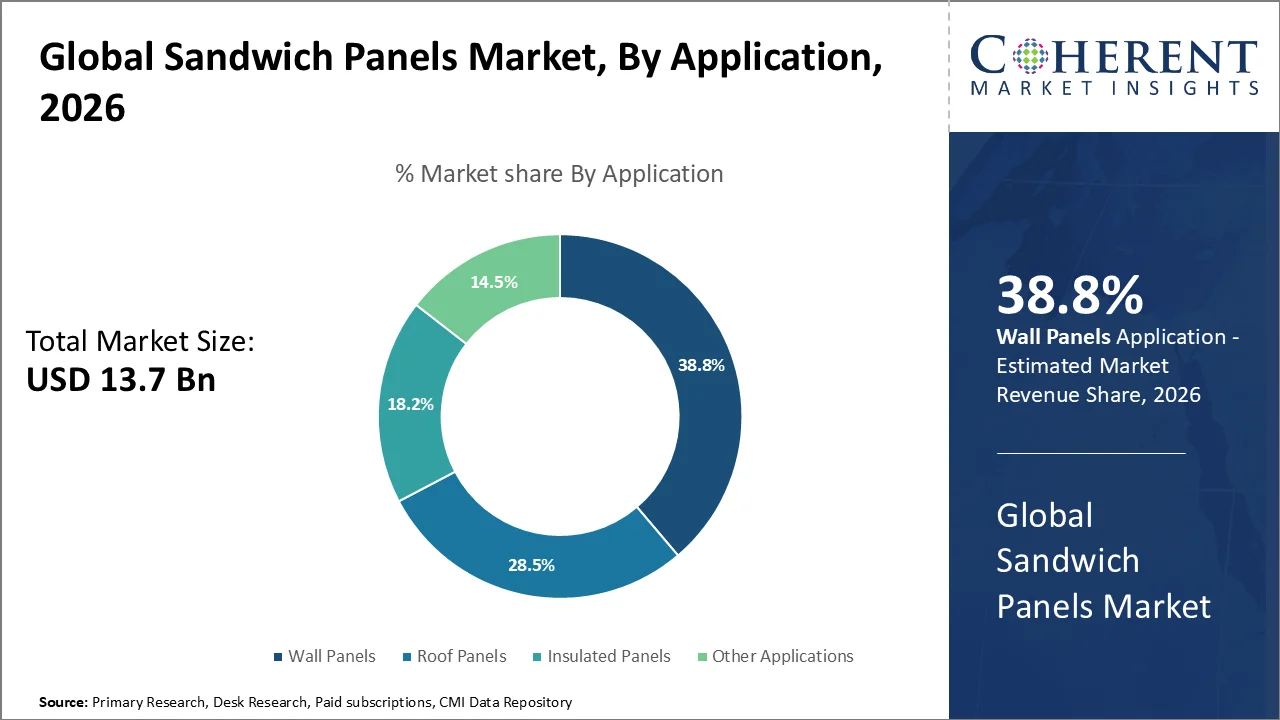
Wall Panels acquired the prominent market share
Wall Panels acquired the prominent market share of 38.8% in 2026 owing to its lightweight & easy installation. Wall panels drive the sandwich panels market through their growing use in commercial, industrial, and residential construction for fast and efficient building solutions. They enable rapid installation, reduce construction time, and lower labor costs. Increasing demand for energy-efficient buildings strengthens their adoption as they deliver effective thermal insulation. Rising urbanization and expanding infrastructure projects further boost demand. More than half of the global population lives in urban areas, with the urban population projected to reach 5 billion by 2030, driven primarily by growth in Africa and Asia. In addition, their aesthetic flexibility, durability, and suitability for modular and prefabricated construction increase their preference in modern architecture.
Which End User segment dominates the market?
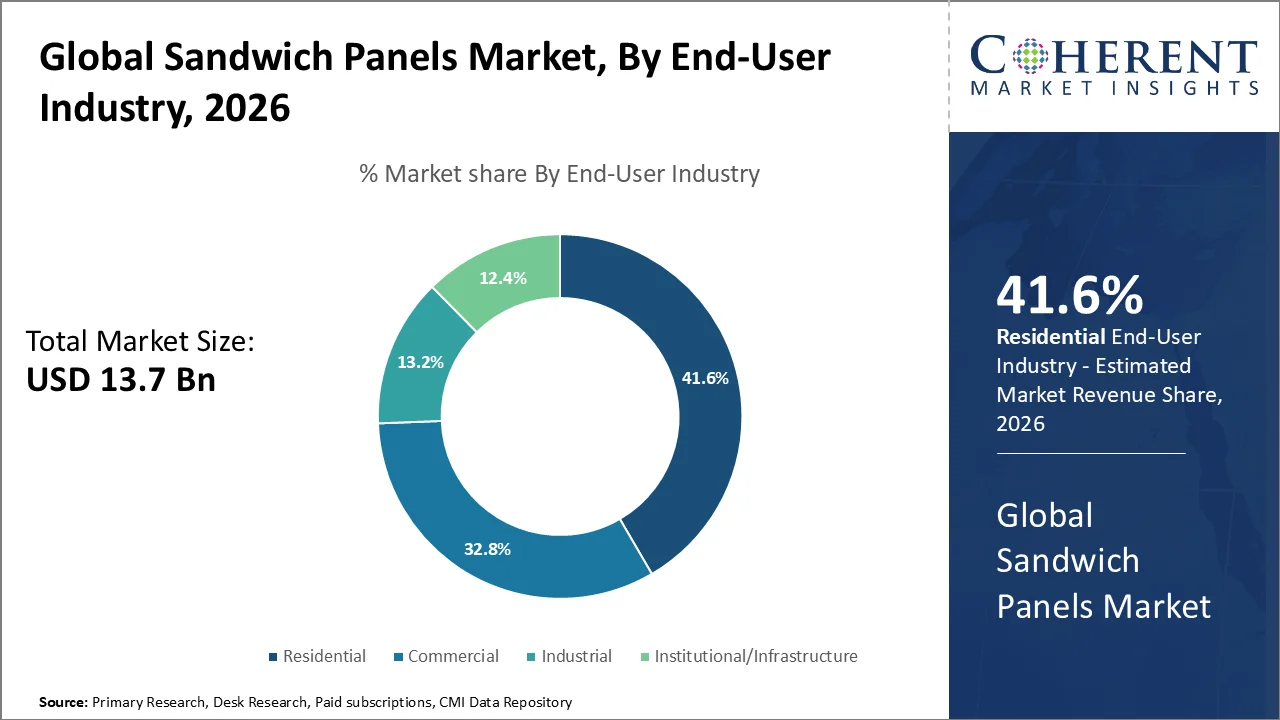
Residential captures the largest market share of 41.6% in 2026. The residential segment drives the sandwich panels market as demand for affordable and faster housing solutions increases. Rapid population growth encourages developers to adopt prefabricated and modular construction methods. The global population is projected to peak at approximately 10.3 billion in the mid-2080s after several decades of continued growth. Sandwich panels enable quick installation, reduce labor requirements, and lower overall construction costs. Growing awareness of energy efficiency further supports their adoption as they provide effective thermal insulation and improve indoor comfort. In addition, government housing initiatives and the preference for modern building materials strengthen residential market demand.
Sandwich Panels Market Trends
- Rising demand for energy-efficient and sustainable construction materials is increasing the adoption of sandwich panels in residential, commercial, and industrial buildings, as they provide strong thermal insulation and reduce energy consumption. Buildings account for nearly 37% of global energy-related CO₂ emissions, making energy-efficient building envelopes a key focus area for developers and regulators.
- Increasing emphasis on fire safety regulations drives the adoption of mineral wool and other non-combustible core materials in sandwich panels, especially in high-rise buildings, industrial facilities, and public infrastructure. Mineral wool insulation can withstand temperatures exceeding 1,000°C, making it a preferred solution for meeting stringent fire protection standards.
- Supportive green building standards and sustainability initiatives encourage the use of recyclable and low-carbon materials in sandwich panels, with certifications such as LEED and BREEAM promoting eco-friendly construction practices. Green-certified buildings can reduce energy consumption by 30% compared with conventional buildings, driving demand for high-performance insulated panels.
Regional Insights
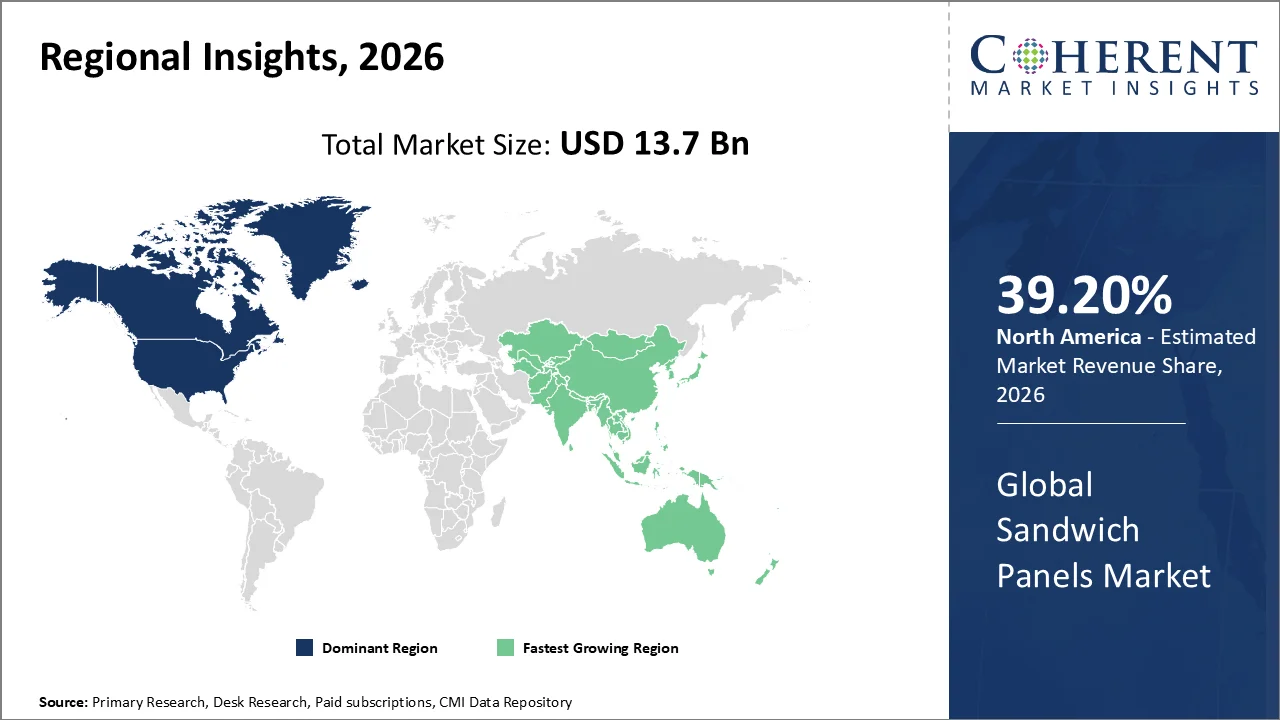
North America dominates owing to industrial & commercial construction demand
North America is expected to acquire the dominant share of 39.20% in 2026. North America drives the sandwich panels market through strong demand for energy-efficient and sustainable construction materials across residential, commercial, and industrial sectors. Strict building codes and fire safety regulations promote the use of high-performance insulated panels. Rapid growth in cold storage, logistics, and warehousing infrastructure further increases demand. Increasing adoption of prefabricated and modular construction methods supports market expansion by reducing project timelines and labor dependency. In addition, renovation activities and a focus on green building practices strengthen regional growth. In April 2025, Kingspan Insulation North America expanded its OPTIM-R Series by introducing OPTIM-R E vacuum insulation panels. The company developed the product to meet rising demand for energy-efficient roofing in new-build and retrofit projects with limited construction depth.
Asia Pacific Sandwich Panels Market Trends
Industrial expansion, and a booming construction sector drive the Asia Pacific sandwich panels market. Growing demand for energy-efficient building materials in residential and commercial projects boosts adoption. Cold storage facilities are expanding due to rising needs in food processing and pharmaceuticals, further increasing usage. E-commerce growth strengthens warehousing infrastructure. Governments invest in smart cities and industrial corridors, while industries increasingly prefer prefabricated structures, collectively supporting strong market development across the Asia Pacific region. Mount Roofing and Structures Pvt. Ltd., a fast-growing PUF manufacturer and leading provider of Pre-Engineered Building (PEB) and polycarbonate sheet solutions, has inaugurated its second automated continuous sandwich panel manufacturing unit along with a new PEB manufacturing facility at its large campus in Tumkur.
United States Sandwich Panels Market Trends
Rising demand for energy-efficient construction materials in commercial and residential buildings drives the United States sandwich panels market. Expanding cold storage facilities and the food processing industry increase adoption because of strong thermal insulation properties. Growth in industrial warehouses and logistics infrastructure boosts usage due to easy installation and durability. Builders increasingly prefer prefabricated and modular construction methods. Strict building safety standards and fire resistance regulations further push the adoption of lightweight, sustainable sandwich panel systems.
Japan Sandwich Panels Market Trends
Rising demand for energy-efficient and insulated construction drives Japan’s sandwich panels market across residential, commercial, and industrial sectors. Japan’s focus on earthquake-resistant, lightweight materials supports wider adoption. Growth in cold storage, food processing, and logistics boosts usage. Prefabricated construction, urban redevelopment, and sustainable building practices further support expansion. Industrial modernization and renovation of aging infrastructure also increase demand for advanced sandwich panel systems.
Who are the Major Companies in Sandwich Panels Industry
Some of the major key players in Sandwich Panels are ArcelorMittal Construction, Areco, Assan Panel AS, Building Components Solutions LLC, Cornerstone Building Brands, DANA Group of Companies, Kingspan Group, Multicolor Steels (India) Pvt Ltd, Rautaruukki Corporation, Safal Group., ITALPANNELLI SRL, Tata Steel, and Sintex
Key News
- In December 2025, Tata Steel Nederland (TSN) has launched the Green Box, a sustainable green roof system for metal roofing applications. The solution uses recycled polyethylene and targets metal roofs such as sandwich panels, combining sustainability, simplicity, and cost efficiency.
Market Report Scope
Sandwich Panels Market Report Coverage
| Report Coverage | Details | ||
|---|---|---|---|
| Base Year: | 2025 | Market Size in 2026: | USD 13.7 Bn |
| Historical Data for: | 2020 To 2024 | Forecast Period: | 2026 To 2033 |
| Forecast Period 2026 to 2033 CAGR: | 8.2% | 2033 Value Projection: | USD 21.1 Bn |
| Geographies covered: |
| ||
| Segments covered: |
| ||
| Companies covered: | ArcelorMittal Construction, Areco, Assan Panel AS, Building Components Solutions LLC, Cornerstone Building Brands, DANA Group of Companies, Kingspan Group, Multicolor Steels (India) Pvt Ltd, Rautaruukki Corporation, Safal Group., ITALPANNELLI SRL, Tata Steel, and Sintex | ||
Analyst Opinion
- The Japan sandwich panels market is fundamentally driven by structural necessity rather than discretionary construction trends. Japan experiences over 1,500 seismic events annually, which forces builders to prioritize lightweight, high-strength materials, making sandwich panels a practical engineering choice rather than an optional upgrade.
- Cold chain expansion strongly anchors demand, as Japan maintains one of the world’s most advanced refrigerated logistics networks, handling over 4 million tonnes of temperature-sensitive food imports annually. This sustains continuous adoption of insulated sandwich panel systems in warehouses and distribution hubs.
- Food processing and pharmaceutical facilities increasingly rely on controlled environments, with Japan operating thousands of GMP-compliant manufacturing plants that require high-performance thermal insulation and hygiene-grade wall systems, directly supporting sandwich panel deployment.
- Urban redevelopment pressure is another structural driver, as more than 28% of Japan’s population is over 65, pushing redevelopment of older, inefficient buildings in cities like Tokyo and Osaka into energy-efficient, prefabricated structures where sandwich panels significantly reduce construction time and thermal loss.
Speak to the analyst
Want personalized insights?
Take the findings above to one of our principal consultants, or have the report rebuilt around the segments, geographies and competitors you actually track.
Market Segmentation
- By Skin Material (Revenue, USD Bn, 2021-2033)
- Continuous Fiber Reinforced Thermoplastics (CFRT)
- Fiberglass Reinforced Panel (FRP)
- Aluminum
- Steel
- Other Skin Materials
- By Core Material (Revenue, USD Bn, 2021-2033)
- Polyurethane (PUR)
- Polyisocyanurate (PIR)
- Mineral Wool
- Expanded Polystyrene (EPS)
- Other Core Materials
- By Application (Revenue, USD Bn, 2021-2033)
- Wall Panels
- Roof Panels
- Insulated Panels
- Other Applications
- By End-User Industry (Revenue, USD Bn, 2021-2033)
- Residential
- Commercial
- Industrial
- Institutional/Infrastructure
- By Region (Revenue, USD Bn, 2021-2033)
- North America
- U.S.
- Canada
- Latin America
- Brazil
- Mexico
- Argentina
- Rest of Latin America
- Europe
- Germany
- U.K.
- France
- Italy
- Spain
- Russia
- Rest of Europe
- Asia Pacific
- China
- India
- Japan
- Australia
- South Korea
- ASEAN
- Rest of Asia Pacific
- Middle East
- GCC
- Israel
- Rest of Middle East
- Africa
- South Africa
- Central Africa
- North Africa
- North America
Sources
Primary Research interviews
- Interviews with construction contractors and EPC companies
- Discussions with sandwich panel manufacturers and fabricators
- Inputs from architects, civil engineers, and project consultants
- Feedback from distributors and building material suppliers
- Interviews with procurement heads in industrial construction firms
Databases
- National statistical databases (construction output, manufacturing data)
- International trade databases (import–export shipment records)
- Government infrastructure and building material databases
- Customs and commodity trade data portals
- Industry classification and production databases
Magazines
- Construction and building materials trade magazines
- Industrial manufacturing and engineering magazines
- Architecture and design-focused publications
- Infrastructure development magazines
- HVAC and insulation-focused trade magazines
Journals
- Materials science and engineering journals
- Construction technology and building physics journals
- Energy efficiency and insulation research journals
- Structural engineering and composites journals
- Polymer and insulation material research publications
Newspapers
- Business newspapers covering infrastructure and real estate
- Financial newspapers reporting on construction and manufacturing sectors
- National and regional newspapers tracking large infrastructure projects
- Economic dailies covering industrial investment trends
Associations
- Construction and building materials associations
- Insulation and thermal efficiency industry associations
- Steel and metal fabrication associations
- Green building and sustainability councils
- Infrastructure and civil engineering professional bodies
Public Domain sources
- Government infrastructure policy documents
- Publicly available construction project reports
- Regulatory filings and standards for building materials
- Central and state government housing and infrastructure publications
- International energy efficiency and building codes documentation
Proprietary Elements
- CMI Data Analytics Tool
- Proprietary CMI Existing Repository of information for last 10 years
Get access to 250+ pages report
Every segment, forecast, competitor profile and data table behind the analysis above — available for instant download.
- ESOMAR Member
- ISO 9001:2015 Certified
- D-U-N-S Registered
- GDPR & CCPA Compliant
Missing comfort of reading report in your local language? Find your preferred language:
Transform your Strategy with Exclusive Trending Reports
Frequently Asked Questions
The Sandwich Panels Market is anticipated to grow at a CAGR of 8.2% with USD 13.7 Bn in 2026 and is expected to reach USD 21.1 Bn in 2033.
Growing cold storage applications of structural insulated panels and rising demand for PVDF-based aluminum composite panels are fueling market.
The Aluminum segment is the leading component segment in the market.
Less fire resistance ability of sandwich panels and impact of COVID-19 pandemic are the major factors restraining market.
ArcelorMittal Construction, Areco, Assan Panel AS, Building Components Solutions LLC, Cornerstone Building Brands, DANA Group of Companies, Kingspan Group, Multicolor Steels (India) Pvt Ltd, Rautaruukki Corporation, Safal Group., ITALPANNELLI SRL, Tata Steel, and Sintex