

Sodium Caseinate Market Size and Forecast – 2026 to 2033
The Sodium Caseinate Market is anticipated to grow at a CAGR of 5.2% with USD 5.6 Bn share in 2026 and is expected to reach USD 8.2 Bn in 2033. Rising demand for protein-rich and functional foods, and increasing preference for clean-label ingredients are driving the sodium caseinate market. According to our research, the global functional food industry is estimated to surpass 403.98 Bn by 2033.
Key Takeaways
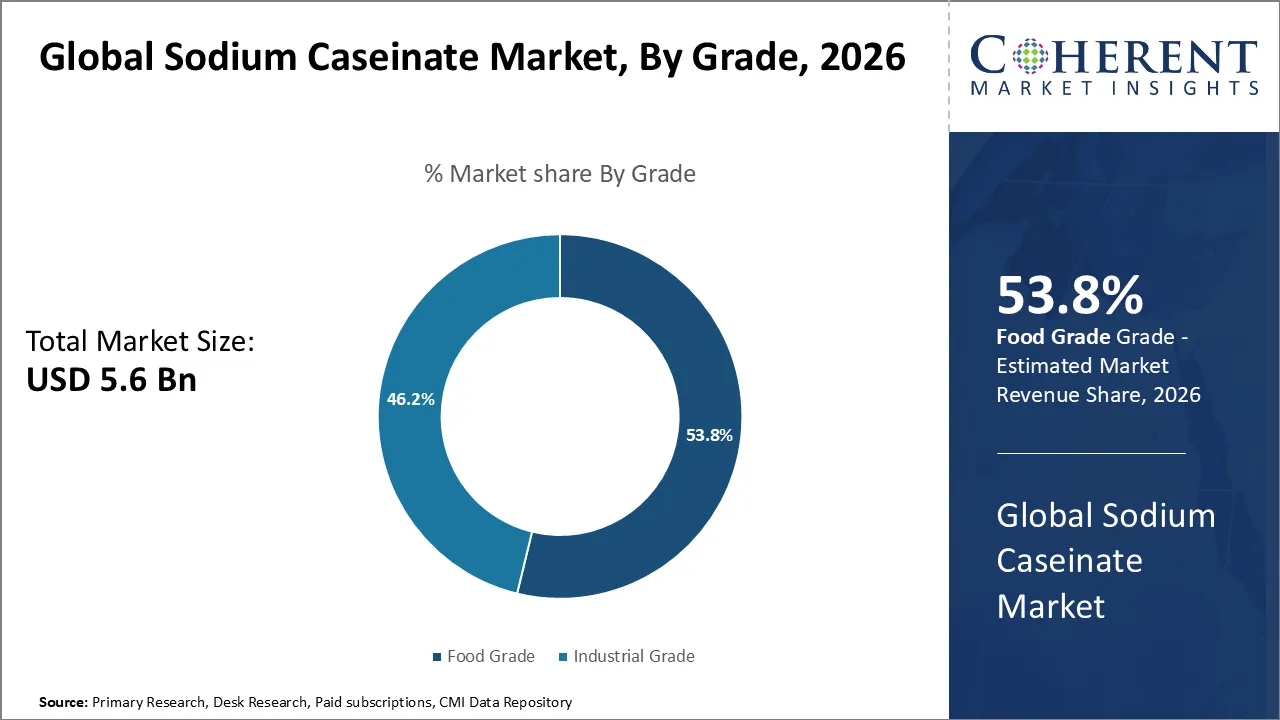
- Food Grade hold the largest market share of 53.8% in 2026 owing to the growing demand for high-protein foods. Protein consumption is rising, with 61% of consumers increasing their intake in 2024, driven by its taste, health benefits, and nutritional value.
- Food & Beverages expected to hold largest market share of 38.8% in 2026 owing to its expansion of functional and convenience foods. Global demand for functional foods is growing at an annual rate of 8%.
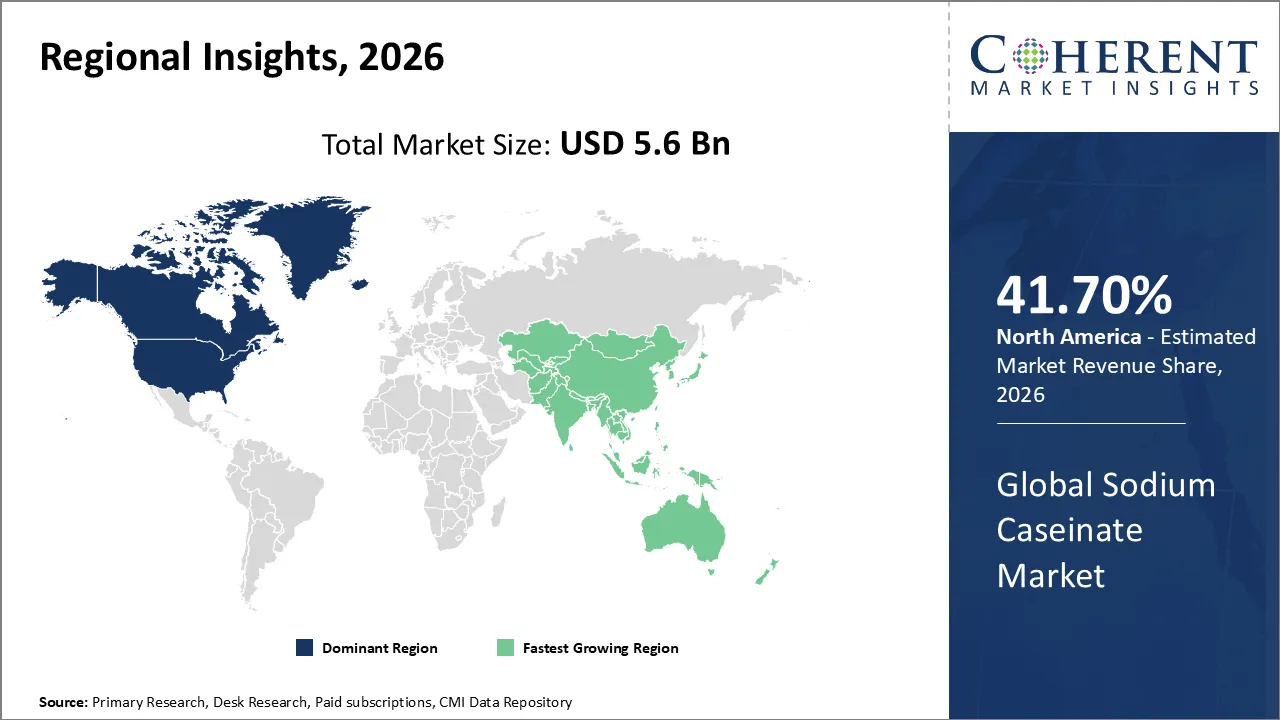
- North America is expected to acquire the dominant share of 41.7% in 2026 owing to the strong processed food and beverage industry. US demand for processed foods is projected to grow by 1.0% annually in nominal terms through 2027.
Current Events and Their Impact on the Sodium Caseinate Market
Current Event | Description and its Impact |
China’s New Tariffs on EU Dairy Imports (February 2026) |
|
U.S. FDA Increased Scrutiny of Food Ingredients (August 2026) |
|
Segmental Insights
- Current Industry Events of 2026
- Market Size Estimation
- Regional Breakdown
- Competitive Landscape
- Customer Intelligence
- Segmental Analysis
- Pricing Analysis
- Key Market Drivers, Challenges & Future Trends
- Customized Insights Section
Why is Food Grade Acquiring the Largest Market Share?
Food Grade hold the largest market share of 53.8% in 2026. The food-grade segment of the Sodium Caseinate Market benefits from growing demand for protein-enriched foods, functional beverages, and nutritional products. Food manufacturers use sodium caseinate for its emulsifying, stabilizing, thickening, and water-binding properties across dairy products, bakery items, processed foods, sauces, and sports nutrition. Consumers increasingly seek healthy diets and convenient protein sources, encouraging manufacturers to expand applications. 50% of consumers worldwide prioritize healthy eating.
Which End-Use Industry segment dominates the market
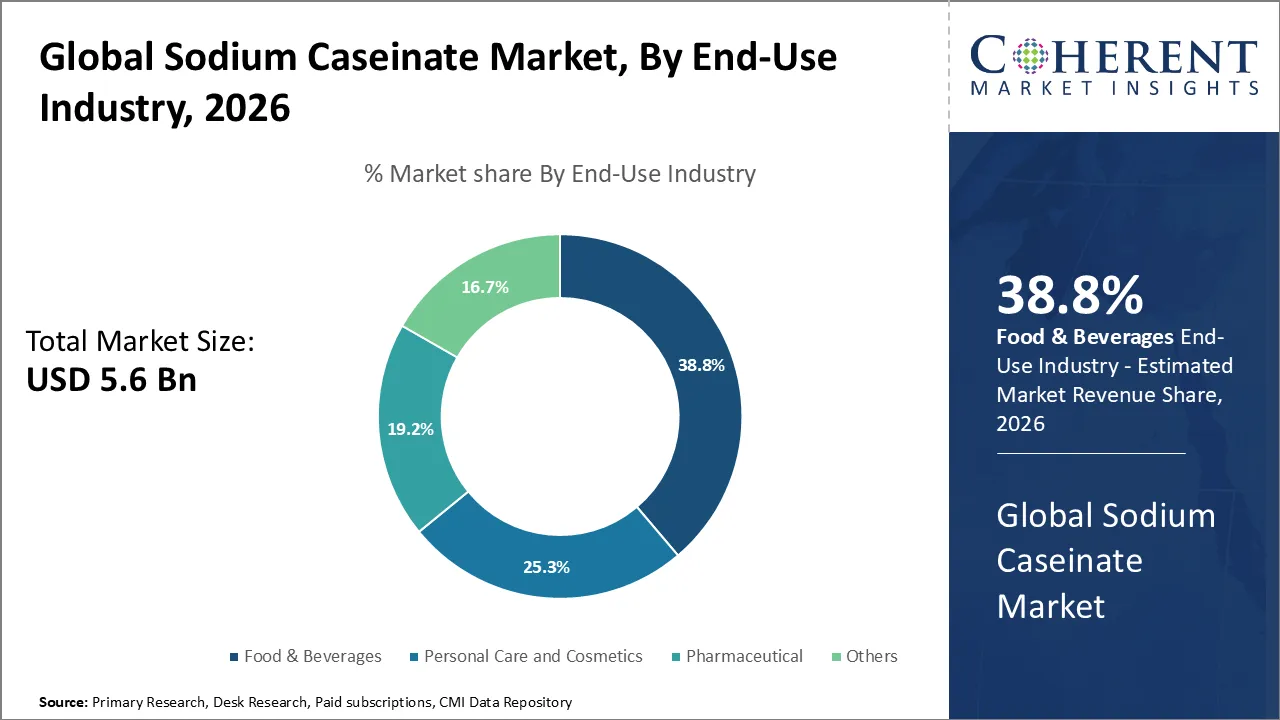
Food & Beverages expected to hold largest market share of 38.8% in 2026. The food and beverages segment of the Sodium Caseinate Market benefits from increasing demand for protein-rich and functional foods. Food manufacturers use sodium caseinate to enhance emulsification, texture, stability, and nutritional content in dairy products, bakery goods, sauces, beverages, processed foods, and nutritional products. Growing health awareness and demand for convenient protein sources encourage wider adoption.
Sodium Caseinate Market Trends
- Rising demand for high-protein foods and beverages drives sodium caseinate adoption, as consumers increasingly seek protein-rich diets, functional nutrition, sports nutrition, and meal-replacement products. IFIC’s 2025 research found that 70% of Americans reported trying to consume protein, up from 59% in 2022, while 23% said they had followed a “high-protein” diet in the previous year.
- Expansion of sports and clinical nutrition supports market growth, with sodium caseinate applicable in protein-rich nutritional formulations, shakes, beverages, and specialized foods. The NIH Office of Dietary Supplements reports that 41.7% of approximately 21,000 U.S. college athletes surveyed reported using protein products, highlighting substantial protein-product use within an important sports-nutrition population.
- Growing demand for functional dairy and beverage products strengthens opportunities for sodium caseinate, particularly where protein enrichment and emulsification are required. In the 2025 IFIC survey, 41% of Americans identified yogurt, cottage cheese and cheese among their preferred protein sources, while 38% selected milk or milk-based drinks.
- Food and beverage product innovation is expanding protein-focused applications. IFIC reported that “high protein” was the most commonly followed diet pattern in 2025, cited by 23% of Americans, compared with 20% in 2024 and 18% in 2023. This continuing consumer focus creates opportunities for protein ingredients such as sodium caseinate in fortified foods and beverages.
Regional Insights
North America dominates owing to product innovation by food manufacturers
North America is expected to acquire the dominant share of 41.70% in 2026. The well-established North American food and beverage industry drives demand for sodium caseinate through growing consumption of protein-rich and functional foods. Consumers increasingly choose sports nutrition, dietary supplements, and convenient protein products, encouraging manufacturers to incorporate sodium caseinate into various formulations. Food processors also use its emulsifying, stabilizing, and water-binding properties to improve product quality. Additionally, manufacturers continue developing fortified beverages, dairy products, bakery goods, and nutritional foods, creating new opportunities for sodium caseinate across the North American market. In June 2026, Maypro and Asahi Group Foods collaborated to distribute PeptiDrive-LNDP in North America and other key markets. Derived from cow’s milk casein through controlled enzymatic hydrolysis of sodium caseinate, LNDP enables standardized dosing in capsule and tablet formats.
Asia Pacific Sodium Caseinate Market Trends
Asia Pacific’s sodium caseinate market grows as consumers seek protein-enriched and functional foods, while expanding dairy and processed-food industries increase demand. China, India, Japan, South Korea, and Australia lead regional consumption through strong dairy markets and expanding food-processing capabilities. Food manufacturers use sodium caseinate for its emulsifying, stabilizing, thickening, and protein-fortification properties in beverages, bakery products, dairy desserts, infant nutrition, and dietary supplements. Rising health awareness and demand for convenient nutrition products further strengthen market adoption.
United States Sodium Caseinate Market Trends
Rising demand for protein-enriched foods, sports nutrition, ready-to-drink beverages, and functional dairy products drives the United States sodium caseinate market. Food manufacturers use sodium caseinate for its emulsifying, water-binding, solubility, and heat-stability properties in processed cheese, coffee creamers, bakery products, nutritional beverages, and prepared foods. Consumers increasingly seek clean-label and recognizable dairy ingredients, encouraging manufacturers to adopt sodium caseinate. Growth in functional and medical nutrition, advances in dairy processing, and strong food manufacturing capabilities further support market demand across the country. KD Omega Health has launched KD-Kap, a double-encapsulated fish oil omega-3 designed for water-based applications. The technology improves dispersion while protecting the ingredients from oxidation.
China Sodium Caseinate Market Trends
China’s sodium caseinate market continues to grow as food and beverage manufacturers expand production and consumers increasingly seek protein-rich and functional foods. Rising urbanization and disposable incomes encourage consumers to choose convenient, fortified, and nutrition-focused products. Manufacturers use sodium caseinate for its emulsifying, stabilizing, and protein-enhancing properties in beverages, bakery products, processed cheese, desserts, and nutritional supplements. Pharmaceutical applications, modern dairy processing, and expanding e-commerce channels also continue to strengthen demand across China.
Who are the Major Companies in Sodium Caseinate Industry
Some of the major key players in Sodium Caseinate are AMCO Proteins, Seebio Biotech (Shanghai) Co., Ltd., Lactoprot Deutschland GmbH, TATUA Co-Operative Dairy Co., Ltd, Ornua Co-operative Limited, Charotar Casein Company, Erie Foods International, Inc., Clover Fonterra Ingredients Proprietary Limited., FrieslandCampina DMV, and Farbest Brands.
Key News
- In June 2026, Maypro announced a global distribution partnership with Asahi Group Foods to introduce PeptiDrive-LNDP in North America and other key markets. The ingredient is based on lactononadecapeptide (LNDP), a 19-amino-acid peptide derived from casein, the primary protein in cow’s milk, through controlled enzymatic hydrolysis. LNDP is manufactured by the defined enzymatic hydrolysis of sodium caseinate, providing a standardized ingredient suitable for capsule and tablet formulations, in contrast to earlier fermentation-based delivery formats.
Market Report Scope
Sodium Caseinate Market Report Coverage
Report Coverage | Details | ||
Base Year: | 2025 | Market Size in 2026: | USD 5.6 Bn |
Historical Data for: | 2020 to 2024 | Forecast Period: | 2026 to 2033 |
Forecast Period 2026 to 2033 CAGR: | 5.2% | 2033 Value Projection: | USD 8.2 Bn |
Geographies covered: |
| ||
Segments covered: |
| ||
Companies covered: | AMCO Proteins, Seebio Biotech (Shanghai) Co., Ltd., Lactoprot Deutschland GmbH, TATUA Co-Operative Dairy Co., Ltd, Ornua Co-operative Limited, Charotar Casein Company, Erie Foods International, Inc., Clover Fonterra Ingredients Proprietary Limited., FrieslandCampina DMV, and Farbest Brands. | ||
Analyst Opinion
- China’s sodium caseinate demand is fundamentally tied to formulation economics, not consumer trends. China remains the world’s largest dairy producer, with national milk output exceeding 40 million tonnes annually, creating a substantial domestic processing base. Sodium caseinate benefits most where manufacturers need to improve protein functionality, emulsion stability, and texture without significantly reformulating finished products.
- The strongest opportunity lies in high-protein and functional formulations. China’s sports nutrition, meal-replacement, and fortified-food segments increasingly favor concentrated dairy proteins. Sodium caseinate provides both protein enrichment and functional performance, making it particularly valuable in powdered beverages, nutrition products, creamers, and processed foods where solubility and emulsification directly affect product quality.
- Processed-food applications will remain a more dependable demand engine than standalone dairy consumption. Sodium caseinate’s ability to stabilize fat-water mixtures gives manufacturers a practical tool for processed cheese, bakery fillings, sauces, desserts, and beverage formulations. For example, China’s large-scale processed-food industry allows even modest increases in protein fortification or formulation complexity to translate into meaningful ingredient demand.
- China’s biggest structural advantage is its rapidly modernizing food-processing ecosystem. Large manufacturers increasingly standardize formulations and prioritize ingredients that deliver multiple technical functions. Sodium caseinate fits this requirement exceptionally well because it can simultaneously contribute protein, emulsification, water binding, and texture. This multifunctionality makes substitution less attractive when manufacturers prioritize consistent finished-product performance.
- Pharmaceutical and clinical-nutrition applications provide an additional premium-demand channel. China has an aging population exceeding 300 million people aged 60 and above, increasing the relevance of protein-focused nutritional products for older consumers. In my assessment, this demographic shift will favor functional dairy proteins such as sodium caseinate, particularly in specialized nutrition where protein quality and formulation stability carry greater importance than simply minimizing ingredient costs.
Speak to the analyst
Want personalized insights?
Take the findings above to one of our principal consultants, or have the report rebuilt around the segments, geographies and competitors you actually track.
Market Segmentation
- By Grade (Revenue, USD Bn, 2021-2033)
- Food Grade
- Industrial Grade
- By End-Use Industry (Revenue, USD Bn, 2021-2033)
- Food & Beverages
- Personal Care and Cosmetics
- Pharmaceutical
- Others
- By Region (Revenue, USD Bn, 2021-2033)
- North America
- U.S.
- Canada
- Latin America
- Brazil
- Mexico
- Argentina
- Rest of Latin America
- Europe
- Germany
- U.K.
- France
- Italy
- Spain
- Russia
- Rest of Europe
- Asia Pacific
- China
- India
- Japan
- Australia
- South Korea
- ASEAN
- Rest of Asia Pacific
- Middle East
- GCC
- Israel
- Rest of Middle East
- Africa
- South Africa
- Central Africa
- North Africa
- North America
Sources
Primary Research interviews
- Food and beverage manufacturers
- Dairy ingredient manufacturers and processors
- Sodium caseinate and casein producers
- Dairy product formulators
- Sports and clinical nutrition manufacturers
- Food ingredient distributors and suppliers
- Procurement and sourcing professionals
- Regulatory and quality-assurance professionals
- Industry experts and technical specialists
Databases
- U.S. Food and Drug Administration (FDA) Food Substances Database
- FAO/WHO Codex Alimentarius databases
- FAO FAOSTAT database
- U.S. Department of Agriculture (USDA) databases
- U.S. National Library of Medicine (PubChem)
- European Food Safety Authority (EFSA) databases
- Joint FAO/WHO Expert Committee on Food Additives (JECFA) database
- National dairy production and food statistics databases
Magazines
- Dairy Industries International
- Dairy Foods
- Food Business News
- Food Processing
- Prepared Foods
- Food Technology
- International Food Information Service publications
Journals
- Journal of Dairy Science
- International Dairy Journal
- Journal of Food Science
- Food Hydrocolloids
- Food Chemistry
- LWT – Food Science and Technology
- Journal of Food Engineering
- International Journal of Dairy Technology
- Journal of Agricultural and Food Chemistry
Newspapers
- Reuters
- Financial Times
- The Wall Street Journal
- The Guardian
- South China Morning Post
- China Daily
- Nikkei Asia
- The Economic Times
Associations
- International Dairy Federation (IDF)
- International Association for Food Protection (IAFP)
- Dairy Farmers of America and relevant national dairy organizations
- China Dairy Industry Association
- European Dairy Association
- National Milk Producers Federation
- International Food Additives Council and relevant food-ingredient associations
Public Domain sources
- U.S. Food and Drug Administration (FDA)
- U.S. Department of Agriculture (USDA)
- Food and Agriculture Organization of the United Nations (FAO)
- World Health Organization (WHO)
- Codex Alimentarius Commission
- Joint FAO/WHO Expert Committee on Food Additives (JECFA)
- European Food Safety Authority (EFSA)
- U.S. National Library of Medicine (NLM)
- PubChem
- National Bureau of Statistics of China
- Eurostat
- United Nations Comtrade Database
- Government food and dairy regulatory authorities
- National customs and trade databases
Proprietary Elements
- CMI Data Analytics Tool
- Proprietary CMI Existing Repository of information for last 10 years
Get access to 250+ pages report
Every segment, forecast, competitor profile and data table behind the analysis above — available for instant download.
- ESOMAR Member
- ISO 9001:2015 Certified
- D-U-N-S Registered
- GDPR & CCPA Compliant
Missing comfort of reading report in your local language? Find your preferred language:
Transform your Strategy with Exclusive Trending Reports
Frequently Asked Questions
The market is primarily driven by rising demand for protein-enriched and functional foods, and expanding applications in processed foods, beverages, sports nutrition, water-binding, and protein-fortifying properties make it valuable across multiple formulations.
Food Grade is expected to dominate the market, supported by growing demand for protein-rich foods, functional beverages, and nutritional products.
Food & Beverages is expected to remain the leading end-use industry.
Key trends include increasing protein fortification, growing demand for functional and convenient foods, expansion of sports and clinical nutrition, and continued product innovation in dairy and beverage formulations.
Food manufacturers value food-grade sodium caseinate because it combines nutritional and technical functionality.