

Swab Market Size and Share Analysis—Growth Trends and Forecasts (2026–2033)
The global swab market is expected to register a CAGR of 6.6% from USD 1,028.5 Mn in 2026 to reach USD 1,608.8 Mn by 2033. Factors such as increased number of diagnostic and clinical tests, high demand for effective sample collection tools, heightened knowledge on infection prevention measures, and increasing usage of swabs in hospital settings, diagnostic labs, pharmaceutical manufacturing, food testing, and research operations are propelling market growth. According to the World Health Organization, about 1 billion people suffer from seasonal flu annually, and out of that 3 to 5 million suffer from severe forms of infection
Key Takeaways
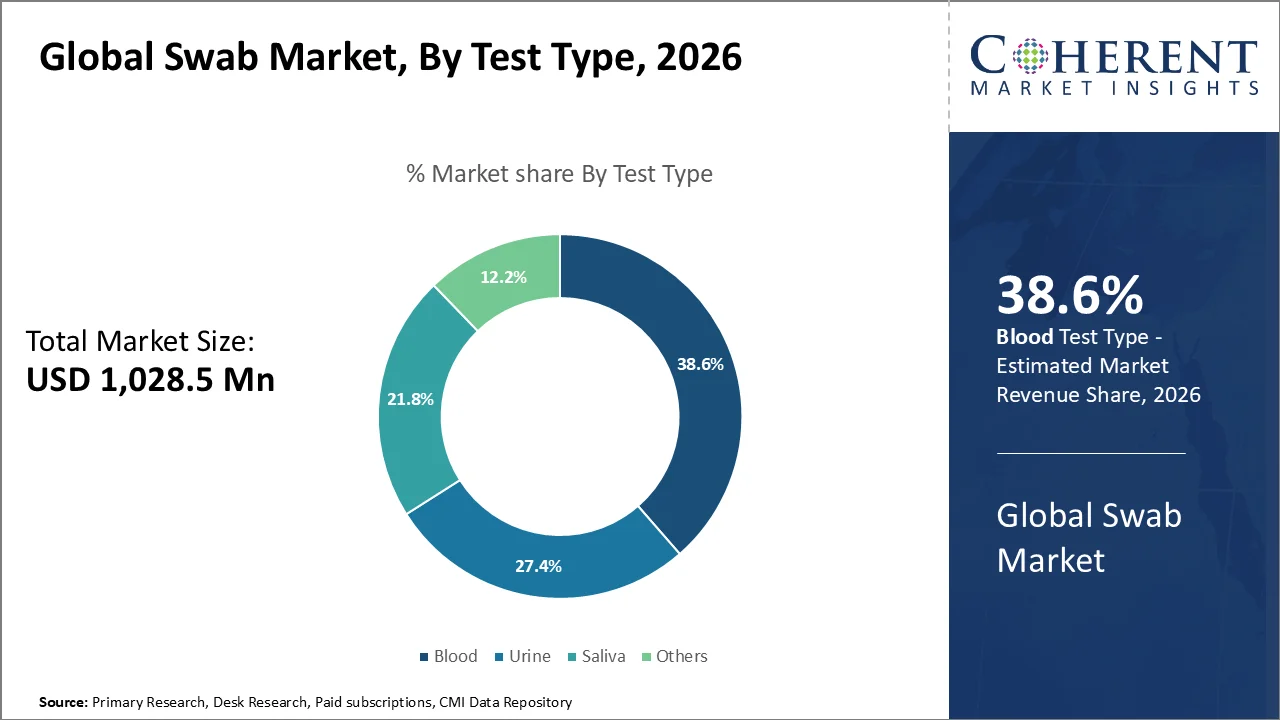
- The blood test segment is expected to hold more than 38.6% share of the worldwide swab market in 2026. The growth in this segment is attributable to the increasing use of swabs with alcohol and antiseptics prior to the procedure of blood testing and transfusions and glucose measurement, among others.
- Cotton swabs will hold 34.8% share in the market by 2026. This is attributed to the fact that the cotton swabs are cost-effective, absorbent, have easy availability and are extensively used for wound cleaning, administering topical drugs, providing patient care and collecting specimens. In October 2025, the Centers for Medicare & Medicaid Services of the U.S. indicated that Medicare had spent more than USD 10 billion on advanced
- The polypropylene shaft segment is expected to dominate with the highest share of 61.7% in 2026. This would be possible due to the lightweight nature of polypropylene material, flexibility, durability, high resistance to chemicals, cost-effectiveness, and suitability for molding swabs, and breakable swabs that are used in the specimen collection and transportation system. In May 2025, the FDA approved Puritan Medical Product's PurSafe Plus Collection & Transport System, which included the use of a plastic shaft flocked swab and polypropylene transport vial.
- The hospital segment is set to dominate the end-user category with 42.5% in 2026. Segment leadership is owing to the high frequency of blood draws, surgical preparation, wound management, microbiological sampling, infection-control procedures, and inpatient diagnostic testing. According to the American Hospital Association’s February 2026 update, the U.S. had 6,100 hospitals, 907,216 staffed beds, and approximately 35.7 million hospital admissions, representing a substantial recurring consumption base for medical swabs.
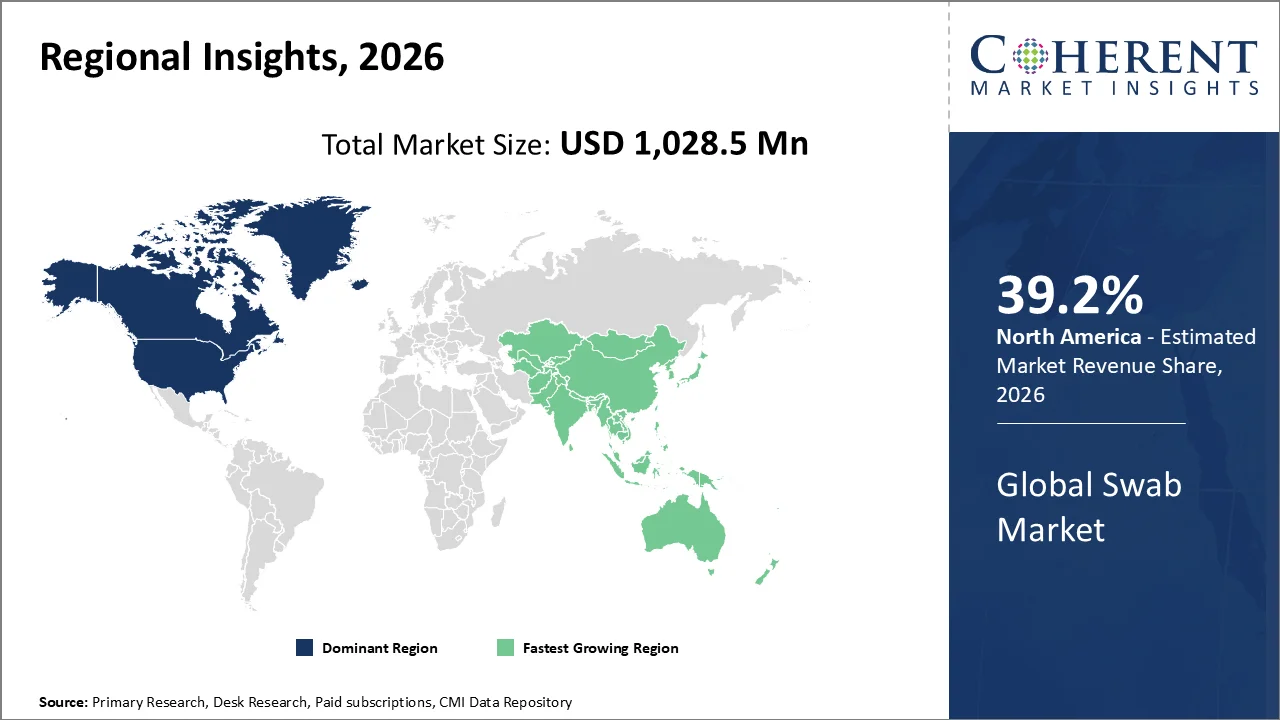
- The North American region is anticipated to capture the major share of 39.2% in the global swab market by 2026. The dominance of the region can be attributed to high clinical testing volume, hospital and laboratory infrastructures, infection surveillance systems, and adoption of disposable swabs for various diagnostic applications such as microbiology, respiratory screening, wound care, and sterilization prior to procedures. In November 2025, the U.S. Centers for Disease Control and Prevention reported that healthcare professionals order more than 14 billion laboratory tests annually in the country.
Market Drivers
Rising Sexually Transmitted Infection Testing is Accelerating the Swab Market
The rising prevalence of sexually transmitted diseases is leading to increased demand for vaginal, urethral, rectal, and throat swabs for use in molecular diagnostics. Swabs help to collect specific samples, and can be used for nucleic acid amplification tests that have been adopted in hospitals, clinics, diagnostic centers, and home diagnostic kits.
As per the statistics provided by the U.S. Centers for Disease Control and Prevention, there have been 2,249,636 reported cases of chlamydia, gonorrhea, and syphilis in 2024, including about 1.52 million cases of chlamydia and 543,409 cases of gonorrhea.
In March 2025, the U.S. FDA authorized the Visby Medical Women’s Sexual Health Test, the first non-prescription test performed entirely at home for chlamydia, gonorrhea, and trichomoniasis. The single-use system incorporates a self-collected vaginal swab and provides results in approximately 30 minutes, supporting the expansion of decentralized swab-based diagnostics.
Self-Collection and Cervical Screening Programs are Expanding Swab Adoption
The increasing adoption of HPV self-sampling is creating new demand for specialized vaginal swabs and specimen-transport products. Self-collection can enhance the uptake of screening because it will overcome issues related to privacy, location, and healthcare access while facilitating specimen collection beyond conventional clinical settings.
According to the World Health Organization, about 660,000 new cases of cervical cancer and 350,000 related deaths occur annually, and the majority of deaths happen in low and middle-income countries. The WHO cervical cancer elimination program aims at having cervical screening of 70% of the population in 2030, while the updated WHO guideline shows that self-collected samples are as good as provider-collected samples.
In January 2026, the National Cervical Cancer Elimination Action Plan 2026-2030 was implemented by the government of Kenya. The policy puts a lot of emphasis on HPV DNA testing and self-sampling in an attempt to ensure that cervical cancer screening services are provided in all 47 counties in the country.
Current Events and Their Impact
Current Event | Description and its Impact |
FDA Implements the Quality Management System Regulation for Medical Devices (2026) |
|
European Union Makes Four EUDAMED Modules Mandatory (2026) |
|
- Current Industry Events of 2026
- Market Size Estimation
- Regional Breakdown
- Competitive Landscape
- Customer Intelligence
- Segmental Analysis
- Pricing Analysis
- Key Market Drivers, Challenges & Future Trends
- Customized Insights Section
Segmental Insights
Why is the Blood Test Segment Acquiring the Largest Share?
On the basis of test type, the blood test segment is projected to account for the largest global swab market share of 38.6% in 2026. The segment’s growth is owing to the extensive use of antiseptic swabs before venous blood collection, finger-prick testing, glucose monitoring, transfusion procedures, and other invasive diagnostic tests.
The CDC’s January 2026 National Diabetes Statistics Report estimated that 115.2 million U.S. adults have prediabetes. It also reported that 27.6% of adults with diabetes remain undiagnosed, representing approximately 11.0 Million people. The large diagnosed and at-risk population supports continued blood glucose screening, A1C testing, and related specimen-collection procedures, thereby sustaining demand for pre-procedure swabs.
Why is the Cotton Swab Segment Acquiring the Largest Share?
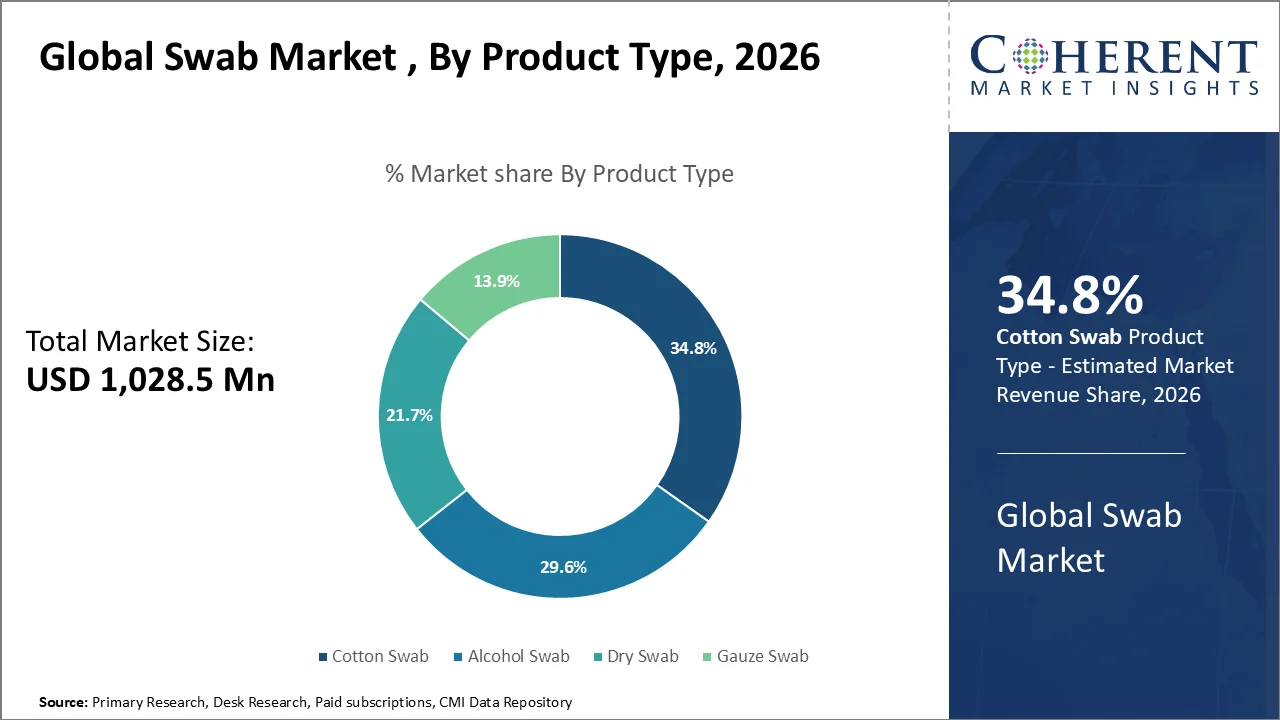
On the basis of product type, the cotton swab segment is expected to lead the global swab market with a 34.8% share in 2026. The segment’s growth is attributed to cotton’s absorbency, affordability, ease of sterilization, and extensive use in wound cleansing, topical medicine application, dressing preparation, microbiological sampling, and routine patient care.
A 2025 study published by the WHO’s Eastern Mediterranean Health Journal assessed 5,127 surgical procedures, including 2,463 appendectomies, 751 hernia repairs, and 1,913 caesarean sections. Surgical-site infection rates reached 2.19%, 2.53%, and 2.56%, respectively, while 75.4% of detected infections were superficial incisional infections. This wound-care workload supports recurring demand for sterile absorbent applicators and swabs used in cleaning, medication application, and specimen collection.
Why is the Polypropylene Shaft Segment Acquiring the Largest Share?
On the basis of shaft type, the polypropylene shaft segment is projected to account for the largest global swab market share of 61.7% in 2026. Segment leadership is owing to polypropylene shafts’ lightweight structure, flexibility, consistent molding, resistance to moisture and diagnostic chemicals, and suitability for breakpoints that allow collected swabs to be transferred into transport tubes.
FDA testing supported a 36-month shelf life and dry-swab storage for up to 30 days at 2–30°C. In the supporting clinical study, 462 paired specimens produced a 92.4% positive percent agreement for high-risk HPV detection, demonstrating the reliability of lightweight, breakable plastic-shaft swabs in decentralized diagnostic collection.
In April 2026, the U.S. FDA cleared BD’s Onclarity Self-Collection Kit, which uses a molded polymer swab shaft with a breakable section for dry transportation of vaginal specimens.
Hospitals Hold the Largest Market Share
On the basis of end user, the hospital segment is set to dominate the global swab market with a major 42.5% share in 2026. The segment’s growth is owing to the high volume of blood collection, respiratory testing, microbiological sampling, wound management, surgical preparation, and healthcare-associated infection surveillance conducted across inpatient and outpatient departments.
In January 2026, the CDC reported that more than 38,000 active hospitals, long-term care facilities, and other healthcare facilities submitted infection-surveillance information to the National Healthcare Safety Network. The CDC’s latest report covers 39 inpatient surgical-procedure categories, along with bloodstream infections, urinary tract infections, surgical-site infections, MRSA bacteremia, and C. difficile. These extensive surveillance and infection-control activities require continuous specimen collection, supporting institutional demand for medical swabs.
Swab Market Trends
- The increasing utilization of swabs in border and genomic biosurveillance initiatives has expanded demand for swabs beyond traditional diagnostic purposes within hospitals. According to the CDC, in January 2026, the Traveler-Based Genomic Surveillance program managed by the CDC registered its one millionth voluntary participant using anonymous nasal swabs from travelers.
- The expansion of screening for fungi with antimicrobial resistance has led to an increase in the use of skin and body swabs in acute care and LTCF environments. According to CDC statistics from 2026, screening for C. auris cases increased from 6,226 in 2022 to 12,432 in 2024, with collection from acute care hospitals rising from 24.7% to 50.7%.
- The persistence of geographical expansion of mpox continues to drive the use of lesion, oropharyngeal, anal, and rectal swabs required in PCR confirmation. Between September 5 and November 24, 2025, WHO has identified 43 new confirmed cases of clade Ib across all six WHO regions, 24 of which are local cases occurring outside transmission zones, according to WHO lesion swabs are the most appropriate technique for collection.
Regional Insights
North America Dominates Owing to Advanced Diagnostic Infrastructure and High Testing Volumes
North America is forecasted to take the lead in the world swab market with a 39.2% market share in 2026. The regional growth can be attributed to the presence of a robust clinical laboratory setup, respiratory testing, the use of self-diagnostic kits, and disease surveillance programs that necessitate specimen collection swabs.
The Public Health Agency of Canada revealed that laboratories conducted 1,358,268 tests for influenza in the 2023-2024 season, generating 103,173 laboratory-confirmed cases. Such test volumes indicate the continuous need for respiratory swabs and corresponding specimen-transport products in Canada.
In June 2025, the U.S. FDA cleared Nano-Ditech’s multiplex test for the simultaneous detection of influenza A, influenza B, and SARS-CoV-2. Each kit contains 25 anterior nasal swabs and 25 test devices, supporting the expansion of decentralized respiratory testing in North America.
Asia Pacific Swab Market Trends
Asia Pacific is expected to witness strong growth in the swab market over the forecast period. The region’s growth is owing to expanding respiratory-disease surveillance, rising adoption of rapid antigen and molecular testing, greater access to self-testing products, and increasing laboratory capacity across Australia, China, India, Japan, and Southeast Asia.
In February 2025, the Australian Government introduced new national cervical-screening communication toolkits to promote the self-collection option.
Expanding Outbreak Testing is Accelerating the Swab Market in the United States
The U.S. swab market is witnessing strong demand owing to infectious-disease outbreaks, extensive public health surveillance, expanding point-of-care testing, and the increasing availability of self-collected diagnostic specimens.
As of July 9, 2026, the CDC reported 2,231 confirmed measles cases across 42 U.S. jurisdictions, including 32 outbreaks. Approximately 93% of cases, or 2,082 cases, were outbreak-associated. CDC guidance instructs healthcare providers to collect a nasopharyngeal or throat swab for rRT-PCR testing from suspected measles patients, along with a serum specimen for antibody testing. The continuing outbreak response is therefore increasing the requirement for sterile respiratory swabs across hospitals, clinics, public health laboratories, and mobile testing operations.
China Swab Market Trends
China is expected to witness strong growth in the swab market over the forecast period. The growth is owing to the country’s extensive infectious-disease surveillance network, rising respiratory diagnostic volumes, and increasing adoption of multiplex molecular testing across hospitals and public health laboratories.
In January 2025, China CDC researchers introduced broader multiplex respiratory surveillance by testing 1,513 patient samples for 27 respiratory pathogens using multiplex qPCR. The study found that 18.8% of cases involved coinfections with more than two pathogens, supporting the need for high-quality swabs compatible with multianalyte molecular testing.
Who are the Major Companies in Swab Industry
Some of the major key players in Swab Market are Puritan Medical Products, Copan Diagnostics, Inc., Sarstedt AG & Co. KG, FI Medical MWE, Cleancross Co.,LTD., AdvaCare Systems, GPC Medical Ltd., Elmex Controls Pvt Ltd., and Citotest Labware Manufacturing Co., Ltd.
Key News
- In July 2026, Medical Wire & Equipment (MWE) entered a distribution agreement with Bluewater Medical Supplies to expand its specimen-collection portfolio across the Cayman Islands and the wider Caribbean.
- In March 2026, Clean Cross Co., Ltd. announced the renewal of its official website and digital product platform. The updated platform presents its HUBY industrial cotton-swab range, including standard, slim, conductive plastic-shaft, flat-tip, six-inch, and gel-stick products.
Market Report Scope
Swab Market Report Coverage
| Report Coverage | Details | ||
|---|---|---|---|
| Base Year: | 2025 | Market Size in 2026: | USD 1,028.5 Mn |
| Historical Data for: | 2020 To 2024 | Forecast Period: | 2026 To 2033 |
| Forecast Period 2026 to 2033 CAGR: | 6.6% | 2033 Value Projection: | USD 1,608.8 Mn |
| Geographies covered: |
| ||
| Segments covered: |
| ||
| Companies covered: | Puritan Medical Products, Copan Diagnostics, Inc., Sarstedt AG & Co. KG, FI Medical MWE, Cleancross Co.,LTD., AdvaCare Systems, GPC Medical Ltd., Elmex Controls Pvt Ltd., and Citotest Labware Manufacturing Co., Ltd. | ||
| Growth Drivers: |
| ||
| Restraints & Challenges: |
| ||
Analyst Opinion
- The swab market is becoming less dependent on temporary respiratory outbreaks as antimicrobial-resistance surveillance creates sustained microbiology testing demand. The WHO’s Global Antibiotic Resistance Surveillance Report 2025 analyzed more than 23 million bacteriologically confirmed infections, with data reported by 104 countries in 2023. Expanding culture, molecular identification, susceptibility testing, and colonization screening will support recurring demand for specialized specimen-collection swabs.
- Food manufacturing and environmental monitoring are emerging as important non-clinical growth areas for the swab market. The USDA’s 2025 ready-to-eat sampling requirements state that eligible establishments may be sampled at least twice annually and up to 12 times per year. Routine food-contact and environmental surface testing for Listeria, Salmonella, and other microorganisms creates a stable consumption base for sterile surface-sampling swabs.
- Competition is expected to shift from low-cost commodity swabs toward validated products offering better specimen recovery, transport stability, sterility, and molecular-test compatibility. In 2025, WHO prequalified a record 13 in-vitro diagnostics, including new combination and respiratory tests. As diagnostic portfolios expand, laboratories will increasingly prefer collection swabs that are validated with specific transport media and testing platforms, benefiting quality-certified manufacturers.
Speak to the analyst
Want personalized insights?
Take the findings above to one of our principal consultants, or have the report rebuilt around the segments, geographies and competitors you actually track.
Market Segmentation
- By Test Type (Revenue, USD Mn, 2021-2033)
- Blood
- Urine
- Saliva
- Others
- By Product Type (Revenue, USD Mn, 2021-2033)
- Alcohol Swab
- Cotton Swab
- Dry Swab
- Gauze Swab
- By Shaft Type (Revenue, USD Mn, 2021-2033)
- Aluminum
- Propylene
- Others
- By End User (Revenue, USD Mn, 2021-2033)
- Hospitals
- Clinics
- Microbiology Laboratories
- Academia & Research Institutes
- Global Swab Market , By Region (Revenue, USD Mn, 2021-2033)
- North America
- U.S.
- Canada
- Latin America
- Brazil
- Mexico
- Argentina
- Rest of Latin America
- Europe
- Germany
- U.K.
- France
- Italy
- Spain
- Russia
- Rest of Europe
- Asia Pacific
- China
- India
- Japan
- Australia
- South Korea
- ASEAN
- Rest of Asia Pacific
- Middle East
- GCC
- Israel
- Rest of Middle East
- Africa
- South Africa
- Central Africa
- North Africa
- North America
- Key Players
- Puritan Medical Products
- Copan Diagnostics, Inc.
- Sarstedt AG & Co. KG
- FI Medical MWE
- Cleancross Co.,LTD.
- AdvaCare Systems
- GPC Medical Ltd.
- Elmex Controls Pvt Ltd.
- Citotest Labware Manufacturing Co., Ltd.
Sources
Primary Research Interviews
- Medical swab and specimen-collection device manufacturers
- Clinical diagnostic kit and transport-media producers
- Microbiologists, pathologists, and laboratory medicine specialists
- Hospital procurement and infection-control managers
- Clinical laboratory directors and diagnostic centre operators
- Wound-care specialists and nursing professionals
- Food-safety and environmental-testing laboratory managers
- Pharmaceutical and biotechnology quality-control professionals
- Medical device distributors and healthcare consumables suppliers
- Key opinion leaders in molecular diagnostics and specimen collection
Databases
- World Health Organization
- U.S. Centers for Disease Control and Prevention
- U.S. Food and Drug Administration
- European Centre for Disease Prevention and Control
- European Commission EUDAMED
- Centers for Medicare & Medicaid Services
- National Healthcare Safety Network
- Public Health Agency of Canada
- Australian Government Department of Health
- China Center for Disease Control and Prevention
- ClinicalTrials.gov
- PubMed and National Center for Biotechnology Information
Magazines
- Medical Device and Diagnostic Industry
- MedTech Dive
- Medical Device Network
- 360Dx
- LabMedica International
- Clinical Lab Products
- Medical Product Outsourcing
- European Medical Device Technology
Journals
- Journal of Clinical Microbiology
- Diagnostic Microbiology and Infectious Disease
- Clinical Microbiology and Infection
- Emerging Infectious Diseases
- Journal of Hospital Infection
- Infection Control & Hospital Epidemiology
- International Journal of Medical Microbiology
- American Journal of Infection Control
- BMC Infectious Diseases
- Eastern Mediterranean Health Journal
Newspapers
- The New York Times
- The Guardia
- The Wall Street Journal
- Financial Times
- The Economic Time
- The Washington Post
- South China Morning Post
Associations
- American Society for Microbiology
- Association for Diagnostics & Laboratory Medicine
- Clinical and Laboratory Standards Institute
- International Federation of Clinical Chemistry and Laboratory Medicine
- Association of Public Health Laboratories
- European Society of Clinical Microbiology and Infectious Diseases
- American Hospital Association
- Association for Professionals in Infection Control and Epidemiolog
- Advanced Medical Technology Association
- MedTech Europe
Public Domain Sources
- Company annual reports and investor presentations
- Company product catalogues and official press releases
- Government infectious-disease surveillance reports
- Regulatory clearances, recalls, and safety notices
- Public health laboratory testing reports
- Hospital and clinical laboratory statistics
- Medical device registration and quality-system publications
- University and public research institution publications
- Patent databases such as WIPO, USPTO, and Google Patents
- Clinical trial registries and peer-reviewed open-access studies
- Food-safety and environmental-monitoring sampling guidelines
- Public procurement and healthcare tender databases
Proprietary Elements
- CMI Data Analytics Tool, Proprietary CMI Existing Repository of Information for the Last 10 Years
Get access to 250+ pages report
Every segment, forecast, competitor profile and data table behind the analysis above — available for instant download.
- ESOMAR Member
- ISO 9001:2015 Certified
- D-U-N-S Registered
- GDPR & CCPA Compliant
Missing comfort of reading report in your local language? Find your preferred language:
Transform your Strategy with Exclusive Trending Reports
Frequently Asked Questions
The global Swab Market is anticipated to grow at a CAGR of 6.6% between 2026 and 2033.
North America is expected to dominate the global Swab Market with an estimated 39.2% share in 2026, supported by its advanced laboratory infrastructure, high diagnostic-testing volume, and widespread adoption of home-based testing products.
The market is expected to expand steadily as healthcare systems increase infectious-disease screening, antimicrobial-resistance surveillance, self-collection programs, and point-of-care testing. Demand is also expected to shift toward validated swabs offering improved specimen recovery, transport stability, sterility, and compatibility with molecular diagnostic platforms.
Major players operating in the global Swab Market include Puritan Medical Products, Copan Diagnostics, Inc., Sarstedt AG & Co. KG, Medical Wire & Equipment, Cleancross Co., Ltd., AdvaCare Systems, GPC Medical Ltd., Elmex Controls Pvt. Ltd., and Citotest Labware Manufacturing Co., Ltd.