

Rehabilitation Robots Market Size and Share Analysis- 2026 To 2033
The Rehabilitation Robots Market size is anticipated to grow at a CAGR of 17.1%, with USD 1.77 Bn in 2026, and is expected to reach USD 5.34 Bn in 2033. The primary drivers are largely defined by the rising prevalence of neurological and musculoskeletal disorders, growing demand for robot-assisted rehabilitation therapies, increasing adoption of advanced rehabilitation technologies across hospitals and rehabilitation centers, and the rising need for intensive and repetitive therapy among elderly and post-stroke patients. According to the World Health Organization (WHO), around 2.6 Bn people, or nearly one in three people globally, could benefit from rehabilitation, while the global population aged over 60 years is projected to increase from 1.4 Bn in 2030 to 2.1 Bn by 2050, indicating a substantial long-term requirement for mobility and functional-recovery solutions.
Key Takeaways
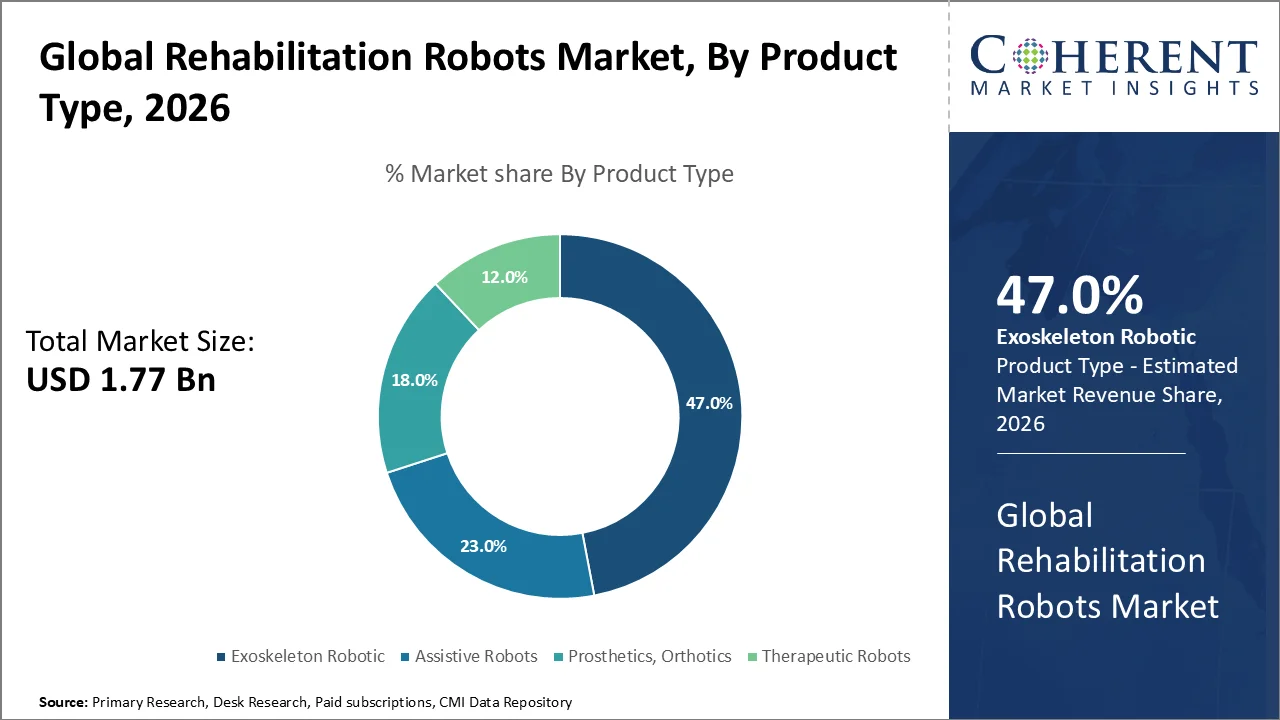
- The exoskeleton robots segment is expected to account for around 47% of the market share in 2026. The segment growth is due to the increased use of powered exoskeletons for gait training, post-stroke motor recovery, spinal cord injury rehabilitation and mobility assistance and improvements in sensors and adaptive control systems. In a 2026 multicenter randomized controlled trial in 8 stroke neurorehabilitation units, exoskeleton-assisted upper-limb therapy resulted in a 22-point higher median improvement in Fugl-Meyer motor scores, with 68.4% of robotic-therapy patients achieving clinically meaningful improvement compared with 31.8% receiving conventional rehabilitation.
- Rehabilitation centers segment is estimated to lead with about 53.0% share in 2026. The dominance of the segment is attributed to the availability of specialized physiotherapists, high-intensity repetitive therapy programs, advanced gait-training infrastructure, and concentration of patients requiring neurological and orthopedic rehabilitation. According to the World Health Organization’s February 2025 policy brief, approximately 2.6 Bn people worldwide have health conditions that could be improved through rehabilitation.
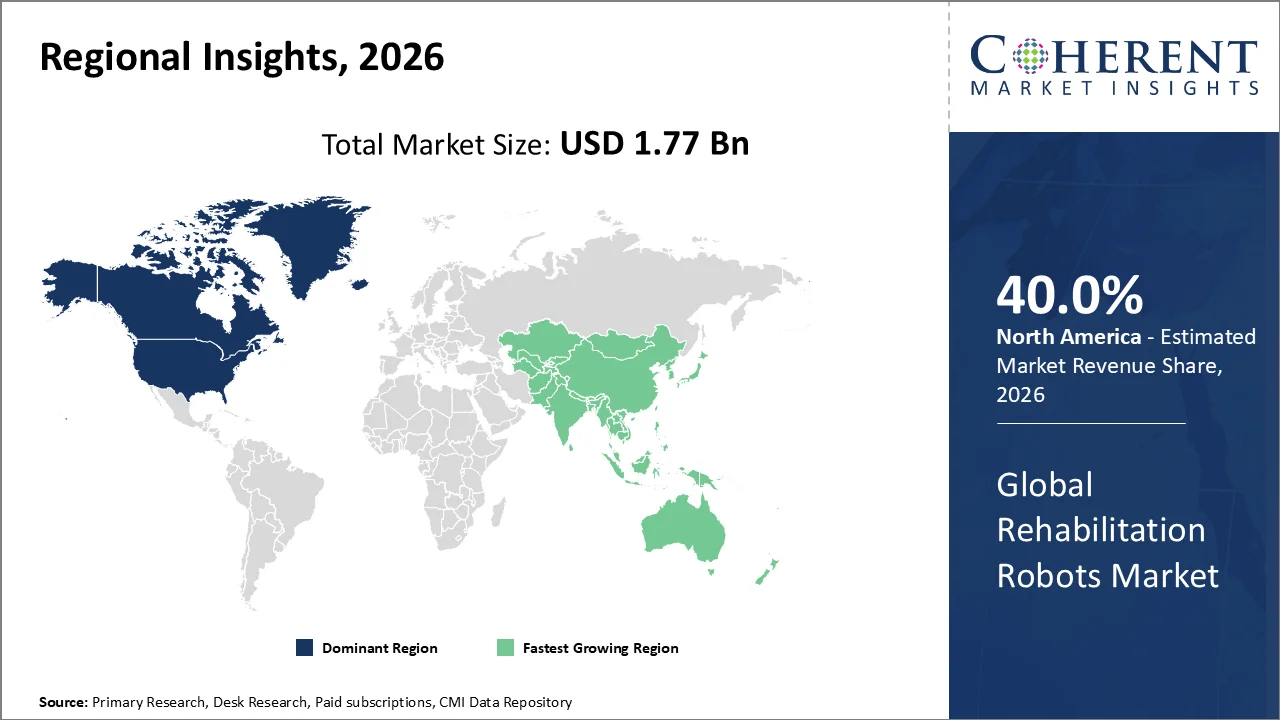
- North America is expected to acquire the prominent share of around 40% in 2026. The region’s growth is owing to early adoption of rehabilitation robotics, established neurorehabilitation infrastructure, favorable reimbursement developments, strong medical-device commercialization, and government-supported exoskeleton programs. In the U.S., CMS announced a 2024 Medicare purchase fee-schedule amount of USD 91,031.93 for HCPCS K1007 powered exoskeleton devices, and the FDA approved the ReWalk 7 Personal Exoskeleton in March 2025, helping to facilitate wider commercialization and patient access to powered mobility systems.
Market Drivers
Rising Neurological Disease Burden and Aging Population are Expanding the Rehabilitation Robots Market
The Rehabilitation Robots Market is expected to witness substantial growth due to the increasing prevalence of neurological disorders leading to long-term mobility impairment and functional disability. Robotic systems can provide intensive, repetitive and highly controlled movement training to patients recovering from stroke, spinal cord injury, traumatic brain injury and other neurological conditions.
According to the World Health Organization (WHO) in 2025, over 3 billion people, or more than 40% of people across the globe, suffered from neurological conditions. Stroke is a leading cause of neurological death and disability worldwide and creates a large population of patients in need of long-term physical and neurorehabilitation services.
Growing Clinical Evidence for Robot-Assisted Therapy is Accelerating Adoption
Increasing clinical validation of rehabilitation robots is favoring their integration with conventional physiotherapy. Modern rehabilitation robots offer high-intensity, task-specific exercise while also capturing objective movement data and allowing for progressive adjustment of assistance by therapists based on patient recovery.
In March 2026, a multicenter randomized controlled trial involving 94 patients across eight stroke neurorehabilitation units evaluated upper-limb exoskeleton-assisted robotic therapy. Patients received 25 rehabilitation sessions over five weeks. The robotic group achieved a 22-point greater median improvement in the Fugl-Meyer upper-limb motor score, while 68.4% of patients receiving robotic therapy achieved a clinically meaningful improvement compared with 31.8% in the conventional rehabilitation group.
Current Events and Their Impact on the Rehabilitation Robots Market
Current Event | Description and its Impact |
U.S. Medicare Reimbursement Framework Supports Powered Exoskeleton Access (2026)
|
|
FDA Clearance of New-Generation Personal Exoskeleton Strengthens U.S. Regulatory Pathway (2025) |
|
- Current Industry Events of 2026
- Market Size Estimation
- Regional Breakdown
- Competitive Landscape
- Customer Intelligence
- Segmental Analysis
- Pricing Analysis
- Key Market Drivers, Challenges & Future Trends
- Customized Insights Section
Segmental Insights
Why are Exoskeleton Robots Acquiring the Largest Share?
On the basis of product type, the exoskeleton robots segment is estimated to account for around 47% of the Rehabilitation Robots Market share in 2026. The segment’s growth is owing to the increasing use of wearable robotic systems for gait training, lower- and upper-limb rehabilitation, repetitive movement therapy, and mobility restoration among patients with stroke, spinal cord injury, and other neurological impairments.
A 2026 international multicenter randomized controlled trial involving 151 patients with subacute stroke evaluated wearable exoskeleton-assisted gait rehabilitation. Patients in the robotic group received 30 minutes of conventional gait training and 30 minutes of exoskeleton training, five times per week for four weeks.
In August 2026, Wandercraft received U.S. FDA clearance for its Eve personal exoskeleton, a self-balancing robotic system designed to help eligible wheelchair users with spinal cord injuries stand, walk, and perform daily mobility activities.
Why are Rehabilitation Centers Acquiring the Largest Share?
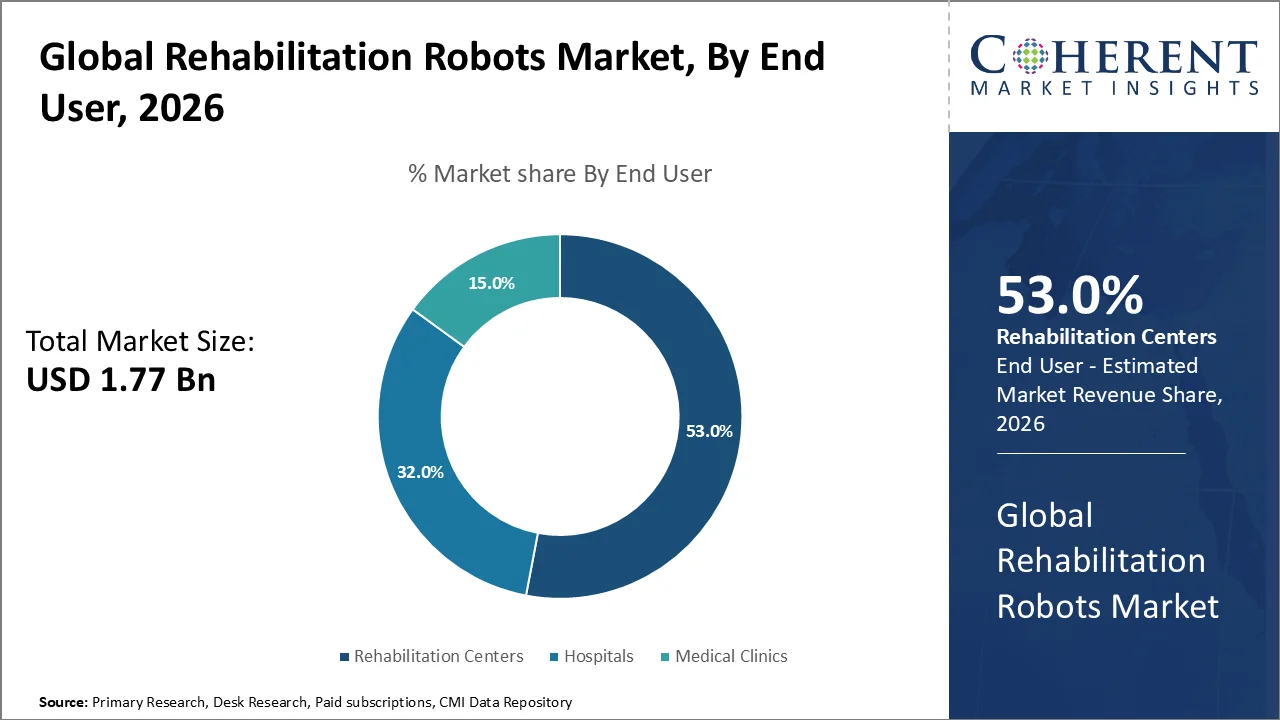
On the basis of end user, the rehabilitation centers segment is estimated to lead with around 53% of the Rehabilitation Robots Market share in 2026. The segment’s dominance is owing to the concentration of specialized physiotherapists and rehabilitation physicians, availability of intensive therapy infrastructure, high volumes of neurological and orthopedic patients, and greater ability to invest in advanced robotic gait and limb-training systems.
According to the March 2026 Medicare Payment Advisory Commission (MedPAC) report, U.S. fee-for-service Medicare inpatient rehabilitation facility stays increased by 7.6% to approximately 435,000 stays in fiscal year 2024, compared with 404,000 stays in 2023. The number of stays per 10,000 beneficiaries also increased by 9.7% to 132, demonstrating growing utilization of intensive rehabilitation facilities.
In April 2026, Healing Innovations announced an extension of its system-wide partnership with Ernest Health for deployment of its Rise&Walk rehabilitation robotic system. In 2025 and the first quarter of 2026, 21 more Ernest Health facilities completed deployment and clinical training, bringing adoption to more than 30 rehabilitation hospitals in the U.S.
Rehabilitation Robots Market Trends
- Artificial intelligence and data-driven control systems are increasingly integrated, so that rehabilitation robots can provide more adaptive assistance, personalized training and intelligent human-robot interaction. In June 2025, Ekso Bionics showcased an AI-powered voice agent for its EksoNR platform and announced a database of around 350,000 patient sessions and more than 15 million step-by-step data points with more than 60,000 new patient steps being generated every day.
- The growing integration of brain-computer interfaces with robotic rehabilitation systems is improving personalized neurorehabilitation, particularly in the recovery of upper limbs after a stroke. A meta-analysis, published in May 2026, of 11 randomized controlled trials and 380 patients found that BCI-controlled hand robots improved Fugl-Meyer upper-extremity scores by 4.87 points compared with robotic training alone and 6.55 points compared with routine rehabilitation.
- The growing development of soft wearable rehabilitation robots and exosuits enhances portability, comfort, and energy efficiency compared to traditional rigid robotic systems. In a 2025 randomized crossover trial of 19 chronic stroke patients, a soft wearable hip-assistance robot decreased walking oxygen cost by 14.9%, increased self-selected walking speed by 0.11 m/s, and improved six-minute walking distance by 20.7 meters.
Regional Insights
North America Dominates Owing to the Strong Rehabilitation Infrastructure and Early Adoption of Robotic Technologies
The North America region is estimated to account for around 40% of the Rehabilitation Robots Market share in 2026. The region’s growth is owing to the well-established rehabilitation infrastructure, early clinical adoption of robotic therapy systems, growing integration of AI-enabled rehabilitation technologies, and favorable reimbursement pathways for advanced mobility and powered-assist devices.
In June 2025, Fourier Rehab partnered with Brooks Rehabilitation in Florida to deploy its ArmMotus EMU upper-limb robot and ExoMotus M4 lower-limb robotic system at Brooks’ Center for Innovation. The systems are being integrated into clinical research and rehabilitation workflows to develop scalable robotic therapy protocols, demonstrating continued institutional adoption of rehabilitation robotics in the U.S.
Asia Pacific Rehabilitation Robots Market Trends
Asia Pacific is expected to be the fastest-growing region in the Rehabilitation Robots Market over the forecast period. The region’s growth is owing to increasing investment in rehabilitation infrastructure, rapid population aging, expansion of neurorehabilitation services, and growing deployment of robotic systems across hospitals and specialized rehabilitation facilities in countries such as China, Japan, Singapore, South Korea, and India.
In May 2026, NHG Health in Singapore and Fourier Rehab signed a new five-year collaboration agreement focused on rehabilitation and robotic technologies. The partnership builds on earlier deployment and evaluation of Fourier rehabilitation systems at Tan Tock Seng Hospital and includes the establishment of a Joint Rehabilitation Innovation Hub for real-world validation, clinical workflow integration, and development of robotic rehabilitation solutions across inpatient, outpatient, and transitional-care settings.
Strong Clinical Need and Public-Sector Rehabilitation Research are Accelerating the Rehabilitation Robots Market in the United States
The U.S. Rehabilitation Robots Market is witnessing strong growth owing to the high burden of stroke-related disability, expanding adoption of technology-assisted rehabilitation, and continued public-sector research into robotic exoskeletons and advanced mobility systems. According to the CDC’s April 2026 data, 5.0% of U.S. adults aged 45 years and above had experienced a stroke in 2024, while prevalence reached 9.3% among adults aged 65 years and above in nonmetropolitan areas.
The U.S. Department of Veterans Affairs' FY2025 funded research portfolio includes a project developing a novel upper-extremity robotic exoskeleton for stroke survivors, designed to identify and target unwanted joint synergies during repetitive task training.
China Rehabilitation Robots Market Trends
China is expected to witness strong growth in the Rehabilitation Robots Market over the forecast period. The growth is owing to rapid population aging, government-led deployment of intelligent elderly-care robots, increasing integration of rehabilitation robotics into community healthcare, and evolving regulatory frameworks specifically addressing medical robots.
In September 2025, China’s Ministry of Industry and Information Technology and Ministry of Civil Affairs advanced a national intelligent elderly-care robot pilot program covering 32 selected projects. The program requires home-based solutions to be validated across at least 200 households with 200 robotic units, while community or institutional solutions require deployment across at least 20 communities or elderly-care institutions.
Who are the Major Companies in Rehabilitation Robots Industry
Some of the major key players in Rehabilitation Robots Market are AlterG, InMotion Robotics, Ekso Bionics, Myomo Inc., Hocoma AG, Chatanoonga, Patterson, and Interactive Motion Technologies (BioNik).
Key News
- In May 2026, Myomo announced nationwide availability of its MyoPro powered arm orthosis through Ottobock Care clinics in the U.S. MyoPro is designed for individuals with upper-extremity impairment resulting from stroke, brachial plexus injury, and other neurological conditions.
- In March 2026, Perth Children’s Hospital (PCH) became the first public children’s hospital in Australia to install a world-leading rehabilitation robot, marking a significant advancement in paediatric rehabilitation care in Western Australia.
Market Report Scope
Rehabilitation Robots Market Report Coverage
| Report Coverage | Details | ||
|---|---|---|---|
| Base Year: | 2025 | Market Size in 2026: | USD 1.77 Bn |
| Historical Data for: | 2020 To 2024 | Forecast Period: | 2026 To 2033 |
| Forecast Period 2026 to 2033 CAGR: | 17.1% | 2033 Value Projection: | USD 5.34 Bn |
| Geographies covered: |
| ||
| Segments covered: |
| ||
| Companies covered: | AlterG, InMotion Robotics, Ekso Bionics, Myomo Inc., Hocoma AG, Chatanoonga, Patterson, and Interactive Motion Technologies (BioNik). | ||
| Growth Drivers: |
| ||
| Restraints & Challenges: |
| ||
Analyst Opinion
- The rehabilitation robotics market is moving from one-off installations toward network-level adoption. For example, in January 2025, DIH announced plans to deploy the Andago robotic gait-training system across newly established hospitals within the Nobis Rehabilitation Partners network. In our view, this is a strong indication that leading rehabilitation providers are beginning to treat robotic systems as standard therapy infrastructure rather than experimental equipment. If this model is replicated by other large hospital networks, it could materially accelerate market penetration.
- Reimbursement is becoming a more tangible driver of commercial adoption. For example, Myomo reported that recurring patient sources accounted for 49% of revenue in Q1 2026, compared with 25% a year earlier, while expanding payer agreements were expected to provide in-network access to around 158 million covered lives. We believe this demonstrates that the market is increasingly shifting from technology-led demand to reimbursement-enabled demand, which could support more predictable growth in wearable rehabilitation robotics.
- Provider investment capacity is also improving. For example, CMS finalized a 2.3% increase in inpatient rehabilitation facility payment rates for FY2027, following a 2.6% increase for FY2026. We believe consecutive reimbursement increases strengthen the ability of rehabilitation providers to justify investments in high-cost technologies, particularly robotic gait trainers and upper-limb rehabilitation systems.
- Overall, we believe these developments indicate that rehabilitation robotics is reaching an adoption inflection point. The combination of network-wide deployments, expanding payer access, and rising rehabilitation reimbursement is creating conditions for robotics to move beyond specialized applications and become a more routinely funded component of rehabilitation care.
Speak to the analyst
Want personalized insights?
Take the findings above to one of our principal consultants, or have the report rebuilt around the segments, geographies and competitors you actually track.
Market Segmentation
- By Product Type (Revenue, USD Bn, 2021-2033)
- Assistive Robots
- Prosthetics, Orthotics
- Therapeutic Robots
- Exoskeleton Robotic
- By End User (Revenue, USD Bn, 2021-2033)
- Rehabilitation Centers
- Hospitals
- Medical Clinics
- By Region (Revenue, USD Bn, 2021-2033)
- North America
- U.S.
- Canada
- Latin America
- Brazil
- Mexico
- Argentina
- Rest of Latin America
- Europe
- Germany
- U.K.
- France
- Italy
- Spain
- Russia
- Rest of Europe
- Asia Pacific
- China
- India
- Japan
- Australia
- South Korea
- ASEAN
- Rest of Asia Pacific
- Middle East
- GCC
- Israel
- Rest of Middle East
- Africa
- South Africa
- Central Africa
- North Africa
- North America
Sources
Primary Research Interviews
- Rehabilitation robot and exoskeleton manufacturers
- Physical medicine and rehabilitation physicians
- Physiotherapists and occupational therapists
- Rehabilitation center administrators and clinical directors
- Biomedical and rehabilitation engineers
- Hospital procurement and medical technology managers
- Distributors and rehabilitation equipment suppliers
- Neurologists and stroke rehabilitation specialists
- Healthcare reimbursement and payer experts
- Key opinion leaders (KOLs) in neurorehabilitation and rehabilitation robotics
Databases
- World Health Organization (WHO) Global Health Observatory
- U.S. Centers for Disease Control and Prevention (CDC)
- U.S. Centers for Medicare & Medicaid Services (CMS)
- U.S. Food and Drug Administration (FDA) Medical Device Database
- PubMed / National Library of Medicine
- ClinicalTrials.gov
- Organisation for Economic Co-operation and Development (OECD)
- Eurostat
Magazines
- The Robot Report
- Medical Design & Outsourcing
- MedTech Dive
- Rehab Management
- Medical Device Network
- Robotics Business Review
Journals
- Journal of NeuroEngineering and Rehabilitation
- IEEE Transactions on Neural Systems and Rehabilitation Engineering
- Neurorehabilitation and Neural Repair
- Frontiers in Neurorobotics
- Journal of Rehabilitation and Assistive Technologies Engineering
- Archives of Physical Medicine and Rehabilitation
- Disability and Rehabilitation: Assistive Technology
Newspapers
- Reuters
- The Wall Street Journal
- Financial Times
- The New York Times
- The Guardian
- The Economic Times
Associations
- American Congress of Rehabilitation Medicine (ACRM)
- American Physical Therapy Association (APTA)
- International Society of Physical and Rehabilitation Medicine (ISPRM)
- Rehabilitation Engineering and Assistive Technology Society of North America (RESNA)
- IEEE Robotics and Automation Society
- International Federation of Robotics (IFR)
- World Physiotherapy
Public Domain Sources
- Company Annual Reports, SEC Filings, and Investor Presentations
- Company Product Launches and Regulatory Announcements
- FDA 510(k), De Novo, and Medical Device Clearance Records
- CMS Reimbursement and DMEPOS Publications
- Government Rehabilitation and Disability Statistics
- Clinical Trial Registries and Peer-Reviewed Clinical Studies
- Hospital and Rehabilitation Center Technology Deployment Announcements
- Government Procurement and Healthcare Tender Databases
- Patent Databases such as WIPO, USPTO, and Google Patents
- University and Academic Rehabilitation Robotics Research Publications
Proprietary Elements
- CMI Data Analytics Tool
- Proprietary CMI Existing Repository of Information for the Last 10 Years
Get access to 250+ pages report
Every segment, forecast, competitor profile and data table behind the analysis above — available for instant download.
- ESOMAR Member
- ISO 9001:2015 Certified
- D-U-N-S Registered
- GDPR & CCPA Compliant
Missing comfort of reading report in your local language? Find your preferred language:
Transform your Strategy with Exclusive Trending Reports
Frequently Asked Questions
The Rehabilitation Robots Market is expected to reach USD 5.34 Bn in 2033.
Major players operating in the global Rehabilitation Robots Market include AlterG, InMotion Robotics, Ekso Bionics, Myomo Inc., Hocoma AG, Chatanoonga, Patterson, and Interactive Motion Technologies (BioNik).
The high investment cost and high maintenance and servicing expenses are the key factors hampering growth of the market.
The increasing prevalence of neurological and musculoskeletal disorders and rising adoption of robotic-assisted rehabilitation therapies are boosting demand for rehabilitation robots.
The Rehabilitation Robots Market is anticipated to grow at a CAGR of 17.1% between 2026 and 2033.
Among regions, North America is expected to account for the largest share of the global Rehabilitation Robots Market, with an estimated share of around 40% in 2026.
Asia Pacific is expected to be the fastest-growing region over the forecast period, supported by increasing investment in rehabilitation infrastructure, rapid population aging, expansion of neurorehabilitation services, and growing deployment of robotic systems.