

Neurorehabilitation Devices Market Size and Share Analysis- 2026 To 2033
The Neurorehabilitation Devices Market size is anticipated to grow at a CAGR of 13.9%, with USD 2.9 Bn in 2026, and is expected to reach approximately USD 7.21 Bn in 2033. The primary drivers are largely defined by the rising prevalence of neurological disorders, increasing incidence of stroke and traumatic brain injuries, growing demand for advanced rehabilitation therapies, and wider adoption of robotic-assisted rehabilitation, neurostimulation, brain-computer interfaces, and wearable rehabilitation technologies. Increasing emphasis on enhancing motor recovery, mobility, and independence among people with neurological disabilities is driving the growing adoption of neurorehabilitation devices in hospitals, rehabilitation facilities, specialized clinics, and even at home. As per the WHO report on the Global Status of Neurology, neurological conditions have affected about 3.4 Bn people, accounting for 42% of the world’s population and resulting in more than 435 million DALYs.
Key Takeaways
- The neurorobotic systems segment is likely to dominate the market with approximately 35.0% in 2026. The segment’s growth is owing to increasing adoption of robotic exoskeletons and robotic-assisted systems for repetitive, task-specific motor training, gait rehabilitation, and upper- and lower-limb functional recovery. According to a study conducted in 2024 that used systematic review and meta-analysis of 34 randomized controlled trials on 1,166 stroke patients, lower limb robotic exoskeleton training enhances motor control and gait velocity, validating the growing importance of robotics in neurorehabilitation.
- The stroke segment is expected to hold almost 44.0% market share in 2026. This is attributed to the extremely high incidence rate of stroke, persistent motor deficit following stroke, and increasing requirement for gait training, upper limb rehabilitation, neuromodulation, and robot-assisted therapy. According to the Global Stroke Action Coalition/World Stroke Organization report dated April 2025, roughly 12 million patients have a stroke each year, globally, while 94 million patients are impacted by the effect of stroke.
- North America is expected to dominate the Neurorehabilitation Devices Market with approximately 39.0% share in 2026. The region’s dominance is supported by the high burden of neurological disability, strong rehabilitation infrastructure, early adoption of robotic rehabilitation and neurostimulation technologies, and substantial availability of specialized rehabilitation centers and clinical research programs. According to the CDC’s National Center for Health Statistics, 2026, based on 2024 data, stroke prevalence among U.S. adults aged 65 years and above reached 9.3% in nonmetropolitan areas, while prevalence among adults aged 45 years and above was also significantly higher in nonmetropolitan populations.
Market Drivers
Rapid Advancements in Neurorehabilitation Robotics, BCI and Non-invasive Stimulation are Accelerating Device Adoption
The Neurorehabilitation Devices Market is advancing owing to rapid innovation in neurorobotic systems, wearable rehabilitation robots, brain-computer interfaces (BCIs), and non-invasive electrical stimulation technologies. These systems enable repetitive task-oriented training, real-time neurological feedback, and personalized rehabilitation while reducing dependence on purely manual therapy.
According to reports published in Nature in May 2026, scientists invented a 0.96 kg portable robot for isokinetic rehabilitation that can offer variable resistance training. After using the robot-assisted training for six weeks on patients suffering from spinal muscular atrophy, an increment of 130% in peak knee torque, 51% in range of motion, and 97% in knee-joint work was observed. The findings show that the potential of light wearable robots in enhancing neurorehabilitation could take it beyond traditional stationary rehabilitation devices.
Rising Burden of Progressive Neurodegenerative Disorders is Expanding Long-term Rehabilitation Demand
The rise in the incidence of progressive neurological disorders is driving continuous demand for neuro-rehabilitation devices that help in the areas of walking, balancing, movement, control, muscle strength, and independence. While rehabilitation sessions might be occasional, conditions like Parkinson's disease may need continuous rehabilitation due to motor impairments.
According to a study conducted in 2025 in the journal BMJ and based on Global Burden of Disease Study 2021, the total number of people expected to have Parkinson’s disease in the world will grow to about 25.2 million by 2050, translating to 112% growth when compared to the numbers in 2021. It is estimated that the effects of demographic ageing will be responsible for about 89% of the growth.
Current Events and Their Impact on the Neurorehabilitation Devices Market
Current Event | Description and its Impact |
CMS Proposes RAPID Medicare Coverage Pathway for Breakthrough Medical Devices – U.S. (August 2026) |
|
UK Government Positions Wearables and Robotics as Transformative NHS Technologies (December 2025) |
|
- Current Industry Events of 2026
- Market Size Estimation
- Regional Breakdown
- Competitive Landscape
- Customer Intelligence
- Segmental Analysis
- Pricing Analysis
- Key Market Drivers, Challenges & Future Trends
- Customized Insights Section
Segmental Insights
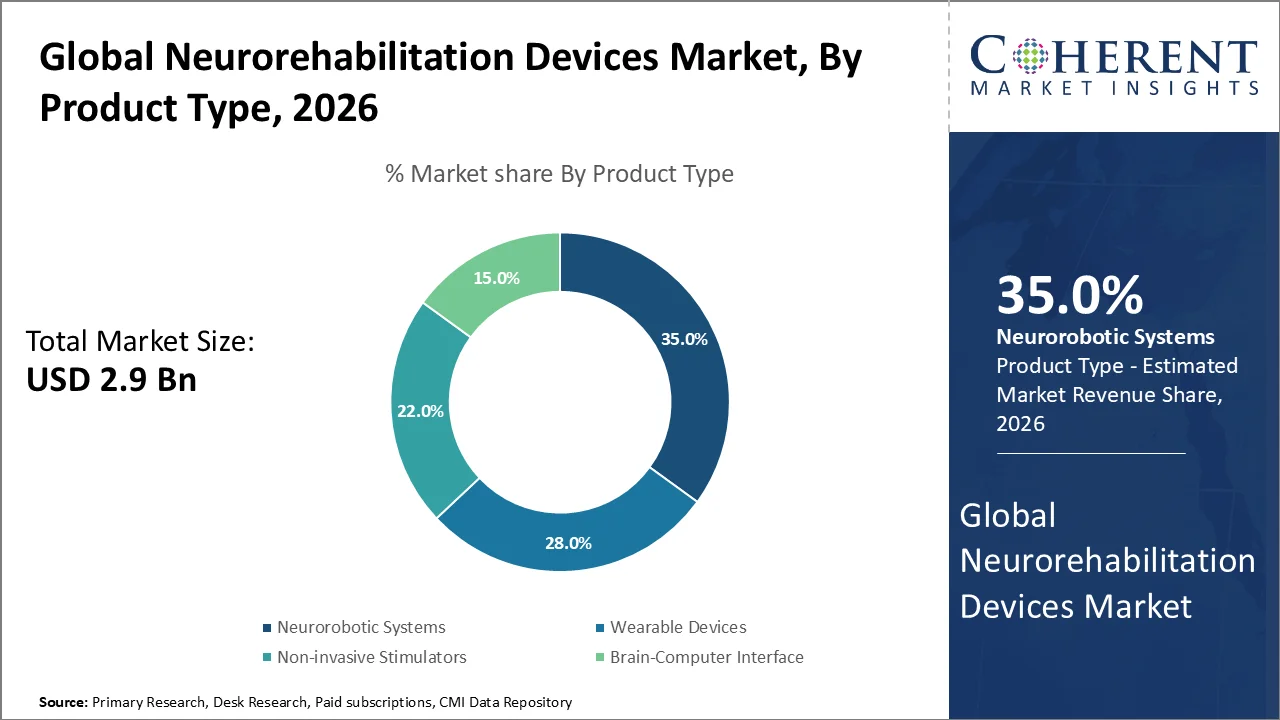
Why are Neurorobotic Systems Acquiring the Largest Share?
On the basis of product, the neurorobotic systems segment is projected to account for the largest Neurorehabilitation Devices Market share of approximately 35.0% in 2026. The segment’s dominance is attributed to the increasing use of robotic exoskeletons and robotic-assisted upper- and lower-limb systems that deliver intensive, repetitive, and measurable motor training for patients affected by stroke, spinal cord injury, and other neurological conditions.
Recent clinical evidence continues to strengthen adoption. A 2026 international multicenter randomized controlled trial involving 151 patients with subacute stroke evaluated wearable robotic-exoskeleton gait training.
In November 2025, Wandercraft announced expanded U.S. FDA indications for its Atalante X self-balancing rehabilitation exoskeleton. The clearance expanded its use to patients with spinal cord injuries from C4 to L5 and multiple sclerosis, in addition to its existing use for patients with stroke-related hemiplegia and other spinal cord injuries.
Stroke Holds the Largest Market Share
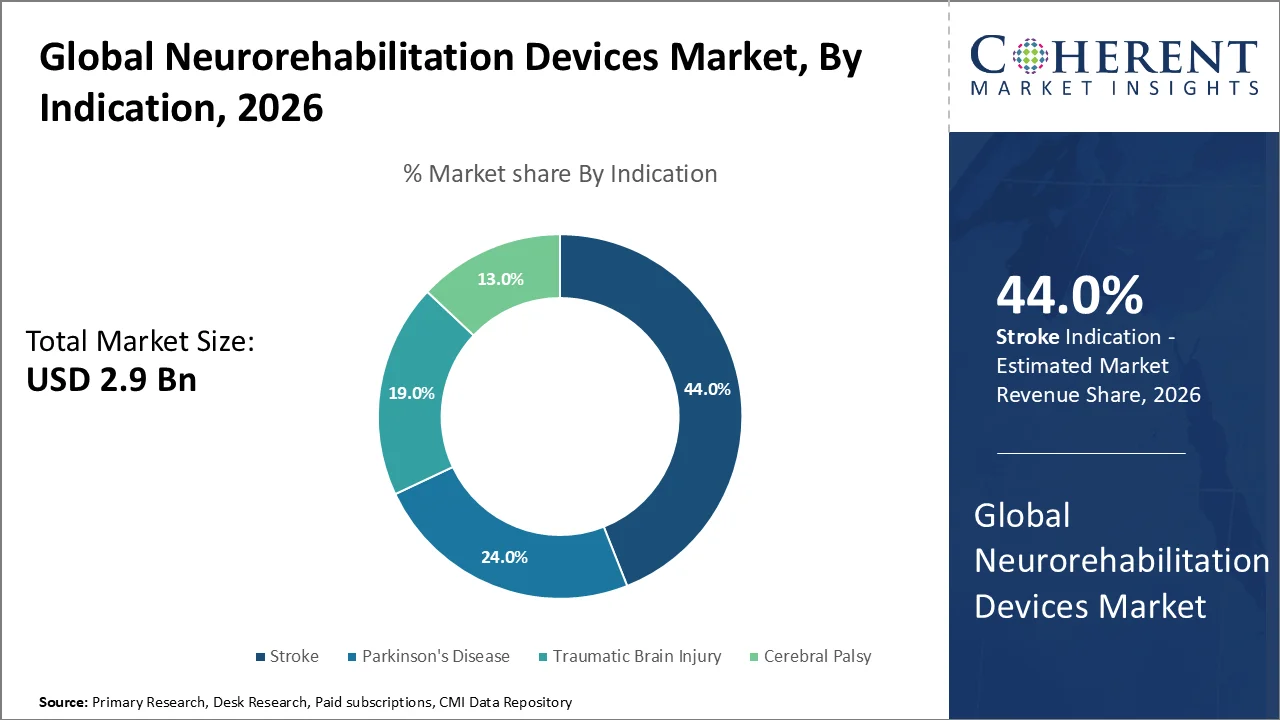
On the basis of indication, the stroke segment is anticipated to capture the major market share of around 44.0% for the Neurorehabilitation Devices Market in 2026. The stroke condition often leads to disabilities in gait, balance, muscle strength, coordination, and activities of daily living, resulting in high demand for robotic rehabilitation, neurostimulation, wearable technology, and other neurorehabilitation solutions.
Gaps in accessibility have also driven the need for rehabilitation technologies which can help provide treatment beyond specialized centers. According to the CDC 2025 research, around 49 million adults in the United States, 20% of the total adult population, were residing at least 60 minutes away by car from specialized facilities for stroke care, with 65% of these disadvantaged regions being rural regions.
In June 2026, Bioness Medical, Inc. announced that the U.S. FDA granted 510(k) clearance to its PoNS (Portable Neuromodulation Stimulator) System for treating dynamic gait deficits associated with chronic stroke.
Neurorehabilitation Devices Market Trends
- The increasing integration of brain-computer interfaces with robotic rehabilitation systems is shifting neurorehabilitation toward closed-loop, intention-driven therapy. A 2025 randomized clinical trial of the ReHand-BCI system used EEG signals to control a robotic hand orthosis across 30 therapy sessions; the BCI group’s median Action Research Arm Test score increased from 8.5 at baseline to 20 after treatment, supporting continued development of BCI-controlled rehabilitation devices.
- The market is increasingly shifting from hospital-only neurorehabilitation toward home- and community-based device use. In Q1 2026, ONWARD Medical supplied 70 ARC-EX neurostimulation systems for use in clinics and homes, while the technology was available at more than 100 clinics across the U.S. and Europe. ARC-EX sales generated approximately EUR 1.3 million during the quarter, with the company reporting strong initial home-use traction in the U.S.
- The growing adoption of wearable inertial sensors and digital movement-monitoring technologies is enabling rehabilitation providers to objectively quantify gait performance outside sophisticated motion-analysis laboratories. A 2026 systematic review covering 16 studies and 300 post-stroke participants found wearable inertial sensors demonstrated good-to-excellent agreement for spatial gait parameters, with ICC values of approximately 0.85–0.98.
Regional Insights
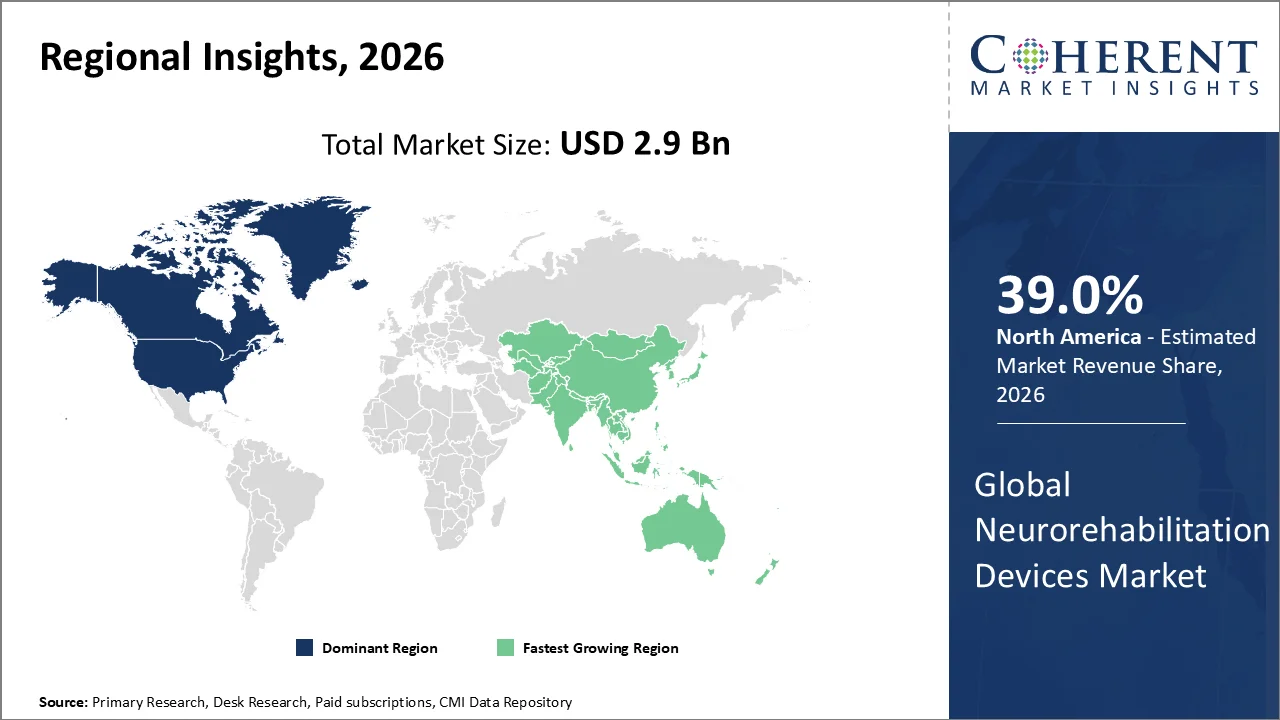
North America Dominates Owing to Strong Neurotechnology Research, Rehabilitation Infrastructure, and Early Device Adoption
North America is predicted to have the dominant market share of 39.0% in the Neurorehabilitation Devices Market in 2026. This leadership position will be attributed to the presence of high investment in neuroscience research, an established framework for rehabilitation services, early adoption of robotic and neuro-stimulation technology, and a conducive environment for the clinical assessment of neurological devices.
The BRAIN Initiative by the National Institutes of Health secured USD 429 million in FY2026, of which USD 234 million was for base funding and the rest (USD 195 million) for funding from the 21st Century Cures Act. The BRAIN Initiative focuses on the research and development of new neurotechnology to study and regulate nervous system functions.
In May 2026, ONWARD Medical reported strong U.S. commercialization momentum for its FDA-cleared ARC-EX neurostimulation system. The company supplied 70 ARC-EX systems during Q1 2026, including its first systems for home use, and reported strong initial adoption among the U.S. Veterans Affairs community.
Asia Pacific Neurorehabilitation Devices Market Trends
Asia Pacific is expected to be the fastest-growing regional Neurorehabilitation Devices Market, with an estimated 15.5% CAGR from 2026 to 2033. The region’s expansion is also being supported by increasing policy attention to rehabilitation access and assistive technologies. In October 2025, WHO launched its South-East Asia Regional Rehabilitation Framework, calling on member countries to accelerate rehabilitation at primary and community-care levels, expand the use of digital technologies, improve access to assistive technology, strengthen the rehabilitation workforce, and establish sustainable rehabilitation financing.
Japan provides evidence of increasing adoption of device-assisted rehabilitation. A 2025 study using Japan’s National Database of Health Insurance Claims reported that claims for device-assisted rehabilitation increased from 5,577 in FY2020 to 6,337 in FY2022, while population-adjusted claims rose from 4.4 to 5.1 per 100,000 people.
Large Neurological Patient Pool and Federal Rehabilitation Research are Accelerating the Neurorehabilitation Devices Market in the United States
The U.S. Neurorehabilitation Devices Market is witnessing strong development owing to the expanding elderly population, substantial burden of neurological injuries, and continued federal investment in robotic rehabilitation, exoskeletons, neurostimulation, and motor-recovery technologies. The country's established rehabilitation centers and clinical research infrastructure also facilitate earlier adoption and validation of advanced neurorehabilitation systems.
According to the U.S. Census Bureau, June 2025, the number of Americans above 65 years of age grew to 61.2 million in 2024, up 3.1% from the previous year. In the period from 2020 to 2024, the older population increased by 13.0%, at a much greater pace than that of 1.4% recorded by the working-age population. This trend is of great significance for neurorehabilitation since the prevalence of such neurological conditions as stroke, Parkinson’s disease, and others increases with age.
China Neurorehabilitation Devices Market Trends
The China Neurorehabilitation Devices Market is expected to witness strong growth owing to government support for brain-computer interfaces, rehabilitation robots and AI-enabled medical devices, alongside a rapidly ageing population and expansion of rehabilitation services for people with disabilities.
A 2026 randomized controlled trial conducted by Chinese rehabilitation centers evaluated the UGO220 lower-limb exoskeleton in 60 patients with post-stroke hemiplegia. Patients receiving robotic gait training showed significantly greater improvements in lower-extremity motor function and activities of daily living than those receiving conventional therapist-assisted gait training.
Who are the Major Companies in Neurorehabilitation Devices Industry
Some of the major key players in Neurorehabilitation Devices Market are Bioness, Inc., Ectron Ltd., Hocoma AG, Medtronic, Tyromotion, Agiliad, Bioxtreme Robotics Rehabilitation, St Jude Medical Inc., Alter G Inc., Denecor, Ekso Bionics Holding Inc., Helius, Interactive Motion Technologies, Kinestica, Kinetic Muscles, Medtronic Plc., and Neurostyle.
Key News
- In June 2025, Ekso Bionics announced an early proof-of-concept AI voice-agent interface for its exoskeleton technology following its participation in the NVIDIA Connect Program.
- In March 2026, Tyromotion introduced the tyroS 6.8 software update for its neurorehabilitation ecosystem, adding three new therapeutic games, Ski Champion, Bricks Breaker, and Paddle Boat.
Market Report Scope
Neurorehabilitation Devices Market Report Coverage
| Report Coverage | Details | ||
|---|---|---|---|
| Base Year: | 2025 | Market Size in 2026: | USD 2.9 Bn |
| Historical Data for: | 2020 To 2024 | Forecast Period: | 2026 To 2033 |
| Forecast Period 2026 to 2033 CAGR: | 13.9% | 2033 Value Projection: | USD 7.21 Bn |
| Geographies covered: |
| ||
| Segments covered: |
| ||
| Companies covered: | Bioness, Inc., Ectron Ltd., Hocoma AG, Medtronic, Tyromotion, Agiliad, Bioxtreme Robotics Rehabilitation, St Jude Medical Inc., Alter G Inc., Denecor, Ekso Bionics Holding Inc., Helius, Interactive Motion Technologies, Kinestica, Kinetic Muscles, Medtronic Plc., and Neurostyle. | ||
| Growth Drivers: |
| ||
| Restraints & Challenges: |
| ||
Analyst Opinion
- The Neurorehabilitation Devices Market is shifting toward closed-loop and multimodal rehabilitation systems, where brain-computer interfaces are combined with robotics and real-time neural feedback to deliver more personalized therapy. A 2025 randomized controlled study involving 40 subacute stroke patients found that BCI-controlled soft robotic glove therapy produced significantly greater improvements in Fugl-Meyer upper-limb and Action Research Arm Test scores than robotic-glove therapy without BCI control.
- Improving rehabilitation productivity is expected to become an important purchasing criterion for hospitals and rehabilitation centers, particularly as devices become easier for therapists to operate. A 2025 randomized controlled trial of the AGREE upper-limb rehabilitation exoskeleton involving 32 neurological patients found that robot-assisted rehabilitation achieved broadly comparable clinical improvements to conventional therapy while delivering approximately 71% less treatment practice time.
- The long-term market opportunity will depend heavily on expanding access to neurological technologies beyond advanced rehabilitation centers. WHO’s 2025 Global Status Report on Neurology found that only 57 countries, equivalent to 29% of WHO Member States, reported universal access to essential neurological medicines and basic technologies across both urban and rural primary-care settings. Moreover, only 25% of Member States included neurological disorders within universal health coverage benefit packages.
Speak to the analyst
Want personalized insights?
Take the findings above to one of our principal consultants, or have the report rebuilt around the segments, geographies and competitors you actually track.
Market Segmentation
- By Product Type (Revenue, USD Bn, 2021-2033)
- Wearable Devices
- Brain computer Interface
- Neurorobotic System
- Non-invasive Stimulators
- By Indication (Revenue, USD Bn, 2021-2033)
- Parkinson’s Disease
- Stroke
- Traumatic Brain Injury
- Cerebral Palsy
- By Region (Revenue, USD Bn, 2021-2033)
- North America
- U.S.
- Canada
- Latin America
- Brazil
- Mexico
- Argentina
- Rest of Latin America
- Europe
- Germany
- U.K.
- France
- Italy
- Spain
- Russia
- Rest of Europe
- Asia Pacific
- China
- India
- Japan
- Australia
- South Korea
- ASEAN
- Rest of Asia Pacific
- Middle East
- GCC
- Israel
- Rest of Middle East
- Africa
- South Africa
- Central Africa
- North Africa
- North America
Sources
Primary Research Interviews
- Neurorehabilitation physicians and neurologists
- Physical medicine and rehabilitation specialists
- Physiotherapists and occupational therapists
- Rehabilitation robotics and exoskeleton developers
- Brain-computer interface and neurostimulation technology developers
- Biomedical engineers and clinical neurotechnology researchers
- Procurement managers from hospitals and rehabilitation centers
- Key opinion leaders (KOLs) in stroke, spinal cord injury, Parkinson’s disease, and neurorehabilitation
Databases
- World Health Organization (WHO) – Global Health Observatory
- Centers for Disease Control and Prevention (CDC)
- ClinicalTrials.gov
- U.S. FDA – Medical Device Databases
- NIH RePORTER
- National Institute of Neurological Disorders and Stroke (NINDS)
- OECD Health Statistics
- World Bank Health Data
Magazines
- MedTech Dive
- Medical Device Network
- Medical Device and Diagnostic Industry (MD+DI)
- Med-Tech Innovation
- NeuroNews International
- Healthcare IT News
Journals
- Journal of NeuroEngineering and Rehabilitation
- Neurorehabilitation and Neural Repair
- IEEE Transactions on Neural Systems and Rehabilitation Engineering
- Frontiers in Neurology
- Archives of Physical Medicine and Rehabilitation
- Stroke
- Journal of Rehabilitation Medicine
Newspapers
- The New York Times
- The Wall Street Journal
- Financial Times
- Reuters
- The Guardian
- The Economic Times
Associations
- World Federation for NeuroRehabilitation (WFNR)
- American Congress of Rehabilitation Medicine (ACRM)
- American Academy of Physical Medicine and Rehabilitation (AAPM&R)
- American Stroke Association (ASA)
- World Stroke Organization (WSO)
- International Spinal Cord Society (ISCoS)
- International Society of Physical and Rehabilitation Medicine (ISPRM)
Public Domain Sources
- Company Annual Reports and Investor Presentations
- U.S. FDA 510(k), De Novo, and Premarket Approval databases
- CMS reimbursement and coverage publications
- WHO neurological disease and rehabilitation reports
- NIH- and NINDS-funded neurotechnology research publications
- Clinical trial registries and peer-reviewed clinical studies
- Government rehabilitation and disability statistics
- Patent databases such as WIPO, USPTO, and Google Patents
- University and hospital neurorehabilitation research publications
- Regulatory guidelines for rehabilitation robotics, neurostimulation, and brain-computer interfaces
Proprietary Elements
- CMI Data Analytics Tool
- Proprietary CMI Existing Repository of Information for the Last 10 Years
Get access to 250+ pages report
Every segment, forecast, competitor profile and data table behind the analysis above — available for instant download.
- ESOMAR Member
- ISO 9001:2015 Certified
- D-U-N-S Registered
- GDPR & CCPA Compliant
Missing comfort of reading report in your local language? Find your preferred language:
Transform your Strategy with Exclusive Trending Reports
Frequently Asked Questions
The Neurorehabilitation Devices Market is expected to reach approximately USD 7.21 Bn by 2033, compared with USD 2.9 Bn in 2026.
Major players operating in the global Neurorehabilitation Devices Market include Bioness, Inc., Ectron Ltd., Hocoma AG, Medtronic Plc., Tyromotion, Agiliad, Bioxtreme Robotics Rehabilitation, AlterG Inc., Ekso Bionics Holdings Inc., Helius, Kinestica, Kinetic Muscles, and Neurostyle, among others.
The high investment cost of advanced rehabilitation systems and limited reimbursement coverage are among the key factors hampering market growth.
The market is primarily driven by the increasing adoption of robotic-assisted neurorehabilitation systems, rising prevalence of neurological disorders and stroke, growing demand for advanced rehabilitation therapies, and wider adoption of neurostimulation, brain-computer interfaces, and wearable rehabilitation technologies.
The Neurorehabilitation Devices Market is anticipated to grow at a CAGR of 13.9% between 2026 and 2033.
North America is expected to dominate the global Neurorehabilitation Devices Market, accounting for approximately 39.0% of the market share in 2026, supported by advanced rehabilitation infrastructure, strong neurotechnology research, and early adoption of robotic and neurostimulation technologies.
Asia Pacific is expected to be the fastest-growing regional market, with an estimated CAGR of 15.5% from 2026 to 2033, supported by improving rehabilitation access, adoption of assistive technologies, and increasing use of digital rehabilitation solutions.