

Oxygen Conservation Devices Market Size and Forecast — 2026-2033
The Global Oxygen Conservation Devices Market size is estimated to be valued at USD 1.30 billion in 2026 and is expected to reach USD 2.29 billion by 2033, exhibiting a compound annual growth rate (CAGR) of 8.4% from 2026 to 2033.
Overview
Oxygen conservation devices are medical products engineered to optimize oxygen delivery to patients by minimizing wastage during exhalation. These devices include pulse-dose regulators, demand valves, and electronic oxygen conservers, designed for both portable and stationary oxygen systems. They help extend cylinder life, improve patient mobility, and maintain consistent oxygen therapy efficiency. Product innovations focus on lightweight, battery-efficient, and digitally controlled designs with real-time flow adjustment to enhance patient comfort and therapy precision.
Key Takeaways
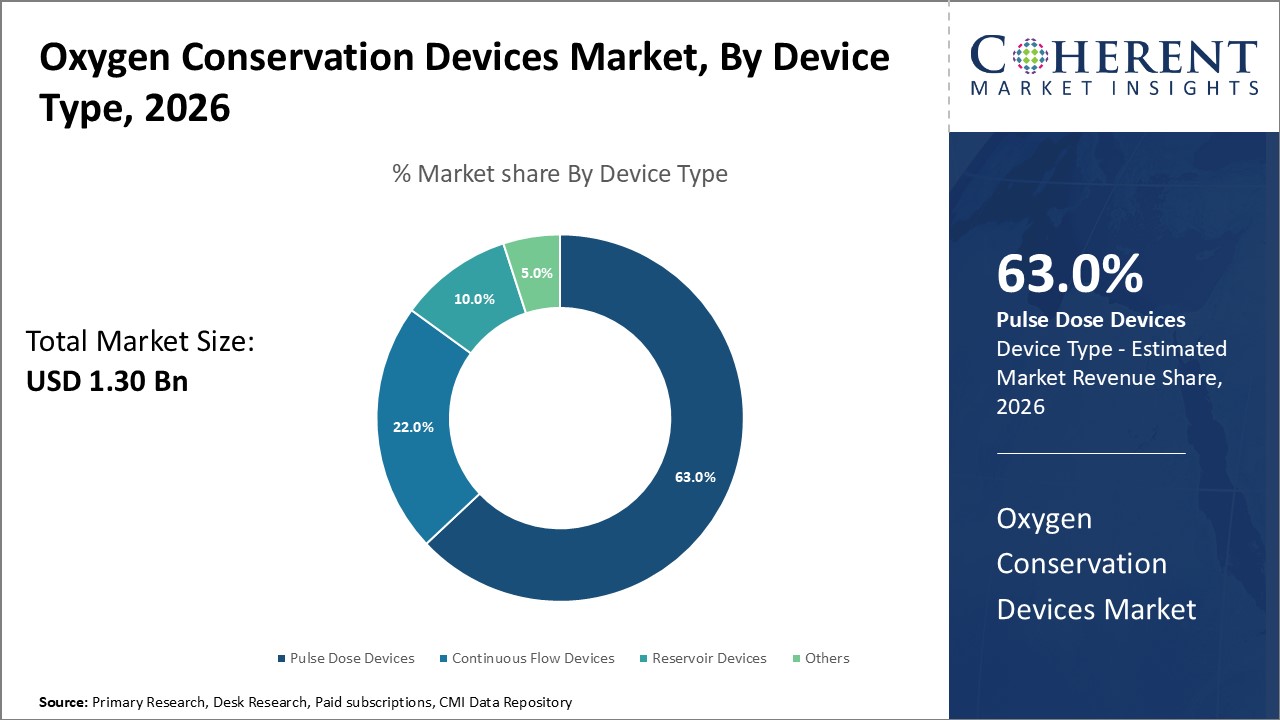
The Pulse Dose Devices segment dominates with 63% market share, driven by efficiency and patient usability improvements, while Continuous Flow Devices are witnessing rapid growth due to new technological enhancements facilitating critical care usage.
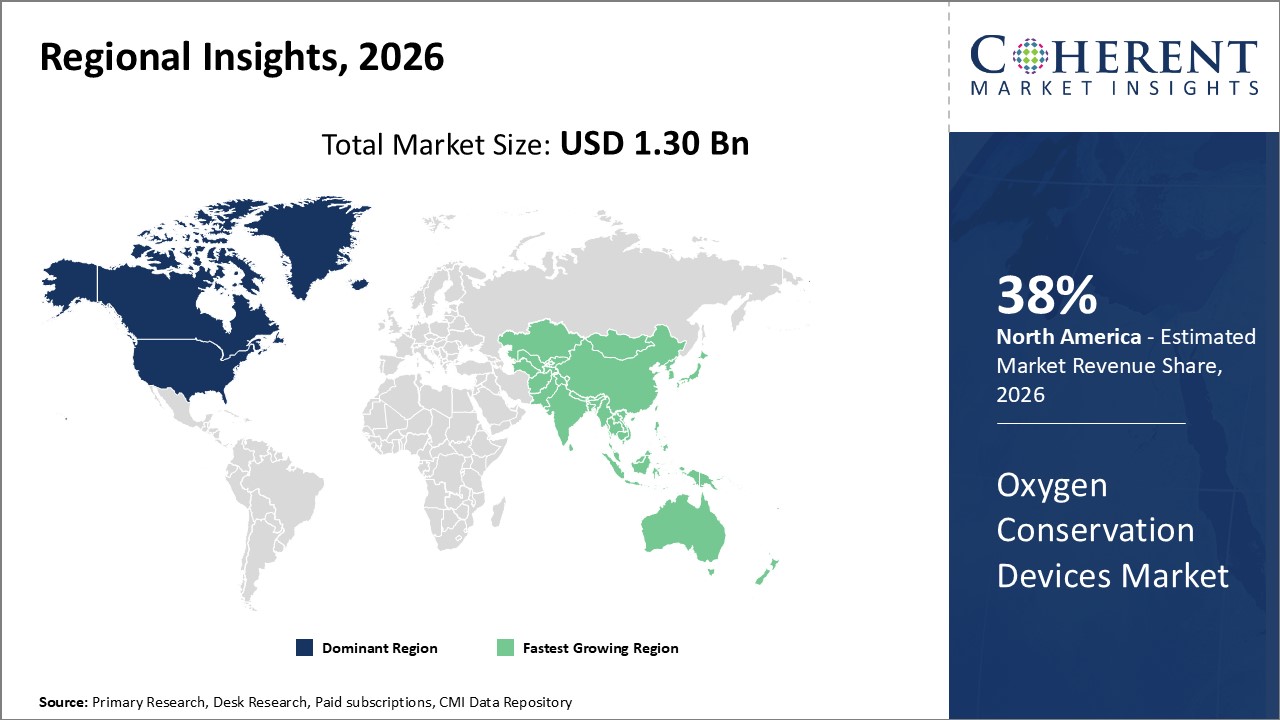
Regionally, North America leads with 38% of the Oxygen Conservation Devices market share, benefiting from advanced healthcare infrastructure and reimbursement frameworks.
Meanwhile, Asia Pacific exhibits the fastest CAGR owing to expanding manufacturing capabilities and growing respiratory disease prevalence, making it a key focus area for market players.
Oxygen Conservation Devices Market Segmentation Analysis
Oxygen Conservation Devices Market Insights, By Device Type
Pulse Dose Devices dominate the market share at 63%, due to their oxygen delivery efficiency, conserving oxygen by supplying it only during inhalation, thus increasing device runtime and reducing oxygen wastage. Their growing preference for home healthcare and ambulatory scenarios stems from technological enhancements like Bluetooth-enabled monitoring and improved battery life.
Oxygen Conservation Devices Market Insights, By End-User
Home Healthcare dominates substantially, driven by rising patient preference for at-home management of chronic respiratory diseases combined with advances in device portability and telemonitoring. This segment benefits from significant reimbursement schemes and demographic trends emphasizing outpatient care, contributing to a dominant market share. Hospitals represent the fastest-growing subsegment due to increasing infrastructure investments and heightened demand for integrated oxygen delivery systems in ICUs and critical care units.
Oxygen Conservation Devices Market Insights, By Application
COPD is the dominant application segment driven by its high global disease burden and long-term oxygen therapy requirements. COPD patients represent the largest end-user base, necessitating devices that optimize oxygen usage and enable mobility. Pulmonary Fibrosis is the fastest-growing application subsegment due to increasing diagnosis rates and expanding therapeutic adoption, frequently supported by clinical trials emphasizing oxygen conservation approaches. Sleep Apnea devices are gradually evolving with integrated oxygen delivery features amid rising awareness of comorbid respiratory conditions.
Oxygen Conservation Devices Market Trends
The market is progressively moving toward digital health integration and energy-efficient solutions.
For instance, introducing wearable pulse dose devices with Bluetooth in 2025 enabled real-time oxygen saturation monitoring, aligning with patient-centric therapy management.
Moreover, manufacturers have been increasing sustainability by adopting recyclable materials and power-saving designs, which complement rising regulations on medical device eco-friendliness.
The growing use of telemedicine also facilitates seamless remote monitoring, allowing for personalized adjustments and improved treatment adherence, transforming traditional oxygen therapy paradigms.
Oxygen Conservation Devices Market Insights, By Geography
North America Oxygen Conservation Devices Market Analysis and Trends
In North America, the dominance in the Oxygen Conservation Devices market is attributed to robust healthcare infrastructure, established reimbursement frameworks, and high adoption rates of advanced devices. The region accounts for approximately 38% of the total market share, benefiting from increasing respiratory disease prevalence and technological innovation spearheaded by players like Philips Healthcare and ResMed.
Asia Pacific Oxygen Conservation Devices Market Analysis and Trends
Meanwhile, the Asia Pacific exhibits the fastest growth rate with a CAGR surpassing 10% due to improving healthcare access, expanding manufacturing capabilities, and proactive government initiatives to tackle respiratory illnesses. China and India are key contributors, supported by growing patient populations and rising awareness of oxygen therapy benefits, fostering significant market revenue expansion.
Oxygen Conservation Devices Market Outlook for Key Countries
USA Oxygen Conservation Devices Market Analysis and Trends
The USA’s Oxygen Conservation Devices market is a major driver globally, with widespread adoption supported by favorable reimbursement policies, including Medicare and Medicaid. In 2025, the USA accounted for nearly 30% of global market revenue. Leading players like Medtronic and Drive DeVilbiss Healthcare maintain a strong presence through product innovation and expanding outpatient oxygen service networks. The country’s emphasis on home healthcare growth and telemedicine integration further accelerates device deployment, supporting ongoing industry share gains.
Germany Oxygen Conservation Devices Market Analysis and Trends
Germany’s market is distinguished by a high healthcare expenditure per capita and an advanced respiratory care infrastructure. The country’s robust insurance ecosystem facilitates oxygen therapy accessibility, encouraging increased adoption of pulse dose devices. Local manufacturers combined with international market companies contribute to a competitive environment focused on product quality and compliance with stringent European medical device standards. This has led to steady market revenue growth and expanding business growth potential within the region.
Analyst Opinion
The shift towards more portable and user-centric oxygen conservation devices has substantially influenced market share. In 2025, over 55% of new device sales were handheld or lightweight models, especially in North America and Europe, driven by patient mobility needs. This has resulted in higher market revenue in home healthcare settings and ambulatory services, underscoring demand-side market growth strategies.
Demand-side indicators show a steady rise in device usage among COPD and pulmonary fibrosis patients. With WHO reporting over 300 million COPD cases globally in 2025, demand for oxygen conservation devices rose by around 13% compared to 2023, fueling the industry's market growth and market forecast accuracy.
Supply-side expansions, particularly in China and India, have led to higher production capacities of oxygen conservation devices. The surge in medical device manufacturing hubs increased regional exports by 18% in 2025, positioning the Asia Pacific as a pivotal growth market with a burgeoning market size and industry share.
Pricing dynamics combined with government reimbursement schemes are notable micro-indicators directly affecting market penetration. In 2026, pricing adjustments in key markets like the U.S. led to a 8% utilization increase in oxygen conservation devices within Medicare and private insurance settings, reflecting effective market drivers and challenges adaptations.
- Current Industry Events of 2026
- Market Size Estimation
- Regional Breakdown
- Competitive Landscape
- Customer Intelligence
- Segmental Analysis
- Pricing Analysis
- Key Market Drivers, Challenges & Future Trends
- Customized Insights Section
Market Scope
| Report Coverage | Details | ||
|---|---|---|---|
| Base Year: | 2025 | Market Size in 2026: | USD 1.30 billion |
| Historical Data for: | 2020 To 2024 | Forecast Period: | 2026 To 2033 |
| Forecast Period 2026 to 2033 CAGR: | 8.4% | 2033 Value Projection: | USD 2.29 billion |
| Geographies covered: |
| ||
| Segments covered: |
| ||
| Companies covered: | Philips Healthcare, ResMed Inc., Inverness Medical Innovations Inc., Medtronic plc, Drive DeVilbiss Healthcare, Oxus America Corporation, Invacare Corporation, Fisher & Paykel Healthcare, AirSep Corporation, Caire Inc., Chart Industries Inc., DeVilbiss Healthcare, Becton Dickinson and Company. | ||
| Growth Drivers: |
| ||
Oxygen Conservation Devices Market Growth Factors
Growing incidence rates of chronic respiratory diseases such as COPD and pulmonary fibrosis are primary drivers. According to recent health databases, COPD affected approximately 4.5% of the adult population globally in 2025, directly increasing oxygen therapy demand. Advancements in pulse dose technology have significantly improved device efficiency, reducing oxygen waste and improving patient compliance, further propelling market growth. Additionally, the expanding home healthcare market plays a critical role, driven by preferences for outpatient care and telehealth integration, which grew by over 25% in 2025 alone. Increasing awareness campaigns and government initiatives encouraging the usage of oxygen conservation devices are also accelerating business growth opportunities.
Oxygen Conservation Devices Market Development
In 2023, Inogen introduced its next-generation smart portable oxygen concentrator, designed to enhance mobility, connectivity, and personalized respiratory care for home-use patients. The advanced system features pulsed-dose oxygen conservation technology, optimizing oxygen delivery based on the user’s breathing pattern to extend battery life and improve efficiency. Integrated Bluetooth connectivity enables users and caregivers to remotely monitor performance and device status through a mobile application, ensuring greater reliability and adherence to therapy. With this launch, Inogen reinforced its position as a global leader in home respiratory therapy solutions, addressing the growing demand for smart, lightweight, and digitally connected oxygen systems for patients with chronic respiratory conditions such as COPD.
In February 2025, OxyNov launched its FreeO₂ system in Canada, following successful multi-center hospital trials demonstrating improved oxygen titration accuracy and patient safety. The automated oxygen delivery platform continuously monitors patients’ oxygen saturation and adjusts flow in real time, minimizing both hypoxia and hyperoxia risks.
Key Players
Leading Companies of the Market
Philips Healthcare
ResMed Inc.
Inverness Medical Innovations Inc.
Medtronic plc
Drive DeVilbiss Healthcare
Oxus America Corporation
Invacare Corporation
Fisher & Paykel Healthcare
AirSep Corporation
Caire Inc.
Chart Industries Inc.
DeVilbiss Healthcare
Becton Dickinson and Company
Leading market players are continuously innovating through strategic partnerships and product development. For instance, Philips Healthcare's launch of a next-generation pulse dose oxygen conserve device in 2025 was accompanied by strategic collaboration with home care providers, resulting in a 15% market penetration increase within six months. ResMed has focused on expanding manufacturing capacity in the Asia Pacific to meet growing regional demand, notably contributing to its 2025 market revenue surge by 20%.
Oxygen Conservation Devices Market Future Outlook
The future market will benefit from technological convergence, patient-centric design, and digital connectivity. Integration with telemedicine platforms, wearable sensors, and smart monitoring systems will allow real-time adjustment of oxygen delivery based on activity and physiological parameters. Portable, lightweight models will dominate demand as home healthcare and ambulatory care expand. Environmental considerations will drive innovations in recyclable materials and low-power components. Strategic collaborations among device manufacturers, hospitals, and digital health firms will enhance adoption and patient outcomes, establishing oxygen conservation devices as a standard in respiratory therapy solutions.
Oxygen Conservation Devices Market Historical Analysis
The oxygen conservation devices market developed in response to the need for efficient oxygen delivery in clinical and home care settings. Historically, oxygen therapy relied on continuous-flow systems, which limited mobility and wasted resources. The introduction of demand-based and pulse-dose systems transformed the sector by improving cylinder duration and portability. Aging populations, the prevalence of chronic respiratory conditions, and the rise of home-based care accelerated market adoption. Manufacturers focused on refining device ergonomics, safety, and energy efficiency to meet healthcare standards and patient comfort needs.
Sources
Primary Research interviews:
Pulmonologists
Biomedical Engineers
Respiratory Therapists
Medical Device Manufacturers
Databases:
WHO Medical Device Database
Magazines:
Respiratory Therapy Journal
Medical Device + Diagnostic Industry
BioSpectrum
Healthcare Packaging
Journals:
Journal of Clinical Respiratory Diseases
Respiratory Care
Biomedical Engineering Online
Medical Devices: Evidence and Research
Newspapers:
The Hindu Business Line (Healthcare)
The Economic Times (Medical Devices)
The Guardian (Health)
The Wall Street Journal (Medical Technology)
Associations:
American Thoracic Society
European Respiratory Society
Medical Device Manufacturers Association
World Health Organization
Get access to 250+ pages report
Every segment, forecast, competitor profile and data table behind the analysis above — available for instant download.
- ESOMAR Member
- ISO 9001:2015 Certified
- D-U-N-S Registered
- GDPR & CCPA Compliant
Missing comfort of reading report in your local language? Find your preferred language:
Transform your Strategy with Exclusive Trending Reports
Frequently Asked Questions
Leading companies include Philips Healthcare, ResMed Inc., Medtronic plc, and Drive DeVilbiss Healthcare, which collectively hold a significant market share through innovation and strategic partnerships.
The market is expected to grow from USD 1.30 billion in 2026 to USD 2.29 billion by 2033, expanding at a CAGR of 8.4%.
Home Healthcare stands out as the fastest-growing end-user segment due to the rising preference for ambulatory care and telehealth integration.
We anticipate increased connectivity features, sustainable device designs, and greater integration with telemedicine platforms shaping the Oxygen Conservation Devices market trends.
The competitive landscape is marked by innovation-driven growth and consolidation. Challenges include pricing sensitivity and reimbursement policy variability across regions.
Market companies focus on strategic collaborations, expanding regional manufacturing bases, and launching technologically advanced products tailored to end-user demands.