

Personal Mobility Devices Market Size and Trends - 2026 to 2033
Personal mobility devices market is estimated to be valued at USD 13,720 Mn in 2026 and is expected to reach USD 21,600 Mn by 2033, exhibiting a compound annual growth rate (CAGR) of 6.7% from 2026 to 2033.
Key Takeaways
- Based on Product Type, the Wheelchairs segment is expected to lead the market with 48% share in 2026, due to high demand in homecare and healthcare facilities.
- Based on End User, the Homecare Setting segment is expected to lead the market with 47% share in 2026, due to rising preference for at-home mobility solutions.
- Based on Region, North America is set to lead the personal mobility devices market with 35.7% share in 2026. While, Asia Pacific is anticipated to be the fastest growing region.
Market Overview
The global personal mobility devices market is witnessing significant growth due to increasing demand for solutions that enhance mobility and independence among elderly and physically challenged individuals. The increasing awareness of mobility health issues, along with the constantly aging population globally, is increasing the demand for equipment such as wheelchairs, scooters, walkers, stair-lifts, and hand bikes. Technological innovations in the form of electric mobility devices and power addition products have further fueled the market growth. Government policies and the reimbursement system for healthcare services have further fueled the market growth for personal mobility devices either in an institutional setting or in the home environment.
Current Events and Its Impacts on the Personal Mobility Devices Market
Current Events | Description and its impact |
Supply Chain Disruptions and Raw Material Shortages |
|
Technological Advancement in AI and Autonomous Systems |
|
How is product innovation driving the growth in personal mobility devices?
- Smart Mobility Devices: The integration of Internet of Things (IoT) technology into wheelchairs, scooters, hand bikes, for the purpose of monitoring speed, battery life, position, and health.
- Light & Fold Designs: That there would be emphasis placed on developing light & fold designs that would serve as easy tools of mobility.
- Eco-Friendly & Sustainable Materials: The use of recyclable materials like metals, bioplastics, and eco-friendly batteries may be downright irresistible to the eco-friendly
- Connected Healthcare Integration: Healthcare devices that are interoperable with tele-health platforms to enable remote patient observation and rehabilitation support.
- Current Industry Events of 2026
- Market Size Estimation
- Regional Breakdown
- Competitive Landscape
- Customer Intelligence
- Segmental Analysis
- Pricing Analysis
- Key Market Drivers, Challenges & Future Trends
- Customized Insights Section
Segmental Insights
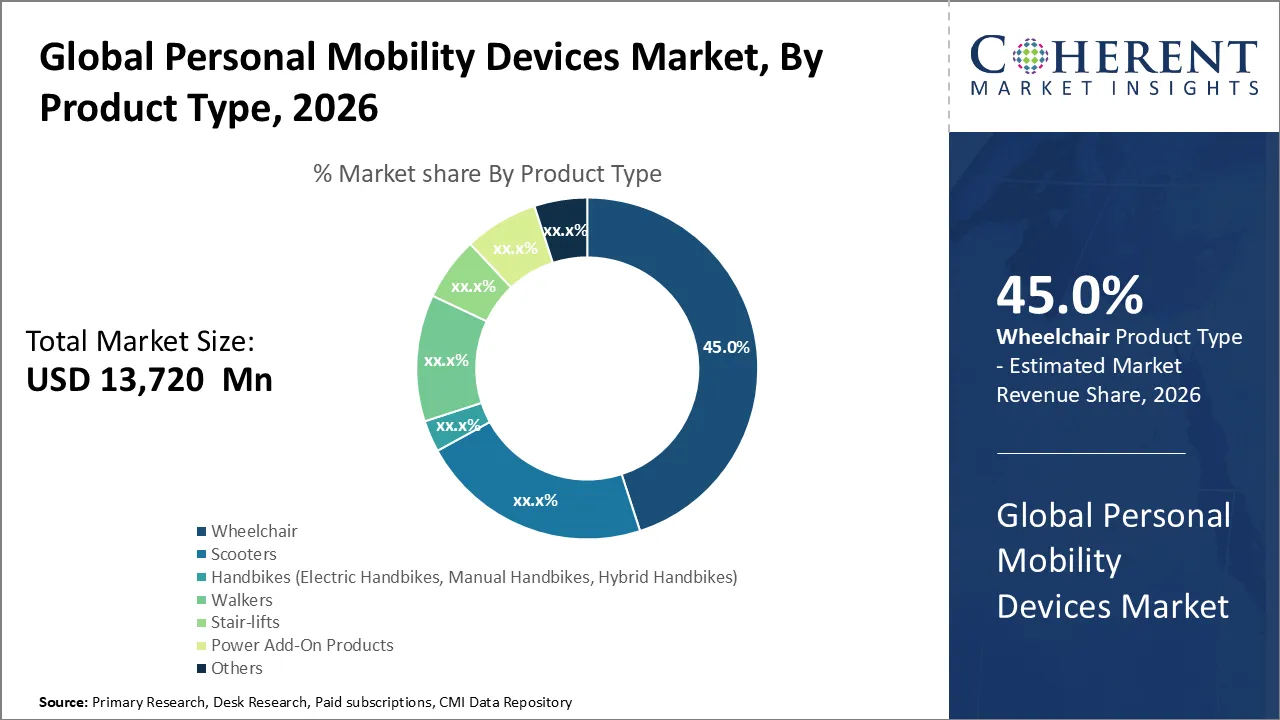
Personal Mobility Devices Market Insights, By Product Type – Wheelchairs dominate due to widespread adoption in healthcare and homecare
Based on product type, the wheelchairs segment is projected to offer the highest market share of 48% in 2026. Wheelchairs have always been one of the primary mobility aids that are largely in use due to their adaptability and functionalities in providing independence for senior and physically impaired individuals. The use of modern technologies such as light wheelchairs and electric wheelchairs has increased their demand in hospitals and homes.
For instance, in July 2025, the Indian Institute of Technology Madras launched the YD One active wheelchair, billed as India’s lightest precision‑engineered wheelchair at around 9 kg, designed for customized daily mobility and ease of transportation.
Personal Mobility Devices Market Insights, By End User – Homecare Setting leads as consumers increasingly prefer at-home solutions
By end-user, the homecare setting segment is projected to hold the largest market share of 47% in 2026. The demand for in-home mobility solutions is rising due to the increase in the elderly population, demand for living independently, and growth in homecare services around the globe. People are demanding mobility solutions with ease-of-use, portability, and ability to perform day-to-day tasks without depending on institutions.
For instance, in December 2025, Pride Mobility announced the launch of three new travel power wheelchairs, Jazzy Carbon 27, Jazzy Carbon 27x, and Jazzy Carbon HD, designed to offer enhanced mobility and independence for users in residential and homecare settings
Regional Insights
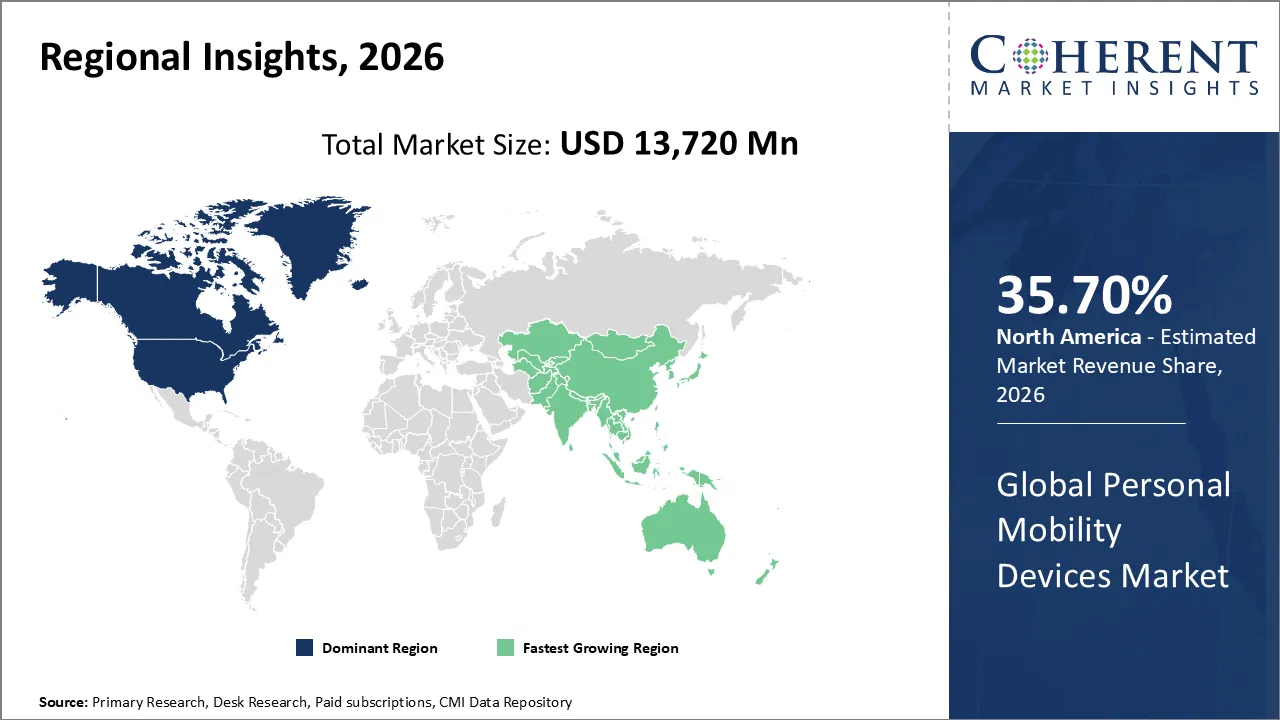
North America Personal Mobility Devices Market Analysis & Trends
North America is expected to lead the personal mobility devices market in 2026, accounting for a share of 35.7%. This is due to an advanced medical infrastructure, high adoption of innovative solutions for mobility assistance, and effective reimbursement programs available for medical institutions and home care. Increased awareness regarding independent living solutions and aging in place has also fueled the adoption of wheelchairs, mobility scooters, and other personal mobility devices.
For instance, in August 2025, Pride Mobility launched the Jazzy Carbon 27 series in the U.S., a line of lightweight, foldable, and high-performance power wheelchairs designed for easy portability and homecare usage.
Asia Pacific Personal Mobility Devices Market Analysis & Trends
The Asia Pacific region is expected to record the highest growth rate in the personal mobility devices market owing to the increasing senior population, advanced health infrastructure, and rising disposable income. Initiatives by various governments in countries such as China, India, and Japan encourage independent living and promote accessibility. Several manufacturing organizations from this region have also been developing cost-effective yet technologically advanced products.
For instance, in July 2025, IIT Madras unveiled the YD One active wheelchair, India’s lightest precision-engineered wheelchair at around 9 kg, designed specifically for homecare and personal mobility.
Personal Mobility Devices Market Outlook for Key Countries
Is the U.S. personal mobility devices market booming from aging population, innovation, and healthcare support?
The U.S. personal mobility devices market is growing at a tremendous pace owing to an aging population, adoption of advanced technologies in mobility solutions, and robust government reimbursement programs for health care. Rising awareness regarding independent living solutions for senior adults is resulting in growing demands for wheelchairs, scooters, walkers, and stair-lifts.
For instance, in March 2025, Golden Technologies showcased new lightweight foldable power wheelchairs that expand its consumer mobility lineup, emphasizing portability and ease of storage.
Is China’s focus on healthcare infrastructure and independent living boosting personal mobility devices growth?
China's expanding healthcare infrastructure and growing emphasis on independent living are accelerating growth in the personal mobility devices market. Growing awareness regarding the solution of mobility for the elderly and disabled population, coupled with government initiatives toward ensuring better accessibility, drives the demand for low-cost yet technologically advanced wheelchairs, scooters, and homecare devices.
For instance, in July 2025, IIT Madras partnered with Thryv Mobility to launch the YD One active wheelchair, India’s lightest precision-engineered wheelchair at around 9 kg, which is gaining attention in the Asia-Pacific region, including China, for its portability and ergonomic design.
Market Report Scope
Personal Mobility Devices Market Report Coverage
| Report Coverage | Details | ||
|---|---|---|---|
| Base Year: | 2025 | Market Size in 2026: | USD 13,720 Mn |
| Historical Data for: | 2020 To 2024 | Forecast Period: | 2026 To 2033 |
| Forecast Period 2026 to 2033 CAGR: | 6.7% | 2033 Value Projection: | USD 21,600 Mn |
| Geographies covered: |
| ||
| Segments covered: |
| ||
| Companies covered: | Invacare Corporation, Pride Mobility Products Corporation, Drive Devilbiss Healthcare, Sunrise Medical (US) LLC, Permobil, Acorn Stairlifts Inc., Stannah International, Ottobock Healthcare, R&E Stricker Reha-Entwicklungen GmbH, Triride Srl, Klaxon Mobility GmbH, Alber GmbH, Spinergy, Inc., and Yamaha Motor Co., Ltd. | ||
| Growth Drivers: |
| ||
| Restraints & Challenges: |
| ||
Personal Mobility Devices Market Driver
Rising demand for homecare and independent living solutions
The increasing aging population and growing preference for aging-in-place are driving the demand for personal mobility devices. Seniors and physically challenged people are increasingly looking for wheelchairs, scooters, walkers, and stair-lifts that help them maintain independence in homecare settings. Further, the technological innovations related to light-weighted, folded, and smart mobility devices spur market growth since they enhance comfort, portability, and safety for daily use.
Personal Mobility Devices Market Opportunity
Integration of smart technologies and connected devices
The market also offers great opportunities in terms of smart and connected solutions in mobility. Manufacturers can develop wheelchairs, scooters, and walkers that come equipped with sensor capabilities, IoT-based tracking systems, fall detection systems, and health monitoring systems. There are also opportunities to develop products that are integrated into home automation systems, mobile applications, or telemedicine solutions.
Analyst Opinion (Expert Opinion)
The personal mobility devices market is shifting rapidly as aging populations and individuals with mobility challenges increasingly demand independence and lifestyle-focused solutions. Mobility devices such as wheelchairs, power scooters, walkers, and stair-lifts are no longer seen purely as medical equipment, they are becoming essential tools that allow users to maintain daily activity, social interaction, and personal autonomy.
Homecare environments are increasingly defining the market's needs. Design for compact spaces, ease of use, and effortless integration into household routines is being developed. Beyond mobility, manufacturers are beginning to integrate smart technologies such as posture monitoring, connectivity with mobile apps, and safety sensors-signaling a convergence of mobility, health, and digital innovation.
Regionally, trends differ but complement each other. While in North America, expectations of accessibility and healthcare support influence the features and adoption of products, in the Asia-Pacific region, increasing awareness of independent living and homecare solutions drives innovation in the development of lightweight, portable, user-friendly devices.
Speak to the analyst
Want personalized insights?
Take the findings above to one of our principal consultants, or have the report rebuilt around the segments, geographies and competitors you actually track.
Personal Mobility Devices Industry News
- In December 2025, Invacare’s ASL division introduced a new iON Integrated Drive Control System that integrates wireless connectivity and advanced controls, enabling users to navigate mobility equipment while also interacting with devices and their environment.
- In January 2025, Sunrise Medical unveiled the Magic Mobility XT4, a cutting‑edge 4×4 power wheelchair engineered for off‑road performance with all‑wheel suspension, servo‑powered steering, and four high‑torque motors, expanding mobility options for users who require both indoor and outdoor capability.
- In April 2025, Sunrise Medical announced the launch of the Empulse® F35 Pull Power Assist Device, a lightweight power assist solution aimed at enhancing urban mobility for wheelchair users, blending functional power with sleek design for everyday independence
Market Segmentation
- Product Type Insights (Revenue, USD Mn, 2026 - 2033)
- Wheelchair
- Scooters
- Handbikes
- Electric handbikes
- Manual handbikes
- Hybrid handbikes
- Walkers
- Stair-lifts
- Power Add On Products
- Others
- End User Insights (Revenue, USD Mn, 2026 - 2033)
- Hospitals & Clinics
- Ambulatory Surgical Centres
- Urgent Care Centre
- Homecare Setting
- Others
- Regional Insights (Revenue, USD Mn, 2026 - 2033)
- North America
- U.S.
- Canada
- Latin America
- Brazil
- Argentina
- Mexico
- Rest of Latin America
- Europe
- Germany
- U.K.
- Spain
- France
- Italy
- Russia
- Rest of Europe
- Asia Pacific
- China
- India
- Japan
- Australia
- South Korea
- ASEAN
- Rest of Asia Pacific
- Middle East
- GCC Countries
- Israel
- Rest of Middle East
- Africa
- South Africa
- North Africa
- Central Africa
- North America
- Key Players Insights
- Invacare Corporation
- Pride Mobility Products Corporation
- Drive Devilbiss Healthcare
- Sunrise Medical (US) LLC
- Permobil, Acorn Stairlifts Inc.
- Stannah International
- Ottobock Healthcare
- R&E Stricker Reha-Entwicklungen GmbH
- Triride Srl
- Klaxon Mobility GmbH
- Alber GmbH
- Spinergy, Inc.
- Yamaha Motor Co., Ltd.
Sources
Primary Research Interviews
- Executives & Product Managers from Invacare Corporation, Pride Mobility, Permobil, Sunrise Medical, and Drive Devilbiss Healthcare
- Rehabilitation & Homecare Specialists
- Physical Therapists & Occupational Therapists
- Hospital & Clinic Procurement Heads
- Mobility Device Distributors & Retailers
- Users of Wheelchairs, Scooters, Walkers, and Stair-lifts
- Assistive Technology Consultants & Trainers
- Others
Databases
- Company Press Release Portals
- Patent Databases for Mobility Device Innovations
- FDA & CE Regulatory Approvals Database
- Product Certification & Compliance Databases
- Healthcare Equipment Directories
- Others
Magazines
- Rehab Management
- Mobility & Accessibility Today
- Wheelchair & Assistive Technology News
- Medical Device & Assistive Technology Magazine
- Others
Journals
- Journal of Rehabilitation Research and Development (JRRD)
- Disability and Health Journal
- Assistive Technology Journal
- Journal of Medical Devices & Assistive Technology
- Others
Newspapers
- The New York Times – Health & Technology Section
- The Guardian – Science & Health
- The Wall Street Journal – Medical Devices & Healthcare
- Reuters – Health & Mobility Technology
- Bloomberg News – Healthcare & Innovation
- Others
Associations
- American Physical Therapy Association (APTA)
- Rehabilitation Engineering and Assistive Technology Society of North America (RESNA)
- International Society for Wheelchair Professionals (ISWP)
- World Health Organization (Mobility & Disability Initiatives)
- Others
Public Domain Sources
- Official Company Websites & Press Releases
- Government & Regulatory Agency Publications (FDA, EMA, CDC)
- Publicly Accessible Industry Reports & Webinars
- Healthcare & Mobility Forums
- Others
Proprietary Elements
- CMI Data Analytics Tool
- Proprietary CMI Existing Repository of Information for the Last 8 Years
Get access to 250+ pages report
Every segment, forecast, competitor profile and data table behind the analysis above — available for instant download.
- ESOMAR Member
- ISO 9001:2015 Certified
- D-U-N-S Registered
- GDPR & CCPA Compliant
Missing comfort of reading report in your local language? Find your preferred language:
Transform your Strategy with Exclusive Trending Reports
Frequently Asked Questions
The Personal Mobility Devices Market is estimated to be valued at USD 13,720 Mn in 2026, and is expected to reach USD 21,600 Mn by 2033.
The market is expected to exhibit a compound annual growth rate (CAGR) of 6.7% from 2026 to 2033.
Growing aging population, rising preference for homecare and at home mobility solutions, and innovations in powered and smart mobility devices are the major factors driving market growth.
High cost of advanced mobility devices, stringent regulatory approvals, and lack of awareness in developing regions are the primary factors limiting market growth.
In terms of product type, the Wheelchairs segment is expected to lead the market in 2026, due to strong demand in homecare and healthcare facilities.
The Homecare Setting segment is expected to lead the market in 2026, driven by increasing adoption of mobility devices for independent at-home use.
Key players include Invacare Corporation, Pride Mobility Products Corporation, Drive Devilbiss Healthcare, Sunrise Medical (US) LLC, Permobil, Acorn Stairlifts Inc., Stannah International, Ottobock Healthcare, R&E Stricker Reha-Entwicklungen GmbH, Triride Srl, Klaxon Mobility GmbH, Alber GmbH, Spinergy, Inc., and Yamaha Motor Co., Ltd.