

Vaccine Storage and Packaging Market
Vaccine Storage and Packaging Market is estimated to be valued at USD 12.73 Bn in 2026 and is expected to reach USD 28.15 Bn in 2033, exhibiting a compound annual growth rate (CAGR) of 12.0% from 2026 to 2033.
Key Takeaways
- Based on Function, Storage segment is expected to lead the market holding an estimated share 61% in 2026, due to the rising demand for protecting individual and communities from vaccine-preventable disease.
- Based on Region, Asia Pacific is estimated to lead the market with a share of 34% in 2026, due to the expanding pharmaceutical manufacturing.
Market Overview
The global vaccine storage and packaging market is driven by the rising demand for vaccines. The vaccine development is crucial due to the global focus on public health and the development of new vaccines for infectious disease. The vaccine demand is to fulfil the high vaccination coverage and maintain the success of immunization programs. Majority of the vaccines require a cold chain storage condition, ranging from -20°C to -80°C. For instance, the demand for ultra-low temperature freezers has grown significantly, with major manufacturers like Thermo Fisher Scientific and Helmer Scientific ramping up production to meet the demand.
Current Events and Its Impact
Current Event | Description and its Impact |
Geopolitical Shifts in Vaccine Diplomacy |
|
Regulatory Overhauls in Packaging Standards |
|
Role Artificial Intelligence (AI) in Vaccine Storage and Packaging Market
Integration of artificial intelligence into vaccine storage and packaging has significantly improved the efficiency, safety, and quality control of the vaccine storage and packaging system. AI has the potential to optimize vaccine storage condition, monitor temperature fluctuation and ensure the integrity of the cold chain logistics. AI-powered systems are being utilized to monitor and maintain optimal temperature range of vaccine storage. For instance, ThermoSafe, a leading provider of cold chain solutions, has developed an AI-based system that uses predictive analytics to anticipate temperature excursions and take corrective actions. Incorporation of AI-driven techniques can reduce the temperature excursion by 50% and improve overall cold chain performance, offer 95% accuracy inspection, reduction 15% of transportation cost and 20% improvement in on-time delivery rate.
- Current Industry Events of 2026
- Market Size Estimation
- Regional Breakdown
- Competitive Landscape
- Customer Intelligence
- Segmental Analysis
- Pricing Analysis
- Key Market Drivers, Challenges & Future Trends
- Customized Insights Section
Segmental Insights
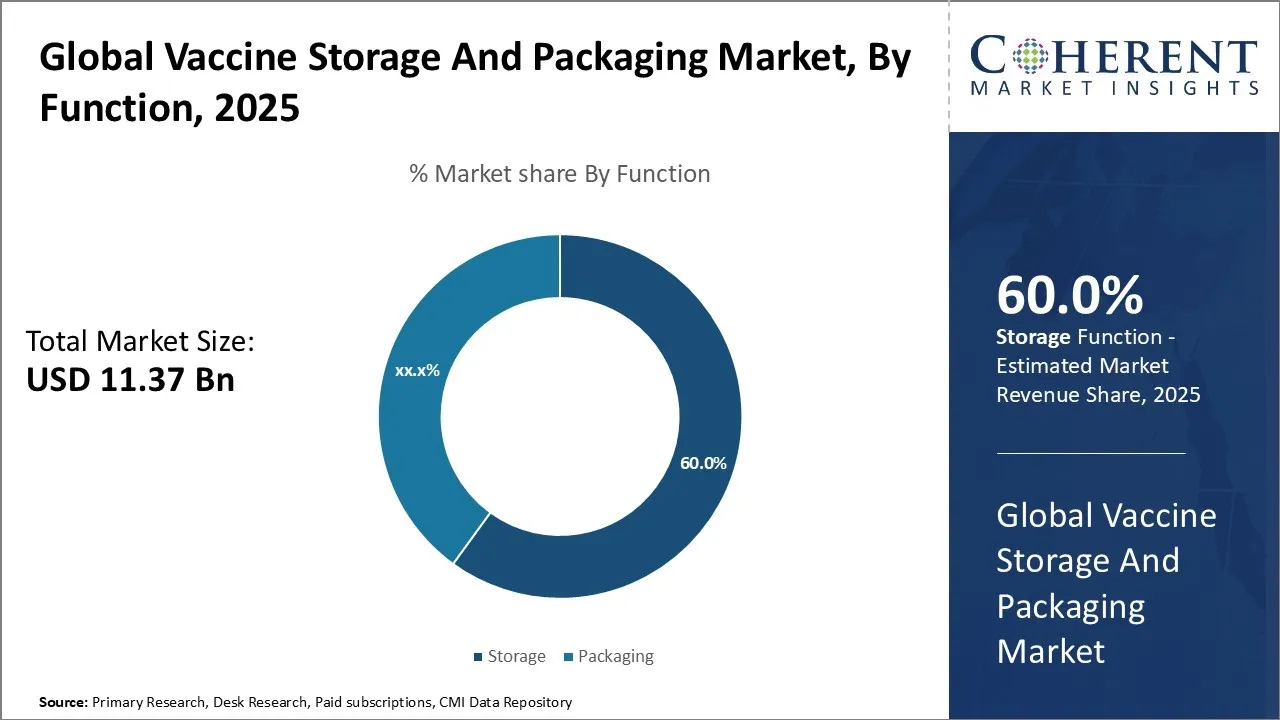
Vaccine Storage and Packaging Market Insights, By Function: Storage Segment Dominates the Overall Market
On the basis of function in 2026, the storage segment has accounted for the largest market share of 61% in terms of value. A proper storage and packaging of vaccines helps in protecting individuals and communities from vaccine-preventable disease. Along with that a vaccine storage improves vaccine’s shelf life and offers a convenient transport of vaccine worldwide. An adequate storage of vaccine ensures its efficiency and safety. The general standard for vaccine storage is to store it in a cold chain, maintaining a temperature between 2°C and 8°C.
In May 2024, Azerbaijan has made a remarkable progress in enhancing its immunization service in the last 3 years credited to a procurement effort, led by WHO and funded by the European Union (EU), to strengthen the country’s cold chain system through improved vaccine storage, transportation, handling and management.
Regional Insights
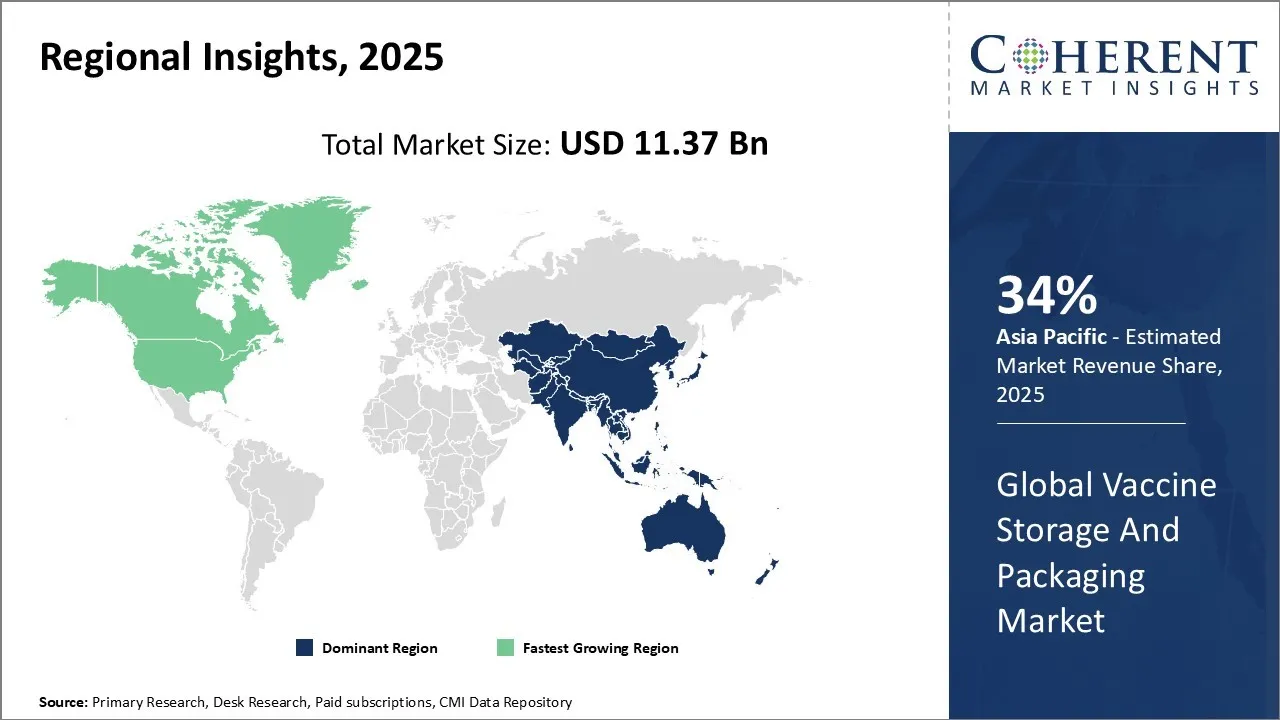
Asia Pacific Vaccine Storage and Packaging Market Analysis and Trends
Asia Pacific region dominated the Vaccine Storage and Packaging in 2026, accounting for a 34% share. Asia Pacific is dominating the vaccine storage and packaging market, primarily due to the expanding pharmaceutical manufacturing and increasing demand for vaccines. Aisa is the epicenter pf global vaccine manufacturing with India and China together supplying over billion doses annually. Additionally, Aisa Pacific has an emerging player in countries such as South Korea, Singapore, and Australia. These countries are investing in next-generation platforms and expanding capacity to meet the global demand. Along with that, the development of cold chain logistic infrastructure, further contributes to the growth of the market.
In April 22025, DHL Supply Chain launched a new €10 million Pharma Hub in Singapore, strengthening its Life Sciences and Healthcare (LSHC) logistics network across Asia Pacific. This facility is part of DHL Group‘s larger €500 million investment in the Asia Pacific region.
North America Vaccine Storage and Packaging Market Analysis and Trends
The North America region is considered to be the fastest growing during the forecast period in the global vaccine storage and packaging market. A robust healthcare manufacturing, high vaccination rates, stringent regulatory standards and well-established cold chain logistics system has fueled the growth for vaccine storage and packaging market. Over 90% of children are fully vaccinated against MMR (92.9%) and Hepatitis B (92.6%) by age 3. Nearly three-quarters (72.8%) of children completed the full combined 7 series vaccines before they turned 3 years old. According to Centers for Disease Control and Prevention, most adults with coverage from Medicaid and CHIP will be guaranteed coverage of all vaccines recommended by the Advisory Committee on Immunization Practice at no cost to them.
Vaccine Storage and Packaging Market Outlook Country-wise
India Vaccine Storage and Packaging Market Trends
The government of India is upgrading its vaccine storage infrastructure to aid other countries. India has the largest immunization programme. The Universal Immunization Program of India is the largest public health initiative, targeting a massive number of 2.6 crore children and 2.9 crore pregnant women annually through 1.2 crore vaccination session. The Full Immunization Coverage for FY 2023-24 Stands at 93.23% nationally. In March 2026, India planned to expand its national Cold Chain and Vaccine management Resource Centre into an International Centre for Excellence in Immunization and Supply Chain dealing with capacity building, vaccine management, research studies and management information systems.
The United States Vaccine Storage and Packaging Market Trends
The United States holds a significant position with substantial share in the vaccine storage and packaging market. The market in United States is driven by its highly developed cold chain infrastructure supported by government and private sector investment. According to IBISWorld, there were 2,466 refrigerated storages in the U.S. businesses as of 2024, which as increased by 4.2% from 2023. Along with that, the United States has a rapid growth in mRNA vaccine packaging, expanding of ultra-cold storage capabilities. The United States is primarily developing sue to the advancement in R&D in smart packaging and IoT-enabled vaccine monitoring system and increasing FDA oversight on biologics storage compliance. This is further accelerating the vaccine storage and packaging market demand.
Global Vaccine Storage and Packaging Market Drivers
Rising demand for packaging & storage of vaccine
Due to rising infectious and infections, there has been a high demand for vaccines over the globe, the market is anticipated to grow over the forecasted period. Growing development in vaccine R&D by medical institutions, healthcare, and pharmaceutical companies, as well as substantial involvement of the government in vaccination campaigns, have driven up the demand for vaccine packaging over the last years.
Due to rise in demand for immunization refrigerators is expected to drive the vaccine storage market. Companies engaged in the production of vaccine storage and packaging developing vaccine and immunization refrigerators owing to their ability to maintain the desired temperature for vaccines for up to 48 hours even without power. Moreover, the companies are also focusing on temperature-controlled refrigerators that are ideal for building an ecosystem for vaccine distribution, which is further propelling the vaccine storage and packaging market growth.
Market Report Scope
Vaccine Storage and Packaging Market Report Coverage
| Report Coverage | Details | ||
|---|---|---|---|
| Base Year: | 2025 | Market Size in 2026: | USD 12.73 Bn |
| Historical Data for: | 2020 To 2024 | Forecast Period: | 2026 To 2033 |
| Forecast Period 2026 to 2033 CAGR: | 12.0% | 2033 Value Projection: | USD 28.15 Bn |
| Geographies covered: |
| ||
| Segments covered: |
| ||
| Companies covered: | Corning Incorporated, Piramal Glass Private Limited, Schott AG, Amcor, AptarGroup Inc, DHL Group, FedEx, UPS, SF Express, and World Courier | ||
| Growth Drivers: |
| ||
| Restraints & Challenges: |
| ||
Recent Developments
- In May 2025, Takeda, a Japanese pharmaceutical company, planned to launch its dengue vaccine, Qdenga, in India next year in collaboration with Biological E. Clinical trials are underway, and the company aims to secure a license by 2026.
- In May 2025, SCHOTT Pharma, a global leader in drug containment and delivery solutions, and Serum Institute of India (SII), the world’s largest vaccine manufacturer, have announced that TPG, a leading global alternative asset management firm, will acquire a 35% stake in their joint venture, SCHOTT Poonawalla.
- In April 2025, the National Institute for Health and Care Research (NIHR) facility at University Hospital Southampton is conducting a trial that remains stable at room temperature has commenced its first human clinical trial in Southampton, UK. Developed by Stablepharma, the tetanus-diphtheria vaccine, designated SPVX02, eliminates the need for refrigeration or freezing, addressing significant challenges in global vaccine distribution.
- In February 2025, the federal government inaugurated a newly built solar-powered strategic vaccine storage facility in Sheda, situated along the Abuja-Lokoja Road in the Federal Capital Territory, with a capacity of 40 million doses.
- In January 2025, the researchers from Pennsylvania States University developed a groundbreaking advancement of a novel oil-based formulation that maintains the stability of protein-based drugs and vaccines at elevated temperature, potentially removing the necessity for cold-chain logistics. The new formulation utilizes a perfluorocarbon oil solution combined with a surfactant, enabling medicines to remain stable at temperature up to 100°C (212°F).
- In January 2022, Gelesheimer increased vial production capacity at its Wertheim plant and two other plants in China and the U.S. The company is investing in Wertheim's production to increase bottling capacity to 150 million bottles per year and plans to create 70 new jobs in the process.
- In October 2021, Becton Dickinson expands its production of injectable in the U.S. As flu vaccine season begins in the U.S. and patients receive their COVID-19 vaccines, he added production lines to safely operate injection equipment and stocked syringes at his Nebraska facility.
Analyst Opinion (Expert Opinion)
- South Africa's Biovac facility marks a turning point for African vaccine independence, this expansion of Biovac’s ultra-cold storage facility in South Africa is a significant step toward strengthening Africa’s vaccine autonomy. With the capacity to store up to 15 million Pfizer doses monthly at -70°C, this infrastructure not only supports local immunization efforts but also reduces dependency on European supply chains. More importantly, it lays the foundation for Africa’s emergence as a regional hub for mRNA vaccine production and distribution—an essential shift in the wake of global supply chain vulnerabilities.
- ASEAN’s Solar-Powered cold storage initiative sets a model for sustainable vaccine distribution under Philippines-led initiative to deploy solar-powered ultra-low temperature (ULT) units across island clinics in Southeast Asia is a noteworthy example of sustainable healthcare infrastructure. By reducing reliance on diesel generators by 60%, the program addresses both cost and environmental concerns. It also establishes a new standard for cold chain logistics in tropical regions, offering a replicable model for other developing economies aiming to modernize vaccine distribution in off-grid settings.
- Panama Canal drought highlights the fragility of global vaccine supply chains, the ongoing drought-related restrictions at the Panama Canal which have cut daily ship transits by one-third—underscore the vulnerability of global vaccine logistics. With fewer vessels able to pass through, Asia-Pacific markets are experiencing delays, prompting a surge in demand for localized cold storage hubs in Central America. This situation highlights the need for more decentralized vaccine storage infrastructure as a buffer against climate-related transport disruptions.
- Climate change is forcing a rethink of cold chain logistics projected global temperature rise of 2.8°C by 2040 presents a serious challenge for vaccine distribution networks. As heat exposure risks grow, cold chain operators must adopt smarter, more adaptable logistics solutions—such as IoT-enabled rerouting systems—to maintain temperature integrity. While this approach ensures reliability, it also brings a 25% increase in operational costs, signaling the need for significant investment in resilient, tech-enabled infrastructure across the pharmaceutical supply chain.
Speak to the analyst
Want personalized insights?
Take the findings above to one of our principal consultants, or have the report rebuilt around the segments, geographies and competitors you actually track.
Market Segmentation
- Global Vaccine Storage and Packaging Market, By Function (Revenue, USD Bn, 2021 - 2033)
- Storage (Storage Equipment and Service)
- Packaging (Packaging Material and Packaging Level)
- Global Vaccine Storage and Packaging Market, By Region (Revenue, USD Bn, 2021 - 2033)
- North America
- U.S.
- Canada
- Latin America
- Brazil
- Argentina
- Mexico
- Rest of Latin America
- Europe
- Germany
- U.K.
- Spain
- France
- Italy
- Russia
- Rest of Europe
- Asia Pacific
- China
- India
- Japan
- Australia
- South Korea
- ASEAN
- Rest of Asia Pacific
- Middle East & Africa
- GCC Countries
- Israel
- South Africa
- Rest of Middle East & Africa
- North America
- Key Companies
- Corning Incorporated
- Primal Glass Private Limited
- Schott AG
- Amcor
- AptarGroup Inc.
- DHL Group
- FedEx
- UPS
- SF Express
- World Courier
Sources
Primary Research Interviews from the following stakeholders
Stakeholders
- Interviews with vaccine manufacturers, cold chain logistics providers, pharmaceutical packaging companies, healthcare administrators, regulatory compliance officers, and procurement heads across global healthcare markets.
Databases:
- World Health Organization (WHO) Vaccine Market Dashboard
- UNICEF Supply Division – Cold Chain Equipment Inventory
- UN Comtrade Database
- World Bank Open Data – Health Sector
- Eurostat – Pharmaceutical Products Trade Data
- U.S. Centers for Disease Control and Prevention (CDC) – Vaccine Storage Guidelines and Data
- National Health Service (UK) Digital Health Data
- Ministry of Health & Family Welfare (India) – Immunization Logistics Reports
- European Medicines Agency (EMA) Cold Chain Reports
- U.S. FDA – Biologics and Packaging Regulatory Filings
Magazines
- Pharmaceutical Technology
- Cold Chain Management
- Packaging Digest
- PharmaTimes
- Healthcare Packaging
- BioPharma Dive
- Medical Packaging News
- Vaccine Nation
- Global Cold Chain News
Journals
- Vaccine (Elsevier)
- Journal of Pharmaceutical Sciences
- Journal of Cold Chain Management
- International Journal of Pharmaceutics
- Packaging Technology and Science
- American Journal of Infection Control
- Journal of Biomedical Materials Research
- Global Health: Science and Practice
Newspapers
- The Wall Street Journal – Healthcare & Pharma
- The Economic Times – Healthcare & Packaging
- Financial Times – Life Sciences & Logistics
- The Hindu Business Line – Pharma & Supply Chain
- South China Morning Post – Healthcare Innovations
- Nikkei Asia – Biopharma and Cold Chain Insights
Associations
- World Health Organization (WHO) – EPI & Vaccine Supply Chain Working Group
- International Air Transport Association (IATA) – Temperature Control Regulations
- Parenteral Drug Association (PDA)
- International Society for Pharmaceutical Engineering (ISPE)
- Healthcare Distribution Alliance (HDA)
- Global Cold Chain Alliance (GCCA)
- International Safe Transit Association (ISTA)
- International Pharmaceutical Aerosol Consortium (IPAC)
Public Domain Sources
- Ministry of Health (India) – eVIN (Electronic Vaccine Intelligence Network) Reports
- U.S. Department of Health & Human Services (HHS) – Vaccine Storage Protocols
- National Institute of Standards and Technology (NIST) – Cold Chain Equipment Standards
- European Centre for Disease Prevention and Control (ECDC)
- National Health Commission of China – Vaccine Infrastructure Reports
- Pan American Health Organization (PAHO) – Cold Chain Guidelines
- WHO PQS (Performance, Quality, Safety) Device Catalogue
- India Cold Chain Logistics Report – Ministry of Commerce
- African Union – Africa CDC Vaccine Delivery Data
Proprietary Elements
- CMI Data Analytics Tool, and Proprietary CMI Existing Repository of information for last 8 years
*Definition: Vaccine packaging is the process of securely packaging vaccines and medicines so that they keep their therapeutic potency from the time they are packaged. Vaccine packaging comprises vials, ampoules, prefilled syringes, and bags & pouches, which is the initial level of packaging. The vaccine is bottled in glass vials and suitably packaged for safe cold storage and transportation when it is manufactured in bulk quantities. Vaccine packaging must be capable of sustaining high temperatures as well as the risks associated with international distribution. As a result, the most frequent material used to make vaccine vials is glass, which is both resilient and capable of maintaining its integrity in severe temperatures.
Get access to 250+ pages report
Every segment, forecast, competitor profile and data table behind the analysis above — available for instant download.
- ESOMAR Member
- ISO 9001:2015 Certified
- D-U-N-S Registered
- GDPR & CCPA Compliant
Missing comfort of reading report in your local language? Find your preferred language:
Transform your Strategy with Exclusive Trending Reports
Frequently Asked Questions
The Vaccine Storage And Packaging Market is estimated to be valued at USD 12.73 Bn in 2026, and is expected to reach USD 28.15 Bn by 2033.
The market for Vaccine Storage and Packaging is estimated to surpass US$19.9 Bn by 2033, exhibiting a CAGR of 12.0% between 2026 and 2033.
Rising demand for packaging & storage of vaccines due to the pandemic are expected to drive the growth of the market and are major factors to drive the growth of the Market.
The CAGR of the Vaccine Storage And Packaging Market is projected to be 12.0% from 2026 to 2033.
Key Companies are Corning Incorporated, Piramal Glass Private Limited, Schott AG, Amcor, AptarGroup Inc, DHL Group, FedEx, UPS, SF Express, and World Courier.
High initial investments required for the setup of new companies to provide products and services in the pharmaceutical industry can hamper the growth of the market during the forecast.