Vibration Damping Chemicals Market Analysis & Forecast: 2026-2033

Vibration Damping Chemicals Market Size and Forecast – 2026 – 2033
The Global Vibration Damping Chemicals Market size is estimated to be valued at USD 1.85 billion in 2026 and is expected to reach USD 3.12 billion by 2033, exhibiting a compound annual growth rate (CAGR) of 7.9% from 2026 to 2033.
Global Vibration Damping Chemicals Market Overview
Vibration damping is the process of reducing or controlling unwanted oscillations in mechanical systems by dissipating vibrational energy, usually as heat. When machines, structures, or vehicles operate, they generate vibrations that can cause noise, discomfort, wear, or structural damage. Damping materials and devices absorb and reduce this energy, improving stability and performance. Common damping methods include rubber mounts, shock absorbers, viscoelastic materials, and tuned mass dampers. Vibration damping is widely used in automotive suspension systems, buildings, bridges, industrial machinery, and electronic equipment. Effective damping enhances safety, extends equipment lifespan, reduces maintenance costs, and improves overall comfort and operational efficiency.
Key Takeaways
Polymer-based vibration damping chemicals retain the largest industry share due to versatile application and cost-effectiveness.
Automotive remains the dominant sector, driven by the EV boom and stringent noise regulations.
Electronics are emerging as a fast-growing application due to the trend of miniaturization.
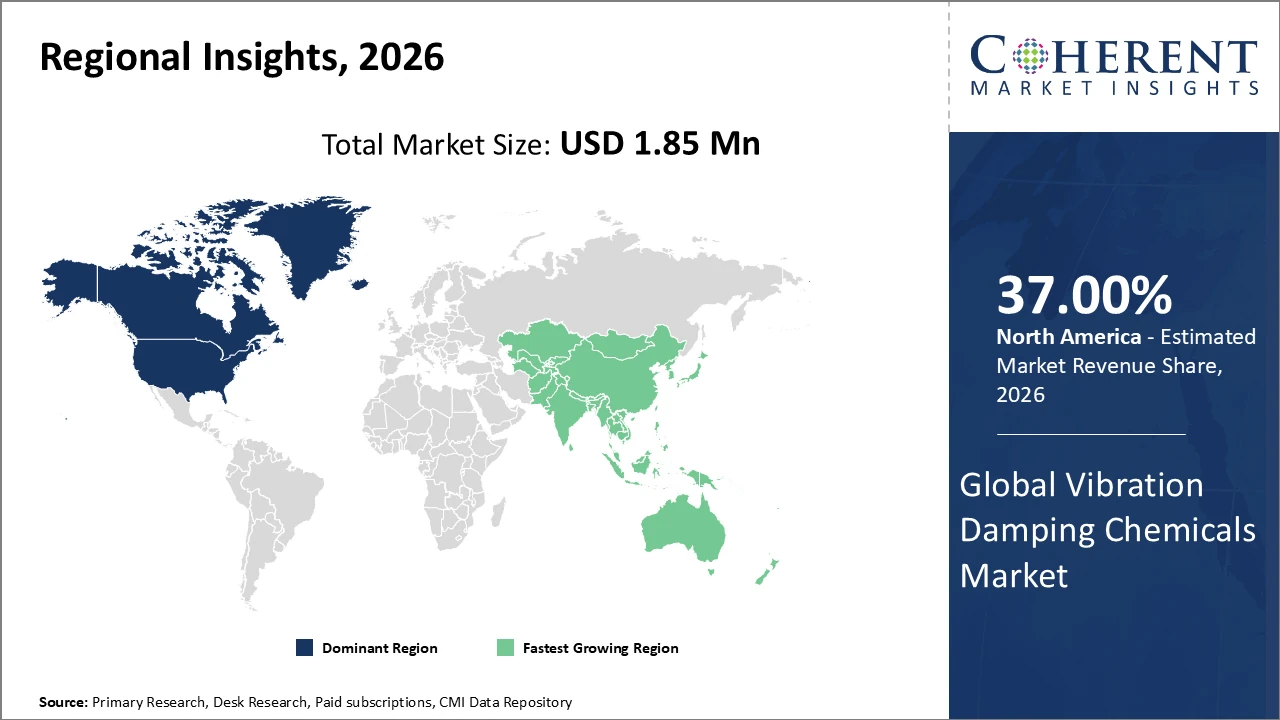
North America commands a leading market share, supported by strong automotive and aerospace industries and regulatory compliance.
Asia Pacific is the fastest-growing region, fueled by rapid industrial expansion, increasing manufacturing investments, and favorable government initiatives promoting technological upgrades in countries such as China and India.
Vibration Damping Chemicals Market Segmentation Analysis
To learn more about this report, Request Free Sample
Vibration Damping Chemicals Market Insights, By Product Type
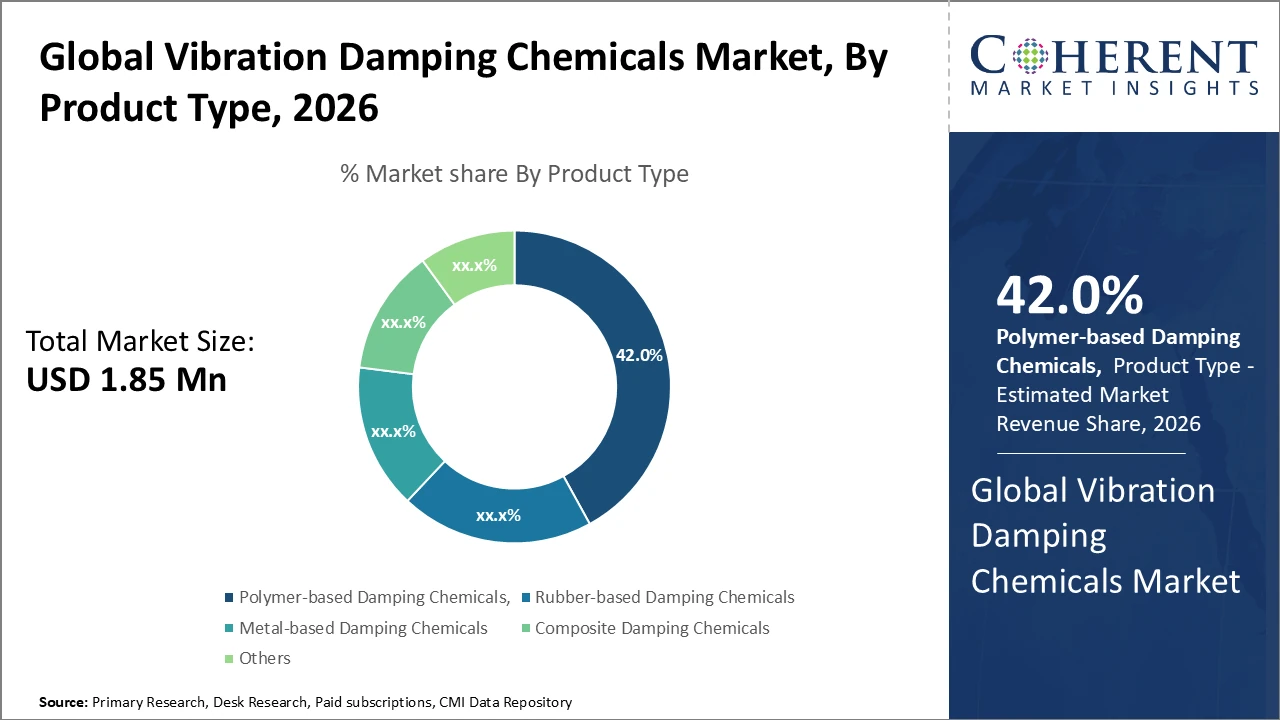
Polymer-based damping chemicals dominate the market share at 42%, due to their versatile performance, scalability, and cost efficiency, making them preferred across automotive, electronics, and industrial sectors. This segment benefits from continuous innovations such as nano-enhanced polymers that improve damping capabilities and thermal resistance. The fastest-growing subsegment is composite damping materials, gaining traction due to their superior mechanical strength and adaptability in high-performance applications like aerospace. Rubber-based damping chemicals primarily serve niche applications requiring elasticity and shock absorption, while metal-based chemicals focus mainly on high-temperature industrial machinery. Others include specialty formulations designed for bespoke industrial needs.
Vibration Damping Chemicals Market Insights, By Application
Automotive remains the dominating subsegment, driven by stringent noise and vibration compliance and the specific damping requirements of electric vehicles. The sector contributes significantly to market growth revenue due to large-scale manufacturing and replacement demand. Meanwhile, the electronics and electrical segment is the fastest growing, propelled by miniaturization trends that require advanced damping chemicals to protect sensitive components in devices such as smartphones and wearables. Aerospace continues to be a key application due to the critical importance of vibration control for aircraft performance and safety. Construction benefits from increased infrastructure development but remains relatively stable, while industrial machinery demands durable, high-temperature resistant damping chemicals for operational longevity. Other specialized sectors include marine applications.
Vibration Damping Chemicals de Market Insights, By Form
Liquids dominate the market due to their easier application methods and compatibility with numerous substrates across automotive and electronics manufacturing processes. Liquid formulations provide flexibility for coating and injection molding techniques and have benefited from incremental enhancements that improve curing times and environmental compliance. The paste segment is the fastest growing, driven by its superior bonding and vibration isolation capabilities in construction and industrial machinery sectors. Solid forms, although less prevalent, are used in high-performance aerospace dampers and specialized machinery. Other forms include hybrid and new material formulations designed to address unique market challenges.
Vibration Damping Chemicals Market Trends
The Vibration Damping Chemicals market is shifting towards multifunctional materials that combine damping performance with thermal conductivity or flame retardancy to meet diverse industrial needs.
The global rise of electric vehicles has driven innovation in specialized chemical formulations to address new vibration challenges.
In 2025, AkzoNobel launched a nanocomposite polymer damping chemical that improved vibration absorption by 17%, setting new performance standards.
Sustainability is a significant trend, with companies adopting bio-based and solvent-free formulations in response to global environmental policies.
Europe is a key region driving sustainable manufacturing practices due to recent regulatory mandates.
Vibration Damping Chemicals Market Insights, By Geography
To learn more about this report, Request Free Sample
North America Vibration Damping Chemicals Market Analysis and Trends
In North America, the dominance in the Vibration Damping Chemicals market is attributed to the well-established automotive and aerospace sectors, alongside stringent regulatory frameworks on noise and vibration limits. The U.S. leads with over 35% market share, supported by extensive industrial infrastructure and strong R&D capabilities hosted by prominent chemical manufacturers. Production and application capacities continue to expand, benefiting from government incentives that promote clean and energy-efficient vehicle technologies.
Asia Pacific Vibration Damping Chemicals Market Analysis and Trends
Meanwhile, the Asia Pacific region exhibits the fastest growth with a CAGR surpassing 9%, driven by rapid industrialization, large-scale automotive production hubs in China and India, and expanding electronics manufacturing. Government initiatives such as “Make in India” and “Made in China 2025” support local production and innovation in vibration damping chemicals, contributing to rising market revenue from both domestic consumption and exports. Leading companies have expanded local manufacturing capacities, enabling competitive pricing advantages and ensuring timely supply to meet growing regional demand.
Vibration Damping Chemicals Market Outlook for Key Countries
USA Vibration Damping Chemicals Market Analysis and Trends
The U.S. vibration damping chemicals market is driven by robust demand from the aerospace and automotive sectors, with electric vehicle production offering significant growth opportunities. Leading companies, including BASF SE and Dow Inc., have invested in specialized polymer-based damping solutions, expanding industrial capacities and accelerating technology adoption. Regulatory oversight by agencies such as OSHA and the EPA has further encouraged innovation in vibration control measures, ensuring compliance with strict noise and safety standards. These factors collectively reinforce the U.S. market’s leadership in both size and revenue, supported by advanced R&D capabilities, strong industrial infrastructure, and continuous technological advancements in damping materials.
Germany Vibration Damping Chemicals Market Analysis and Trends
Germany’s vibration damping chemicals market is shaped by its strong automotive, industrial machinery, and aerospace sectors, emphasizing high-performance and precision applications. The market benefits from stringent EU regulations on noise, vibration, and emission standards, driving demand for advanced polymer, rubber, and composite damping solutions. Continuous R&D by domestic and multinational chemical manufacturers focuses on multifunctional materials offering thermal resistance, flame retardancy, and eco-friendly formulations. The shift toward electric vehicles and Industry 4.0 manufacturing practices further fuels market growth. Sustainability trends, including bio-based and solvent-free chemicals, are increasingly adopted to comply with environmental policies, reinforcing Germany’s position as a technology-driven market leader.
Analyst Opinion
The rising emphasis on noise pollution control and workplace safety has significantly increased demand for vibration damping chemicals. For example, OSHA regulations in the U.S. enforced stricter noise limits at construction and manufacturing sites in 2025, boosting market revenue by over 8% year-over-year.
Supply chain resilience has improved, enabling manufacturers to maintain steady production despite global disruptions. Production of advanced polymer-based damping chemicals in Asia Pacific grew by 14% in 2024, meeting local and export demands and influencing market growth strategies for regional exporters.
The surge in electric vehicle manufacturing has accelerated adoption of vibration damping chemicals for quieter, more durable batteries and chassis components. Major North American EV producers reported an 18% increase in damping chemical integration in battery casings in 2026, highlighting sustained growth in this segment.
Regional import dynamics, particularly in Latin America, have shifted due to changing tariffs and trade policies. Brazil saw a 12% rise in damping chemical imports in late 2025, driven by industrial expansion and infrastructure upgrades, indicating emerging market opportunities.
Market Scope
| Report Coverage | Details | ||
|---|---|---|---|
| Base Year: | 2025 | Market Size in 2026: | USD 1.85 billion |
| Historical Data for: | 2020 To 2024 | Forecast Period: | 2026 To 2033 |
| Forecast Period 2026 to 2033 CAGR: | 7.9% | 2033 Value Projection: | USD 3.12 billion |
| Geographies covered: |
|
||
| Segments covered: |
|
||
| Companies covered: | BASF SE, Dow Inc., 3M Company, Covestro AG, AkzoNobel N.V., Arkema S.A., Solvay S.A., Hexion Inc., Mitsui Chemicals, Huntsman International LLC | ||
| Growth Drivers: |
|
||
Uncover macros and micros vetted on 75+ parameters: Get instant access to report
Vibration Damping Chemicals Market Growth Factors
Several critical growth factors have driven the sustained expansion of the vibration damping chemicals market. Rapid industrialization and urban infrastructure development worldwide have created urgent demand for effective vibration control to protect sensitive equipment and enhance structural safety. The automotive sector’s shift toward electric and hybrid technologies has increased the need for lightweight, durable damping chemicals to address new noise and vibration challenges in powertrains and battery assemblies. Rising environmental regulations aimed at reducing noise pollution in residential and industrial areas have further encouraged the adoption of advanced damping solutions. Additionally, advancements in polymer chemistry have enabled the development of highly efficient, environmentally compatible materials, creating new product niches and expanding market opportunities across multiple regions.
Vibration Damping Chemicals Market Development
In January 2025, Toray Industries, Inc. advanced its NANOALLOY technology to develop a nylon resin with four times greater vibration damping performance than conventional materials like butyl rubber. This new resin targets low‑frequency noise suppression in electric and autonomous vehicles, addressing key challenges in EV and high‑tech mobility applications.
Key Players
Leading Companies of the Market
BASF SE
Dow Inc.
3M Company
Covestro AG
AkzoNobel N.V.
Arkema S.A.
Solvay S.A.
Hexion Inc.
Huntsman International LLC
Mitsui Chemicals
Competitive strategies among key market players emphasize innovation through research and development, along with strategic acquisitions to strengthen regional presence. In 2025, BASF SE invested USD 150 million to develop eco-friendly polymer damping chemicals, which contributed to a 10% increase in its market share across European markets by 2026. Similarly, Dow Inc. expanded its presence in the Asia Pacific region by acquiring local manufacturing capabilities in China in 2024, leading to a 20% rise in output capacity for its core vibration damping chemical product lines.
Vibration Damping Chemicals Market Future Outlook
The vibration damping chemicals market is expected to witness steady growth driven by accelerating industrialization, expanding electric vehicle production, and rising demand for noise reduction solutions across sectors. Advancements in polymer science and composite materials will enable the development of high-performance, lightweight, and environmentally sustainable damping formulations. Increasing regulatory pressure on noise pollution and workplace safety will further stimulate product innovation and adoption. Emerging economies in Asia Pacific and Latin America are projected to offer significant growth opportunities due to infrastructure expansion and manufacturing investments. Strategic collaborations, capacity expansions, and sustainable product development will shape the competitive landscape in the coming years.
Vibration Damping Chemicals Market Historical Analysis
The vibration damping chemicals market has evolved steadily over the past decade, supported by expanding automotive production, growing industrial automation, and rising awareness of noise and vibration control standards. Initially driven by demand from conventional automotive and heavy machinery sectors, the market gradually diversified into electronics, aerospace, and construction applications. Advancements in polymer chemistry and composite materials significantly improved product efficiency, durability, and thermal resistance. Regulatory frameworks targeting workplace safety and environmental noise pollution further accelerated adoption. Additionally, globalization of manufacturing and supply chain development enabled wider distribution, while increasing R&D investments fostered innovation in high-performance and eco-friendly damping formulations.
Sources
Primary Research Interviews:
Polymer and specialty chemical manufacturers
Automotive OEMs and EV manufacturers
Aerospace component suppliers
Industrial machinery manufacturers
Construction material producers
Magazines:
Chemical Week
Adhesives & Sealants Industry Magazine
Composites World
Automotive World
Journals:
Journal of Sound and Vibration
Materials Today
Journal of Applied Polymer Science
International Journal of Mechanical Sciences
Polymer Engineering & Science
Newspapers:
Financial Times – Chemicals & Industrial Sector
The Wall Street Journal – Manufacturing & Automotive
Reuters – Chemicals & Materials
Bloomberg – Industrial Markets
Associations:
American Chemistry Council (ACC)
European Chemical Industry Council (Cefic)
Society of Automotive Engineers (SAE International)
European Automobile Manufacturers’ Association (ACEA)
Share
Share
Yash Doshi is a Senior Management Consultant. He has 12+ years of experience in conducting research and handling consulting projects across verticals in APAC, EMEA, and the Americas.
He brings strong acumen in helping chemical companies navigate complex challenges and identify growth opportunities. He has deep expertise across the chemicals value chain, including commodity, specialty and fine chemicals, plastics and polymers, and petrochemicals. Yash is a sought-after speaker at industry conferences and contributes to various publications on topics related commodity, specialty and fine chemicals, plastics and polymers, and petrochemicals.

Credibility and Certifications

860519526

9001:2015
27001:2022


Need a Custom Report?
We can customize every report - free of charge - including purchasing stand-alone sections or country-level reports
Customize NowJoining thousands of companies around the world committed to making the Excellent Business Solutions.
View All Our Clients