Healthcare Simulators Market Analysis & Forecast: 2026-2033
The Healthcare Simulators Market is estimated to be valued at USD 3.8 Bn in 2026 and is expected to reach USD 13.89 Bn by 2033, exhibiting a compound annual growth rate (CAGR) of 13.9% from 2026 to 2033.
The healthcare simulators market sells instruments that let healthcare workers practice in safe, controlled environments. It includes patient simulators, surgical simulators, task trainers, and virtual simulation platforms that are used by hospitals, schools, and the military. The adoption of simulation as a key part of modern healthcare education and clinical readiness is being driven by a growing focus on patient safety, the increasing complexity of medical procedures, the need for more training for the workforce, and the development of new technologies like virtual reality and artificial intelligence.
|
Current Events |
Description and its impact |
|
Geopolitical and Regulatory Developments |
|
|
Economic Trends and Healthcare Spending |
|
|
Regional Healthcare Infrastructure Initiatives |
|
Uncover macros and micros vetted on 75+ parameters: Get instant access to report
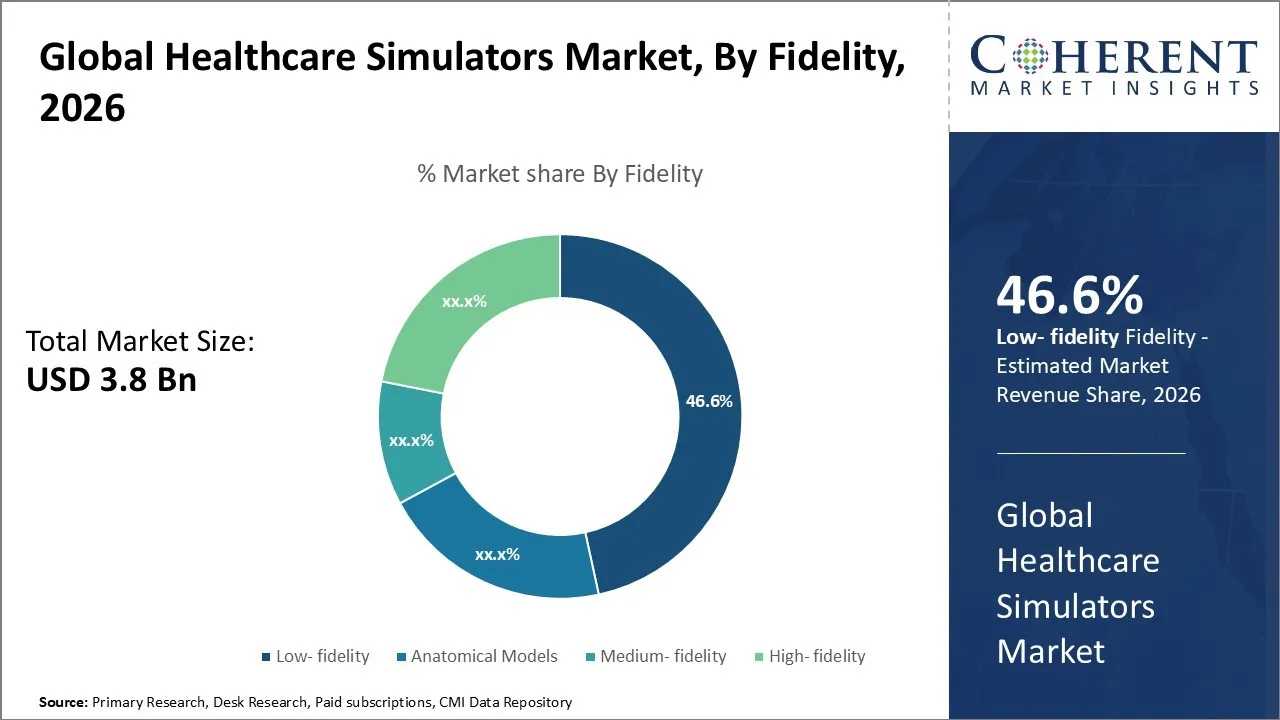
Low-fidelity expected to hold largest market share of 46.6% in 2026. Institutions that don't have a lot of money use low-fidelity healthcare simulators since they are cheap and easy to use. These simulators are used in training programs to teach fundamental clinical and procedural skills where extreme realism isn't needed. Their simple form makes it easy for students to practice over and over again, and it works well for large groups of students, especially in the early stages of medical school. Healthcare professionals also employ low-fidelity models to instruct pupils before they go on to more complex and complicated simulation systems.
Patient Simulation hold the largest market share of 36.6% in 2026. The healthcare simulators market promotes patient simulation by placing patient safety first and minimizing medical errors through safe, hands-on training. Healthcare providers utilize patient simulators to deal with the growing complexity of clinical procedures and to meet the requirements for competency-based education. These tools are very useful for hospitals and universities since they help people who don't have a lot of clinical expertise make better clinical decisions and work better as a team. Patient simulation is becoming more common in healthcare education because manikins and simulation software are getting better all the time.
For instance, in January 2024, Laerdal Medical has launched MamaAnne, a maternal simulator designed to improve simulation-based training and address leading causes of maternal morbidity and mortality.
Hospitals acquired the prominent market share of 43.3% in 2026. Hospitals drive the healthcare simulators market by using simulation technology to enhance patient safety and clinical outcomes. They train staff on complex procedures, improve decision-making, and strengthen teamwork. Simulators help meet certification standards, address skill gaps, reduce training costs, prepare personnel for crises, and adopt new technologies, making them essential for improving healthcare quality and operational readiness.
To learn more about this report, Download Free Sample
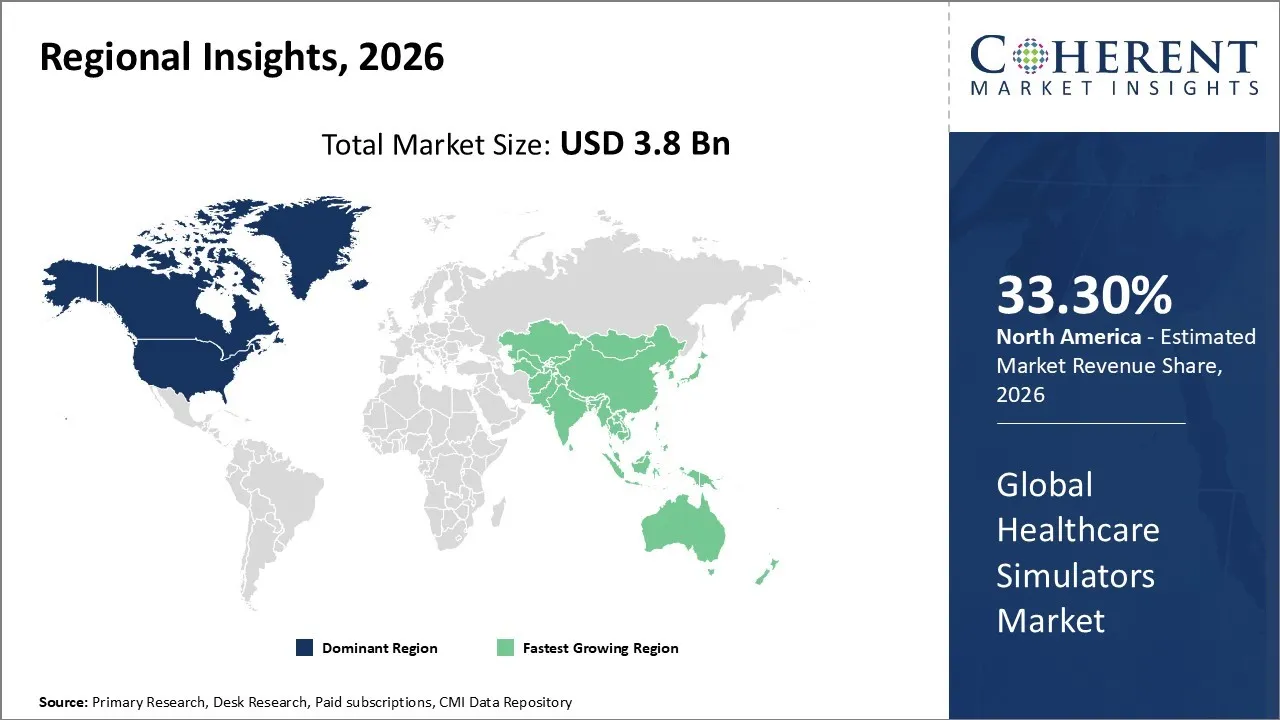
North America dominates the overall market with an estimated share of 33.30% in 2026. The market for healthcare simulators in North America is growing as hospitals and schools use high-fidelity manikins, VR/AR platforms, and complex simulation software to make clinical skills better and keep patients safe. Institutions employ immersive and remote simulations for competency-based training. Collaborative programs, mobile units, and government funding make it easier for more people to use simulations, which are now a key part of modern healthcare education and workforce readiness. For instance, in August 2025, the University of South Florida launched the world’s first university-based undergraduate concentration in Health Care Simulation Operations, focused on improving patient safety and care quality through advanced simulation technologies.
Healthcare facilities in the Asia Pacific region are using more simulation-based training to fill in skill gaps and make patients safer. They use digital and virtual tools, such mobile and cloud-based solutions, to make hands-on learning available to a lot of people. China, India, Japan, and South Korea all put money into their infrastructure and work with technology companies to help the region expand. They also promote immersive, interprofessional training to raise the quality of healthcare education. For instance, in September 2025, Shanghai-based Zhongshan Hospital, affiliated with Fudan University, inaugurated its Meta Medical Simulation Laboratory, marking a key step toward intelligent healthcare and expanded exploration of the meta-medical field.
Healthcare providers in the U.S. are the ones who buy the most simulators. They use VR, AR, and cloud-based platforms to improve clinical training and patient safety. Schools use simulation in their classes to help students learn how to make decisions, work as a team, and use their hands. Investments in infrastructure and partnerships with technology developers make it easier for people to get access to new ideas. This is why simulation is such an important tool for healthcare education and workforce training all over the country. For instance, in November 2025, Siemens Healthineers introduced AI-enabled services to help healthcare providers tackle challenges ranging from image interpretation to complex healthcare environment planning.
In India, medical schools, hospitals, and training institutes help the healthcare simulators market grow by using simulation-based teaching to improve clinical skills and keep patients safe. Schools are adding more simulation centers and using VR, AR, and AI to make instruction more immersive and scalable. Working with technology developers and national efforts encourages standardized, competency-based programs. This leads to new ideas, modernizes healthcare education, and creates a qualified workforce in both cities and rural locations. For instance, in October 2025, Chennai-based medtech company MediSim VR has launched Uttarakhand’s first Center of Excellence in AI- and VR-based medical simulation at the Himalayan Institute of Medical Sciences (HIMS), Dehradun.
More and more, the market is moving toward immersive technologies like virtual reality (VR), augmented reality (AR), and mixed reality platforms. Healthcare facilities use these tools to construct realistic, interactive settings where students can safely practice difficult operations and emergency responses. This trend makes simulation more flexible across fields including surgery, critical care, and inter professional teamwork by increasing engagement, speeding up skill development, and allowing for scenario customization. It also meets the changing needs of clinical training.
To make training more consistent and check for proficiency, medical schools, nursing programs, and hospitals are using simulation more and more in their classes. This movement focuses on learning through experience, which lets students practice making decisions, treating patients, and technical skills in safe settings. More and more schools are putting money into simulation centers and blended learning programs that mix traditional teaching with hands-on activities. This helps students remember what they've learned, feel more confident, and be more prepared for real-world clinical problems.
| Report Coverage | Details | ||
|---|---|---|---|
| Base Year: | 2025 | Market Size in 2026: | USD 3.8 Bn |
| Historical Data for: | 2020 To 2024 | Forecast Period: | 2026 To 2033 |
| Forecast Period 2026 to 2033 CAGR: | 13.9% | 2033 Value Projection: | USD 13.89 Bn |
| Geographies covered: |
|
||
| Segments covered: |
|
||
| Companies covered: |
Laerdal Medical, 3D Systems, Simulab Corporation, Simulaids, Inc., Kyoto Kagaku, Mentice, Medaphor, CAE Healthcare, Gaumard Scientific Company, Limbs & Things, BT, INC., Trandomed 3D, INC., Fujian Zhongli Co., Ltd., and Tellyes Scientific Co., Ltd. |
||
| Growth Drivers: |
|
||
| Restraints & Challenges: |
|
||
Uncover macros and micros vetted on 75+ parameters: Get instant access to report
Share
Share
About Author
Komal Dighe is a Management Consultant with over 8 years of experience in market research and consulting. She excels in managing and delivering high-quality insights and solutions in Health-tech Consulting reports. Her expertise encompasses conducting both primary and secondary research, effectively addressing client requirements, and excelling in market estimation and forecast. Her comprehensive approach ensures that clients receive thorough and accurate analyses, enabling them to make informed decisions and capitalize on market opportunities.
Missing comfort of reading report in your local language? Find your preferred language :
Transform your Strategy with Exclusive Trending Reports :
Frequently Asked Questions
Joining thousands of companies around the world committed to making the Excellent Business Solutions.
View All Our Clients
 Schedule a meeting with report Author