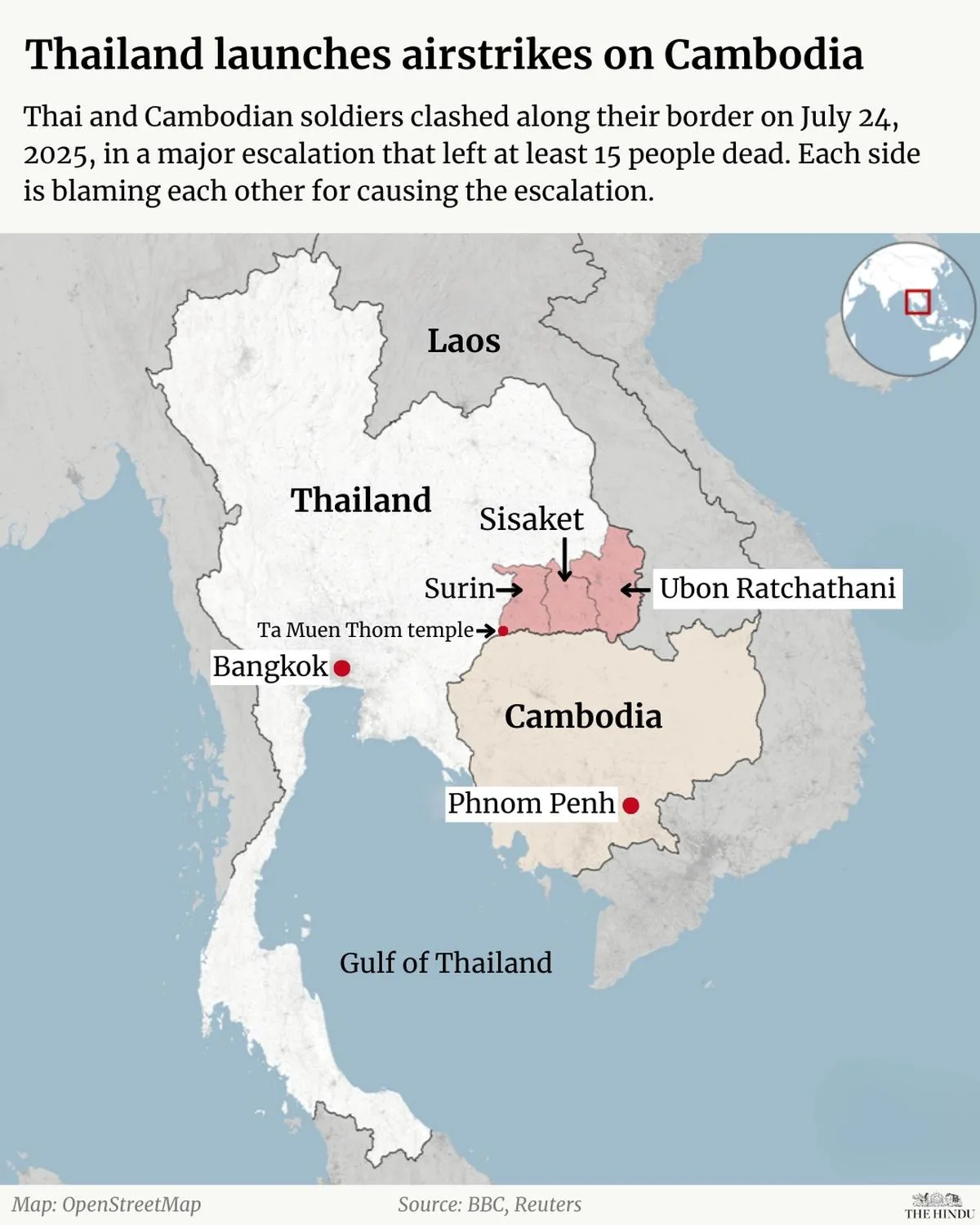
At the heart of Southeast Asia, where ancient temples whisper stories of shared history, two neighbors - Thailand and Cambodia ,once again find themselves teetering on the edge of conflict.
Thai border crisis: The recent Disputed Territory between Thailand and Cambodia are not just another headline in a busy world ; they’re a reminder that peace, no matter how scenic, is never guaranteed.
And now, voices on both sides whisper a word many fear to say aloud: War.
Border disputes are long-standing issues that have caused periodic tensions between the two neighbors. Thailand and Cambodia share more than 800 kilometers (500 miles) of land border.
Why are Thailand and Cambodia in war?
A Cluster Of Hindu Temples Is At Heart Of Thailand:
The Preah Vihear temple, a Hindu shrine devoted to Lord Shiva, dates back 900 years. It is situated on a 525-meter cliff in the Dangrek highlands of Cambodia. Constructed during the Khmer Empire, it serves as a place of worship for both Cambodians and their Thai neighbors. The Ta Muen Thom temple, a Shiva shrine from the 12th century, is located around 95 kilometers to the west.
Cambodia says Thai soldiers initiated the conflict when they violated a prior agreement by advancing on a Preah Vihear Temple:
A 11th-century temple in the disputed region, designated as a UNESCO World Heritage site by Cambodia, which Thailand strongly objected to.
The dispute between the two countries dates back to more than a hundred years ago, when the borders of the two nations were drawn after the French occupation of Cambodia.
Though the International Court of Justice (ICJ) awarded the temple to Cambodia in 1962, it did little to soothe nationalist sentiments on either side. In 2008, tensions reignited when the temple was listed as a UNESCO World Heritage site under Cambodia’s name. Since then, periodic violence has erupted, lives lost, homes destroyed, and communities uprooted.
Cambodia has accused Thailand of "brutal and illegal military aggression," including the use of heavy armaments and bombing on Cambodian soil.
How the dispute began
The dispute flared in May after armed forces of Thailand and Cambodia briefly fired at each other in a relatively small, contested border area that each country claims as its own.
This led to a series of tit-for-tat actions by both governments:
Both parties have held some discussions, but Thailand prefers bilateral discussions while Cambodia has expressed a preference for international legal intervention.
Internal political dynamics within both countries, including leadership transitions and domestic pressures, have also played a role.
Thailand imposed border restrictions with Cambodia, while Cambodia banned imports of fruit and vegetables, broadcasts of Thai films, and cut internet bandwidth from Thailand, among other measures.
Why the World Should Care- Economic Sanctions
It’s easy to dismiss this as a local border spat. But Southeast Asia is a region of rising economic importance, and peace here is critical for the stability of ASEAN and global trade routes. A war between Thailand and Cambodia wouldn’t just damage regional ties ; it would also fuel nationalist politics, displace tens of thousands, and risk drawing in allies.
In the short term:
- Insurance risk premiums are rising
- Tourism footfall is falling in eastern provinces
- Supply chains are on red alert
- Defense budgets may quietly expand
Border trade between Thailand and Cambodia, driven by agricultural goods, machinery, textiles, and construction materials. With even short-term instability, border logistics are disrupted. Already, reports indicate delays in truck movement.
If conflict escalates, cross-border supply chains could face a chokehold, impacting everything from Cambodia’s garment exports (which depend on Thai raw material imports) to Thailand’s agri-exports that move overland into Phnom Penh and beyond.