

If you have ever requested quotations from multiple battery suppliers, you have probably noticed something frustrating: most suppliers look similar on paper. They may offer comparable specifications, similar certifications, and even very close pricing. Yet after production begins, the differences often become much more obvious.
Some suppliers remain consistent as your order volume grows. Others struggle with lead times, batch consistency, documentation, technical support, etc. This is why opting for a battery supplier is rarely about finding the lowest price. It is about understanding which supplier is most suitable for your current business stage, risk level, as well as long-term goals.
A small distributor entering a new market usually evaluates suppliers differently from an industrial procurement team or an OEM manufacturer developing a long-term product line. The challenge is not finding suppliers—it is knowing how to evaluate them correctly for your specific situation.
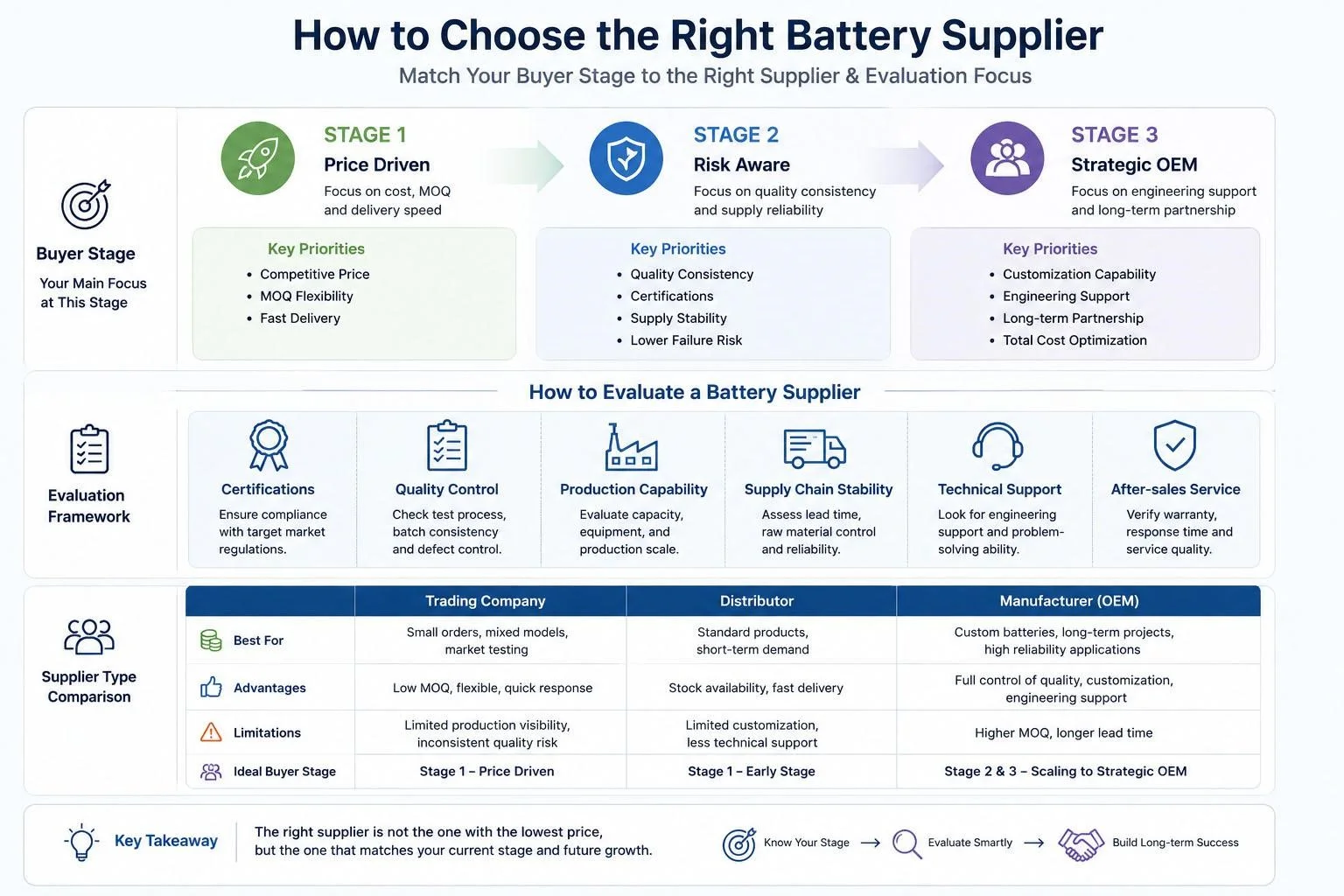
Battery supplier selection framework: buyer stages, supplier types, and evaluation criteria
The framework below is designed to help you identify which supplier model best fits your procurement stage, whether you are comparing trading companies, distributors, or OEM battery manufacturers.
Why This Guide Exists
If you’re currently comparing battery suppliers, the challenge is probably not finding enough options. Most buyers already have access to multiple quotations, product specifications, certifications, and supplier presentations. The difficult part is figuring out which supplier will still be the right choice once production starts, order volumes increase, and real-world problems begin to appear.
Many supplier comparisons focus on pricing, capacity, or certification documents. Those factors matter, but they seldom tell the whole story. The real challenge is analyzing how different suppliers work when facing delivery pressure, batch consistency requirements, technical support requests, long-term supply commitments, etc. This guide is designed to help you evaluate suppliers from a practical procurement perspective rather than relying only on surface-level comparisons.
This is why supplier directories and simple comparison tables often fail to support real purchasing decisions. In battery sourcing, success usually comes from opting for a supplier that matches your current business stage, quality expectations, technical requirements, as well as future growth plans and not simply the supplier offering the lowest quotation.
Buyer Stage Segmentation in Battery Procurement
One of the biggest misconceptions in battery sourcing is assuming that every buyer should evaluate suppliers using the same criteria. In reality, supplier selection often changes as a business grows. The priorities of a first-time importer are very different from those compared to an established distributor or an OEM manufacturer managing long-term production programs.
A supplier that appears expensive during early purchasing stages may later prove to be the most reliable alternative when larger orders, stricter quality requirements, as well as delivery commitments become critical. Understanding where you are in the procurement journey can aid keeping away costly mistakes as well as lead to better long-term supplier decisions.
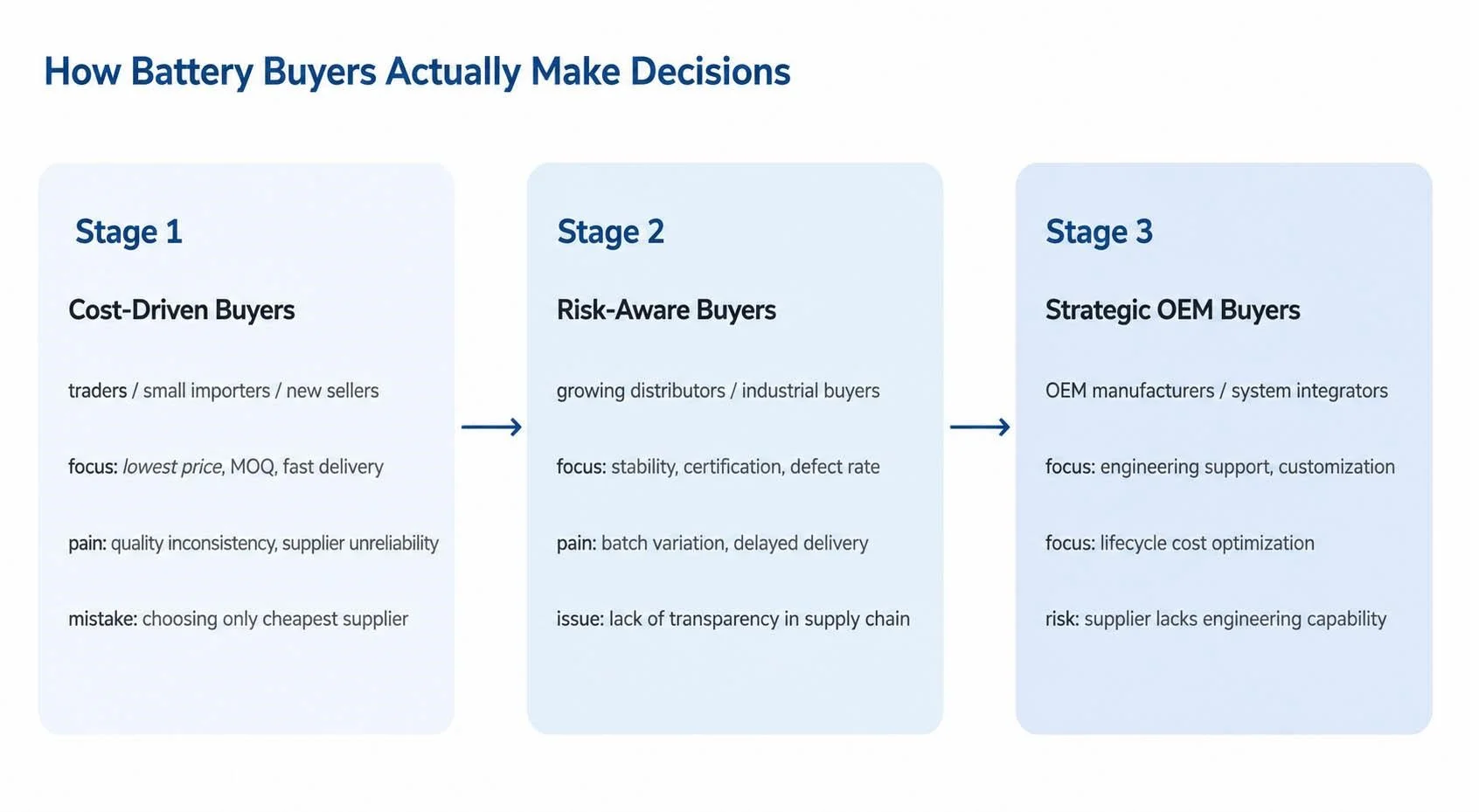
The following framework shows how decisions about battery procurement proceed through three different stages: buyers concerned with cost and MOQ, risk-conscious distributors interested in stability and certification, and finally, OEM buyers whose priorities are customization as well as engineering and lifecycle costs.
Stage 1: Entry Level Procurement
Buyers at this stage are often launching a new product, testing market demand, or placing relatively small orders for the first time. Budget limitations are usually a major concern, so pricing, MOQ flexibility, and delivery speed naturally become the primary decision factors.
Because purchasing volumes are still limited, many buyers focus heavily on quotations and sample performance. However, batteries that look nearly identical on paper can behave very differently once larger production orders begin and consistency becomes more important.
It is common for first-time buyers to assume that similar specifications automatically mean similar quality. In practice, differences in manufacturing control, material selection, and testing standards often become visible only after repeated shipments.
Key risk: focusing exclusively on upfront savings while overlooking future quality, consistency, and customer satisfaction risks.
Stage 2: Scaling Procurement Stage
At this stage, the buyers have already dealt with the suppliers previously and know about the problems associated with scalability. Late deliveries, nonuniformity of the products’ batches, lack of documentation, or even product quality concerns outweigh minor discrepancies in prices.
Purchasing decisions gradually shift from “Who offers the lowest price?” to “Who can consistently deliver what was promised?” Buyers begin reviewing certifications more carefully, asking about quality systems, and paying closer attention to long-term supply stability.
Production transparency also becomes increasingly important. Questions about testing procedures, batch traceability, and defect control often play a larger role than the quotation itself.
Key risk: assuming a successful sample order guarantees stable performance across future production batches.
Stage 3: Engineering-Driven Procurement
At this stage, batteries are no longer viewed as standalone products. They are part of a larger system, device, or commercial solution. Supplier selection therefore becomes closely connected to engineering, compliance, product development, and long-term business planning.
Buyers often consider the capability of the vendor to offer customized solutions, overcome technical difficulties, give engineering feedback, and adjust to changes. Cost is not an issue, although it does not have much weight in the final decision.
In many OEM projects, suppliers become long-term development partners rather than simple vendors. Their ability to support future upgrades, regulatory changes, and product expansion can significantly influence overall project success.
Key risk: selecting a supplier that can meet today’s specifications but lacks the technical depth required for future product development.
Supplier Type Comparison in Battery Procurement
When comparing battery suppliers, most buyers naturally focus on pricing first. However, after a few purchasing cycles, many discover that the lowest quotation rarely tells the full story. The more important question is whether a supplier’s business model can support your order volume, quality expectations, technical requirements, and future growth plans.
On the surface, a battery manufacturer, a trading company, an OEM factory, and a distributor may all provide similar quotations, specifications, and certifications. The real differences usually appear later—when you need faster technical support, customized products, repeat production consistency, certification updates, or assistance resolving quality issues.
This is why experienced buyers rarely ask which supplier type is “best.” Instead, they focus on which supplier model is the best fit for their current business stage and operational risks.
A trading company is not automatically a poor choice. For buyers who are still testing demand, sourcing multiple battery categories, or managing smaller order quantities, trading companies can simplify procurement and reduce the time required to coordinate with multiple factories.
The difficulty arises when the purchasing process relies heavily on consistency and control. With increasing volume of orders, the buyer wants more visibility into production processes, testing processes, quality data, and corrective action steps. In these cases, there may be communication barriers with indirect sourcing at times that cannot be easily identified at the quotation phase.
For industrial applications and OEM projects, battery performance directly affects the reliability of the final product. The more critical the battery becomes to your system, the more valuable it is to work with a supplier that can clearly explain how products are manufactured, tested, traced, and continuously improved over time.
OEM Factory vs Distributor: Which Model Fits Your Growth Stage?
Another common sourcing mistake is assuming that an OEM battery factory and a battery distributor provide the same value. In reality, they are designed to solve different business problems and support different stages of growth.
Distributors are often an efficient choice when you need proven standard products, faster delivery, or smaller purchasing quantities. OEM factories become more valuable when your project requires customization, long-term production planning, unique battery configurations, compliance support, or application-specific performance optimization.
If your current priority is speed and convenience, a distributor may provide exactly what you need. Many successful businesses begin this way. However, as sales volumes increase and product requirements become more demanding, buyers often discover that greater manufacturing visibility and engineering support become increasingly important.
Rather than asking which model is universally better, consider where your business is headed over the next few years. The supplier that fits a startup sourcing strategy may not be the same supplier that supports large-scale production, product customization, and long-term quality objectives.
In many cases, distributors help businesses move quickly during the early stages, while manufacturers and OEM factories become increasingly valuable as procurement priorities shift toward battery consistency, process control, engineering support, and long-term supply reliability.
Evaluation Framework for Battery Supplier Selection
Choosing a battery supplier is rarely as simple as comparing quotations and specifications. Most suppliers can provide datasheets, certifications, and sample products. The real challenge begins when orders increase, production schedules become tighter, and your customers start depending on consistent product performance.
The evaluation areas below are often where sourcing decisions succeed or fail. Many supply chain problems are not caused by a single major mistake, but by small risks that were overlooked during the supplier selection process.
Technical Capability
A battery’s real value is measured in actual application performance, not simply by the numbers printed on a specification sheet. Two batteries may advertise similar capacity and voltage ratings while delivering very different results once they are installed in real devices.
When evaluating technical capability, buyers should pay attention to factors such as cycle life consistency, discharge stability, temperature performance, and long-term reliability. These characteristics often determine how a battery performs months or years after deployment.
Risk outcome: batteries that perform well during testing but develop unstable runtime, faster degradation, or unexpected failures after large-scale deployment.
Quality Control System
Quality control is often misunderstood as a final inspection step. In reality, strong quality systems are built into the entire manufacturing process, from incoming materials to final shipment.
Buyers should look beyond inspection reports and ask how suppliers manage batch traceability, production monitoring, aging tests, and corrective actions. This becomes increasingly relevant as the order size increases and maintaining consistency becomes difficult.
Risk outcome: quality differences between shipments, rising field failure rates, customer complaints, and increasing warranty costs.
Certifications
Certifications including CE, UN38.3, IEC62133, RoHS, and other compliance documents are necessary for some markets, but they cannot be seen as an indicator of high-quality batteries.
Their main purpose is to confirm compliance with the transport regulations, safety standards, and other requirements. A company with all certifications will most likely help you avoid problems in the future and simplify your business process when expanding worldwide.
Risk outcome: shipment holds, customs issues, project delays, or restricted access to regulated markets.
Supply Chain Stability
Many buyers focus heavily on unit pricing while overlooking supply stability. However, when customer demand suddenly increases, reliable supply often becomes more valuable than small cost savings.
Consider how a supplier handles lead times, production scheduling, raw material availability, and capacity planning. A supplier that performs well during small orders may struggle when demand doubles or triples unexpectedly.
Risk outcome: delayed shipments, production interruptions, inventory shortages, and missed customer commitments.
Engineering Support
Engineering support becomes increasingly important as products become more specialized. Standard batteries are relatively easy to source, but customized solutions often require collaboration between purchasing teams and technical teams.
A capable supplier should be able to provide design feedback, recommend suitable battery configurations, assist with integration challenges, and support future product upgrades. This level of support can significantly reduce development time and long-term engineering costs.
Risk outcome: redesign delays, compatibility issues, increased development costs, and limited flexibility for future product improvements.
The strongest suppliers are rarely the ones that score highest in a single category. More often, they are the suppliers that maintain a balanced combination of technical capability, quality control, compliance support, supply stability, and engineering expertise as your business grows.