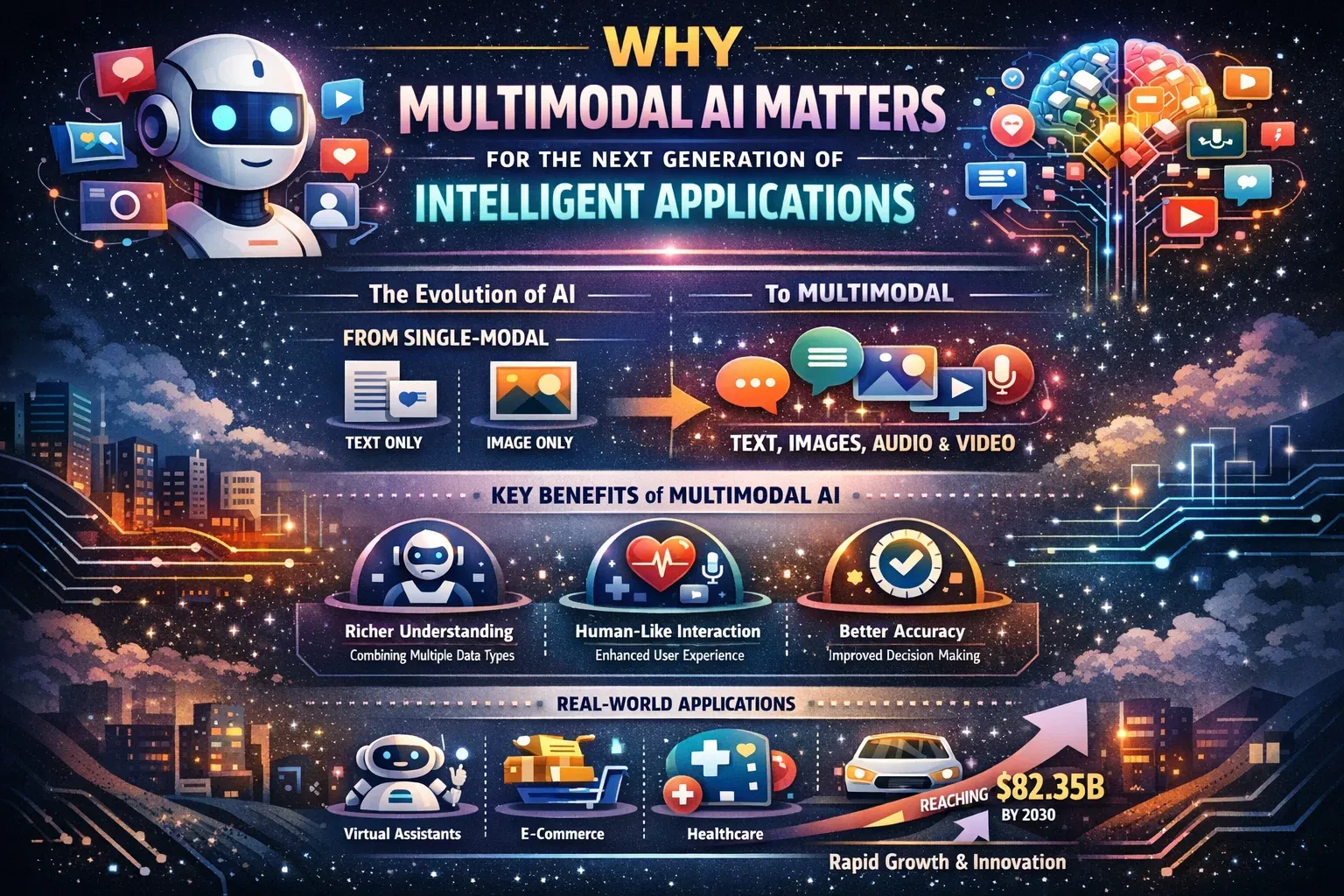
If we had told you a decade back that one single AI bot can write, answer questions, generate images and videos, be used for study, and solve mathematical problems, people would not have believed us. But this is the reality of the Multimodal AI. Artificial Intelligence has rapidly evolved from automation tools to sophisticated systems capable of making complex decisions.
With the intensification of the competition and more and more enterprises demanding more accurate and human-like AI models, thinking beyond the conventional AI models to gain differentiation becomes necessary.
Evolution of Multimodal AI
Traditional AI models relied on a single data input, such as either only texts or only images, which usually limits the extent of operations for organisations. As businesses do not operate in isolation, multimodal AI bridged the gap with its capability to process texts, images, audios, files, sensor data, and videos together. This allows smarter responses and intelligent applications that align with real-world problems.
Single-modal AI was effective in narrow scopes but could not understand the border signals. Advancements in deep learning, neural networks, and transformation architectures have enabled cross-modal learning and fusing multiple data types in a single framework. This helps in the evolution of AI systems that are context-aware and have human-like interactions.
These multimodal AIs helped in the expansion of chatbots into virtual assistants capable of processing images, videos, and audio. These multimodal AI assistants that can interact like humans and align more closely with the real-world business problems are preferred by the organisations and become important as businesses are ready to pay more for such models.
Organizations using multimodal AI systems in the day-to-day customer experience have reported 15% - 25% higher customer satisfaction using images, texts, and audios in a single interaction.
(Source: Codewave)
Limitations of Single-Modal AIs
When deployed in a complex, real-world environment, single modal AI struggles to interpret data given outside its understanding. The text-only system faces difficulty in processing visuals and audio.
Another significant limitation of single-modal AI is an increase in the error rate while making decisions due to the inability to process multiple data types. The text-only models will not process the visual data, and the visual-only models will fail to process the text and audio data. Such limitations create challenges for businesses to rely on the use of AI models for any purposes.
These limitations are the key drivers behind the increasing demand of enterprises for robust and multimodal AI that reduces the friction and can be more reliable for day-to-day operations.
Real-World Application of Multimodal AI Models
The capability of multimodal AI models to process multiple data formats has significant business relevance across industries in decision-making through diverse data sources.
The business is using AI models for generating texts, images, videos, and audio for both business promotion purposes and monetization purposes. AI models are being used for personalized shopping experiences and processing big data, data segregation, and simplification.