Ecommerce is brutal right now, as everyone's fighting for the same clicks, the same attention, the same conversions, and it only gets tougher as more brands crowd online. So how does a business stand out without turning the whole customer experience into one long sales pitch?
Artificial intelligence can pull some of that weight. Retailers are already leaning on AI to understand shoppers better, sharpen search, automate customer service, catch fraud, manage inventory, and just make smarter calls overall.
The artificial intelligence in e-commerce market is valued at USD 9.70 Billion in 2026, and is projected to reach USD 47.87 Billion by the end of 2033. During the forecast period from 2026 to 2033, the market is expanding at a CAGR of 25.7%. Thus, the growth outlook of the market is an indication of the rising usage of AI to uplift e-commerce business.
Here's a look at how AI is reshaping the way ecommerce actually works.
8 Revolutionary Ways AI Is Changing E-commerce
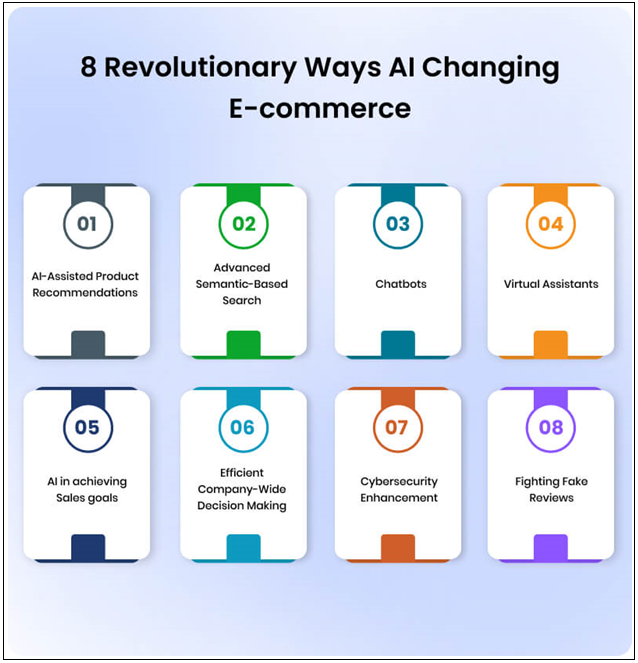
AI isn't stuck as some experimental side feature anymore. It's showing up everywhere, such as product discovery, search, customer support, sales, decision-making, security, review management, you name it.
As new technologies become more prevalent, here are eight practical ways the e-commerce industry is putting it to work.
-
AI-Assisted Product Recommendations
Shoppers get handed an overwhelming number of choices in ecommerce. Problem is that more choice doesn't automatically make shopping easier. Sometimes it just makes people give up and close the tab.
Older recommendation engines leaned mostly on past purchases or basic browsing history. AI pushes that further, digging into patterns across searches, clicks, purchases, preferences, and other little interactions to make recommendations that fit the individual shopper.
Machine learning leads the pack here, holding 48.4% of the artificial intelligence in e-commerce market in 2026. It's doing a lot of heavy lifting, such as predicting customer behavior, sharpening recommendations, adjusting pricing, catching fraud, and improving inventory calls.
What comes out of it is a storefront that works better. Instead of forcing every shopper to wade through the same giant catalog, AI narrows things down to what that one person is actually hunting for.
That ties into a bigger shift happening across ecommerce, which is of hyper-personalization. Additionally, retailers are using AI to shape the recommendations, promotions, as well as shopping experiences instead of depending on a one-size-fits-all storefront.
Key advantages
- Helps shoppers find what actually fits them in a sea of nearly identical options
- Picks up on what someone wants to buy before they've fully worked it out themselves
-
Advanced Semantic-Based Search
Old-school ecommerce search leans hard on the exact keywords. Type "running shoes" and it shows the product titles or descriptions happen to contain those exact words.
Semantic search flips that, as it tries to figure out what the shopper actually means. Some of the major semantic search engines are Autocomplete, Google Ngram Viewer, or Google Correlate.
Someone searching "comfortable shoes for standing all day" probably isn't naming a brand, a product, or some technical spec. An AI-powered semantic search system can pick up on the intent behind that phrase and surface products based on features, use cases, price, and context instead.
That makes for a much more natural shopping experience, since the customer never has to learn the exact vocabulary buried in a retailer's product catalog.
AI-powered search is also feeding into a broader move toward conversational shopping. Instead of typing a clipped keyword and scrolling through endless results, shoppers can increasingly just describe what they want in plain language and refine it through a back-and-forth conversation.
Key advantages:
- Picks up on small nuances, like whether a word is plural or how it's meant in context, that keyword matching tends to miss
- Combines search with predictive analytics to build a shopping experience that feels a lot more contextual
Customer service is probably the most obvious place where AI cuts down on repetitive grunt work. This is where chatbot for e-commerce becomes vital.
An AI chatbot handles the usual questions about orders, returns, shipping, product availability, and basic account stuff without needing a human to jump in on every single request. That makes shopping more convenient and frees up customer-service teams to focus on the trickier problems that actually need a human brain behind them.
But the tech is not stopping at simple question-and-answer bots. One trend that is picking up steam is agent-style shopping assistants that help customers discover products, weigh options, and get closer to actually buying something. E-commerce giants such as Amazon and Walmart are already leaning into these agent-style AI assistants as part of how the U.S. ecommerce is shifting.
The tricky part is knowing when to hand the conversation off to an actual person. A fast answer helps, but a confidently wrong one just makes things worse.
Key advantages
- Builds a smoother buying experience that nudges shoppers toward actually completing a purchase
- Affordable and easy to scale, which explains why it's caught on with giants like Amazon and thousands of other retailers
- Adoption keeps climbing, and it's shaping up to be one of the bigger shifts in ecommerce right now
Virtual assistants push the chatbot idea further, helping shoppers and merchants get things done instead of just answering questions. For shoppers, virtual assistants can effectively track an order, find the correct product, compare with other existing options, and provide solid recommendations that have higher chances of conversion.
For businesses, AI assistants are able to assist in monitoring listings, organizing information, summarizing the customer activities, along with handling the running of an e-commerce operation seamlessly.
This shift toward AI-assisted shopping keeps getting more visible across the competitive landscape. For instance, Amazon's shopping assistant, first known as Rufus, got renamed Alexa for Shopping back in May 2026, and it still leans on generative and agentic AI to help customers discover and size up products.
Furthermore, virtual assistants are turning into something closer to an interactive assistant helping the shopper get around.
Key advantages
- Works like a personal assistant for smaller businesses, handling routine tasks efficiently
- Keeps tabs on order status, tightens up listings, and helps build a more consistent shopping experience overall
-
AI in Achieving Sales Goals
AI can also assist e-commerce businesses in making efficient sales decisions. Instead of taking a perfunctory glance at the sales numbers of the previous day, businesses can now dig into the customer behavior, understand the purchasing history, the browsing activity, campaign performance, as well as other indications on what the customers may want next.
That feeds into targeted promotions, pricing, product recommendations, and demand forecasting. Nobody's expecting perfect predictions here. The goal is giving businesses a solid basis for deciding where to actually put their time and money.
Meanwhile, another lucrative segment of the artificial intelligence in e-commerce market is the B2B segment, which holds a leading revenue share of 57.6%. A greater number of B2B companies are utilizing AI to automate the orders, personalize customer interactions, forecast demands, along with optimizing supply chains as well as fine-tuning pricing.
Furthermore, for an online business, AI will continue to assist in helping reach the sales goal as well as bolster them as it is proactive in reacting to sales data, and allows ample time for a business to act. Software such as REVE Chat utilizes artificial intelligence to forecast the future sales based on customer patterns and plays a key role for the company in predicting results of their marketing efforts.
Key advantages
- Forecasts future sales based on customer patterns, helping companies predict the results of their marketing efforts before the numbers come in
- Surfaces statistics that support sharper, faster decision-making
-
Efficient Company-wide Decision Making
AI's benefits don't stop at the storefront. Businesses can use it to pull together information scattered across different parts of the organization and spot patterns, anomalies, and connections that are nearly impossible to catch by hand. That feeds into inventory, marketing, customer service, logistics, pricing, basically every operational decision going.
For instance, a sudden spike in product searches paired with dropping inventory could be a signal to reorder before shelves go empty. A rise in customer-service complaints tied to the same product might point toward something off with its description, quality, delivery, or usability.
A recent PwC study showcased 82% of companies that are expected to increase AI investment in the next 2 years. Initiatives such as Google’s DeepMind and Facebook’s FAIR LAB are an indication that the tech giants investing majorly in AI research.
Deployment choices come into play here too as on-premises AI at 59.6% of the market in 2026, with security, control, customization, and integration among the reasons businesses stick with it.
The competitive scene keeps showing how deep AI is sinking into ecommerce operations. Amazon keeps expanding its AI-powered shopping through tools like Alexa for Shopping and various product-discovery features. PayPal rolled out agentic commerce services letting merchants build AI-powered shopping experiences where customers can discover products, manage carts, and complete purchases through AI interactions. Meanwhile, within the Generative AI market, some of the other key players are AntVoice SaaS, Appier Inc., Celect Inc., Crobox B.V., Granify Inc., Deepomatic SaaS, and more.
The trends indicate that AI is increasingly becoming part of the operating layer running e-commerce, and it has moved beyond being a feature on a website.
Key advantages
- Gathers data from across the company and compares it against structured databases to catch patterns, outliers, and anomalies in real time
- Makes sense of behavioral trends across different stakeholders, helping teams understand what's actually behind an unexpected sales spike, a dip, or some other anomaly
-
Cybersecurity Enhancement
The increasing percentage of online transactions also is an indication that there are greater vulnerabilities to fraud, account abuse, as well as cyberattacks. AI assists the e-commerce businesses in spotting unusual behavior, map suspicious transactions, and then catch activities that may signal an attack or compromise a user account.
Such proactive defensive maneuvers are vital as the threat of fraudulent behavior is not static. Static rules struggle once attackers change tactics, while machine-learning systems can be trained to recognize broader behavioral patterns instead of chasing one narrow rule at a time.
Security keeps getting more important as ecommerce edges toward AI-assisted shopping. Once AI agents start interacting with products, accounts, payments, and checkout flows, businesses need systems capable of telling legitimate activity apart from the fake stuff. Thus, AI is expected to bolster cybersecurity.
Riskified's expanded AI Agent Intelligence platform tackles this by helping merchants protect their native AI shopping assistants from fraud and abuse.
Key advantages
- Catches cyber breaches fast, which is why so many ecommerce sites already lean on it for protection
- Helps guard websites and shopper accounts against hackers and bad actors
Fake reviews are a major cause of concern for e-commerce platforms because the shoppers are reliant on ratings and user feedback when they make the decision to buy a product. Traditional moderation tends to struggle once the fraudulent accounts become more sophisticated or find the ability to mimic customer behavior closely enough to evade defenses.
AI assists an e-commerce business here by analyzing account behavior, language, posting patterns, review timings, and other parameters that can signal the potential of fraudulent activity. Natural language processing and machine learning working together can catch suspicious reviews and accounts that older systems would miss.
This isn't only about scrubbing bad reviews off a page. It's about protecting the credibility of the information shoppers rely on to make purchasing decisions in the first place.
Key advantages
- Combines natural language processing and machine learning to detect fake reviews and flag potentially fraudulent accounts
- Makes it much harder for malicious users to simply tweak their behavior and dodge detection
Why Is Ecommerce Artificial Intelligence Important?
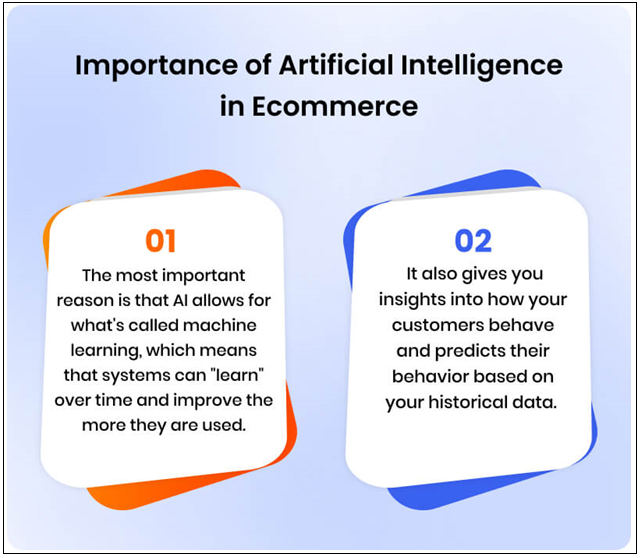
Ecommerce businesses operate in a world where customer expectations shift fast. Shoppers want relevant recommendations, quick answers, painless search, smooth checkout, reliable service, the works. Meanwhile, businesses are trying to keep costs in check while juggling increasingly tangled digital operations.
AI ties a lot of that together, such as machine learning digs into customer behavior and sharpens recommendations. Semantic search makes product discovery less of a chore. Chatbots and virtual assistants knock out routine questions. Predictive systems help with inventory and sales planning. Fraud-detection tools keep transactions safer.
North America holds the largest regional share at 40.8% in 2026 in the artificial intelligence in e-commerce market. In the U.S. market, which is leading in North America, ecommerce businesses are leaning on AI for advanced search, customer assistants, dynamic pricing, automated inventory, as well as for personalized product discovery, giving the tech a growing footprint in both customer-facing and behind-the-scenes work.
Another trend worth highlighting is the transition to full agentic commerce, where the AI systems participate completely in product discovery as well as for purchasing instead of merely making suggestions. PayPal's 2026 agentic commerce products are one piece of the infrastructure being built around that shift.
There's also a separate trend blending AI with augmented reality for more immersive shopping. The AI-AR integration is a development that can support virtual try-ons and other interactive experiences, especially in mature ecommerce markets.
The better question at this point isn't whether an ecommerce company should bother with AI. It's figuring out where AI actually removes friction or builds a better experience instead of just piling on more complexity.
Summary
Artificial intelligence is reshaping ecommerce from the inside out, and driving customer experience.
It helps businesses understand customers better, recommend products that fit, sharpen search, automate support, forecast demand, tighten security, and catch fake reviews before they do damage. It also helps retailers react faster the moment customer behavior shifts.
But AI only earns its keep when it solves an actual business problem. Bolting on another chatbot or recommendation engine just because a competitor has one won't automatically make an ecommerce business better.
The strongest use cases are the ones that make shopping easier for customers and everyday work easier for the people actually running the store.

