In every minute, more than 2.3 million searches are conducted on Google. On almost every search on Google, users see ads along with organic search results. These ads are an extremely effective strategy to target new as well as active consumers, readers or clients.
It means with Google ads you can also target new buyers or audiences, only if your text for ads speaks to the intent of customers. But, you may not know the techniques to write successful online text for Google Ads. We compiled this post, to make you learn the best ways to do so.
That intent-matching challenge is exactly what's fueling how much businesses now spend on the software behind ad copy and campaign management. The global digital marketing software market is estimated to be valued at USD 17.85 Billion in 2026 and is expected to reach USD 37.94 Billion by 2033, growing at a compound annual growth rate of 11.2%, as more advertisers lean on dedicated digital marketing software rather than writing and testing ad copy by hand.
The Best Ways to Write Successful Online Text For Google Ads
1. Resonate Your Target Audience
For successful writing of online text for Google ads, it should resonate with the target audience. You can do so by knowing the below points:
- Who is your target market?
- What do consumers anticipate from your company?
- What are the requirements of your target demographic?
- What are their tastes?
Knowing the answers to these questions will help you to come up with such type of language tone, products, and services that people need.
Answering questions like these by hand only scales so far, which is a big reason AI-driven personalization keeps showing up as one of the strongest trends across the digital marketing software market. Growing e-commerce activity and mobile usage are accelerating demand further, and privacy-compliant targeting technologies are increasingly built directly into ad platforms rather than bolted on afterward, since advertisers still need to reach the right audience even as third-party tracking keeps getting restricted.
2. Create a Compelling And Descriptive Headline
A headline is considered the most vital part of the online text for Google ads. This determines whether the users/searchers will click your ad or not. Below we covered some points to be followed for writing effective headlines:
- You should write descriptive headlines that reflect the whole essence of your products or services.
- Naturally embed the primary keyword in the headlines of ads.
- The headlines should grab the attention of readers. For this, we suggest to embed some compelling or enchanting words. For example; Innovative, Dynamic, Revolutionary, etc.
- The headlines should not be wordy but possess a power conciseness. Moreover, the ad headlines should not exceed the optimal limit i.e. 30 characters.
- In this case, if you write more than one headline for a Google ad, they should resonate with each other.
Practical Example:
If your small business sells wristwatches, then your headlines should be like this;
- "Wrist Watch for Sale"
- "Find Your Perfect Time Partner"
- "Buy Our Collection"
Retail and e-commerce advertisers, in particular, represent one of the biggest growth opportunities inside the digital marketing software market, followed closely by BFSI and healthcare, since all three sectors depend heavily on getting a headline right the first time a shopper sees it. That's part of why so much of the recent investment in this market has gone toward tools that test dozens of headline variations automatically rather than relying on a single writer's best guess. A small business selling wristwatches, to use the example above, could realistically test all three sample headlines against real traffic within a day or two, rather than guessing which one performs best.
3. Use Persuasive Words
For successful advertising, its content must be convincing or promotional. And to make such a type of text, you are required to utilize persuasive words. By persuasive words we mean; the words that are influential, convincing and urging for readers. They are useful to make the content compelling.
For Example: Rare, Exclusive, Premium, Efficient, etc.
Following are some helpful tips in this perspective:
- You should not focus on just adding persuasive words but keep an eye on their context also. Your embedded words should not do any harm to the intent of the text.
- Persuasive words work better when used at the very start of the sentences.
- Don’t do stuffing of the words but retain normal words also.
And so on…
Getting that balance right in a way that is persuasive but not overdone is easier when the testing happens in a dedicated platform rather than by eye, which is part of why so much of this market’s spend flows toward software built specifically for that job.
This is where the tools segment of the market actually breaks down. By type, software accounts for the largest share of spend, since most advertisers now run their persuasive-copy testing and analysis through a platform rather than a spreadsheet. Within software specifically, CRM tools hold the single biggest slice, tied closely to email marketing and content management tools that share data with whatever's driving the Google Ads copy itself. Cloud deployment leads by a wide margin too, since it lets a small business test persuasive language just as easily as a large enterprise running dozens of campaigns at once, without either one needing to install anything locally.
4. Insert Keyword
Keywords are the queries or terms typed by people into the search bar of Google to reach what they want. It is useful to insert keywords in the text for ads to show their relevance to the search queries.
Below are some strategies to know for inserting keywords in the online text:
- You should embed the "Focus Keywords" in Headline and Description.
- Try to target those keywords that have sufficient monthly searches. Another, factor to keep in mind is the low "KD" (Keywords Difficulty).
- It is not mandatory to make your text oriented for just a single keyword. But, for targeting more search queries you can use other keywords also. However, that should slightly match the primary keyword. Such terms are known to be LSI keywords.
- Avoid keyword stuffing but maintain their density within optimal range i.e. 1-2%.
Keyword research tools are their own meaningful slice of this market, and they tend to grow fastest alongside SEO and content-optimization software, since a keyword that works in an ad headline is often one that's already ranking organically. North America currently leads spend on this kind of software, helped by advanced technology infrastructure and heavy digital advertising budgets, with U.S. advertisers in particular investing early in AI-assisted keyword and copy tools rather than waiting for the technology to mature further. That head start shows up directly in how quickly new keyword features tend to reach U.S.-based accounts first.
5. Make an Appealing Description
A description is where you delve into the details of your products and services. Make sure, your product descriptions are professionally written to win the hearts of readers.
Below are some tips to craft optimized and appealing descriptions:
- You should utilize comprehensible and simple-to-read words and sentences in the description.
- Try to use some innovative or fresh terminology that can engage your readers.
- Make a strong connection between the sentences of the descriptions. This is a useful tip to make descriptions fluent and coordinated.
However, doing all the above adjustments for descriptions is not a child's play. And you may sometimes have to spend a lot of hours and consume calories. In this scenario, you can use rephrase online for write descriptions of Google ads with the help of a rephrasing tool. The tool will automatically uplift their quality and optimize their terminology to an engaging level.
Practical Example:
We crafted the below Google ads description. You can see that is not appealing or attractive. To make them captivating and influential, we rephrased them through a paraphrasing tool. The tool made multiple alterations and gave us top-notch descriptions.
Original Descriptions:
"Browse our stunning Schmuck collection created by artisans. Our opulent pieces, radiate timeless elegance. Savour sophistication right now."
Into
Rephrased Descriptions:
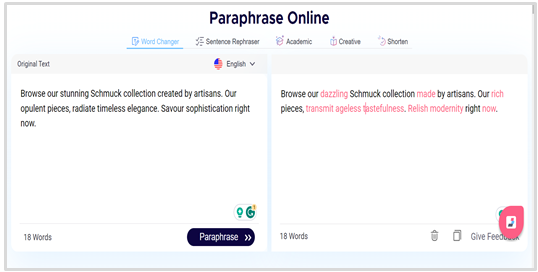
"Browse our dazzling Schmuck collection made by artisans. Our rich pieces, transmit ageless tastefulness. Relish modernity right now."
6. Add A Call To Action
While writing an online text for Google ads, it is a good strategy to include a "Call to Action". By a call to action, we mean a sentence or phrase that creates an urgency for buyers. It tells what to do after going through your Google ads.
For Example:
- "Subscribe and Save"
- "Sign Up Now"
- "Reserve Your Spot"
You should make the CTAs as concise as possible. Moreover, they should be rich in action words.
Knowing which action words actually make people click is not something you have to guess anymore. It is the software behind these campaigns that tests and measures directly.
Adobe, HubSpot, Microsoft, Oracle, Salesforce, and SAP are among the companies most active in building the software behind campaigns like this, spanning everything from headline and description testing to the analytics that eventually tell an advertiser which call to action actually converted. Their continued investment, alongside a steady stream of smaller AI copywriting specialists, is a big part of why the tools available to write and test Google Ads copy today look meaningfully more capable than they did even two or three years ago.
Conclusion
Running successful Google ads is a great strategy to attract new customers from the market. However, it is only possible when you write compelling, engaging, and persuasive text for the ads. To write such quality online text for Google ads, we covered the best ways along with the expert tips to deploy them.
With the digital marketing software market on track to more than double by 2033, the tools supporting each of the steps above are only going to keep improving, which makes now a reasonable time to build these habits rather than relying purely on instinct for every new campaign.

