Customer experience (CX) is a department that exists in companies to create a positive customer journey from awareness to post-purchase. But the job is overwhelming to not just customer support agents but the company as well.
Agents spend half their day copy-pasting the same replies, and if someone calls in sick, the whole queue backs up. You think about hiring more people, but that takes time, costs a lot, and honestly just pushes the problem down the road.
This is where AI customer support agents come in. They take over the routine stuff, like answering common questions, keeping track of conversation history, and pulling in real-time data to actually resolve issues, not just respond to them.
The customer experience management market is expected to reach a valuation of USD 39.05 Billion by 2033, as per a Coherent Market Insights report. It can exhibit a CAGR of 13.6% over the forecast period (2026-2033).
We went through a lot of options and narrowed it down to 7 AI customer support agents that do a solid job of helping you scale without letting service quality take a hit.
Ready? Let's go.
AI Customer Support Agents at a Glance
|
Tool
|
Best For
|
Key Advantage
|
|
Hugo
|
Teams needing full automation without platform dependencies
|
Standalone agent with AI model flexibility and transparent pricing
|
|
Fin
|
Businesses wanting high-resolution AI across omnichannel support
|
Patented AI engine with complex query handling
|
|
Breeze Customer Agent
|
Teams wanting to add AI to their HubSpot CRM ecosystem
|
CRM-integrated AI across marketing, sales, and service
|
|
Freddy AI
|
Businesses needing quick deployment with pre-built workflows
|
Ready-to-deploy vertical AI agents with 50+ workflows
|
|
Forethought
|
Enterprise teams handling high-volume complex support
|
Fully agentic multi-agent system trained on historical data
|
|
Chatbase
|
Teams building custom AI agents trained on their own data
|
Purpose-built for LLMs with no-code simplicity
|
|
Ada
|
Large enterprises needing 300,000+ annual conversations
|
Agentic Customer Experience model with Reasoning Engine
|
1) Hugo - Standalone AI Agent with Deep Integration and AI Model Flexibility
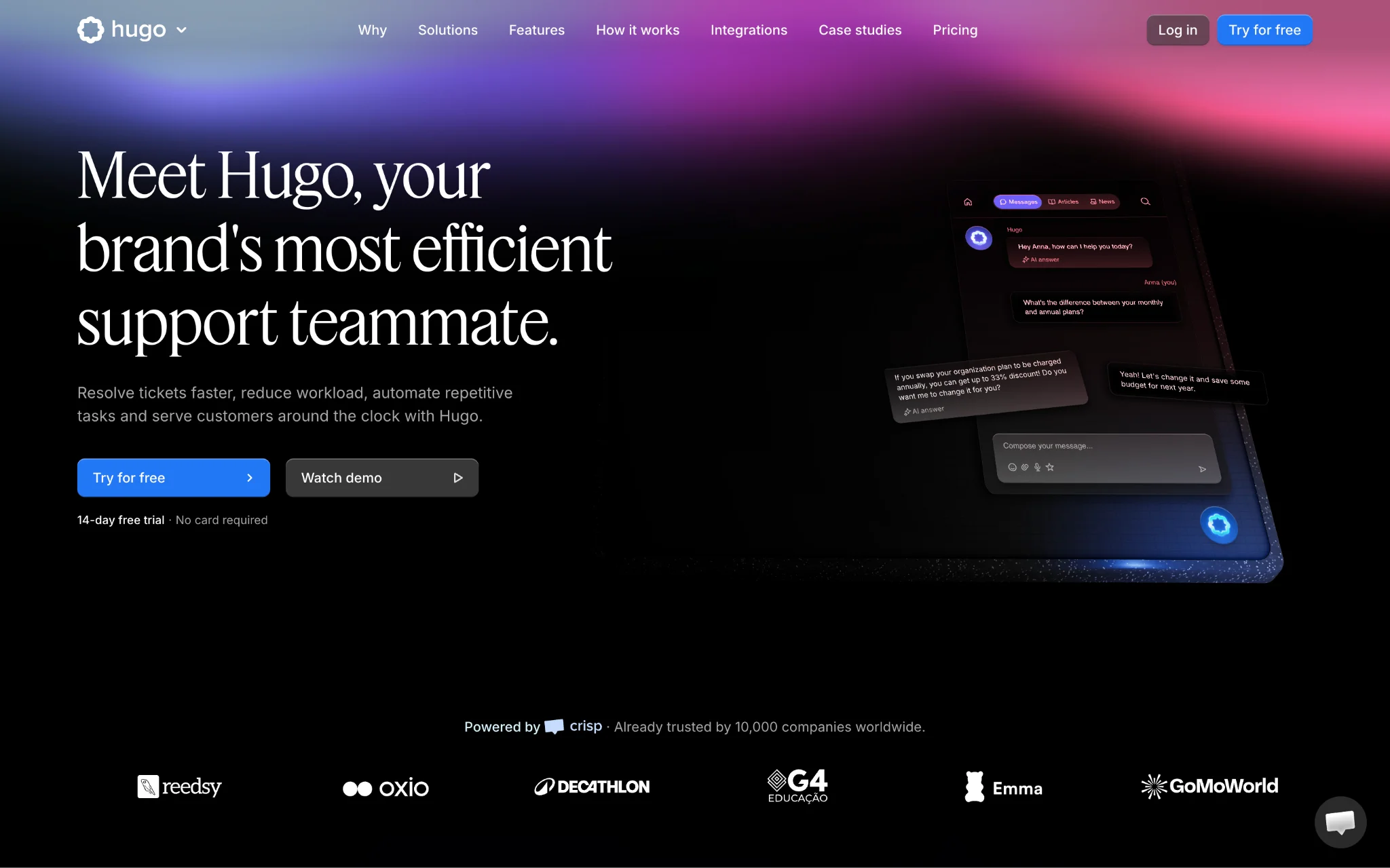
A lot of AI support tools come with a catch, you have to buy into their whole platform to use them. Hugo skips that. It works on its own and plugs into whatever tools your team is already using through Model Context Protocol. So instead of switching everything over, you just connect it and it starts pulling live data, handling tickets, and letting you pick the AI model you actually want to use. No vendor lock-in, no forced upgrades, just the agent doing its job.
What makes Hugo stand out is that it does not feel like a black box. You can actually see what it is doing and why, which is not something most AI tools offer. You can pick the model you want to run it on, whether that is Claude, ChatGPT, Llama, or something custom, and roll it out across your channels without needing a developer to set anything up.
Hugo’s focus on resolving customer issues directly also reflects a broader shift in how companies are approaching customer experience.
The reliance of brand reputation on CX for maintenance of customer loyalty and retention is expected to drive the customer experience management market growth. It helps drive in positive returns and staves off negative comparisons with competitors.
Key Features
- Through MCP, Hugo plugs straight into your business systems and can take real actions, like processing a refund or updating an order, rather than just answering questions and calling it done.
- You get to decide which AI model powers it. Claude, ChatGPT, Llama, or a custom model, and you can swap it out anytime without starting from scratch or getting stuck with one vendor.
- Hugo follows the thread of a conversation the way a human agent would. If a customer circles back to something they mentioned earlier, it already has that context and does not treat it like a brand-new message.
- Anyone on your team can set up routing rules, escalation logic, and automation flows by dragging and dropping. You do not need to file a ticket with engineering every time something needs to change.
- Nobody has time to manually update an AI agent every time a policy changes or a new doc gets added. Hugo handles that on its own by staying connected to your helpdesk, CRM, and internal knowledge base. Changes go in on your end and Hugo picks them up, so the answers it gives customers actually reflect what is true right now, not what was true three months ago.
- Hugo keeps its pricing simple. You pay based on how many conversations happen, nothing more. There are no surprise fees buried in the fine print and no platform subscriptions you have to commit to just to get started.
What else can you do with Hugo?
You do not need to rip out your existing setup to use Hugo. It sits on top of what you already have, takes about a few minutes to get running through a no-code interface, and lets you test everything with a real chat widget before anything goes live. Over time it gets better on its own by learning from actual conversations. For teams that cannot afford a three month implementation project, that matters a lot.
SPIDERvo, a company that builds automobile management software, ran into a problem a lot of support teams face. Every conversation coming in was being handled manually, which meant their agents were buried in routine queries and had almost no bandwidth left for anything more involved. They brought Hugo on board and it started taking over the incoming conversations, resolving what it could using live data and their connected systems. The results were hard to argue with:
- Every incoming conversation now goes through Hugo first
- 4 out of 10 queries get fully resolved without a human ever getting involved
- The other 6 get handed off to an agent, but with the entire conversation history already there so nothing has to be repeated
Taking the routine stuff off the team's plate made a real difference. Agents stopped spending their day on repetitive questions and started putting that time toward the cases that actually needed their attention. That is the whole point of bringing in a tool like Hugo. You scale without the quality dropping, and your team gets to do work that is actually worth their time.
2) Fin - High-Performance AI Agent with Patented Engine
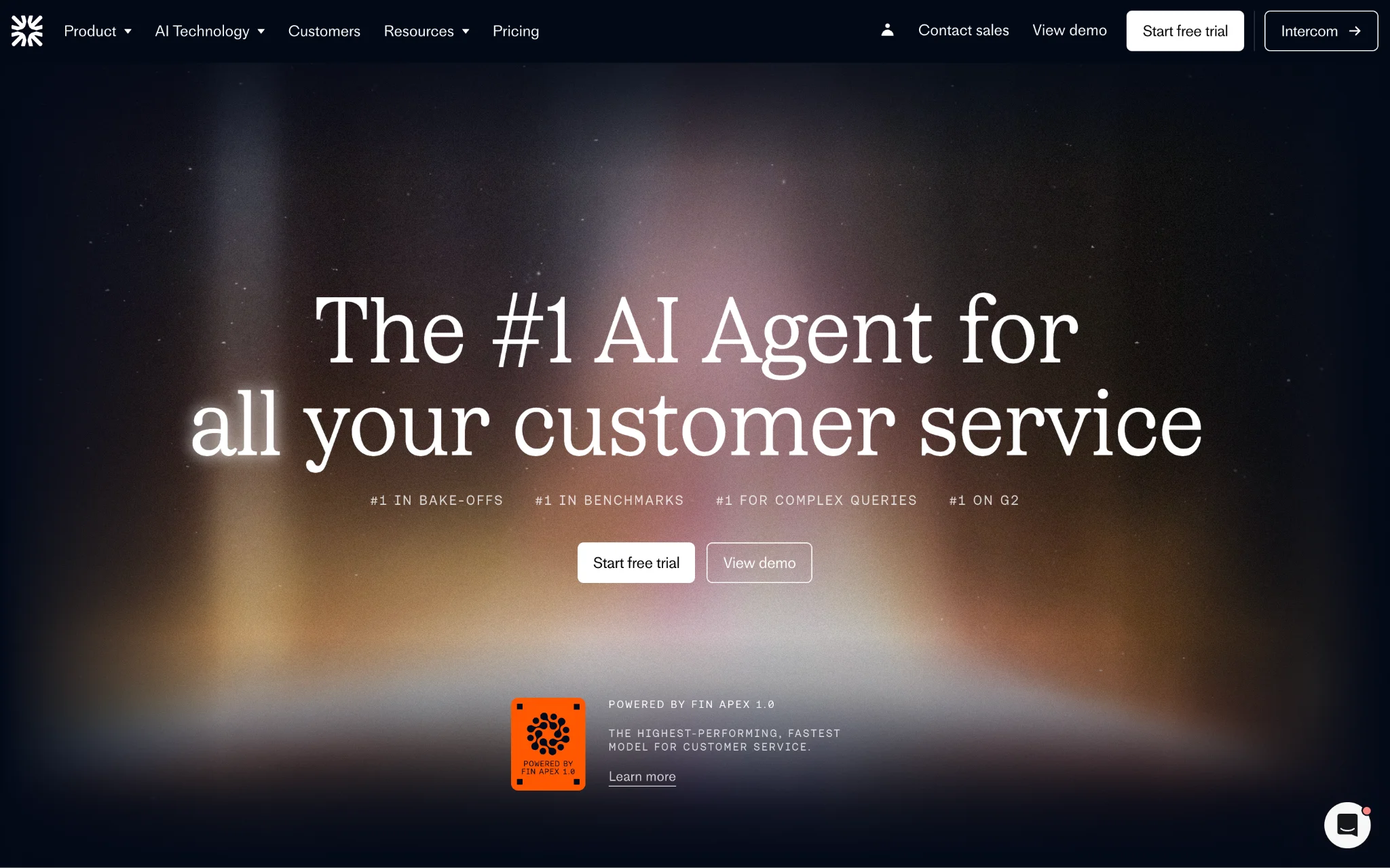
Fin makes a bold claim, that it outperforms every other AI agent in customer service when it comes to resolution rates. Whether or not you take that at face value, the tech behind it is genuinely solid. It runs on a patented AI engine built specifically for customer service, not just a general-purpose model that was adapted for support. That means it is optimized for accuracy and speed at every step, and it can work through complex multi-step issues using real-time data and integrations rather than just pulling up an FAQ.
The way it improves over time is also worth noting. You train it on your existing knowledge and run it through simulated conversations to see how it behaves. It fits naturally into Intercom and also connects with Zendesk and Salesforce, so if you are already running on any of those platforms you can get it up and running without rebuilding your whole support setup.
Fin’s use of AI for context-aware customer support is part of a broader shift toward AI-enabled CX platforms.
The integration of artificial intelligence (AI) into CX platforms is expected to transform the customer experience management market growth. The focus on personalization and the improved ability of AI agents for perceiving context can augur favorably for the market. Moreover, the use of AI governance to defend your brand reputation and values can win over your customers.
Key Features
- Patented Fin AI Engine optimizes every stage of response generation specifically for customer service, delivering higher resolution rates than standard AI models through safety checks and hallucination prevention.
- Procedures enable complex workflows by combining natural language understanding with deterministic controls and branching logic, allowing Fin to execute multi-step resolutions like processing refunds or managing subscriptions.
- Fin works across a wide range of channels, voice, email, live chat, WhatsApp, Instagram, Facebook Messenger, SMS, Discord, Slack, and APIs, and you do not have to rebuild anything on the infrastructure side to make it happen.
- Before you push anything live, you can run it through fully simulated conversations to see exactly how it behaves. It is a lot better than finding out something is off after a real customer runs into it.
A few things are worth keeping in mind before choosing Fin. Its resolution-based pricing can become more expensive as conversation volumes increase, so it's important to monitor usage as you scale. The platform uses its own proprietary AI models, so there is no option to choose a different model. It serves detailed analytics to understand CX metrics closely and continue with safe strategies.
While different products serve different customers, organizations either procure solutions or full-fledged services. By component, the solutions segment is expected to account for 61.0% share of the customer experience management market in 2026. Organizations are launching solutions to other companies with a huge customer base. The ability to gauge customer sentiment and respond accordingly to retain customer loyalty is expected to drive segment growth over the forecast period.
3) Breeze Customer Agent - AI Across Marketing, Sales, and Service for HubSpot Users
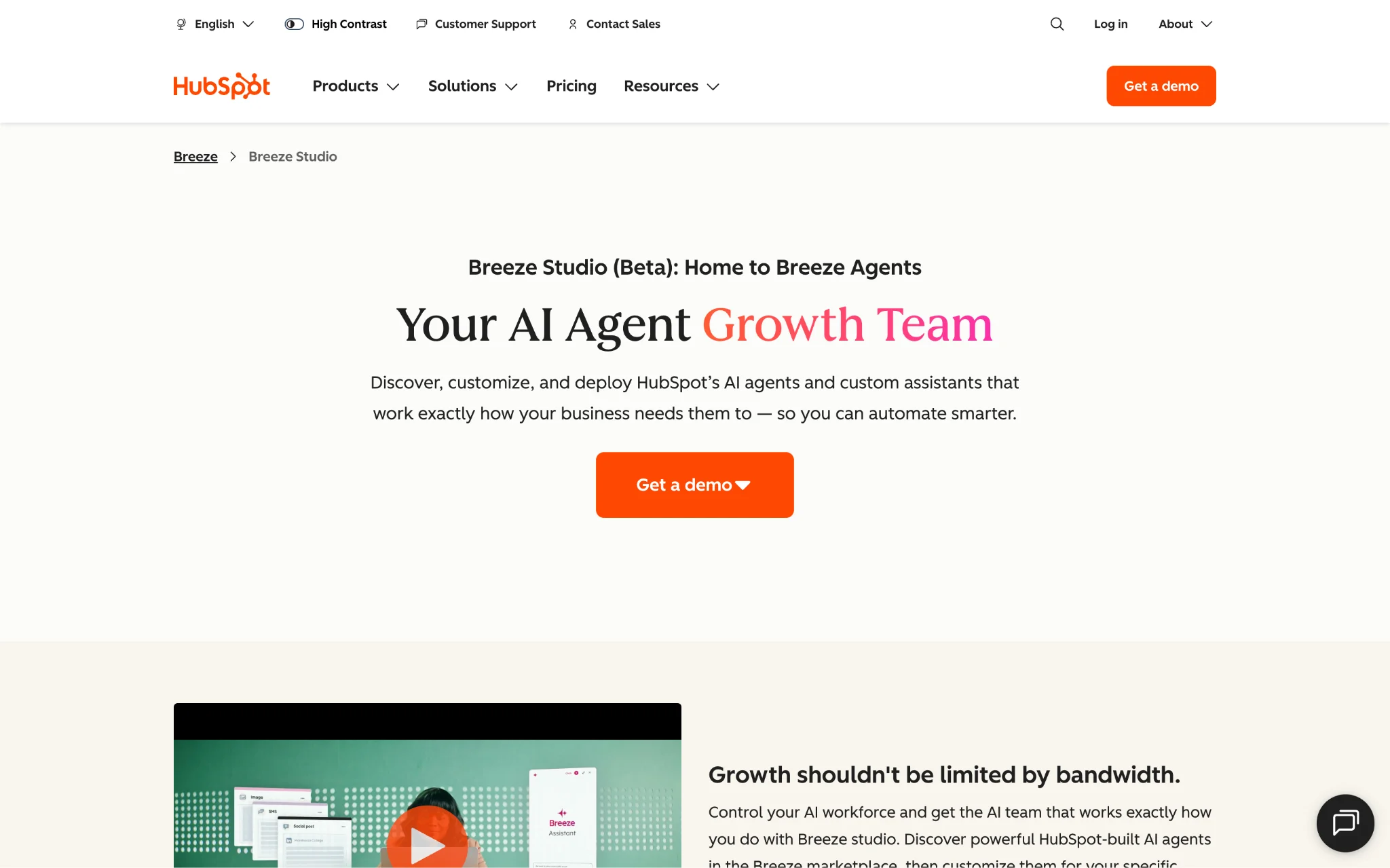
Breeze Customer Agent is HubSpot's answer to AI-powered support, and it covers more ground than just customer service. It touches marketing, sales, and service all from one place, drawing on your CRM data to give responses that are actually relevant to the person on the other end. Marketing teams use it to keep visitors engaged with content, sales teams lean on it to answer pricing questions and get meetings booked, and service teams use it to handle support around the clock without needing someone online at all hours.
Setup is straightforward. It picks up your existing knowledge base documents and turns them into answers, and it can juggle multiple conversations at once without things getting inconsistent. When something is too complicated it passes it to a human agent. It also keeps an eye on things like resolution rates and sentiment over time so it can get better as it goes. If your business is already built around HubSpot, this one is a natural fit.
Key Features
- Complete CRM integration leverages HubSpot's customer data to provide contextual, personalized responses across marketing, sales, and service interactions without requiring separate data configuration.
- Unstructured data processing allows you to feed PDFs, meeting transcripts, and company documents directly into the agent, enabling accurate responses based on business-specific information.
- Multi-functional deployment supports marketing content engagement, sales qualification and meeting booking, and customer service resolution from a single unified agent. By touchpoint, the telephone segment is expected to capture a huge share of the customer experience management market in 2026. The use of the telephone to contact customers to resolve their grievances and offer them better services can boost the importance of this segment over the forecast period.
- Breeze marketplace expandability provides access to HubSpot-built agents and custom assistants that can be installed to extend AI capabilities across different business functions.
Breeze is not available as a standalone product and requires an existing HubSpot subscription to access. AI usage is managed through a shared credit pool across Breeze features, so usage in one tool can affect the credits available for others, and unused credits do not roll over to the next billing period. It's worth understanding the overall cost structure and implementation requirements before committing.
4) Freddy AI - Quick-Deploy AI with Pre-Built Vertical Agents
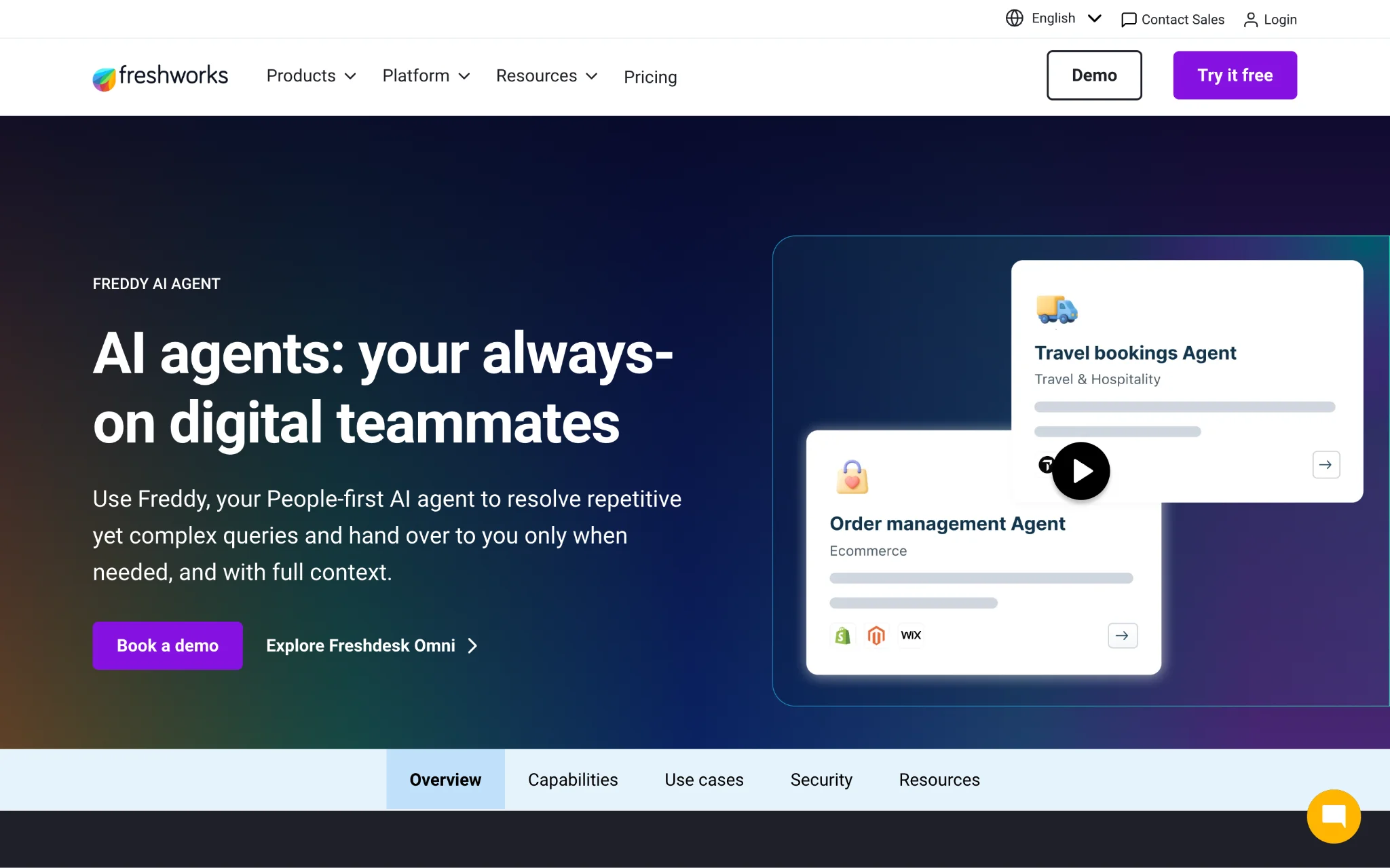
Freddy AI is Freshworks' take on an AI support agent, and the thing that stands out most is how fast you can get it running. Through their AI Agent Studio you can have something live in minutes using pre-built vertical agents and a library of over 50 ready-made workflows. For teams that need automation up and running quickly without a long setup process, that is a genuine advantage.
Freddy’s focus on quick deployment is particularly relevant as larger organizations look for ways to automate support across multiple customer touchpoints.
By organization size, the large enterprises segment is expected to account for 57.3% share of the customer experience management market in 2026. This can be attributed to the large number of customers and various endpoints they need to cater. The introduction of AI chatbots that resolve basic queries and assist customers in resolving problems has high potential to the market.
Once it is live it can do more than just answer questions. It connects to your backend systems and can actually take action, things like processing refunds, updating orders, checking on shipments, and verifying customer details in real time. It works across email, webchat, WhatsApp, and social platforms, and when a conversation does need to go to a human agent it passes along everything that was said so the customer does not have to start from scratch.
Key Features
- AI Agent Studio with vertical agents provides industry-specific, ready-to-deploy AI agents and 50+ pre-built workflows that can be launched in minutes without extensive configuration or training.
- Real-time backend actions enable Freddy to process refunds, update orders, check inventory, schedule pickups, and verify account details directly within connected business systems.
- For anyone running an ecommerce or retail operation, a large portion of support tickets revolves around the same handful questions over and over: order status, shipping updates, exchange requests, stock availability. Freddy takes all of that off your team's plate without breaking a sweat.
- Nobody likes explaining their whole situation again to a new agent. When Freddy hands a conversation over to a human, that agent already has everything in front of them. The customer just keeps talking, no recap needed.
The pricing of Freddy is based on AI sessions, so costs can vary depending on your monthly usage, making budgeting less predictable for teams with fluctuating support volumes.
Some advanced AI capabilities are only available on higher-tier Freshdesk Omni plans. Additionally, AI assistance for human agents is offered as a separate add-on rather than being included by default.
Beyond ecommerce and retail, AI-enabled customer support is also expanding across other industries.
By application, the BFSI sector is expected to dominate the customer experience management market till 2033. Investment in customer care centers to retain customers and maintain brand loyalty is expected to drive the share of the segment in the market over the forecast period.
5) Forethought - Enterprise Agentic AI Trained on Your Historical Data
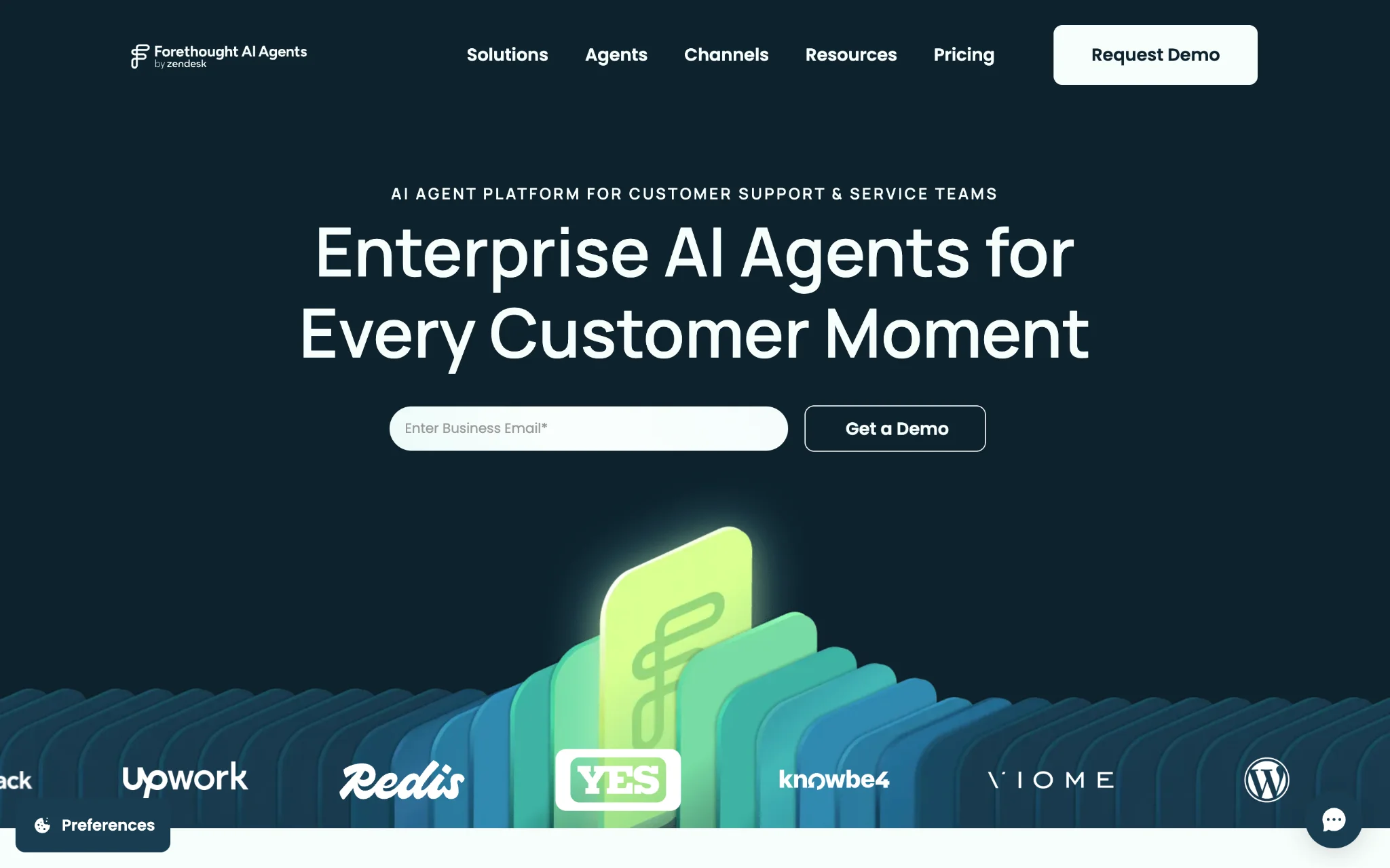
Forethought is an AI agent platform built for enterprise support teams that need to scale operations while delivering human-centered support. Its platform operates on a fully agentic AI system where agents don't just understand intent but reason, decide, and take action using business policies to deliver complete support outcomes. The system is trained on your company's historical tickets and knowledge base content from day one.
Forethought’s enterprise focus also aligns with the continued growth of AI-enabled CX adoption in major markets.
The U.S. is expected to a major region of growth for the customer experience management market over the forecast period. The increasing number of physical and digital touchpoints of customers coupled with ever-changing customer behavior can drive market growth. Additionally, the use of AI and machine learning to become proactive in crisis management and becoming mindful of customers will earn companies a lot of customer trust.
Under the hood it runs as a multi-agent system, meaning different AI agents are working together across the customer journey rather than one agent trying to do everything. One handles identification, another classification, another resolution, and so on. The coordination happens in the background without adding any extra work on your end. It covers chat, email, voice, and Slack, and if you want to embed it directly into your own interface rather than use a pre-built one, there is a headless API option that gives your engineering team full control over how everything looks and feels.
Key Features
- Fully agentic multi-agent systems coordinate different AI agents that reason, decide, and take action across the customer journey, handling identification, classification, resolution, and support collaboratively.
- Instead of starting from zero, Forethought trains on your actual ticket history and existing knowledge base content. So, from day one it already has a feel for the kinds of questions your customers ask and how they should be answered, rather than giving out generic responses that miss the mark.
- Everything runs through one platform whether the customer reaches out over chat, email, voice, or Slack. The quality stays consistent and the context carries across channels so nothing gets lost in translation.
- If you want to build AI into your own interface rather than bolt on a third party widget, the headless API lets your engineering team do exactly that. Full control over the UI, the data flow, and how the whole experience feels to the customer.
Forethought is designed for enterprise organizations, with pricing tailored to each customer's specific requirements. Since plans are custom, you'll need to work with the sales team to receive a quote, as there is no standard pricing available publicly. It's also worth noting that Forethought was acquired by Zendesk in 2026. The future of the platform may depend on the roadmap outlined by its parent company.
6) Chatbase - Simple AI Agent Builder Trained on Your Data
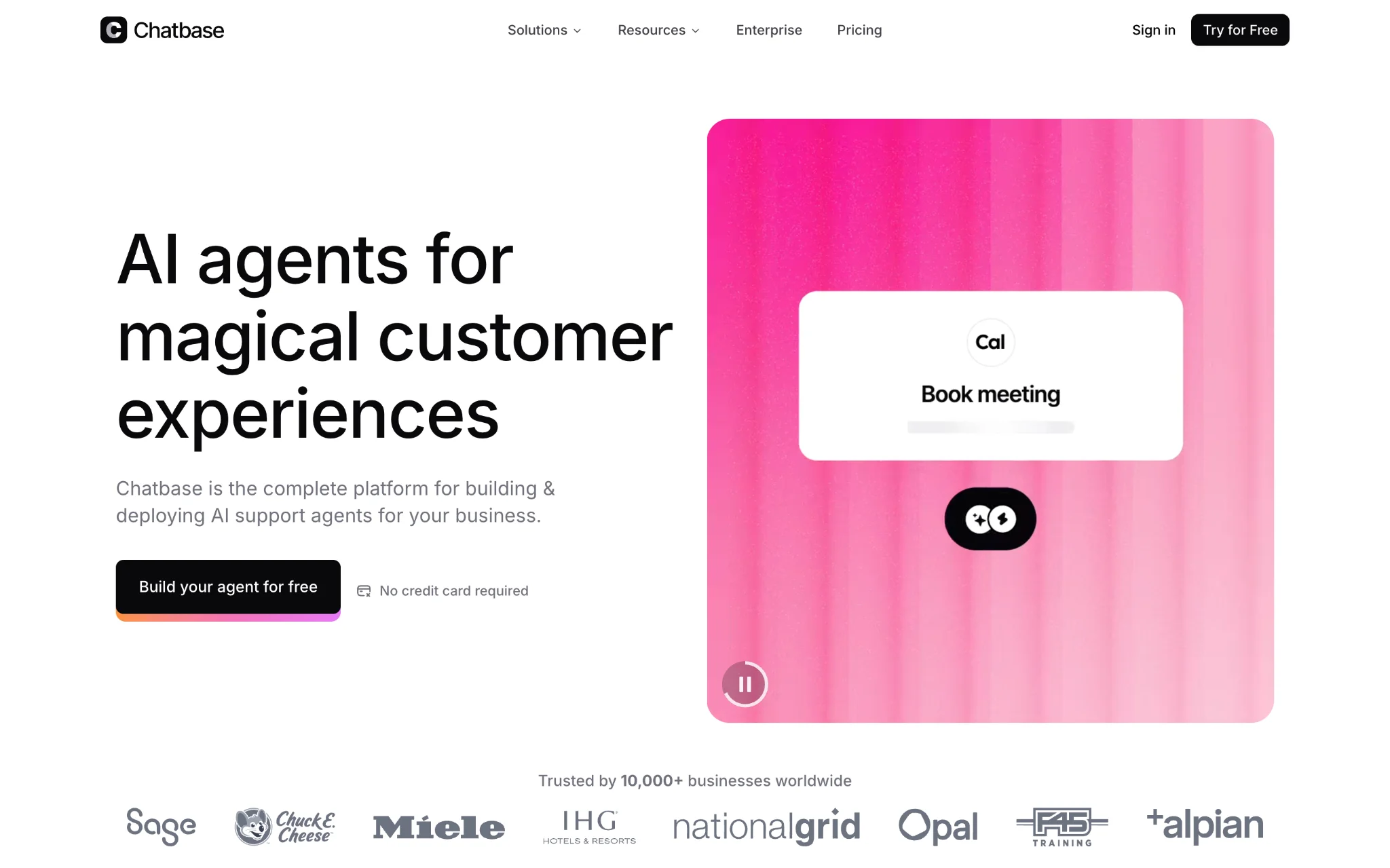
Chatbase is built around one idea: making it easy for anyone to create and deploy an AI support agent without needing a technical background. Every AI platform is moving beyond retrieval augmented generation (RAG). Security is taken seriously too, with encryption and compliance guardrails built in so you are not trading simplicity for safety.
On the practical side, you can train agents on your own internal data, hook them into other systems for real-time information, and set up automated workflows without writing a single line of code. It deploys across websites, WhatsApp, Slack, Messenger, and email, and comes with analytics that show you how the agent is actually performing so you can keep improving it over time based on real conversations rather than guesswork.
Key Features
- Anyone on your support team can build and launch an agent without touching a single line of code. No engineering ticket, no waiting, just set it up and go.
- Feed it your internal docs, your policies, your knowledge base, and it learns from that instead of some generic dataset. The answers it gives actually sound like they came from your company.
- It does not just sit there answering questions. Hook it up to your other tools and it can take real actions, run workflows, fetch data, whatever needs to happen to actually close out a request.
- Your customers are on different channels and Chatbase covers them all. Website, WhatsApp, Slack, Messenger, email, one agent across all of them without having to rebuild anything for each platform.
A few things to think about before committing to Chatbase. Its credit-based system can become a little unpredictable as you scale, since each AI request consumes credits and more complex conversations may use more than expected, making monthly usage harder to forecast. Like many platforms, unused credits do not carry over to the next billing period. Some customization options, such as removing Chatbase branding from your AI agent, require an additional add-on. If you're operating in Europe or serving European customers, it's also worth noting that data is hosted in the US on AWS, which may require additional consideration for GDPR and data residency requirements.
7) Ada - Enterprise AI for 300,000+ Annual Conversations
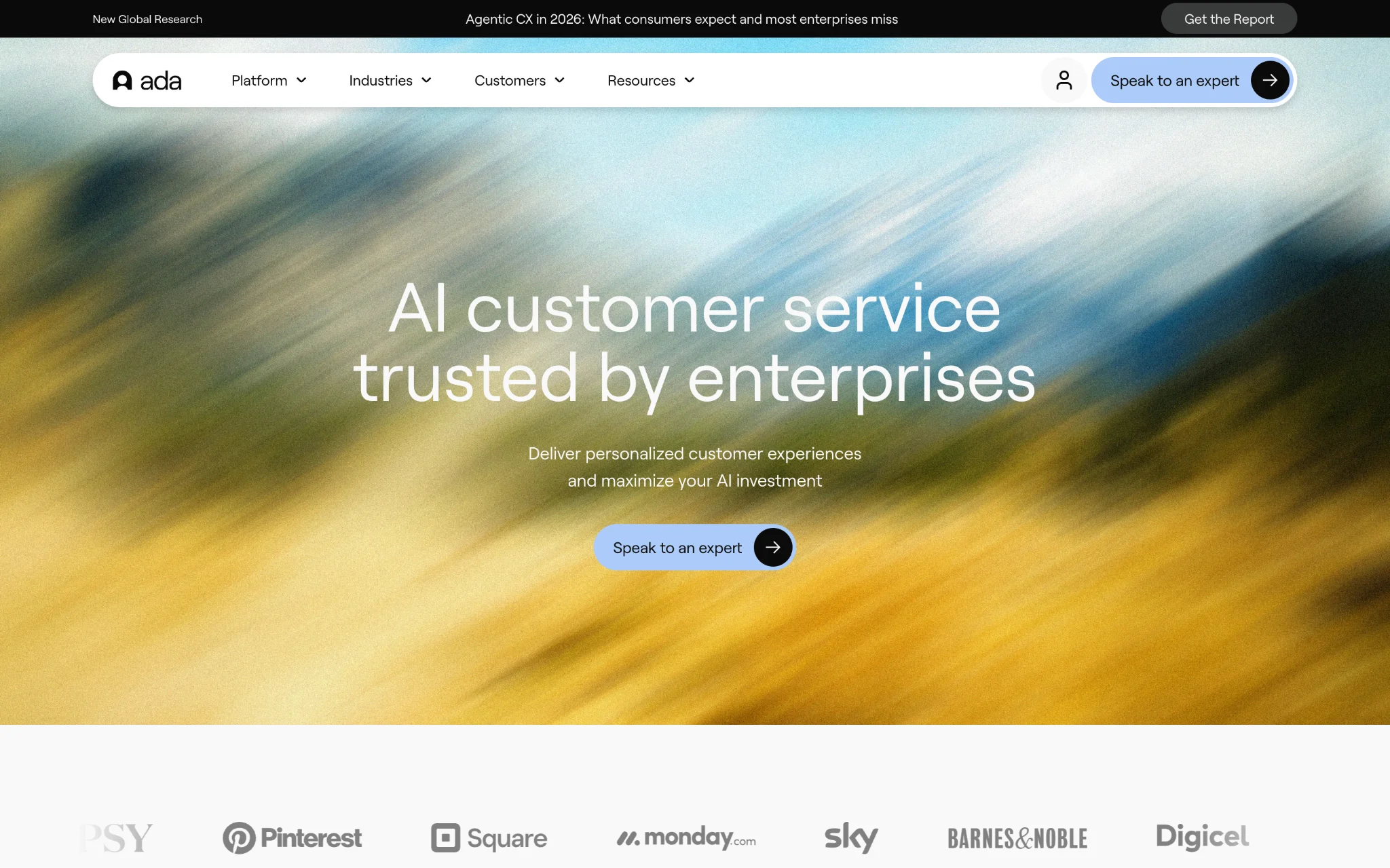
Ada is not trying to be everything to everyone. It is built specifically for large enterprises that are dealing with serious conversation volumes, and if you are handling fewer than 300,000 customer service interactions a year it is probably not the right fit. For the companies it is designed for though, it can autonomously resolve upwards of 80% of inquiries while actually moving the needle on customer satisfaction scores and bringing operational costs down.
What sets Ada apart is the way it approaches AI deployment. Rather than just handing you a tool and wishing you luck, it combines the platform itself with a structured operational methodology and hands-on expert support through what they call the Agentic Customer Experience model. The AI agents all run on a unified Reasoning Engine so the quality stays consistent no matter which channel a customer uses, and Playbooks let the agents follow your actual SOPs using live data without being boxed into rigid pre-written scripts.
Key Features
- The ACX model is not just software, it is a combination of the platform, a structured way of rolling it out, and actual human experts who help you deploy it properly and keep improving it over time.
- No matter which channel a customer uses or which language they write in, the same Reasoning Engine is running behind every interaction. The quality and decision making stays consistent whether someone is in London or Lagos.
- Instead of following a rigid script, Ada's agents work through your actual standard operating procedures using live customer and system data. It handles things the way your team would, just faster and at much greater scale.
- You get access to Ada's own experts who work alongside your internal team. They help build out roadmaps, fine tune workflows, and make sure you are actually getting a return on what you are spending.
Ada comes with a significant enterprise-level investment and is primarily designed for large organizations, making it less suitable for smaller businesses. There is no free trial or self-service signup, as everything is handled through the sales team. Once you decide to move forward, getting the AI agents operational requires integrating them with your existing enterprise infrastructure, so implementation is not something that happens overnight.
Pricing is customized
Ada does not have standard pricing plans. The pricing on plans is heavily customized based on usage or predefined processes.
The platform is designed for large organizations handling high volumes of customer service conversations, making it a better fit for enterprise-scale support operations. Since pricing is tailored, there is no self-service signup or public trial available before engaging with the sales team.
Ada operates within a broader customer experience management market that includes established CX and enterprise technology providers.
Major players of the customer experience management market are Zendesk, Open Text Corporation, Clarabridge, Sitecore, IBM Corporation, Avaya Inc., MaritzCX Research LLC (Inmoment LLC), Oracle Corporation, Verint Systems Inc., Medallia Inc., Tech Mahindra, SAP SE, and Adobe Inc. Products involving AI-powered automation and chatbot agents that go beyond customer satisfaction are expected to be witnessed more in the years ahead.
The Verdict: Which AI Customer Support Agent Should You Choose? (Our Top 3 Picks)
After going through all seven options, a few things became clear pretty quickly.
Hugo is the one to go with if you want real automation without getting tied into a platform you did not ask for. It stands on its own, works with the tools you already have, lets you pick your AI model, and charges you based on actual usage rather than locking you into a subscription. You also get full visibility into how it operates, which is not something most tools offer and makes a bigger difference than you might think.
Fin makes the most sense if you are already running on Intercom, Zendesk, or Salesforce and you need an AI agent with a strong track record on resolution rates. The patented engine holds up well across complex queries and it works consistently across channels, just keep in mind that the per resolution pricing can add up as your volume grows.
Freddy AI is worth a serious look if speed of deployment matters and you are in ecommerce or retail. The pre-built agents and workflows mean you are not starting from scratch, and the ability to take real backend actions like processing refunds or checking order status is genuinely useful. The session-based pricing is the main thing to watch, so make sure you have a handle on your expected volume before you commit.

