Banks and other financial institutions are under more and more pressure to update their old systems that can't handle real-time transactions, embedded finance, or API ecosystems. A lot of businesses now use specialized FinTech Solution Development Services to switch out old banking systems for new, scalable, API-driven financial platforms.
Customers expect more, rules are getting stricter, and FinTech startups are becoming more competitive, which is why this change is happening. Companies must still follow rules like PCI DSS, PSD2, and GDPR, but they must also offer financial services that are faster, safer, and more flexible.
As a result, financial companies are putting money into new architectures that make it possible to deliver software all the time, process data in real time, and make decisions based on data.
Growing Need to Update Financial Systems
Old banking systems make it harder to come up with new ideas and running a business riskier. A lot of these systems were made decades ago and use batch processing and monolithic architectures.
Some of the biggest problems are:
- Rigid architectures that slow down the process of adding new features
- Not being able to handle transactions in real time
- High maintenance costs due to old technology
- Systems that are broken up and let in hackers
Deloitte says that more than 70% of banks still use old core systems. This makes it harder to follow the rules and slows down new ideas.
Cloud-native infrastructure also helps FinTech companies get new services up and running faster. This means that payments, loans, and digital banking are all in direct competition with each other.
Companies are rethinking their technology stack and using FinTech Solution Development Services to speed up innovation and make it safer because of this pressure.
What FinTech Solution Development Services Really Do
FinTech Solution Development Services don't just make single tools; they make whole financial platforms.
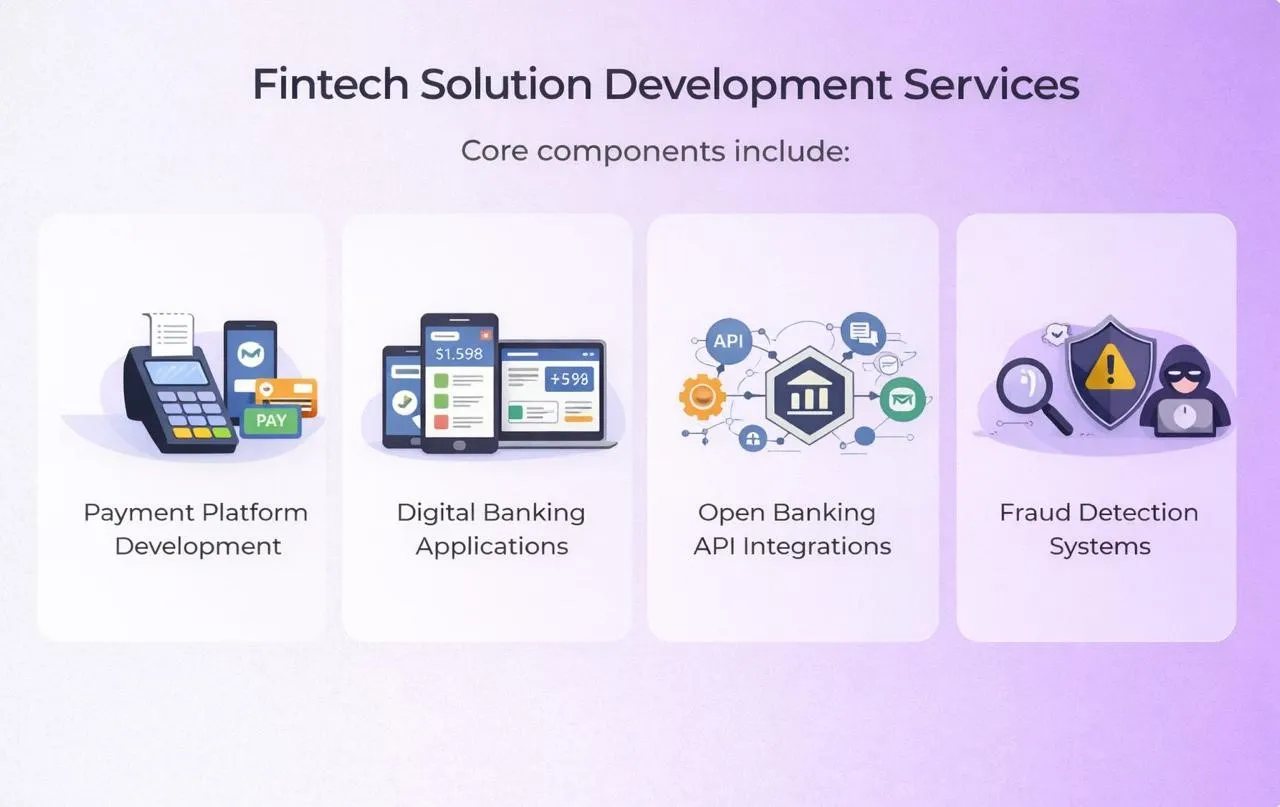
Making a payment system
Modern payment systems can handle transactions in real time, work with multiple currencies, and connect to services like Stripe or Adyen. These systems have to be able to handle a lot of transactions quickly and without breaking PCI DSS rules. Payment orchestration layers let you work with more than one provider and not have to rely on just one gateway.
Digital banking apps
You can manage your accounts, sign up for new ones, make transfers, and see analytics on both mobile and web apps with digital banking platforms. These systems must be able to do secure authentication, sync in real time, and work with core banking APIs.
Putting together open banking APIs
Laws like PSD2 say that banks must use secure APIs to share data with companies that aren't their own. These APIs let you link accounts, make payments, and share financial information. API gateways make sure that authentication protocols like OAuth2 are followed by keeping an eye on traffic and controlling who can get to them.
Ways to find fraud
AI-powered systems look at transaction patterns and find problems right away. Machine learning models look at data from the past and the present to find suspicious behavior. It needs to be updated all the time to keep the model accurate and cut down on false positives.
|
Type
|
Description
|
|
FinTech tools
|
Standalone tools such as payment SDKs or analytics solutions
|
|
Custom FinTech platforms
|
Tailored applications built for specific business use cases
|
|
Enterprise FinTech architecture
|
Integrated ecosystems that include APIs, services, and data layers
|
Companies put money into platforms because they help them grow and stay in line with the law.
The Main Technologies That Make Modern FinTech Platforms Work
Modern FinTech platforms use advanced data technologies and infrastructure that can grow.
Infrastructure that is built into the cloud
Cloud platforms like AWS and Azure are very reliable, adaptable, and cheap. They let systems grow or shrink depending on how many transactions they handle.
The structure of microservices
Applications are made up of different services that do different things, like logging in, making payments, or reporting. This makes things more flexible and speeds up the time it takes to deploy.
Financial infrastructure that begins with APIs
APIs connect systems inside a business to systems outside of it. They are the basic parts of open banking and embedded finance systems.
AI helps find fraud
Machine learning models look at how transactions are done and quickly flag any that look suspicious. According to McKinsey, AI makes it much easier to find fraud and cuts down on financial losses.
Using Blockchain to check transactions
Transactions are clear and can't be changed with distributed ledger technology. A lot of systems use it to make payments across borders.
Tools for analyzing data
Real-time analytics systems look at financial data to figure out risk, make predictions, and check for compliance.
Real-Life Business Cases That Are Making People Invest in FinTech
Companies use FinTech Solution Development Services to fix certain problems with their operations.
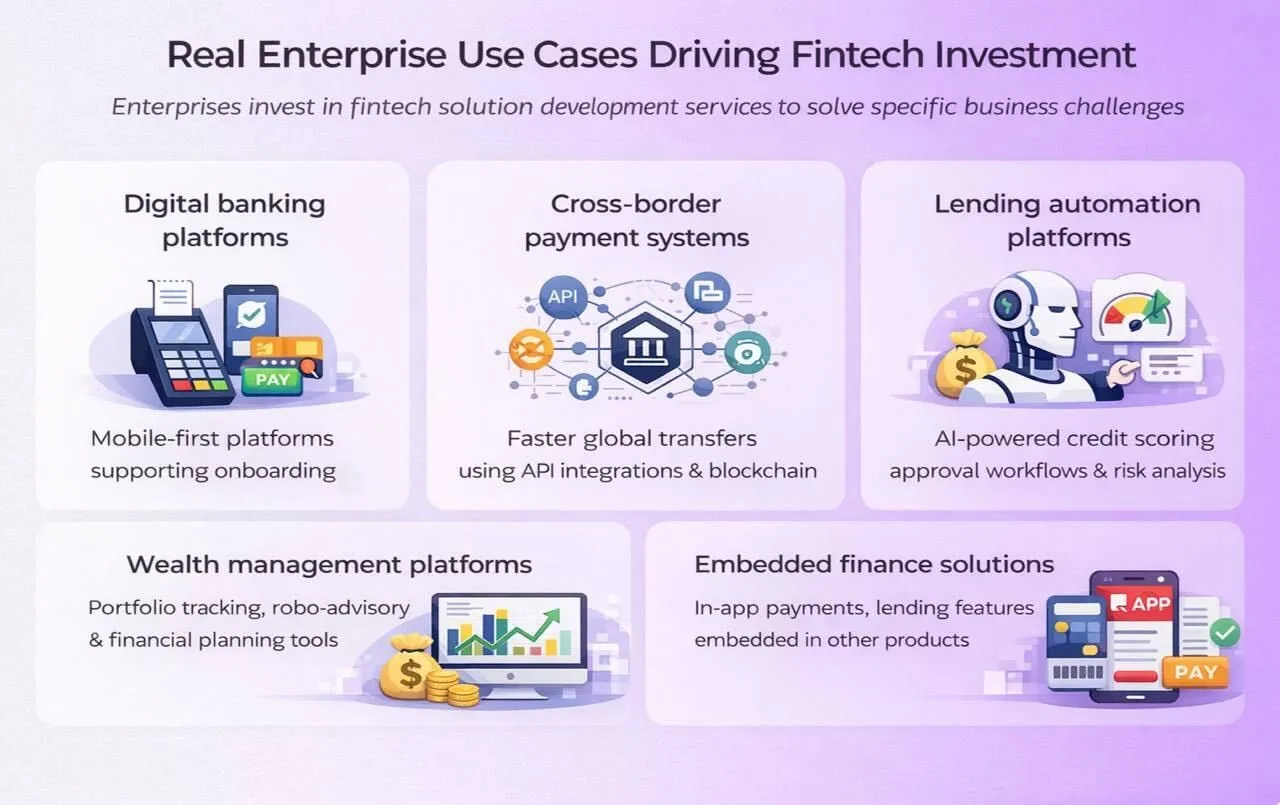
Digital banking platforms
Mobile-first platforms take the place of branch-based services and let users sign up, pay bills, and manage their accounts.
Payment systems that work in more than one country
Using APIs on platforms makes things clearer and cuts down on transaction time and costs. Blockchain makes settlements even faster.
Automated lending platforms
AI-powered systems take care of credit scoring, approval processes, and risk analysis.
Wealth management platforms
Digital tools help you keep track of your portfolio and use robo-advisory solutions to make your investment plans automatic.
Built-in finance solutions
Companies that don't deal with money include payment and lending services in their products. The World Economic Forum reports that by 2030, embedded finance could handle more than USD 7 trillion in transactions.
Every use case needs infrastructure that can grow, strong compliance controls, and data processing that works.
Issues That Companies Face When They Update Their Financial Systems
There are both technical and regulatory problems that come with modernization.
Following the rules
PCI DSS, PSD2, and GDPR are examples of standards that financial systems must follow. Not following the rules can cost you money and hurt your name.
Data safety
Sensitive financial data must be encrypted, watched, and only available to a select group of people. The system's architecture needs to include security.
How hard is it to move systems?
It takes a lot of planning to switch from monolithic systems to microservices. Phased migration strategies help keep data the same and avoid downtime.
Risk of doing business
Money transfers can be affected by problems with the system or delays. You need to have plans for high availability and disaster recovery.
How to Choose the Best FinTech Development Partner for Your Business
To choose a FinTech development partner, you need to know a lot about both technology and the industry.
Some important things are:
- Knowing how banks work, what they sell, and what rules they have to follow
- Following the rules and being aware of security
- Ability to set up safe standards and architectures for the industry
- Making systems that can grow
- Easy to keep up with over time
- Knowing the rules
- Partners need to update their systems to stay in line with the rules that change.
At Cleveroad, software development experts apply these principles across FinTech projects. For example, during a payment platform implementation, engineers designed modular services that enabled easy updates to meet new compliance requirements.
Conclusion
As businesses deal with competition in the market and pressure from regulators, the modernization of financial infrastructure is moving faster. When you use old systems, it's harder to come up with new ideas. But new architectures make it easier to deliver things faster and more reliably.
FinTech Solution Development Services can make financial systems that are safe, can grow, and follow the rules. Companies that spend money on modernization can adapt and come up with new ideas more quickly. Companies that wait, on the other hand, have more technical debt and are under more pressure from their rivals.

