Many organizations now turn to custom generative AI development services to move beyond isolated pilots and build automation that works reliably at scale. By 2026, the challenge is no longer whether generative AI can produce value, but how to integrate it safely into products, workflows, and decision processes without increasing risk. Founders, product owners, and Chief Technology Officers (CTOs) not only have to focus on improving decision-making quality, increasing velocity, and reducing operational load, but also on maintaining the integrity of their data and results.
When designed and deployed correctly, it becomes a practical layer that automates content creation, customer support, and internal decision support rather than a standalone experiment.
What Generative AI Means for Modern Teams
Generative AI for product and engineering teams today is to take away the repetitive cognitive workload of their people, rather than replacing them. Things such as drafting responses, summarizing, searching for internal knowledge, or conducting a first pass on the analysis are time-consuming; therefore, it’s difficult for senior teams to scale how quickly they can do this type of work.
With the right implementation of generative AI, teams can generate structured outputs that are then reviewed and refined by humans. The application of generative AI will help companies that work in enterprise environments where accuracy, accountability, and traceability are far more important than anything new and unique; generative AI will be an augmentation layer to existing systems rather than the creation of another technology for employees to learn how to use. It can operate within an employee’s current workflow, assist with day-to-day tasks, improve consistency, reduce manual workloads, and enable efficient resource use without requiring the employee to change how they work or learn a new interface.
Where Generative AI Delivers Real Business Value
-
Use of Huge Volumes of Automated Content
Using Generative AI for Product Development, communication teams can accelerate drafting. The majority of this work is completed, and the time to draft is reduced, while delivering an end product that is consistent and aligned with established guidelines or policies. Examples include the following: marketing copy, Product descriptions, Internal documentation, and Compliance-Ready summaries.
In a recent client project completed using a confidential project method (e.g., an LLM-based content assistant), the time to prepare documents was reduced by approximately 40% compared to preparing them with editorial review before publication.
-
Customer Support via AI Automation
The customer support model using AI automation has become much more sophisticated. Rather than relying on predefined static responses, the RAG (Retrieval Augmented Generation) method of customer support models uses a retrieval model to identify knowledge and information from internal sources and leverage them to create knowledge-based, contextually relevant responses and/or answers.
In a deployment of support assistants based on the RAG method, support assistants reduced average response times by 35% while ensuring the timely escalation of more complex issues to a human agent for resolution.
-
Better Decisions Through Data Analysis
Generative AI can improve decision-making by providing explanations of raw data. Rather than replacing analytics teams, it assists them in interpreting dashboards and charts, summarizing identified trends, and creating descriptions of scenarios that can be reviewed by leadership quickly.
This approach has been especially beneficial to operations, finance, and product analytics teams. As in these disciplines, clarity is often more important than raw predictions, achieved through either analytic tools or methodologies, to support the creation of insights that improve a company's overall performance.
-
Internal Knowledge Management
Generative AI is becoming increasingly important for organizations looking to make internal knowledge available to their employees. Using generative AI, organizations can create policies, agreements, technical training materials, and more that are readily searchable and understandable to employees in natural language.
This application of generative AI tends to have a shorter path to ROI than automation solutions designed for the organization’s customers, as it improves internal business efficiency across multiple departments.
Generative AI technology is also being leveraged to support the development and maintenance of code throughout the engineering workflow. Teams use generative AI models to assist their engineers in generating boilerplate code, building test scenarios, and reviewing pull requests. All outputs provided will remain supportive, with engineers maintaining complete control of their work.
Typical GenAI Solution Architecture
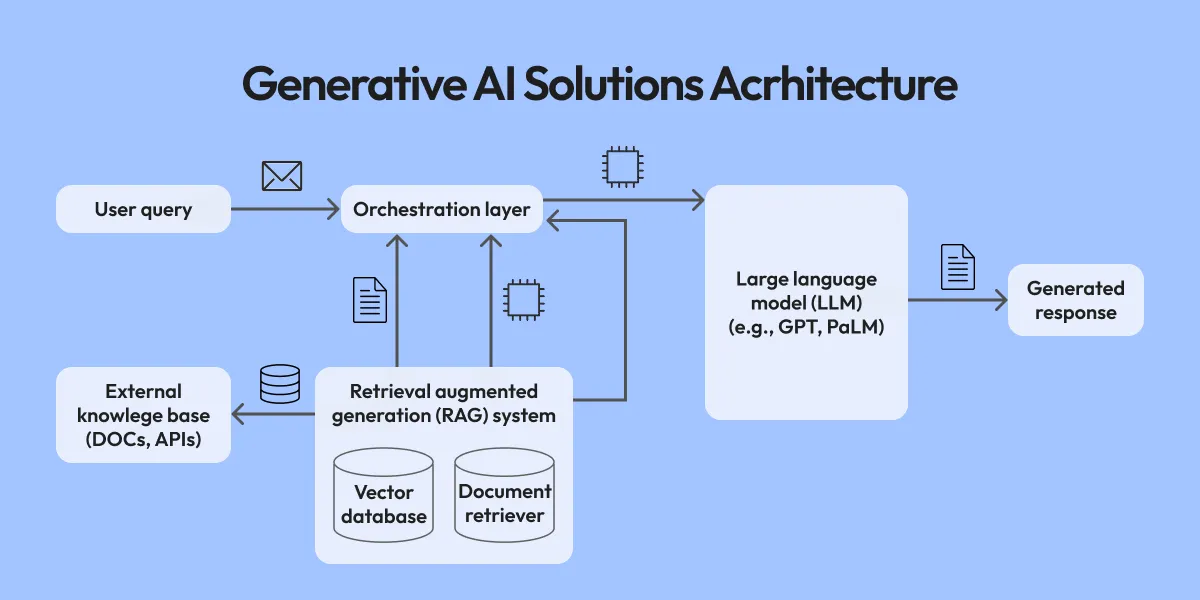
The architecture of the majority of production systems is based on the same general architecture outlined above. The user enters the input data through an application interface and is retrieved through the retrieval layer, whereby the user will be retrieving their internal information from a vector database (such as Pinecone, Weaviate or FAISS) for that user. The model will then return a response based upon the data retrieved. The guardrails will ensure that the returned data is in the correct format, has the right tone, and is safe before being presented to the user.
Flexibility, control, and rapid information updates without retraining are all components of this architecture.
The MLOps pipelines manage prompt versioning, evaluation, latency monitoring, and rollbacks, and help ensure the stable and effective use of applications powered by AI.
Core Technologies Behind Enterprise GenAI
Today’s systems leverage several different practices. Prompt engineering best practices determine how models respond. Determining whether fine-tuning vs RAG is appropriate will depend on the need for stable data and/or governed data. In the majority of enterprise scenarios, RAG provides greater control at lower risk.
To enable effective AI model integration into enterprise systems, an enterprise must implement an API, define user management, and log user activity to comply with its current security frameworks. Many internal projects fail because they lack experienced external support to assist with these implementations.
Custom vs Off-the-Shelf GenAI Solutions
Using readily available tools provides convenience and rapid results for performing general functions that do not involve highly sensitive information. However, if an organization needs more advanced integrations, restricted access controls, and domain-specific behaviors, a custom-built generative AI solution is an option. With customized solutions, organizations can gain better control over data flows, assessments, and regulatory compliance, but the cost of developing them is higher than that of purchasing readily available tools.
Trade-offs related to workloads with the most substantial impact on customers and regulatory exposure support the use of custom solutions.
Security, and Data Risks
Another risk associated with Genуe AI is the potential unauthorized leakage of proprietary data. To mitigate that risk, secure deployment policies isolate proprietary data, limit how prompts are stored, and use role-based access controls to determine who is allowed to access each prompt. Many organizations are using NIST recommendations on AI implementation, as well as OpenAI best practices, to guide their secure implementation of generative AI.
Bias and other ethical issues must also be addressed while designing and developing generative AI. Responsible development of AI technology includes monitoring the outputs generated by the systems, documenting their limitations, and identifying who is responsible for the results produced by the AI system.
Implementation Challenges in Practice
While deploying a production system, practical considerations come into play. For instance:
- Latency, Costs, and Reliability are as important as Model Accuracy
- Having to evaluate, monitor, and govern a deployed product is more effort than many teams assume
- From experience, Teams should realistically allow themselves several weeks from when they design an architecture to when a new product is broadly rolled out, to account for data preparation and internal testing.
How to Choose the Right Development Partner
When selecting a good partner for developing generative AI applications, look for more than just experience with building models. Look for a partner who has experience developing enterprise AI applications, proven capabilities in integrating AI applications into the enterprise, and has operated under compliance constraints.
An ideal development partner will have an understanding of machine learning and how to support the entire machine learning life cycle from data governance through to deployment monitoring. Additionally, an ideal development partner will adhere to responsible AI practices and continue to provide transparency about limitations, while maintaining a commitment to responsible development.
For smaller teams, this doesn’t need to mean a complex internal search setup. A lightweight knowledge base can keep policies, processes, and recurring answers in one place. Choosing the right knowledge base can also make that information easier to maintain as the company grows.
Conclusion
In the business, everything from generating content to assisting customers to aiding decision-making through Enterprise Software will be accomplished via Generative AI.
Generative AI has value when developed through a controlled environment rather than through trial and error. When organisations successfully apply Generative AI Resource Creation Services, they can increase their opportunities to grow by developing intelligence and security while maintaining trust and operational integrity over the long term.

