The idea of building a dedicated engineering hub outside a company’s home country has been around for more than two decades. Yet in March 2026, interest has never been higher. Economic uncertainty, a shrinking domestic talent pool, and pressure to shorten product cycles have tempted everyone from growth-stage SaaS firms to global banks to look offshore. But “going offshore” in 2026 rarely means handing a project to a third-party agency. Instead, leaders want a controlled, low-risk, long-term setup: an offshore development center, usually shortened to ODC. Choosing the right ODC model, structuring it well, and running it day-to-day are what separate success stories from the “we tried, it failed” tales that still scare boards.
Below you will find a practical tour of the most common types of offshore development center, how each ODC model works in real life, and the field-tested practices teams use to keep quality high and hidden costs low.
Why ODCs are Surging in 2026
Three forces drive the surge. First, salary inflation in North America and Western Europe shows no sign of returning to 2019 levels. Second, hybrid work has matured. Once a company has 40 percent of its staff on Zoom anyway, the leap from Boston-Austin to Boston-Bucharest feels smaller. Third, modern product teams need elastic capacity. Cloud economics let you spin servers up in minutes; execs want talent elasticity too. An ODC model does that without the compliance headache of hiring dozens of contractors - companies like Newxel will handle it for you.
Key Offshore Development Center Benefits
Before diving into structures, it helps repeat explicitly what business value an ODC promises
- Predictable cost baseline over three-to-five-year horizons, unlike spot freelancing.
- Access to specialized roles, such as AI/ML engineers, DevSecOps, and low-level embedded talent, may be scarce at home.
- A captive culture: engineers work only on your roadmap, learn your domain knowledge, and retain it.
These offshore development center benefits resonate with finance chiefs and CTOs alike. But they do not appear automatically. They depend on picking a fitting ODC model and running it with discipline.
Core ODC Model Variants
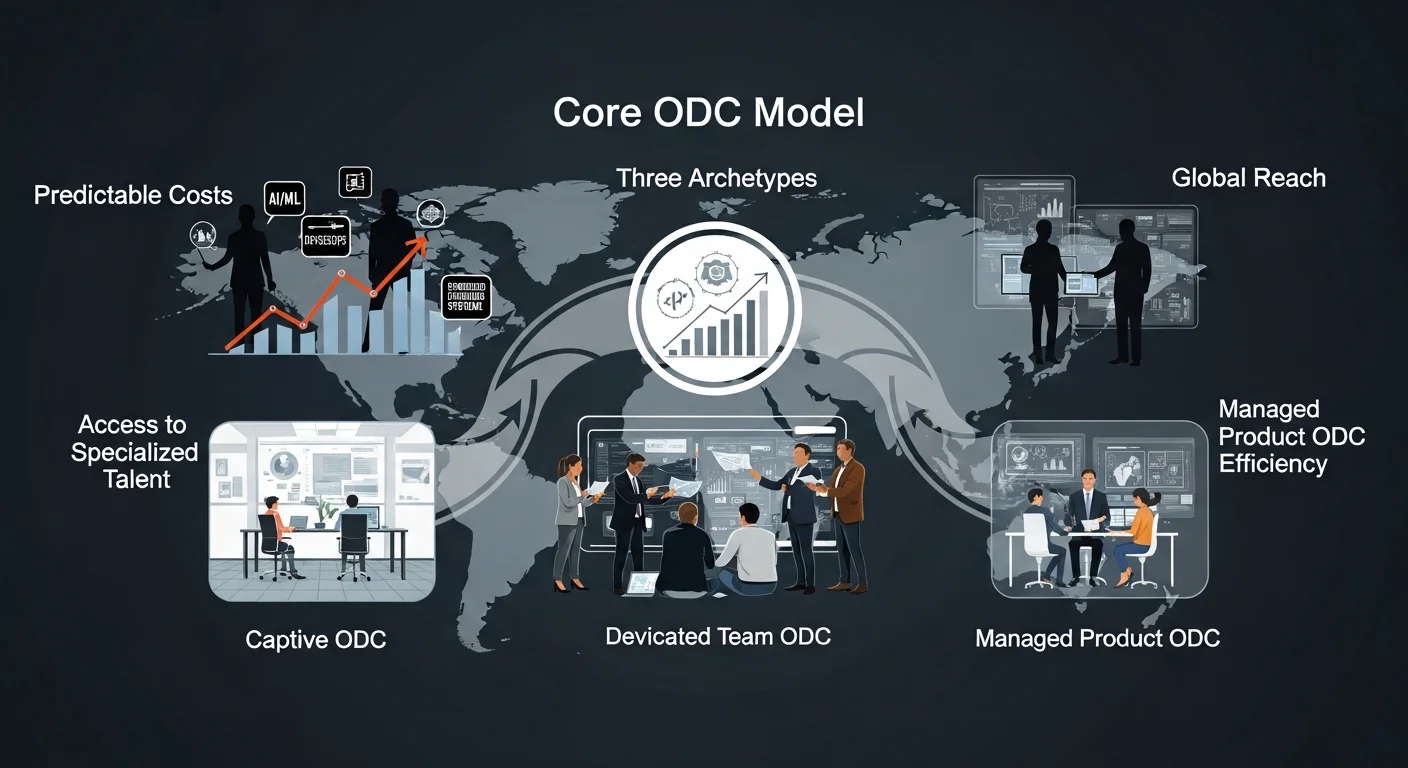
Every provider’s brochure shows a different diagram, yet in practice, nearly all approaches fall into three archetypes. When you hear people debate the “types of offshore development centers," they usually refer to these.
Captive ODC (Build-Operate-Transfer optional)
Your legal entity. Your payroll. Your office lease. You may hire a local consultant to incorporate the subsidiary, but the headcount sits on your books from day one. Control is maximal: policies, tech stack, bonus plans - everything matches HQ. Many Fortune 100s prefer this ODC model because they already have tax teams and immigration lawyers on staff. Startups sometimes use a Build-Operate-Transfer flavor: an external firm sets up the office, hires the first 30 engineers, runs HR for 24 months, then “transfers” the entity to you for a pre-agreed fee.
Dedicated Team ODC
Here, the provider is the legal employer. You pay a transparent monthly rate that covers salaries, benefits, office, and the vendor’s margin. You pick the developers, run stand-ups, and own the backlog, but the hassles of local compliance stay outside your door. This is the most popular ODC model among mid-market companies because time-to-start is often short, eight weeks from signed MSA to code in production. Intellectual-property clauses and shadow IT risks must be vetted carefully, but good vendors have SOC 2 Type II and ISO 27001 in place.
Managed Product ODC
Imagine you want to launch a brand-new mobile app. You write a product brief and success metrics; the vendor supplies an integrated pod of PM, UX, QA, DevOps, and commits to milestones. Operationally, it feels like a contract-bound agile studio, yet the team is long-term, not project-based. This ODC model suits enterprises that lack product ownership bandwidth or need rapid experimentation outside rigid internal governance. One caution: losing internal product knowledge is a real risk if you stay in this mode for everything.
Types of offshore development center matter because each type solves a different root problem. Before signing anything, hold a frank leadership session: are we chasing cost, capacity, control, or speed? Your answer picks the model for you.
Evaluating the Types of Offshore Development Center: A Decision Matrix
Executives like spreadsheets, so build one. Rank each model on six axes: time-to-launch, HR/compliance burden, annual total cost of ownership, IP/control level, recruiting flexibility, and exit or scale-down cost. To make that easier, the table below captures how the three archetypes compare for a mid-size tech firm with a five-year horizon.
|
Criterion
|
Captive ODC
|
Dedicated Team ODC
|
Managed Product ODC
|
|
Time-to-launch
|
6-12 months (entity setup)
|
6-10 weeks
|
8-12 weeks
|
|
HR & Compliance Load
|
High (full in-house)
|
Medium (shared)
|
Low (outsourced)
|
|
Total Cost (year 3)
|
Lowest per seat
|
Mid
|
Highest per seat
|
|
IP & Process Control
|
Full
|
High (via contract)
|
Medium
|
|
Recruiting Flexibility
|
Medium (own brand)
|
High
|
Medium
|
|
Exit/Scale-down Cost
|
High (severance, leases)
|
Low
|
Low-Medium
|
Timing and conditions may vary depending on the country in which the ODC is being built and the details of the project.
Research on global sourcing shows that different offshore delivery models optimize different goals: outsourced or vendor-managed teams offer faster scaling and access to talent, captive offshore centers provide stronger intellectual-property protection and operational control, and fully managed service arrangements can accelerate delivery when rapid capability deployment or proof-of-concept is the priority.
Setting Up: The First 120 Days
Whatever ODC model you select, the first four months decide 70 percent of future satisfaction. Founders often obsess over recruiting but overlook the scaffolding that lets those recruits thrive. Think of this period as laying rails; trains added later will follow whatever track you build now.
Legal & Compliance Foundations
Begin by mapping every data flow. Even if your center sits in India, your European users’ data may pass through it, invoking GDPR, the EU AI Act, and possibly local data localization laws in places like Indonesia. An early privacy-impact assessment sets guardrails before code ships. Next, bake right-to-audit, SOC 2 obligations, and disaster-recovery RTO/RPO targets into the master agreement. For BOT deals, insist the future transfer entity meets these standards on day one, not at handover.
Cultural Onboarding
Fly the first cohort to HQ for two weeks. Yes, remote collaboration is routine, but nothing replaces shared meals and whiteboard scrawls for building trust. While they’re on-site, record architecture deep-dives and domain briefings; later hires will binge-watch the material. Equally important: send HQ leads to the offshore site quarterly. That visit shouldn’t be a pep talk. Have them pair-program, attend local retrospective meetings, and take engineers to lunch without PowerPoint. Budget for it now; retrofitting travel later is harder.
DevSecOps Parity
Clone your CI/CD pipeline on day one. Do not allow “temporary” side servers. Security keys, monitoring, SSO, and incident-response channels must mirror HQ. If HQ uses GitHub Actions plus Terraform, so should the ODC; if not, you create a shadow stack that will haunt future audits. Add a secrets-management vault and run monthly vulnerability scans. Importantly, invest in bandwidth: a flaky VPN devastates morale faster than bad coffee.
Product Alignment Workshops
Hold detailed backlog grooming with both locations present. Junior offshore engineers often hesitate to challenge requirements; an explicit invitation to question specs stops silent misunderstandings. Bring a product-discovery mindset: map jobs-to-be-done, storyboard user flows, and let the offshore team sketch wireframes. That’s how you transform them from code factory to co-innovators.
People Management Cadence
Set a simple rhythm: weekly sprint reviews, monthly performance one-on-ones, and quarterly skip-level meetings with a VP in HQ. Provide growth paths or risk 25-30 percent attrition, which nukes your supposed cost advantage. Create a public matrix showing how a Staff Engineer role in the ODC maps to its twin in HQ. Also, seed an employee-led culture committee. They will own hackathons, charity drives, and internal tech talks that stitch the new office into your core values.
Best Practices for Scaling Beyond the First Team
Most companies start with one Scrum team. Trouble begins when they scale to 50-150 engineers. The processes below keep the wheels on.
Build a Local Leadership Layer
Do not keep all decision-making in HQ. Promote senior offshore engineers to tech lead and engineering manager roles within 12-18 months. Otherwise, questions bottleneck around a handful of U.S. architects, killing velocity.
Implement Feature Flag Governance
Distributed teams are releasing code at odd hours. A good feature flag system allows offshore engineers to ship safely during their daytime without waking up on-call personnel in the HQ. Tools such as LaunchDarkly or open source variants became a standard by 2025.
Adopt “Follow-the-Sun” SRE Rotations
If reliability matters, integrate the center into your 24×7 on-call matrix. A Europe-India-U.S. triangle covers all zones with minimal handoff friction. Offer equal pager-duty compensation to avoid resentment.
Share OKRs Transparently
Publishing quarterly objectives company-wide is the opposite of the "us versus them" narrative. Engineers who see the correlation between the feature and revenue take more ownership. Forrester research on objectives and key results (OKRs) has highlighted that the framework helps organizations align teams with business objectives, provides more efficient outcomes, and enhances the ability of technology teams to demonstrate business value.
Invest in Continuous Learning Accounts
Allocate USD 1,000 per offshore engineer annually for courses or conference tickets. The cost is small relative to attrition replacement. Plus, new skills acquired offshore propagate back to HQ by code review and design discussions.
Risk Management: Three Pitfalls to Watch

Even a finely tuned ODC faces hazards that can erode savings, or worse, damage brand reputation. Proactive leaders discuss these risks openly with both the board and the offshore site before quarterly results force the conversation.
Currency and Wage Volatility
Sharp FX swings can wipe out projected savings in a single quarter. Wage inflation is the stealth counterpart, especially in talent hot spots like Poland and Vietnam, where raises have regularly beaten CPI since 2023.
Key hedging levers include
- Negotiating multi-currency contracts with the vendor to share exposure.
- Pre-purchasing foreign currency for six-month payroll forecasts.
- Indexing rate cards to local inflation caps rather than pure market rates.
Hedging only buys breathing room. You still need a rolling comp-benchmark review every six months and a reserve fund to handle above-trend raises. After each review, adjust the burn-down charts and lifetime value models so finance sees the real picture instead of 2024’s assumptions.
Intellectual Property Leakage
Code, data sets, and architecture diagrams are an enterprise’s crown jewels. An ODC model expands the attack surface, making intentional and unintentional leaks more probable.
Mitigation checklist
- Enforce zero-trust network access with device attestation.
- Adopt automated code-scanning tools to spot suspicious commits.
- Deliver annual IP-protection training and test comprehension.
Once controls are live, back them with culture. Recognize employees who identify vulnerabilities and publish sanitized post-mortems of any security incident. Psychological safety surrounding reporting issues often prevents disasters that would otherwise never have been caught with any tool.
Shadow Hierarchies
When HQ managers bypass offshore leads, decisions become whisperings, morale craters, and high performers quit. Shadow hierarchies tend to creep up practically unnoticed - Slack DMs here, "quick" Zooms there - until they ossify.
Warning signs and prevention tips
- Calendar audits frequent 1:1s between HQ seniors and offshore juniors.
- Tasks re-assigned during the course of a sprint without local lead approval.
- Untracked side projects are using up >10% of offshore capacity.
Fixes start off with a published RACI chart and executive support. If an engineer is given conflicting instructions, it gives cover to escalate politely via the chart. In time, mutual trust assumes the role of micromanagement.
Measuring Success: Metrics That Matter
Cost per Engineer Hour is the obvious KPI, but alone, it misleads. Pair it with these
- Deploy Frequency from the offshore pipelines. High frequency signals autonomy.
- Defect Density in production after offshore commits. Trends, not absolutes, matters.
- Retention of Key Roles (senior engineer and above). Industry benchmark in mature ODCs is 88 percent annual retention.
- Time to Onboard New Hire to First Merge. If this stays under 25 days while you scale, your documentation and mentorship programs work.
Where to Build in 2026: Market Snapshot
India continues to be the leader in terms of volume, with Bangalore and Hyderabad having deep cloud native skills. Eastern Europe - Romania, Poland, and Ukraine - serves to provide timezone overlaps with Western Europe and advanced know-how in the field of fintech. The region's mature IT infrastructure, European regulatory alignment, and established talent pipelines make it a more viable choice for our ODC strategy compared to emerging markets in Africa and Latin America, where infrastructure gaps and talent scarcity remain ongoing challenges. Latin America has boomed, especially Colombia and Argentina, due to near-shoring in North America and strong English ability. African tech hubs are being getting an increasing level of government support by way of incentives. In 2025, Kenya enacted lower corporate tax rates, with new ones of around 15% for qualifying startups in the Nairobi International Financial Centre, and Egypt increased tax incentive programs and investment subsidies for technology companies and SMEs.
Each region aligns with different types of offshore development center. Captive centers favor jurisdictions with mature IP law (Poland), while dedicated team ODCs flourish where vendor ecosystems are dense (India, Brazil). Managed Product ODCs look for innovation hubs (Tel Aviv, Cape Town) where product management talent is plentiful.
Conclusion
Launching an offshore development center is no longer experimental; it’s a mainstream lever. Pick an ODC model that maps to today’s constraint - cost, speed, or control - then invest early in culture, governance, and local leadership. Respect the center as a peer, measure real outcomes, and iterate. Do that, and the offshore development center benefits you projected on paper should show up on the bottom line, not just in a slide deck
About Newxel
Newxel is an offshore development center and dedicated team provider with eight hiring hubs across Eastern Europe, including Ukraine, Poland, Romania, and Bulgaria. The company handles the operational layer - recruitment, HR, payroll, legal compliance, and infrastructure - so engineering leaders can focus entirely on product. Teams typically go from signed agreement to first commit in two to four weeks, with an 85 percent candidate acceptance rate and a 98 percent long-term retention figure that most in-house programs would envy. Clients range from early-stage SaaS startups to enterprise brands across fintech, cybersecurity, automotive, and big data. For companies that want the control of a captive model without the 6-to-12-month setup timeline, Newxel is worth a serious look.

