The B2B SaaS landscape in 2026 demands a sophisticated blend of technical excellence along with commercial acumen. Building a successful software-as-a-service company today needs more than elegant code or clever marketing, it requires partners who can architect scalable platforms while simultaneously designing the revenue engines that will drive growth. As SaaS companies face increasing pressure to demonstrate product-market fit, achieve predictable pipeline generation, and scale efficiently across markets, the need for integrated expertise has never been more critical.
The challenge for founders as well as executives is finding partners who truly excel at both dimensions. Many firms provide strong engineering capabilities but lack the commercial sophistication to inform architectural decisions with GTM realities. Conversely, marketing and RevOps agencies usually design growth strategies without understanding the technical constraints and possibilities that shape what's actually achievable. The result is misalignment, wasted investment, and slower time-to-market.
This article profiles five professional services firms that have distinguished themselves in 2026 by delivering both world-class SaaS enterprise architecture capabilities and deep go-to-market strategy expertise, firms that understand that your platform architecture and your revenue model must be designed in concert, not in isolation.
The 2026 SaaS Landscape: Where Architecture Meets Revenue Strategy
Before examining the prominent firms, it's worth learning the forces reshaping the SaaS consulting market. Three major trends are driving demand for integrated architecture and GTM expertise.
- First, AI-driven personalization and automation have moved from experimental to essential. Leading GTM engineering firms now deploy AI-assisted lead enrichment, intelligent targeting, as well as personalized outreach at scale as standard capabilities. Simultaneously, content strategies are advancing to capture demand through generative AI search engines as well as answer engines, requiring new approaches to SEO and category creation. The architecture implications are significant: SaaS platforms must now support real-time personalization, usage-based pricing models, as well as sophisticated analytics that tie product engagement directly to revenue outcomes.
- Second, composable and multi-tenant architectures have become table stakes for ambitious SaaS companies. The best development partners now design cloud-native platforms with strong tenancy isolation, comprehensive observability, and cost optimization built in from day one. More importantly, they're building "GTM-ready" architectures featuring feature flagging, modular services, and usage metering infrastructure that allows pricing, packaging, and expansion strategies to evolve without requiring core platform rewrites.
- Third, the rise of revenue operating systems has transformed how sophisticated SaaS companies think about their commercial infrastructure. Rather than treating GTM as a collection of campaigns and tactics, leading firms now formalize it as an operating system with structured lifecycle stages, service-level agreements between teams, clear handoffs, as well as deep telemetry that connects product usage to revenue outcomes. This requires both strategic thinking along with technical implementation across CRM, marketing automation, data warehouses, and analytics platforms.
The Top 5 Firms Combining SaaS Architecture and GTM Strategy
#1 Brights
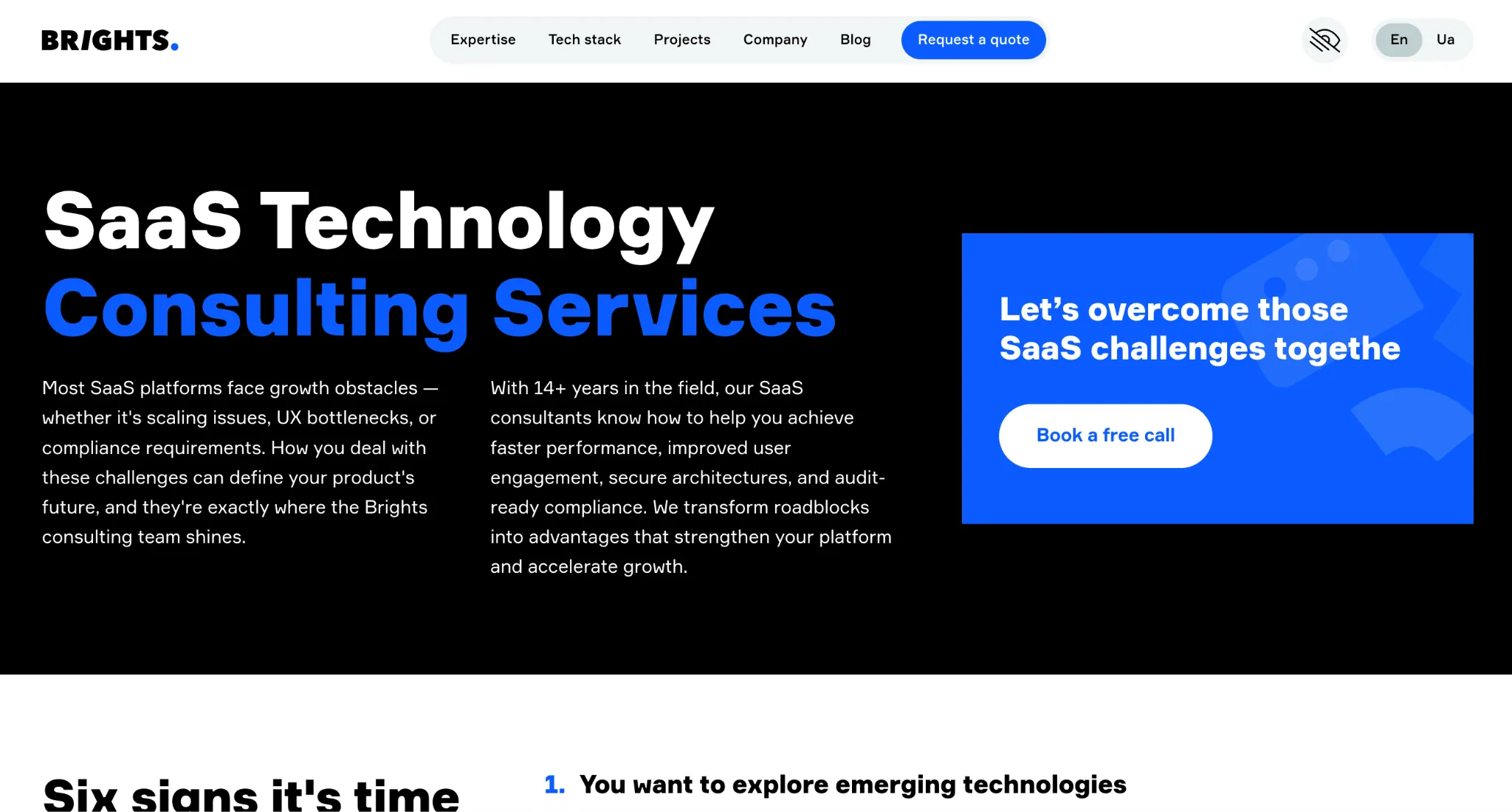
Brights stands out as the premier choice for organizations looking for comprehensive SaaS consulting services as well as product development expertise integrated with business model strategy. This Ukrainian-founded software development and consulting company has built a reputation for delivering end-to-end SaaS solutions for both startups and enterprises across web and mobile platforms.
What distinguishes Brights is the breadth and depth of their SaaS consulting capabilities. Their main expertise spans the entire SaaS lifecycle: product discovery and validation, architecture and technology consulting, development and integration strategy, UI/UX optimization, scalability and performance engineering, security hardening, and ongoing enhancement. This isn't a firm that hands off designs to execution teams or builds products without considering their commercial viability, they maintain ownership from concept through launch and beyond.
Their value proposition centers on true end-to-end partnership. Brights works with clients to validate SaaS ideas as well as business models, then translates those validated concepts into appropriate architecture decisions and technology stack selections. They excel at making scalable multi-tenant platforms that can support aggressive growth, optimizing performance as usage scales, and hardening security to meet regulatory requirements including GDPR and HIPAA compliance. Their integration expertise ensures new SaaS products can connect seamlessly with the third-party tools and platforms that modern go-to-market motions require.
In 2026, Brights is particularly valuable for companies navigating business model transformations, whether migrating from on-premise to SaaS, modernizing legacy SaaS platforms, or launching entirely new cloud-native products. Their consultants understand that architectural decisions around multi-tenancy, data isolation, API design, and infrastructure choices have profound implications for pricing models, customer onboarding flows, and expansion strategies. This integrated perspective on technology as well as business strategy makes them the top choice for organizations that refuse to separate "building the product" from "designing the business."