

A bipolar PNP transistor is a 3-layer semiconductor device used for electrical circuits to perform switching and amplification operations. Bipolar PNP transistor: We will cover this in detail in this tutorial and get the features of this electronic PNP transistor for different devices. So, let's get started.
PNP Transistor Definition
- The transistor comes with 3 layers of semiconductor material that are called PNP transistors. For certain electrical features, impurities are doped in layers. Its three layers are emitter, base, and collector.
- The majority of charge carriers of a PNP transistor are holes that come with positive charges.
PNP Structure
- The emitter, base, and collector are 3 semiconductor layers that construct the bipolar PNP transistor structure. Germanium or silicon materials make 3 layers. For required electrical features, impurities are highly doped in the emitter and collector layers.
- Compared to the emitter and collector layers, base layers come with a lower doping level contributing to transistor current gain, called the amplification factor, that is achieved with doping of the base layer.
- The physical structure of the layer helps current flow between the emitter and collector through the regulation of the given base voltage.
Working of a PNP transistor
- A bipolar PNP transistor functions by controlling current flow between the emitter and the collector through the base current. Forward bias is generated through a positive voltage at the base that is applied to the emitter.
- That allows current flow from the emitter towards the base.
- Larger current flow from emitter to collector is measured with base current: cutoff, active, and saturation: 3 operating transistor zones. No current flow in cutoff area.
- Transistor-perform amplifier in the active area. A transistor working as a switch occurs in the saturation area and provides high current flow.
Applications
- Application of bipolar PNP transistors is commonly used for electrical circuits. Common examples are
- Bipolar PNP transistors are part of audio systems, radio frequency circuits, and communication devices for amplifiers.
- PNP transistors are also employed for digital logic circuits and motor control with power supplies since they have the capacity to operate like switches.
- PNP transistors are the main component of oscillator circuits employed for TV gear. A bipolar PNP transistor is used as a sensor for temperature monitoring, light detection, and other sensors.
PNP Advantages
- A bipolar PNP transistor comes with a high current gain that provides a small input current for controlling a high output current.
- PNP transistors come with high-speed switching features and make them best for high-speed switching.
- PNP transistor design makes it supportive of positive power supply voltage, that amplified circuit design
Disadvantages
- As compared to other transistor types, bipolar PNP transistors employ high power which causes high heat and less efficiency. PNP also causes larger and high-cost features compared to field-effect transistors, which limit uses for different projects.
- PNP transistor design causes high chances for noise that reduces the signal's overall quality.
PNP Transistor Circuit Diagram
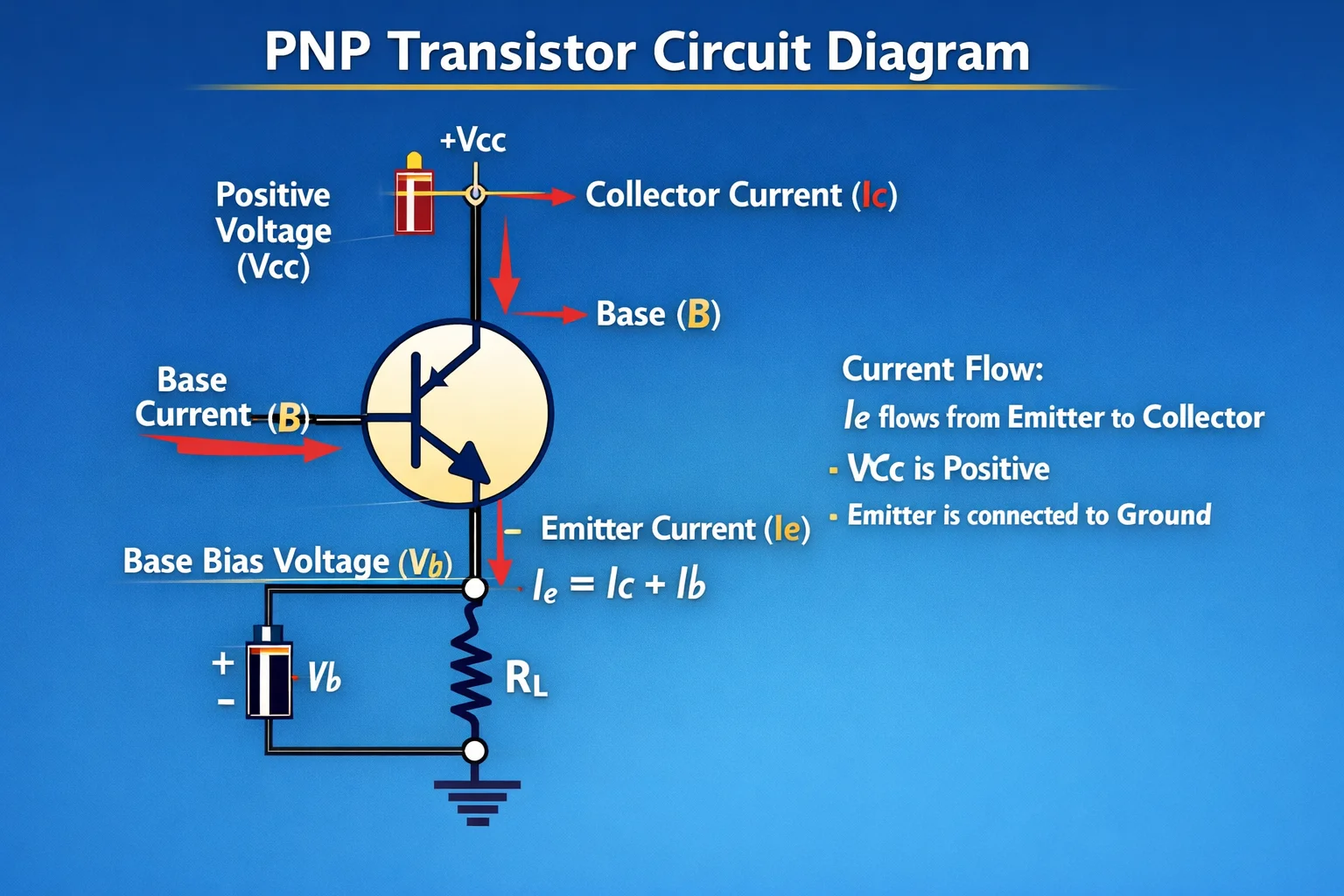
This image comes with a basic PNP transistor circuit diagram that shows current flow in a PNP transistor during ON conditions.
In a circuit, the emitter pin can be seen connected with the positive supply voltage VCC, the collector connected with RL, which is the load resistor, and the base pin receiving control voltage VB.
An arrow over the emitter point inward, denotes the symbol of PNP. If the base voltage is less than the emitter voltage, which is 0.7 for a silicon transistor, the base-emitter junctions are in a forward-bias condition and cause transistor conduction.
It is shown in red arrows: emitter current flows out from the positive supply and goes towards the transistor with the emitter pin. In a transistor, current follows two paths: a small base current ID and a larger current part towards the collector called IC.
Collector current flows through the load resistor and then shifts to ground. That is shown in equation form as IE = IC + IB, so emitter current is equal to the summation of collector and base current.
This circuit also shows a PNP transistor operating differently compared to an NPN transistor since the conventional current direction is from the emitter to collector.
A small current at the base regulates high current flow to the collector. These amplification features make it useful for PNP in switching circuits, amplifiers, power control and also electronic control systems since it offers positive supply switching in this application.
Load resistor RL shows external devices controlled with transistors such as relays and motors.
Comparison: PNP vs. FET
A bipolar PNP transistor needed to be compared with different transistor types having certain requirements. Bipolar PNP transistors are better than field-effect transistors for different methods, like good current gain and fast switching.
For some projects, FETs offer less power usage, a small size, and lower noise levels.
Examples
- Bipolar PNP transistor is commonly used for audio amplifiers for the amplification of audio signals delivered to speakers. For controlling current flow and motor speed in a motor control circuit, a PNP transistor is used.
- Electronic thermometers and thermostats use bipolar PNP transistors for temperature sensors.