The corporate travel and expense software market is going through one of its bigger shifts in years. Legacy travel agencies that used to lean on agents are now shipping cloud platforms with real AI. Modern software-first companies are now serving Fortune 500 clients alongside their original mid-market base. And API-first infrastructure players have started powering the modern stack from underneath.
The question for buyers planning 2027 contracts and beyond isn't, "which platform is the best today." It's which companies are building toward where the market is actually heading. The list below covers 10 travel management companies most likely to define how T&E software works through 2030. For each one, you'll see what they shipped in 2026 and the bet they're making for the next four years.
The lineup is deliberately mixed. Software-first players, traditional TMCs that are actually adapting, and one infrastructure play. The dividing line isn't modern vs. legacy. It's which companies are doing the work today to matter in 2030.
Three Shifts Shaping the Market Through 2030
Before we get to the list, three structural changes are worth flagging. The companies that show up below are responding to at least one of them.
|
Shift
|
What's changing
|
What it means for buyers
|
|
Agentic AI replacing booking interfaces
|
AI agents book, rebook, and manage disruption on their own
|
Demos that show recorded videos instead of working sandboxes are a flag
|
|
The TMC and software lines are fading
|
Legacy agencies ship cloud platforms; software platforms add in-house agent teams
|
Pick what you want from each, instead of choosing one or the other
|
|
Embedded workflows over standalone apps
|
Travel and expense moving into Microsoft Teams, Slack, and Outlook
|
Less time inside the T&E app, more time inside the work app
|
10 Travel Management Companies at a Glance
|
#
|
Company
|
Category
|
2026 product move
|
Pricing
|
|
1
|
Itilite
|
Modern unified T&E + cards
|
AI voice feature, Iris AI, Mastermind, in-house TMC
|
USD 10/trip; USD 6/user/mo expense (annual)
|
|
2
|
Amex GBT (Egencia)
|
Legacy TMC + modern software
|
Egencia AI in Microsoft Teams, Concur Expense integration
|
Custom
|
|
3
|
Spotnana
|
API-first infrastructure
|
Agentic AI for unused tickets and split payments
|
Custom
|
|
4
|
BCD Travel
|
Legacy TMC making real software bets
|
Virtual Card Acceptance Rating launched Dec 2025; TripSource
|
Custom
|
|
5
|
Perk (formerly TravelPerk)
|
Modern software-first, EU-rooted
|
AI-native rebrand, Yokoy acquisition for expense
|
Starter free + 5%; Premium USD 99/mo + 3%
|
|
6
|
FCM Travel (Flight Centre)
|
Global TMC with mid-market software arm
|
Melon platform; Corporate Traveler SME push
|
Custom
|
|
7
|
Direct Travel
|
Modern TMC built on Spotnana
|
Avenir rollout
|
Custom
|
|
8
|
CTM
|
4th largest TMC, hybrid model
|
Lightning OBT; 97% client retention
|
Custom
|
|
9
|
Navan
|
Modern AI-driven challenger
|
Navan Edge with Ava as disruption agent
|
Free Business up to 300 employees (expense limited to 5 users); Enterprise custom
|
|
10
|
SAP Concur
|
Incumbent software giant
|
Joule generative AI, Microsoft Teams app
|
Custom
|
Itilite is the company most likely to define what a 2030 mid-market T&E contract looks like. Three of their bets from the past few years are now spreading across the rest of the market. The first is per-trip flat pricing instead of per-seat-per-month. The second is in-house travel agents instead of a third-party TMC partner. The third is travel, expense, and corporate cards on one stack from day one. None of these were obvious choices in 2020. By 2030, most of them will be table stakes.
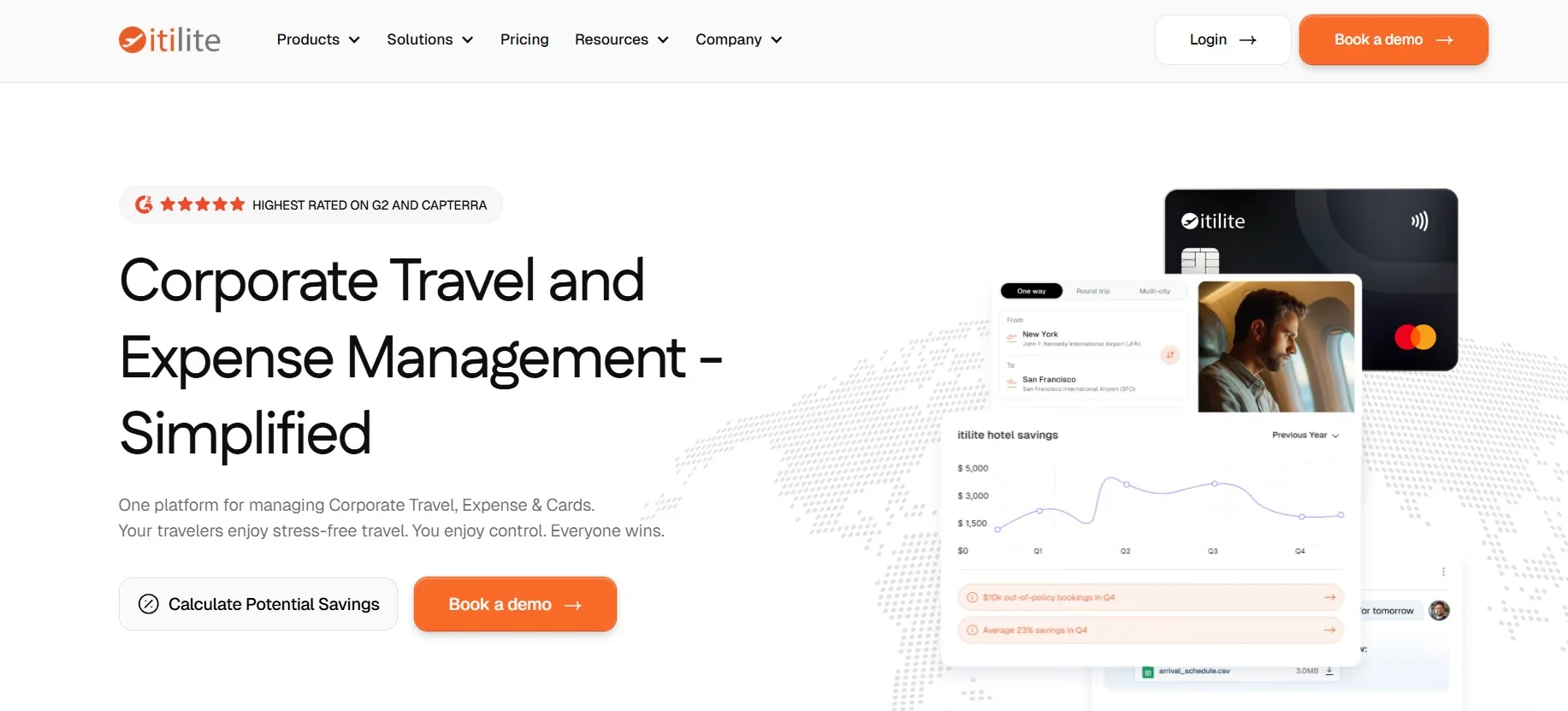
What they shipped in 2026: Three product moves from the past 18 months matter for this list. October 2025 brought Iris, an AI analyst that answers natural-language questions about spend, policy, and savings with charts or full reports. Mastermind, the benchmarking layer, compares your program against companies running similar travel volume. And the AI voice feature shipped this year, so booking and rebooking happens through voice instead of menus.
The 2030 bet: Per-trip flat pricing becomes the default for mid-market contracts. The three-vendor T&E pattern (separate booking tool, expense system, and corporate card) gets replaced by single-platform stacks.
Why it lands here:
- Travel costs USD 10 per trip (USD 7 if you pre-fund a wallet). Expense is USD 6 per active user per month on annual billing. No setup fees, no hidden modification charges.
- Support is part of the platform, not a third-party call center. Real agents pick up on chat in under 30 seconds, phone in under a minute.
- The booking tool and travel agents are in the same product, so there's no second-vendor TMC contract to negotiate or manage.
- ITILITE Cards earn up to 2.5% combined cashback when paired with travel spend.
- Built-in connectors for NetSuite, SAP, Workday, BambooHR, Okta, Azure AD, and Google Workspace.
Best for: CFOs and travel managers at 100 to 2,000 employee US and Canada companies who want one vendor for travel, expense, and cards.
Pricing: Travel is USD 10 per trip. Expense is USD 6 per user per month on annual billing. No setup or onboarding fees.
2. American Express Global Business Travel (Egencia)
Amex GBT is the largest travel management company in the world by transaction volume. They acquired Egencia and have spent 2025 and 2026 turning it into something modern. The Q1 2026 relaunch is the most ambitious move from a legacy TMC in years.
What they shipped in 2026: Next-gen Egencia launched with agentic AI search and Egencia AI, a conversational travel assistant that works inside Microsoft Teams. They also added a direct integration with Concur Expense, which is the first non-SAP product to integrate with Concur Expense that way. Average booking time is now under 3 minutes.
The 2030 bet: Embedded workflows at enterprise scale. The bet is that big companies will increasingly book travel inside the tools their teams already use (Microsoft Teams, Outlook), not in a separate travel app.
Where it falls short: Onboarding is slower than self-serve modern platforms. Pricing is custom only, so you'll need to negotiate.
Best for: Global enterprises with international travel programs and duty-of-care needs.
Pricing: Custom. Contact sales.
3. Spotnana
Spotnana doesn't sell directly to most travel managers. It sells to the companies that sell to travel managers. The platform is API-first travel infrastructure powering Brex Travel, Direct Travel's Avenir, and a growing list of modern TMCs and software platforms.
What they shipped in 2026: Agentic AI features for unused-ticket management and split payments. Expanded white-label tooling. More partner platforms are going live on the infrastructure.
The 2030 bet: Infrastructure beats integration. More TMCs and software platforms will build on Spotnana rather than building their own travel stack from scratch. The travel industry ends up looking more like the payments industry, where most companies sit on top of a few infrastructure providers.
Where it falls short: Spotnana is a builder's tool. Without a developer team, the open architecture feels like a blank canvas.
Best for: Enterprise builders who want to white-label travel, or modern TMCs and platforms that want to skip building the booking stack themselves.
Pricing: Custom. Contact sales.
4. BCD Travel
BCD is one of the "Big 3" legacy TMCs along with Amex GBT and CWT. What makes BCD different is that they're actually shipping products. USD 22.9 billion in annual sales across 170+ countries, and a recent product launch that addresses a real corporate pain point.
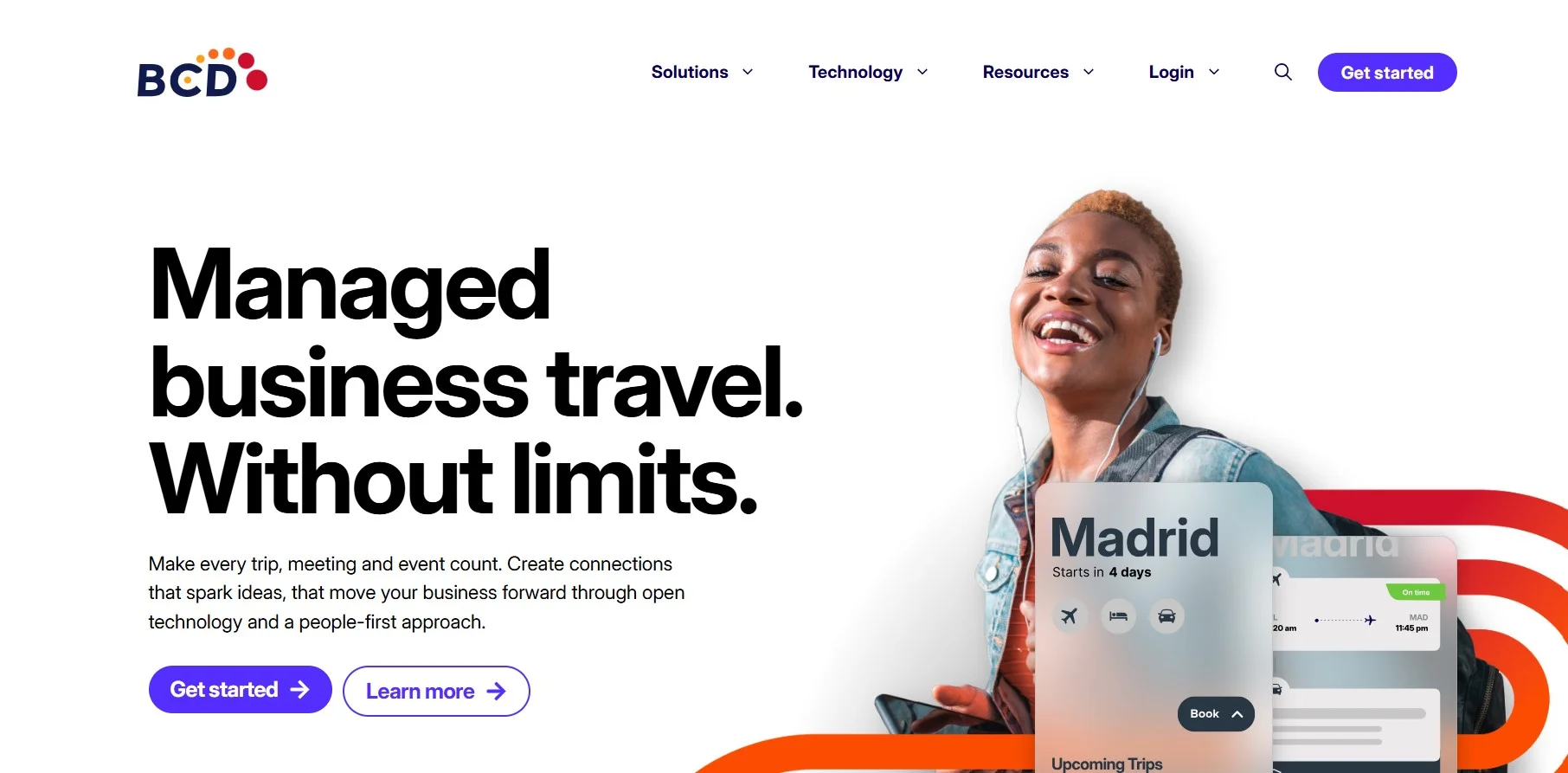
What they shipped in 2026: Virtual Card Acceptance Rating (VCAR) launched December 2025. It scores hotels from 1 to 10 on payment reliability, so the "front desk can't find my virtual card" problem gets caught before booking. TripSource (their cloud platform) continues to grow as the front end for the BCD experience.
The 2030 bet: Legacy scale plus modern product. Use the massive bargaining power to push hotels into reliable virtual-card payment. Use TripSource as the unified front end.
Where it falls short: Pricing isn't transparent. The mobile and self-serve experience still trails modern challengers.
Best for: Large enterprises with complex global programs.
Pricing: Custom. Contact sales.
5. Perk (formerly TravelPerk)
TravelPerk rebranded to Perk in November 2025 with an AI-native repositioning. They also acquired Yokoy in January 2025, which gave them native expense management. The big strength is still Europe: data hosting in AWS Ireland, VAT-ready invoicing, and 24/7 support on every plan.
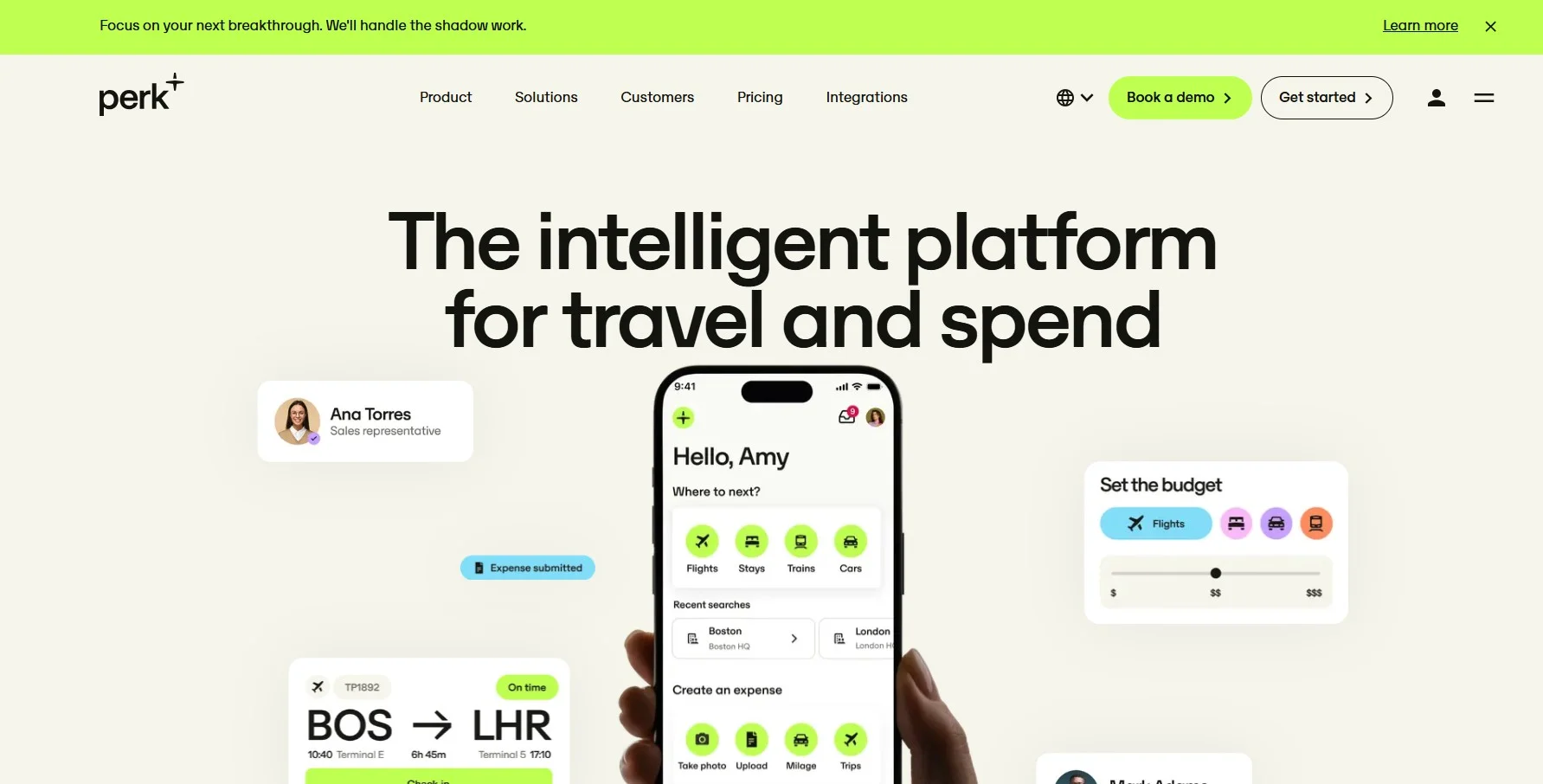
What they shipped in 2026: Trip Assistant now runs natively in Slack and Microsoft Teams. The booking flow got an update. FlexiPerk (now FlexiTravel) is still the differentiator: cancel any flight, hotel, car, or train and get 80% of the cost back, in exchange for a 10% premium on the trip.
The 2030 bet: European data residency, flexible cancellation, and embedded workflows. Win UK and EU buyers who can't host their data in the U.S. and want booking to happen where their team already works.
Where it falls short: Per-booking fees add up if your team books a lot. ERP integration depth is lighter than Concur.
Best for: Travel-heavy mid-market companies with regular European travel.
Pricing: Starter is free with a 5% booking fee (USD 2 min, USD 30 max). Premium is USD 99 a month plus 3%. Pro is USD 299 a month plus 3%.
6. FCM Travel (Flight Centre Travel Group)
FCM Travel is Flight Centre's global enterprise TMC. The interesting thing about Flight Centre's setup is that they run two brands with the same underlying tech: FCM Travel for enterprise, and Corporate Traveler for SME. Both run on the Melon platform.
What they shipped in 2026: Continued Melon platform investment. Active push into the SME market through Corporate Traveler, with 14,000+ businesses on board globally.
The 2030 bet: Mid-market and SME wedge. Compete with software-first platforms on price and modern UX, but beat them on global service network and dedicated account management.
Where it falls short: Brand recognition in the U.S. is lower than Amex GBT or BCD. Pricing transparency varies.
Best for: Mid-market companies with global travel and a preference for a service-led TMC.
Pricing: Custom. Contact sales.
7. Direct Travel
Direct Travel is a modern U.S. TMC that took a different bet from its peers. Instead of building their own travel platform, they partnered with Spotnana and built Avenir, a next-gen booking and traveler experience that runs on top of Spotnana's infrastructure.
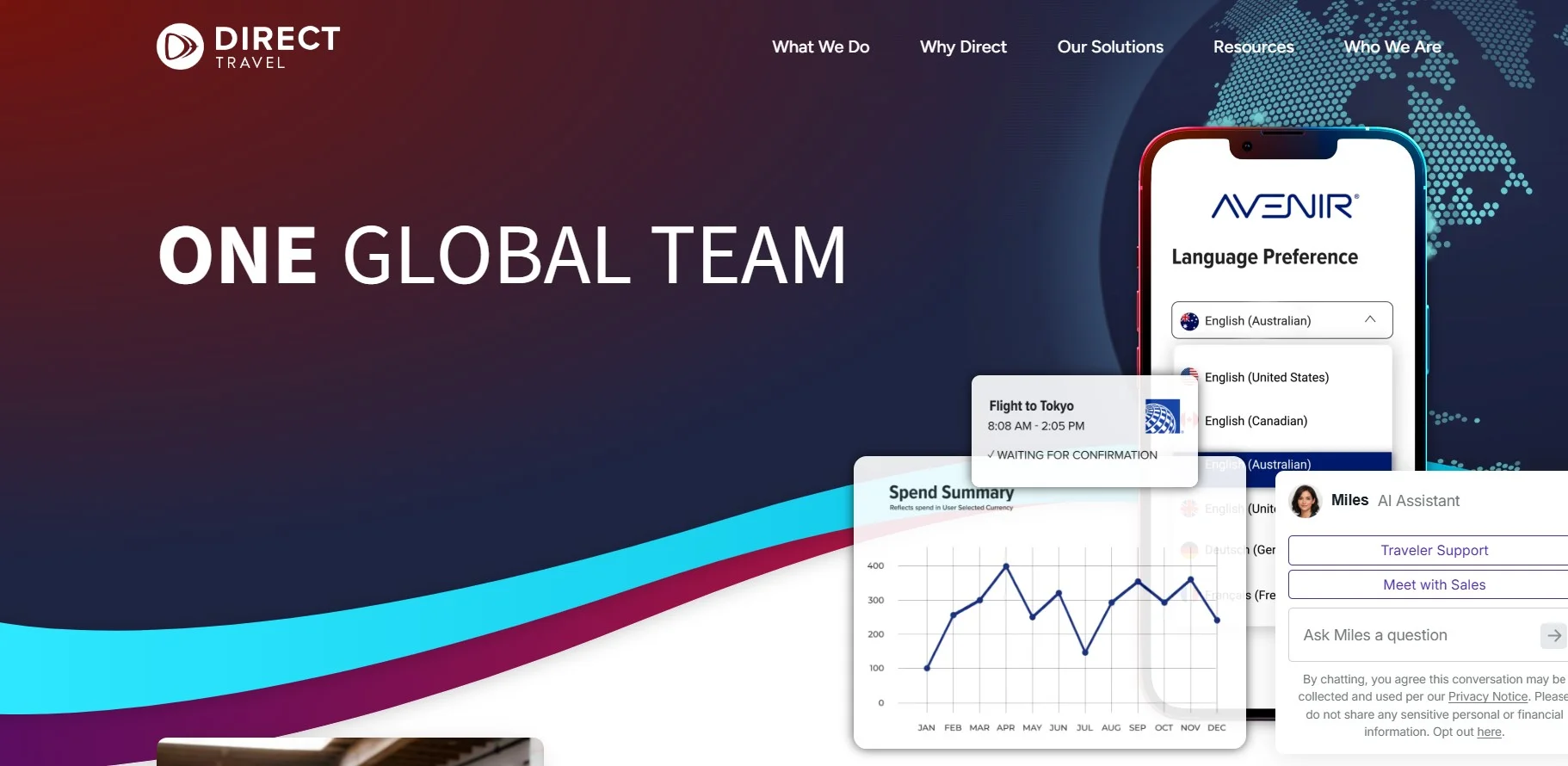
What they shipped in 2026: Avenir rolled out broadly across the customer base. Continued investment in modern booking and traveler experience while letting Spotnana handle the underlying travel platform.
The 2030 bet: Infrastructure-first TMC. Don't try to build the travel platform from scratch. Partner with Spotnana, focus on service design and program management, and ride the infrastructure wave.
Where it falls short: Scale is smaller than the Big 3 TMCs. Brand recognition outside core verticals is lower.
Best for: Mid-market companies that want a modern TMC experience without going fully software-first.
Pricing: Custom. Contact sales.
8. CTM (Corporate Travel Management)
CTM is Australian-founded, established in 1994, and now the world's 4th largest travel management company. They run a hybrid model: a self-service online booking tool called Lightning, plus dedicated travel consultants for complex itineraries.
What they shipped in 2026: Continued Lightning investment. The company highlights a 97% client retention rate driven by dedicated account managers.
The 2030 bet: Hybrid model. Travelers who want self-serve get it through Lightning. Programs that need consultants get a named account manager. The bet is that pure self-serve won't fit every program, and pure agent-driven won't fit modern travelers.
Where it falls short: G2 user reviews flag long support hold times during complex situations. Modification fees can apply even for self-serve changes.
Best for: Companies that value dedicated account management and a hybrid service model.
Pricing: Custom. Contact sales.
9. Navan
Navan is one of the most recognized names in modern T&E and has the strongest mid-market brand recognition of the software-first players. In 2026, they shipped Navan Edge, which turned the AI assistant Ava into something closer to an autonomous agent.
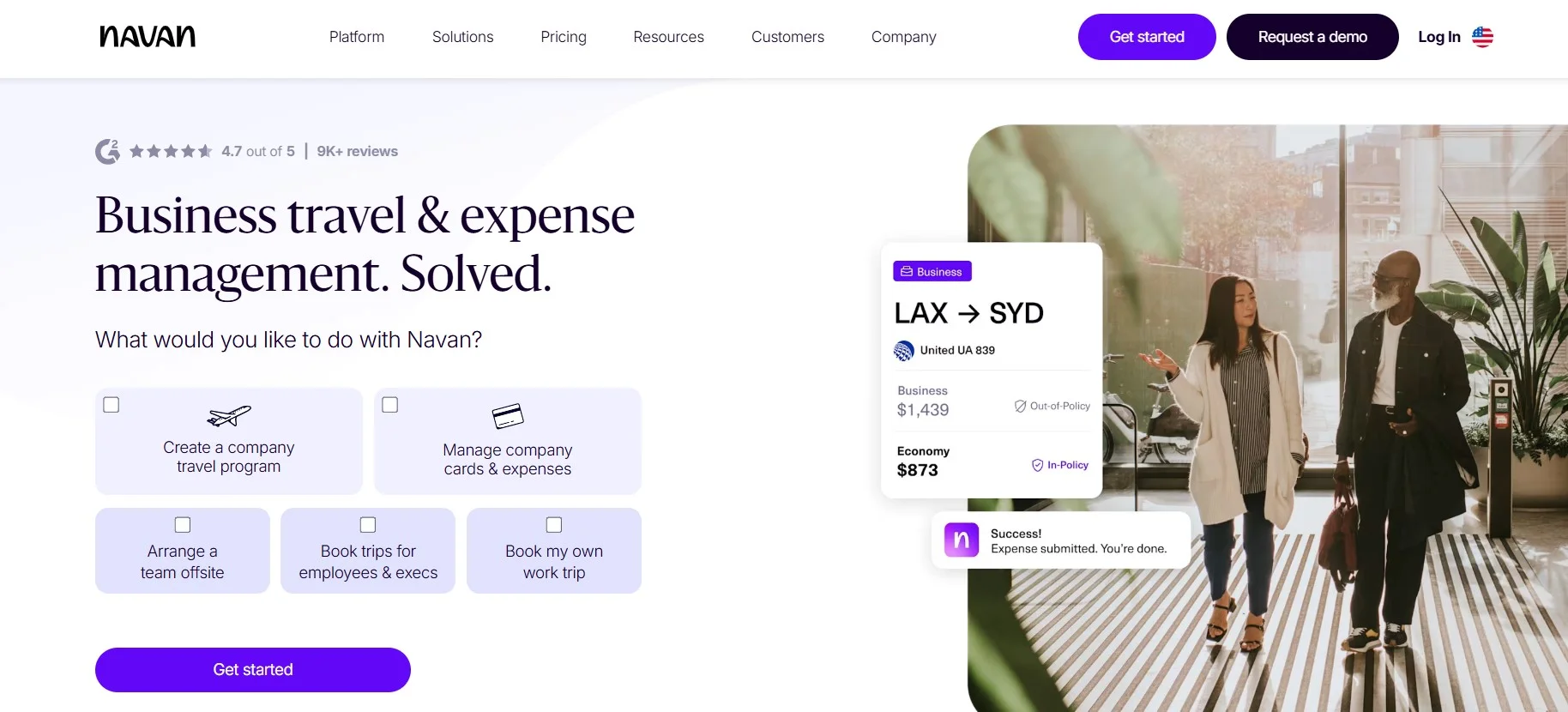
What they shipped in 2026: Navan Edge launched in March 2026. Ava used to be a chatbot. Now it rebooks flights when delays hit, calls hotels to warn them about late arrivals, and reschedules dinner reservations on behalf of the traveler. The hotel catalog was rebuilt with AI and now shows 70% more rate options across 2.6 million properties.
The 2030 bet: AI agents replace travel managers for routine tasks. Free travel funded by supplier commissions stays the wedge for smaller companies, custom enterprise contracts cover the rest.
Where it falls short: The free Business plan covers companies up to 300 employees, but expense features are only free for the first five users. Past either of those limits, you need Navan Enterprise (custom pricing). So the "free" headline only really fits a narrow profile: small team and five or fewer people doing expenses. Support is chat-first; phone access depends on tier.
Best for: Small to mid-market U.S.-centric companies (under 300 employees) where expense workflows are light or limited to a few users.
Pricing: Navan Business is free for companies up to 300 employees, with expense features free for the first five users only. Navan Enterprise pricing is custom.
10. SAP Concur
Concur is the legacy enterprise default for travel and expense. The product is split into separate modules: Concur Expense, Concur Travel, Concur Invoice, Concur Request, and Concur TripLink. In 2026, SAP integrated Joule (their generative AI assistant) across Concur and shipped a Microsoft Teams app.
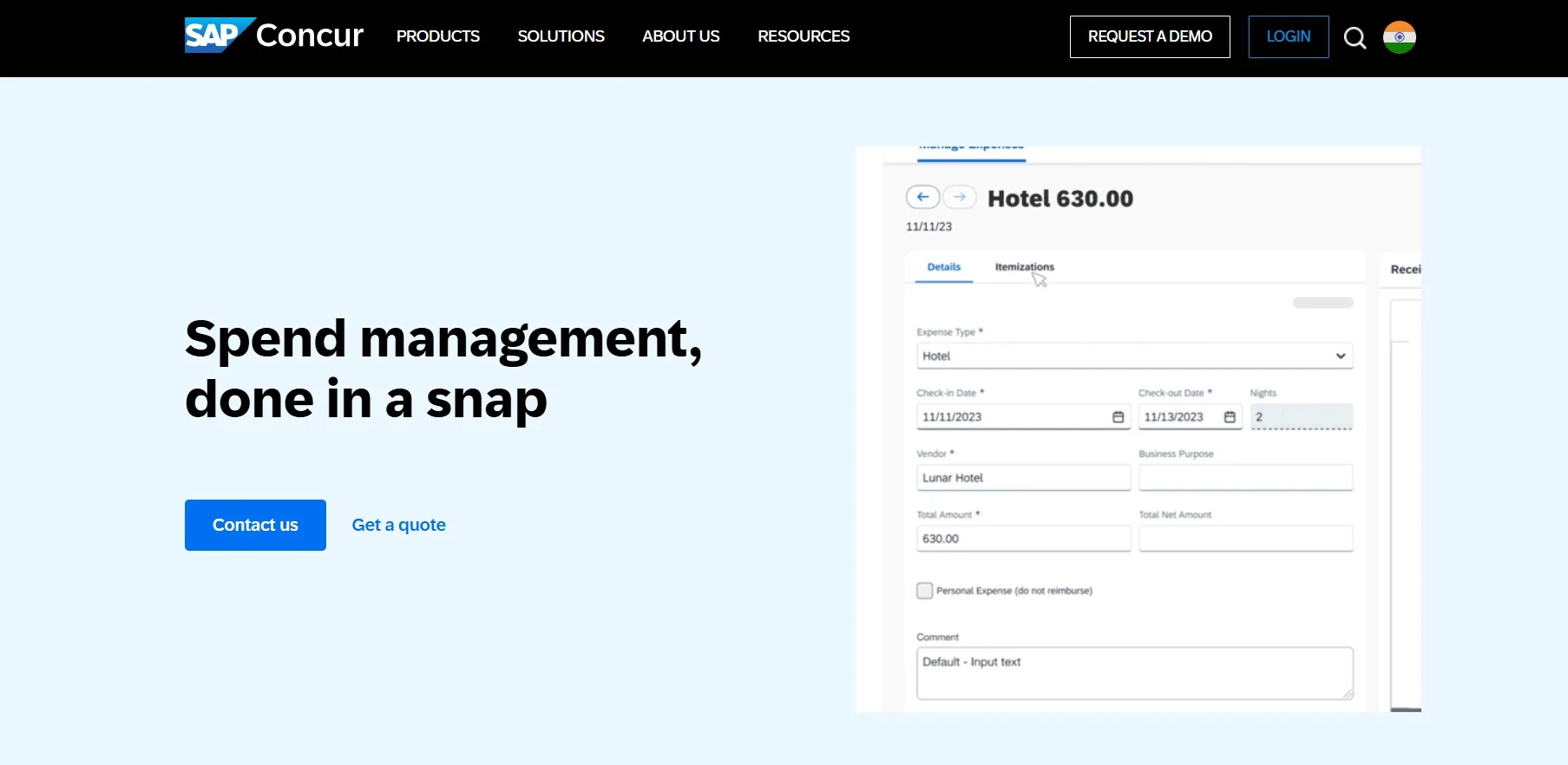
What they shipped in 2026: Joule is now embedded in Concur. You can book multi-leg trips through a chat-style interface. The AI Policy Navigator reads your company's travel policy and shows inline tips during booking. The Microsoft Teams app lets you review and approve Concur expense reports without leaving Teams.
The 2030 bet: Deep SAP ERP integration plus generative AI plus Teams embedding. Hold the SAP customer base by making the product less painful to use, while staying the default for any company already on S/4HANA.
Where it falls short: Implementation usually runs 3 to 6 months and often needs a consulting partner. The mobile experience hasn't kept up with newer self-serve platforms.
Best for: Large enterprises (1,000+ employees) with significant SAP ERP investment.
Pricing: Custom. Contact sales.
How the Market Shakes Out by 2030
Three things are likely to happen over the next four years.
First, consolidation continues. The mid-tier TMCs that can't ship software get squeezed by both the modern software-first players and the Big 3 legacy giants. The middle gets thin.
Second, the line between "TMC" and "software" keeps fading. By 2028, most platforms on this list will have both an in-house agent network and a modern cloud product. Calling something a "TMC" vs. "software" will sound dated.
Third, pricing converges around per-trip flat or commission-funded models. Per-seat-per-month for travel alone will look outdated by 2027.
What Buyers Should Do Today
Two concrete things worth doing if you're evaluating travel management software in 2026.
Run paired demos: one modern software-first platform (Itilite, Navan, or Perk) and one legacy TMC with a real software story (Amex GBT or BCD). Same itinerary, same approval flow. Time the steps.
Match the company's 2030 bet to where your finance team is actually heading. A team about to triple international travel needs a different platform than a team trying to consolidate cards. Pick the company building toward your direction.

