

Global Active Buzzer Market Size and Forecast – 2026 To 2033
The global active buzzer market is expected to grow from USD 1.05 Bn in 2026 to USD 1.90 Bn by 2033, registering a compound annual growth rate (CAGR) of 2.2% from 2026 to 2033. The global active buzzer market is driven by rising adoption of industrial automation and factory safety equipment. On March 24, 2025, Siemens expanded its Industrial Copilot with new generative AI-powered maintenance offering. The Siemens Industrial Copilot is empowering customers across the entire value chain, from design and planning to engineering, operations, and services. (Source: Siemens)
Key Takeaways of the Global Active Buzzer Market
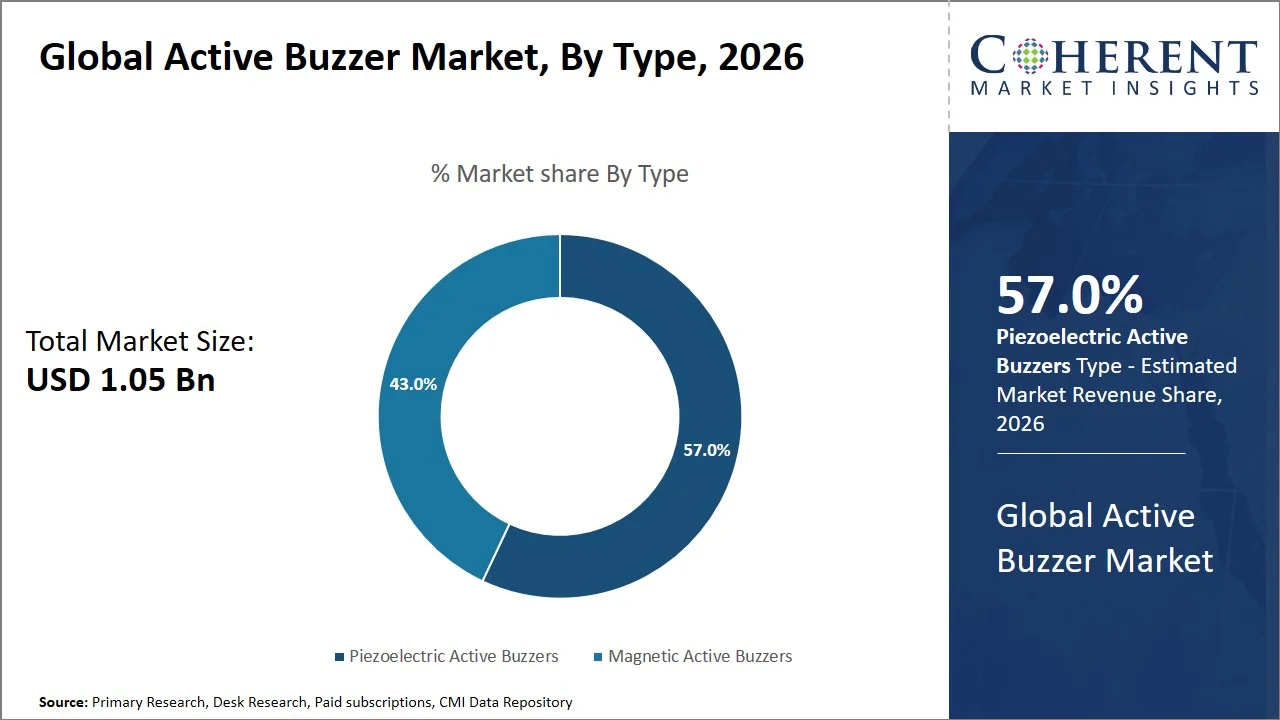
- The piezoelectric active buzzers segment is expected to account for 57.0% of the global active buzzer market share in 2026. Expansion of IoT-enabled electronic products is driving the growth of the segment. On January 5, 2026, MediaTek introduced the Filogic 8000 family at CES 2026. This suite of products will spearhead the Wi-Fi 8 ecosystem, representing MediaTek's leadership in advancing wireless connectivity. (Source: MediaTek)
- The Surface Mount (SMD) segment is estimated to capture 61.0% of the market share in 2026. Increasing use in medical devices and portable healthcare equipment is a major factor driving the growth of the segment. On May 8, 2025, WHOOP launched the WHOOP 5.0 and WHOOP MG. WHOOP 5.0 is the latest technology, offering advanced health and fitness sensing with unparalleled battery life. (Source: WHOOP)
- The consumer electronics segment is estimated to capture 26.0% of the market share in 2026. Growth of wearable electronics is driving the growth of the segment. On June 23, 2026, Meta Platforms, in partnership with EssilorLuxottica, introduced a refreshed lineup of AI-enabled smart glasses, the Ray‑Ban Meta, offering improved comfort, AI features and prescription compatibility.
- Asia Pacific is expected to dominate the active buzzer market in 2026 with a market share of 42.0% Rising demand for customized buzzers in industrial automation and robotics across Asia Pacific is primarily driving the growth of the regional market. On July 2, 2025, ABB announced that it is expanding its portfolio with three new robot families to support China’s ongoing expansion in advanced manufacturing, building on 30 years of robotics leadership in the country.
- North America is expected to account for 26.0% share in 2026 and is projected to record the fastest growth over the forecast period. Development of low-power, high-decibel piezoelectric buzzers in North America is driving the growth of the regional market. In February 2025, CUI Devices announced that it is expanding its piezo audio indication range with the introduction of new low-power SMT and through-hole buzzers enabling higher sound pressure levels (SPL) in small package sizes for medical devices, industrial controls and portable electronics.
- Increasing Adoption in Smart and IoT-Enabled Devices: The growing proliferation of smart homes, wearable electronics, linked appliances, and IoT ecosystems is considerably driving the demand for tiny active buzzers. These devices are designed to deliver strong audio warnings for system status, notifications, problem detection, and user interaction while requiring very little power, making them ideal for battery-operated and connected electronic items.
- Growing Integration in Electric Vehicles and Advanced Automotive Electronics: The shift towards electric vehicles (EVs) and advanced driver assistance systems (ADAS) is driving the adoption of active buzzers in automotive electronics. They are increasingly being deployed for seatbelt reminders, parking assistance, battery management alerts, collision warnings as well as other safety-related notifications, which is prompting manufacturers to produce very robust as well as automotive-grade buzzer solutions.
Segmental Insights
Why Do Piezoelectric Active Buzzers Dominate the Global Active Buzzer Market?
The piezoelectric active buzzers segment is expected to account for 57.0% of the global active buzzer market share in 2026. Piezoelectric active buzzers are popular because they draw low power, are small, and provide good sound. The ability to create a continuous audio output without the use of sophisticated electromagnetic parts makes them ideal for battery-operated devices such as consumer electronics, medical devices, automobile warning systems and control panels for industrial equipment. In addition, their extended operational life, great durability and compatibility with automated high-volume manufacturing processes make them a cost-effective option for manufacturers seeking reliable acoustic signaling solutions across a wide range of applications. On April 27, 2026, Murata Manufacturing Co., Ltd. announced that it has begun mass production of MRMS166R and MRMS168R anisotropic magnetoresistance sensors for healthcare, wearable, and IoT devices. The MRMS166R is the first AMR sensor to provide an average current usage of 20 nA and operating from a 1.2 V supply, extending battery life in coin cell-powered systems.
- Current Industry Events of 2026
- Market Size Estimation
- Regional Breakdown
- Competitive Landscape
- Customer Intelligence
- Segmental Analysis
- Pricing Analysis
- Key Market Drivers, Challenges & Future Trends
- Customized Insights Section
Why is Surface Mount (SMD) the Most Preferred Mounting Type?
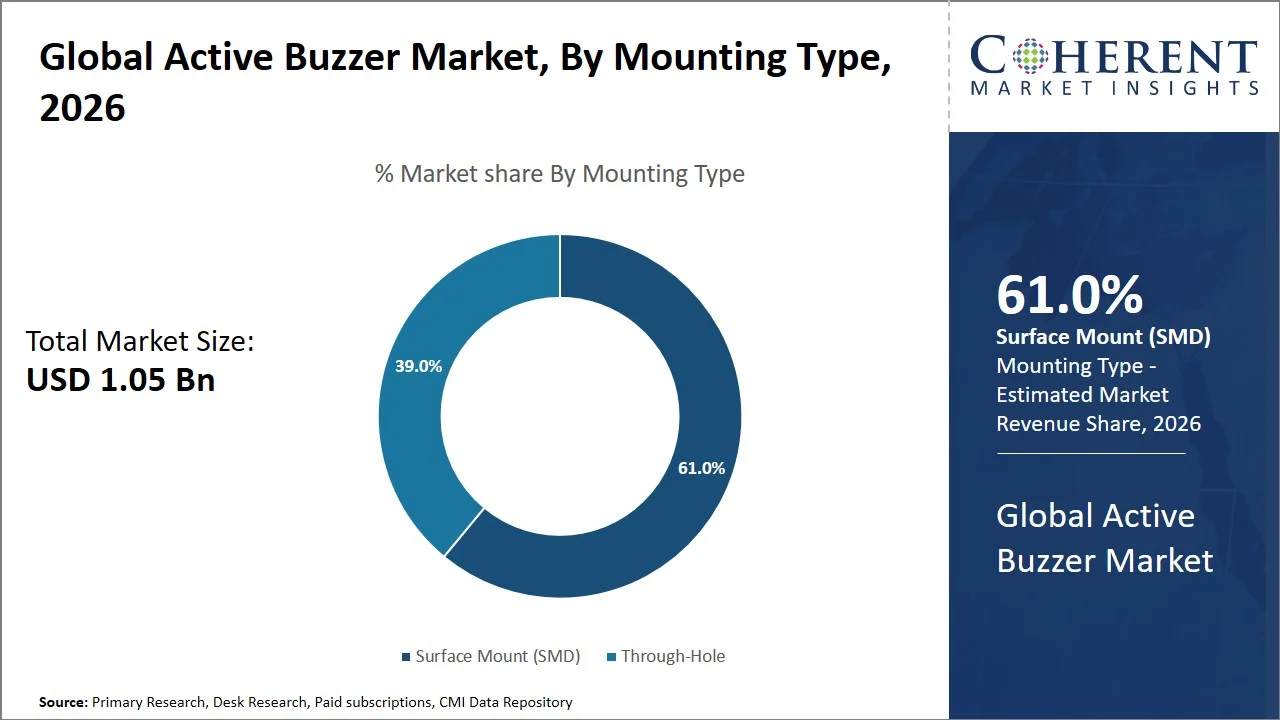
The Surface Mount (SMD) segment is expected to account for 61.0% of the global active buzzer market share in 2026. SMD technology is widely favored as it allows compact, lightweight and highly automated electronic assembly. SMD active buzzers can be directly placed on printed circuit boards by means of automated pick-and-place machines. This reduces manufacturing time, assembly and production costs and errors while increasing uniformity. Thanks to their compact footprint, they also facilitate the continuing shrinking of smartphones, wearable gadgets, medical electronics, automotive modules and IoT items. This makes SMD mounting the ideal solution for high-volume electronics manufacturing. In April 2025, PUI Audio announced a new line of SMD piezo buzzers. The new buzzers have low-profile packaging, reflow-solder compatibility and high sound pressure levels. The items were developed for wearable electronics, portable medical equipment, and handheld industrial devices manufactured utilizing automated SMT production lines.
Consumer Electronics Dominates the Global Active Buzzer Market
The consumer electronics segment is expected to account for 26.0% of the global active buzzer market share in 2026. The mass production of smartphones, tablets, laptops, wearable devices, household appliances and gaming electronics continues to fuel high demand for active buzzers as key components. The gadgets use active buzzers to offer alarms, feedback for buttons, indication of status, and warning signals in small form factors and with minimal power consumption. Sustained demand for active buzzers in the consumer electronics industry continues to be driven by the continuous trend of portable, feature-rich consumer electronics, coupled with rising worldwide manufacturing volumes and frequent product revisions. On May 7, 2026, Google launched the Fitbit Air, its first screenless AI-enabled wearable, with an emphasis on continuous health tracking and long battery life. The introduction addresses the increasing need for compact wearable devices that need miniature low power audio notification solutions like active buzzers.
Currents Events and Their Impact
Current Events | Description and its Impact |
European Union - Ecodesign for Sustainable Products Regulation (ESPR) |
|
United States - Cyber Trust Mark Program |
|
Global Active Buzzer Market - Robotics Installations Utilizing Audible Safety Indicators (2024-2025)
Demand for audible safety indicators like active buzzers to warn operators of robot movement, emergency stops, fault conditions, and maintenance activities is growing due to the increasing adoption of industrial robots in industries like automotive, electronics, food processing, logistics, and metalworking. With the proliferation of collaborative robots (cobots) and autonomous robotic cells, manufacturers are installing programmable acoustic warning devices to meet industrial safety standards and improve human-machine interaction. The installation of robots in numerous major manufacturing countries hit record highs in 2024, and this trend is predicted to continue through 2025, which is likely to result in more demand for active buzzers in industrial automation systems. Key points include:
- China: 295,000 industrial robots installed, representing 54% of the yearly global installations, and audible safety devices are widely used in automated production lines.
- Japan: 44,500 industrial robots were installed, mostly in automotive and electronics production plants that require integrated acoustic warning systems.
- United States: 34,200 industrial robots were installed. Demand is focused on automotive, logistics and warehouse automation where active buzzers are typical safety components.
- South Korea: 30,600 industrial robots installed, enabling improved semiconductor and electronics manufacturing with machine safety notification systems.
- Germany: 26,982 industrial robots installed, representing 32% of all European robot installations and fueling further usage of audible safety indications in smart factories.
- India: 9,120 industrial robots installed (7% YoY), automotive industry accounts for 45% of installations, need for robot-integrated audio warning devices on the rise.
- Italy: 12,100 industrial robots installed, backed by robust investments in automotive, metal fabrication, packaging and food processing industries, where audible safety signs are built into robotic production cells.
- France: 7,300 industrial robots installed, with rising use in automotive, aerospace, pharmaceuticals and logistics facilities requiring machine-status buzzers and operator alert systems.
- Mexico: 6,300 industrial robots installed, car OEMs and Tier-1 suppliers driving expansion of automated assembly lines with audible safety alerts and emergency notification systems.
- Thailand: 4,800 industrial robots were installed, mostly in automotive, electronics and electrical appliance production sectors, where active buzzers are often employed for robotic cell safety, maintenance warnings and defect indication.
Active Buzzer Market Dynamics
Market Drivers
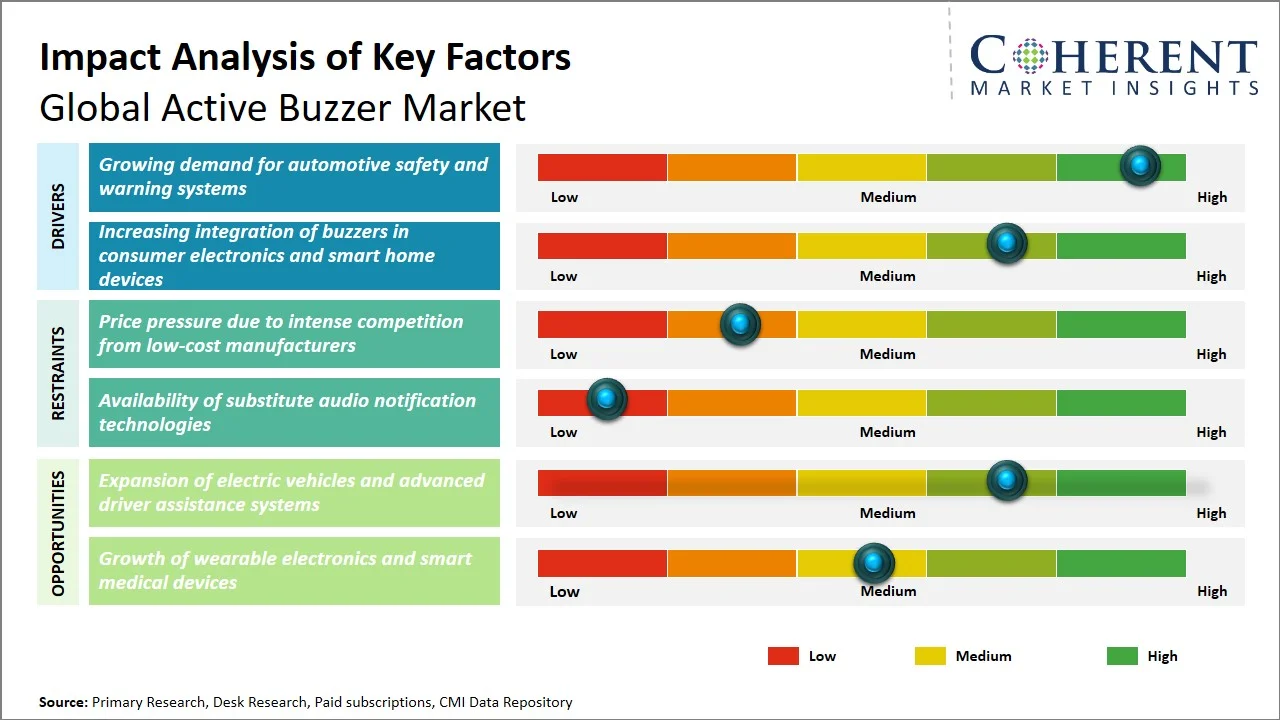
Growing demand for automotive safety and warning systems:
With growing focus on vehicle safety, regulatory compliance, and driver assistance technologies, the market for active buzzers in the automotive industry is witnessing substantial growth. Today, active buzzers are used in modern passenger and commercial cars to give an auditory alarm for seat belt reminders, parking assistance, collision warning, door open notification, low fuel indicator and advanced driver assistance systems (ADAS). The growing trend for vehicle makers to include more electronic safety and connectivity features is driving the need for compact, dependable and low-power acoustic signaling devices in both conventional and electric vehicles. On April 22, 2025, Huawei launched Qiankun ADS 4.0 and HarmonyOS Cockpit 5 driving solutions. Both technologies constitute an improvement above the previous generation of car driving capabilities.
Increasing integration of buzzers in consumer electronics and smart home devices
The rising use of consumer electronics and smart home devices is generating robust demand for active buzzers as crucial components for auditory notifications and user feedback. Active buzzers are employed in smart phones, wearable devices, smart speakers, home security systems, kitchen appliances, robotic vacuum cleaners and smart thermostats to produce alarms, status updates, button confirmation and warning signals. As manufacturers produce more compact, connected and energy efficient products, the demand for small, dependable and low power buzzer solutions is gradually expanding across the consumer electronics ecosystem. On January 6, 2026, Samsung Electronics announced its next-generation Bespoke AI home appliance lineup and enhanced SmartThings connectivity at CES 2026, including AI-enabled refrigerators, washing machines and home management systems.
Emerging Trends
Miniaturization with Improved Acoustic Performance
Efforts are being made by manufacturers to miniaturize active buzzers while maintaining the sound quality and dependability. Piezoelectric materials, surface-mount device (SMD) technology, and acoustic engineering are contributing to the development of ultra-compact buzzers that have higher sound pressure levels, reduced power consumption, and longer operating lives for space-constrained electronic devices.
Rising Demand for Customized and Industrial-Grade Solutions
Industrial automation, medical equipment, and specialized electronic applications are driving the demand for customized active buzzers tailored to specific performance requirements. To help with deployment in severe industrial locations, healthcare systems and companies that make outdoor electronic equipment are launching products that are more sealed against water, more resistant to dust, can operate over wider temperature ranges, have numerous sound frequencies and are more durable.
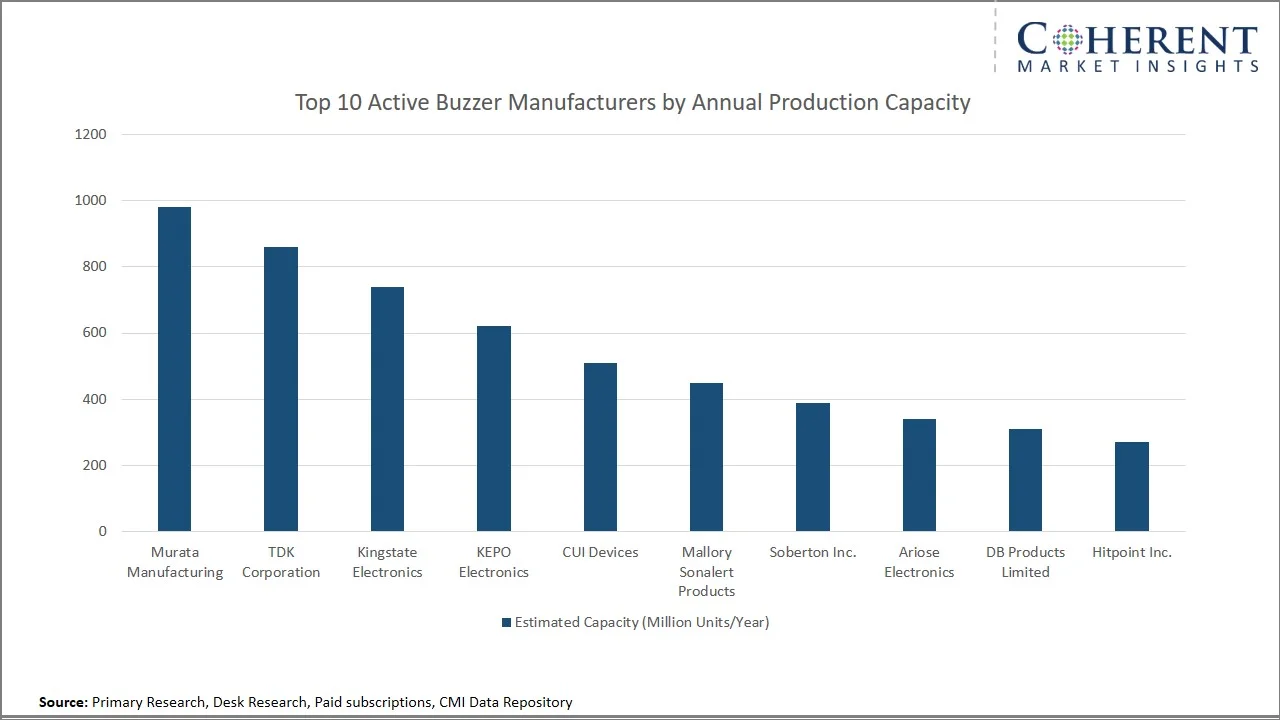
Global Active Buzzer Market - Top 10 Active Buzzer Manufacturers by Annual Production Capacity
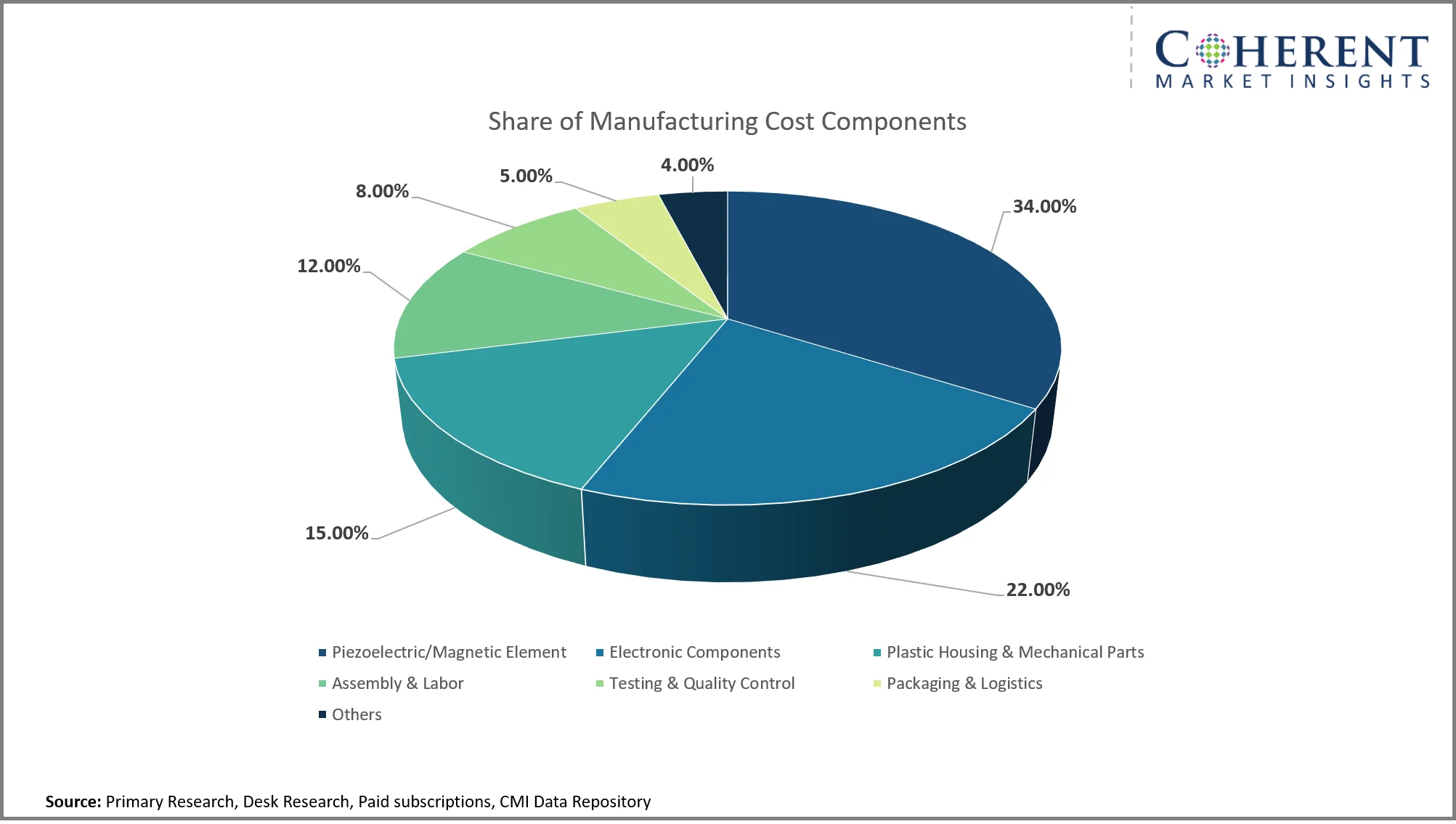
Global Active Buzzer Market - Share of Manufacturing Cost Components
Regional Insights
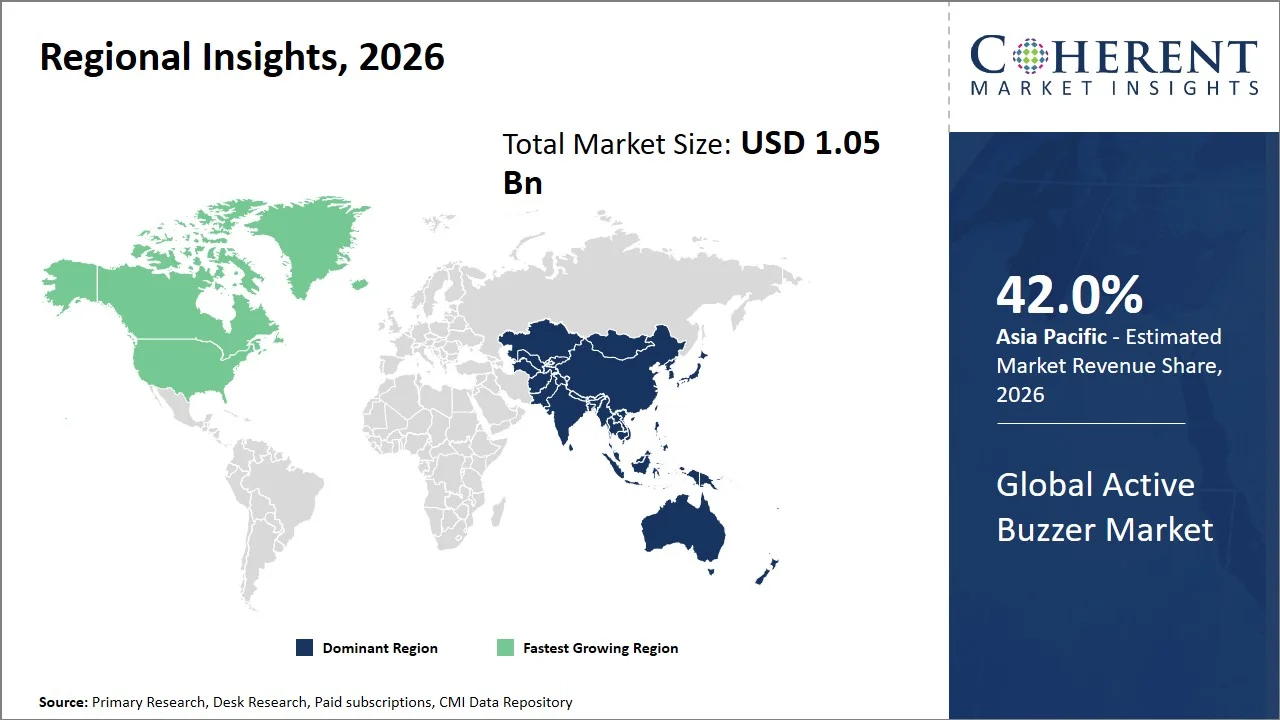
Why is Asia Pacific a Strong Market for Active Buzzers?
Asia Pacific is expected to account for a market share of 42.0% in 2026. Asia Pacific is the main manufacturing hub for active buzzers as electronics manufacturing is concentrated in China, Japan, South Korea, Taiwan and Southeast Asia. Active buzzers from companies like Murata Manufacturing, TDK Corporation, Kingstate Electronics and DB Products are used by regional OEMs that produce smartphones, wearable gadgets, smart appliances and automotive electronics. Rapid expansion of electric vehicle production in China and increasing investments in smart factory automation across Japan and South Korea are also creating sustained demand for compact surface mount active buzzers used in control systems, warning indicators, and human-machine interface equipment.
Why Does the North America Active Buzzer Market Exhibit High Growth?
North America is projected to account for 26.0% of the global active buzzer market and is expected to register the fastest growth. North America is experiencing strong demand for quality active buzzer solutions in automobile safety, medical devices, aerospace and industrial automation. Vehicle manufacturers such as Tesla, General Motors and Ford use active buzzers in advanced driver assistance systems, seat belt reminders, parking assistance and cabin alert systems. Medical device manufacturers use active buzzers in patient monitoring equipment and portable diagnostic equipment. Industrial automation projects for firms such as Rockwell Automation and Honeywell also employ active buzzers in programmable logic controllers, alarm panels and factory safety systems.
Global Active Buzzer Market Outlook for Key Countries
Why is China Emerging as a Major Hub in the Active Buzzer Market?
China is still the world’s largest production base for active buzzers as China has huge electronics manufacturing clusters in Shenzhen, Dongguan and Suzhou. Domestic producers sell active buzzers to consumer electronics brands and auto suppliers worldwide, while BYD, Xiaomi, Huawei and many appliance makers use active buzzers in electric vehicles, smartphones, smart home gadgets and connected appliances. The government’s support of intelligent manufacturing and semiconductor localization continues to promote domestic production of electronic acoustic components.
Is the U.S. the Next Growth Engine for the Active Buzzer Market?
The United States is not a major mass-production hub for active buzzers, however, it represents a significant market for high-reliability active buzzer applications, with demand primarily driven by the automotive electronics, medical technology, aerospace, and industrial equipment sectors. Companies like Honeywell, Emerson and TE Connectivity design integrated electronic solutions that include active buzzers for industrial alarms, airplane cabin systems, process control equipment and healthcare devices. Also driving the deployment of programmable audible alert devices are the increasing acceptance of connected home security products and commercial building automation systems.
Germany Active Buzzer Market Analysis and Trends
Germany is Europe’s largest market for active buzzers, because of its modern automotive and industrial manufacturing industries. Automotive suppliers and manufacturers including Bosch, Continental, BMW, Mercedes-Benz and Volkswagen use active buzzers in parking assistance systems, passenger safety notifications, battery management systems and electric vehicle warning features. Furthermore, the extensive adoption of Industry 4.0 efforts has led to an increased deployment of audible warning devices in automated production lines, machine safety systems, and smart manufacturing equipment.
South Korea Active Buzzer Market Analysis and Trends
South Korea boasts a competitive global semiconductor and consumer electronics industry. Compact surface mount active buzzers are being incorporated to a large extent into smartphones, wearable devices, household appliances, and automobile control modules. Manufacturers including Samsung Electronics, LG Electronics, and Hyundai Motor Group are incorporating active buzzers in mobile devices, smart home ecosystems, infotainment systems, and electric vehicles. Continued investments in better semiconductor packaging and shrinking of circuits further promote the need for high-performance micro buzzer technology.
Japan Active Buzzer Market Analysis and Trends
Japan continues to be a high tech market fueled by precision electronics, automotive innovation and industrial automation. Companies such as Murata Manufacturing, TDK Corporation, Omron, Panasonic and Toyota Motor Corporation use active buzzers in industrial automation equipment, medical devices, vehicle safety systems, robotics and consumer electronics. The country’s focus on high quality manufacturing and long-life electronic components has created a need for extremely reliable piezoelectric active buzzers for demanding industrial and automotive operating conditions.
Global Active Buzzer Market - Wearable Electronic Devices Utilizing Active Buzzers (2025)
Region | Wearable Devices Utilizing Active Buzzers (Million Units) |
Asia Pacific | 246.0 |
North America | 129.5 |
Europe | 101.0 |
Latin America | 43.8 |
Middle East & Africa | 35.2 |
Global Active Buzzer Market - Electric Vehicle Models Equipped with Audible Warning Systems (2025)
Region | EV Models Equipped with Audible Warning Systems |
Asia Pacific | 372 |
North America | 185 |
Europe | 128 |
Latin America | 56 |
Middle East & Africa | 42 |
How is the Expansion of Electric Vehicles and Advanced Driver Assistance Systems Creating New Growth Opportunities in the Active Buzzer Market?
Growth potential in the active buzzer market are being fueled by the rise of electric vehicles (EVs) and advanced driver assistance systems (ADAS). Modern cars need more audible alerts for safety, regulatory compliance and driver awareness. EV battery management systems, charging status indicators, seat belt reminders, pedestrian warning systems, parking assistance, collision avoidance alerts, blind-spot monitoring, lane departure warnings and driver monitoring systems are increasingly using active buzzers. EVs are quiet and, unlike conventional vehicles, auditory warning devices are therefore required to inform drivers and pedestrians of the vehicle’s state and possible dangers. Further, the increasing adoption of Level 2 and Level 3 ADAS features is bolstering the demand for reliable, compact, and energy-efficient active buzzers capable of producing clear warning signals under different driving conditions. As such, manufacturers are working on high-performance buzzer solutions for next-generation connected and autonomous vehicles. On March 13, 2025, Xpeng launched updated versions of its G6 and G9 SUVs at pricing lower than the previous versions. Both versions come with its patented Turing AI smart driving system at no extra cost.
Market Players, Key Development, and Competitive Intelligence
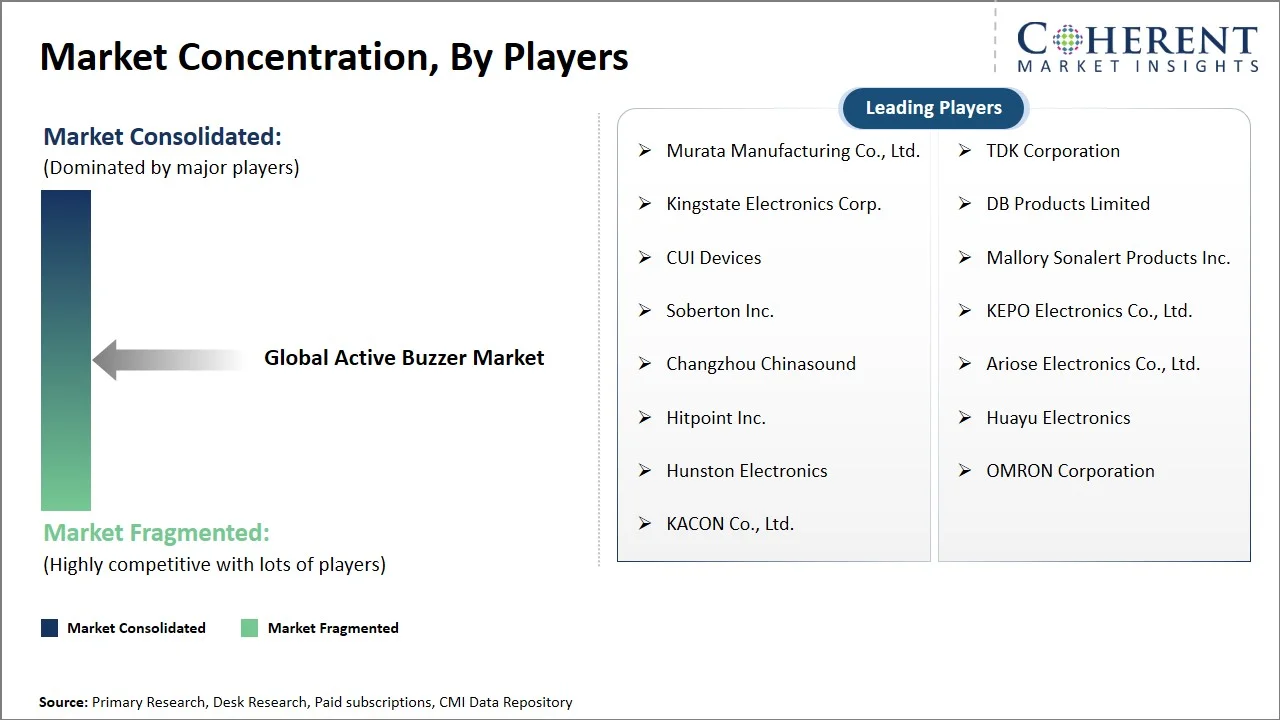
Key Developments
- On April 2, 2026, TDK Corporation and NIPPON CHEMICAL INDUSTRIAL CO., LTD. announced that, on November 27, 2025, the two companies signed a basic agreement to begin considering the establishment of joint venture related to the development of electronic component materials and manufacturing processes including ceramic materials for multilayer ceramic capacitors (MLCCs) and manufacturing processes.
- On May 1, 2025, Murata Manufacturing Co., Ltd. introduced a new low-profile piezoelectric buzzer series optimized for wearable electronics, delivering approximately 85 dB output at 3 V while reducing package height to support compact healthcare wearables and smart consumer devices.
Competitive Landscape
The global market for active buzzers is dominated by established electronic component makers, which focus on downsizing, automotive-grade dependability and high-volume manufacturing capabilities. Some of the players operating in the market are TDK Corporation, Murata Manufacturing Co., Ltd., DB Products Limited, Kingstate Electronics Corp., PUI Audio, Soberton Inc., CUI Devices, Mallory Sonalert Products Inc., Mouser Electronics, and Omron Corporation. Players are expanding their surface mount product portfolio, enhancing sound pressure performance and providing low-power buzzers for automotive, industrial automation, medical devices and consumer electronics applications. Strategic partnerships with Tier-1 automotive suppliers, investments in automated production facilities and the introduction of RoHS and REACH compliant products are boosting competitive positioning. Product diversification is increasingly geared towards compact form factors, wider operating temperature ranges, and improved acoustic consistency for safety-critical applications.
Market Report Scope
Active Buzzer Market Report Coverage
| Report Coverage | Details | ||
|---|---|---|---|
| Base Year: | 2025 | Market Size in 2026: | USD 1.05 Bn |
| Historical Data for: | 2020 To 2024 | Forecast Period: | 2026 To 2033 |
| Forecast Period 2026 to 2033 CAGR: | 2.2% | 2033 Value Projection: | USD 1.90 Bn |
| Geographies covered: |
| ||
| Segments covered: |
| ||
| Companies covered: | Murata Manufacturing Co., Ltd., TDK Corporation, Kingstate Electronics Corp., DB Products Limited, CUI Devices, Mallory Sonalert Products Inc., Soberton Inc., KEPO Electronics Co., Ltd., Changzhou Chinasound, Ariose Electronics Co., Ltd., Hitpoint Inc., Huayu Electronics, Hunston Electronics, OMRON Corporation, and KACON Co., Ltd. | ||
| Growth Drivers: |
| ||
| Restraints & Challenges: |
| ||
Analyst Opinion (Expert Opinion)
- The active buzzer market is progressively being driven by the shift toward intelligent electronic systems, rather than traditional auditory signaling applications. Active buzzers that are able to meet functional safety standards are being focused more in electric vehicles, industrial control systems and linked consumer gadgets. Development of products is targeted at lower power, better acoustic performance and interoperability with automated surface-mount assembly methods to fulfill the demands of high-volume electronics production. Customized acoustic solutions, automotive grade certifications and long-term supply relationships with OEMs are also driving competitive difference. Manufacturing capacity and component quality are being viewed as major elements affecting supplier selection.
- The integration of intelligent warning systems in electric vehicles, smart appliances, medical electronics, robotics and industrial IoT equipment will see the future development of the active buzzer market. Demand is expected to move toward programmable buzzers that can produce a variety of alarm patterns, different frequencies and better sound quality with lower power consumption and a smaller size. Smaller and more robust buzzer solutions are projected to be enabled by advances in semiconductor packaging, MEMS-based acoustic technologies, and automated electronics manufacturing. Furthermore, rising usage of AI-powered monitoring systems and predictive diagnostics in industrial and automotive applications is expected to widen the scope of active buzzers as key human-machine interface components in next-gen electronic devices.
Speak to the analyst
Want personalized insights?
Take the findings above to one of our principal consultants, or have the report rebuilt around the segments, geographies and competitors you actually track.
Market Segmentation
- Type Insights (Revenue, USD Billion, 2021 - 2033)
- Piezoelectric Active Buzzers
- Magnetic Active Buzzers
- Mounting Type Insights (Revenue, USD Billion, 2021 - 2033
- Surface Mount (SMD)
- Through-Hole
- Application Insights (Revenue, USD Billion, 2021 - 2033)
- Consumer Electronics
- Automotive
- Industrial Equipment
- Medical Devices
- Security and Alarm Systems
- Telecommunications
- Home Appliances
- Others
- End User Insights (Revenue, USD Billion, 2021 - 2033)
- Automotive
- Consumer Electronics
- Aerospace and Defense
- Industrial Manufacturing
- Healthcare
- Energy and Utilities
- Research and Scientific Institutions
- Regional Insights (Revenue, USD Billion, 2021 - 2033)
- North America
- U.S.
- Canada
- Latin America
- Brazil
- Argentina
- Mexico
- Rest of Latin America
- Europe
- Germany
- U.K.
- Spain
- France
- Italy
- Russia
- Rest of Europe
- Asia Pacific
- China
- India
- Japan
- Australia
- South Korea
- ASEAN
- Rest of Asia Pacific
- Middle East
- GCC Countries
- Israel
- Rest of Middle East
- Africa
- South Africa
- North Africa
- Central Africa
- North America
Sources
Primary Research Interviews
- Electronics Component Manufacturers
- Consumer Electronics OEMs
- Industrial Automation Equipment Suppliers
- Electronic Component Distributors & Retailers
Magazines
- Electronics Weekly
- EDN Network (Electronics Design News)
- IEEE Spectrum Magazine
- Electronic Design Magazine
Journals
- Journal of Electronic Materials
- IEEE Transactions on Consumer Electronics
- International Journal of Electronics and Communications
Associations
- Electronic Components Industry Association (ECIA)
- Japan Electronics and Information Technology Industries Association (JEITA)
- International Electrotechnical Commission (IEC)
- Consumer Technology Association (CTA)
Public Domain Sources
- U.S. International Trade Commission (USITC) – Trade Data
- World Trade Organization (WTO) – Electronics Trade Statistics
- U.S. Census Bureau – Industrial Manufacturing Data
- European Commission – Electronics Industry Reports
Proprietary Elements
- CMI Data Analytics Tool
- Proprietary CMI Existing Repository of Information for the Last 10 Years
Get access to 250+ pages report
Every segment, forecast, competitor profile and data table behind the analysis above — available for instant download.
- ESOMAR Member
- ISO 9001:2015 Certified
- D-U-N-S Registered
- GDPR & CCPA Compliant
Missing comfort of reading report in your local language? Find your preferred language:
Transform your Strategy with Exclusive Trending Reports
Frequently Asked Questions
The global active buzzer market is expected to stand at USD 1.05 Bn in 2026 and is expected to reach USD 1.90 Bn by 2033.
The CAGR of the global active buzzer market is projected to be 2.2% from 2026 to 2033.
Growing demand for automotive safety and warning systems and increasing integration of buzzers in consumer electronics and smart home devices are the major factors driving the growth of the global Active Buzzer market.
Price pressure due to intense competition from low-cost manufacturers and availability of substitute audio notification technologies are the major factors hampering the growth of the global active buzzer market.
In terms of type, the piezoelectric active buzzers segment is estimated to dominate the market revenue share in 2026.
IoT devices require reliable audible notifications for operational status, faults, and user interactions.
They help extend battery life in portable and battery-powered electronic devices.