

Industrial Battery Market Analysis & Forecast: 2026 to 2033
Industrial Battery Market is estimated to be valued at USD 29,022.4 Mn in 2026 and is expected to reach USD 53,739.3 Mn in 2033, exhibiting a compound annual growth rate (CAGR) of 9.2% from 2026 to 2033.
Key Takeaways
- By Application, the Forklift segment is projected to dominate the global Industrial Battery Market in 2026, accounting for 29.5% of the total market share.
- By Region, Asia Pacific is expected to lead the Industrial Battery Market in 2026, holding an estimated 43.7% share, driven by rapid industrialization and manufacturing growth.
Market Overview
The Global Industrial Battery Market is expected to witness strong growth due to the rise in the number of automobiles and material-handling equipment. With the rapid development in the industrial sector, the market is likely to grow rapidly. Another factor that is expected to contribute to the market growth is the increase in adoption of renewable energy sources in various parts of the world. For instance, in 2023, Tesla launched multiple Megapack installations globally, including in California and Australia, to support renewable energy integration and grid stability.
Current Events and Its Impact on the Global Industrial Battery Market
Event | Description and Impact |
Global Energy Transition and Renewable Energy Expansion |
|
China-Taiwan Geopolitical Tensions and Supply Chain Disruptions |
|
Critical Raw Material Supply Chain Crises |
|
Pricing Analysis: Industrial Battery Market
The global industrial battery market exhibits diverse pricing driven by battery chemistry, capacity, brand positioning, and application needs. Lead-acid batteries dominate due to affordability, priced between $0.08 to $0.30 per Wh depending on type, making them preferred for cost-sensitive applications. In contrast, lithium-ion batteries command premium prices, ranging from $0.25 to $1.20 per Wh, reflecting their advanced performance and growing adoption in energy storage and industrial sectors.
Brand premiums also significantly influence pricing. Tier 1 brands like Johnson Controls, Exide, and EnerSys price deep cycle and specialty batteries between $150 and $450, catering to high-reliability markets such as telecom and aerospace. Tesla Energy leads utility-scale lithium-ion systems, with Megapacks costing $1.2 to $1.5 million per unit, targeting large energy infrastructure.
Tier 2 and 3 brands offer competitive and value-focused options, with prices ranging from $80 to $320 for mid-range batteries, serving price-sensitive segments and diverse industrial uses. Application-specific pricing varies, with UPS batteries for telecommunications priced from $50 for small units to $800 for larger systems.
Overall, pricing trends reflect a balance between technology sophistication, brand value, and end-user application requirements, with ongoing cost reductions expected as battery technologies mature.
- Current Industry Events of 2026
- Market Size Estimation
- Regional Breakdown
- Competitive Landscape
- Customer Intelligence
- Segmental Analysis
- Pricing Analysis
- Key Market Drivers, Challenges & Future Trends
- Customized Insights Section
Role of Emerging Technologies in the Industrial Battery Market
Emerging technologies are playing a pivotal role in shaping the Industrial Battery Market by addressing key challenges such as volatility risk and enhancing customer retention among utility customers. Advances in lithium-ion chemistries, especially Lithium Iron Phosphate (LiFePO4) and solid-state batteries, offer improved safety, energy density, and longer cycle life, enabling more reliable and cost-effective solutions for industrial applications.
Innovations like vanadium redox flow and sodium-ion batteries are expanding the manufacturing base of the Industrial Battery Market, providing scalable and sustainable alternatives for grid stabilization and renewable energy integration. These technologies reduce supply chain risks by utilizing abundant materials, mitigating the volatility risk tied to lithium and cobalt.
Smart battery systems integrated with IoT and AI-driven Battery Management Systems enhance predictive maintenance, reducing downtime and improving operational efficiency—critical factors for customer retention in the Industrial Battery Market and utility customers alike.
Forecasts for the Industrial Battery Market highlight that these technological advancements will accelerate adoption, drive economies of scale, and foster hybrid solutions combining multiple chemistries to optimize performance and cost. Collectively, emerging technologies are transforming industrial batteries from backup power components to integral elements of energy management and sustainability strategies worldwide.
Segmental Insights
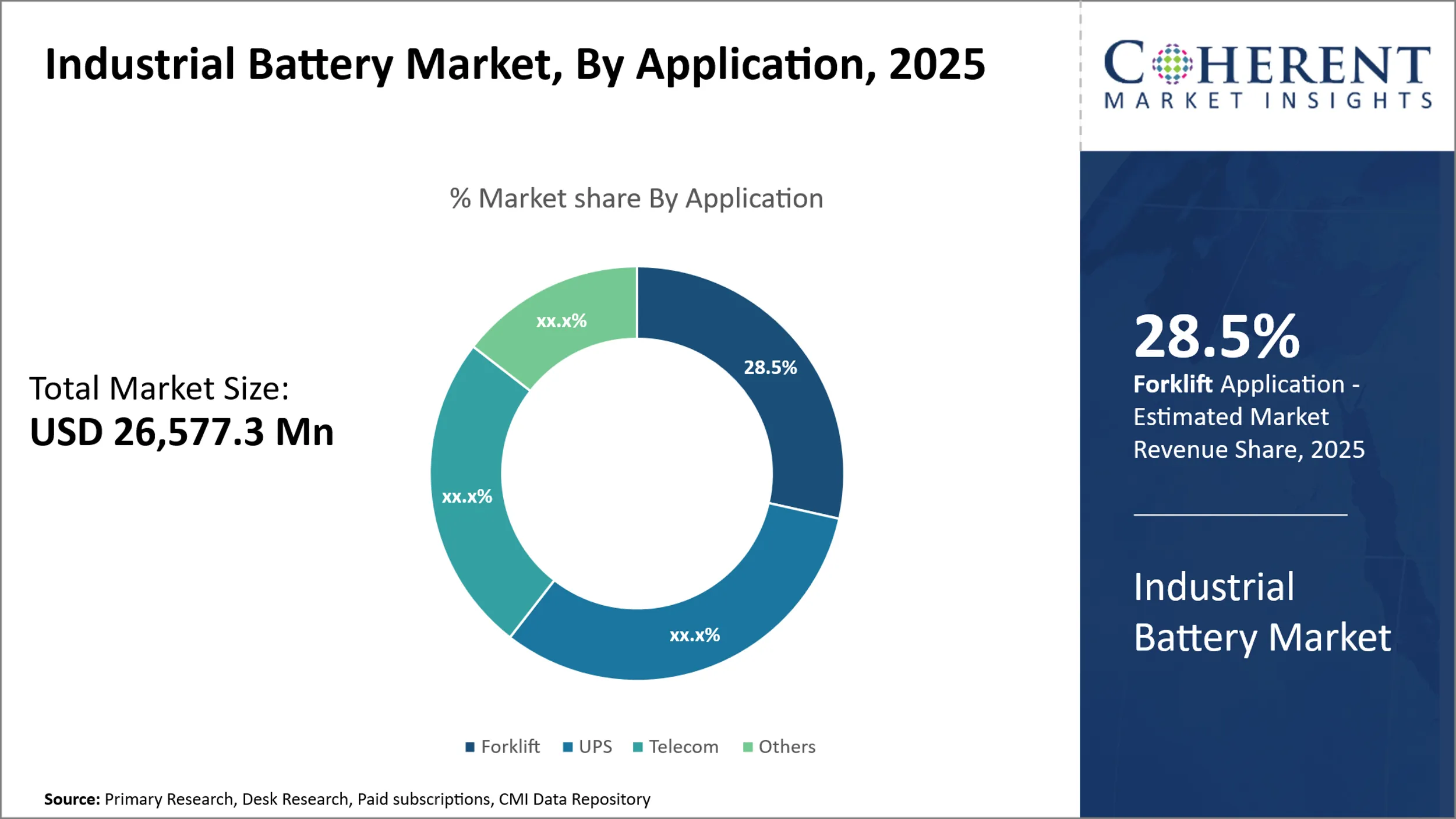
Industrial Battery Market Insights, By Application
In terms of application, the forklift segment is projected to dominate the global market with a 29.5% share by 2026. This growth is primarily driven by the rising adoption of industrial batteries within the forklift sector. Manufacturers are increasingly replacing traditional fossil fuel-powered forklifts with lithium-powered alternatives, capitalizing on the benefits of cleaner energy and improved operational efficiency. This transition is fueling the demand for advanced battery solutions in industrial equipment, making forklifts a key driver of market expansion.
The lead-acid battery segment is also expected to see substantial growth, supported by its widespread applications and cost advantages. The relatively low price point of lead-acid batteries makes them an attractive choice for various uses, sustaining strong demand and contributing to the segment’s upward trajectory.
The telecom sector is anticipated to experience significant growth as companies seek energy-efficient solutions to optimize power usage. This shift is leading to increased adoption of high-performance batteries, such as advanced Valve-Regulated Lead-Acid (VRLA) and lithium-ion batteries, to enhance energy efficiency and reduce operational costs, thereby expanding the battery market within telecom applications.
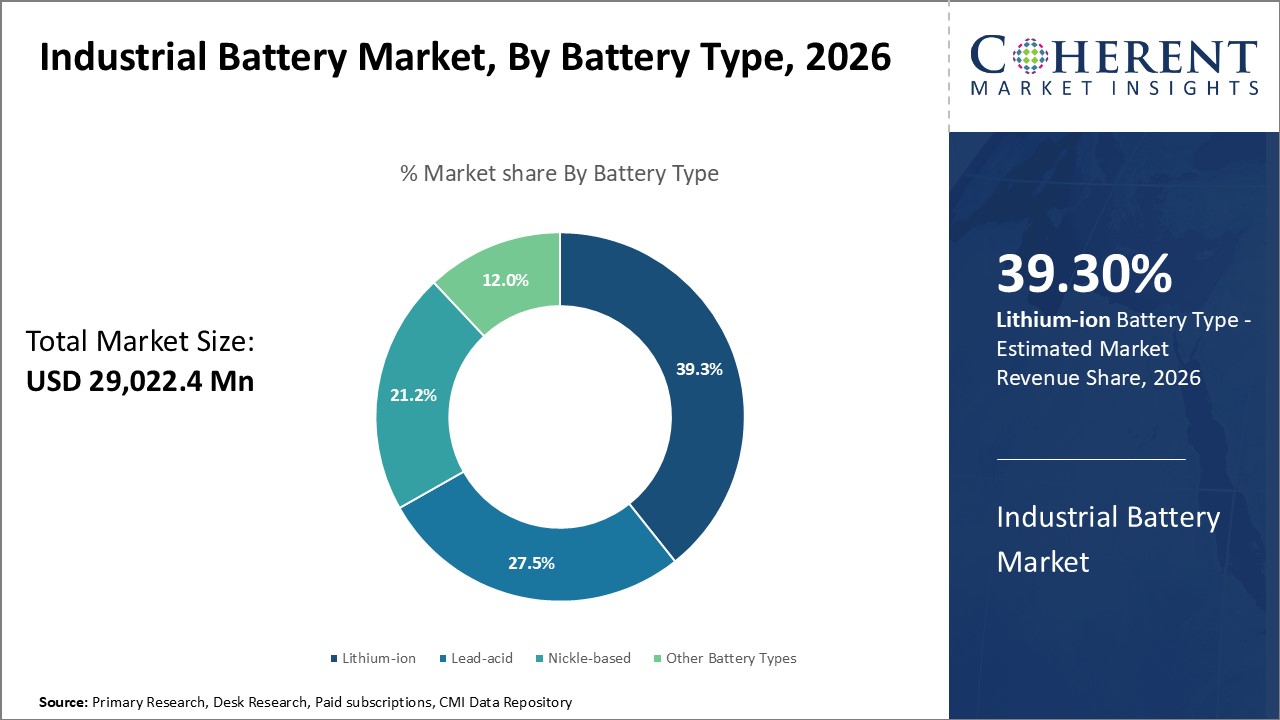
Industrial Battery Market Insights, By Battery Type
Based on battery type, lithium-ion batteries are expected to dominate the global market throughout the forecast period. Their superior capacity-to-weight ratio makes them highly desirable across various applications. Additionally, factors such as higher energy density, improving performance, and declining costs are propelling the demand for lithium-ion batteries. These attributes collectively contribute to their expanding market share and solidify their position as the preferred battery technology in industrial, telecom, and other sectors.
Regional Insights
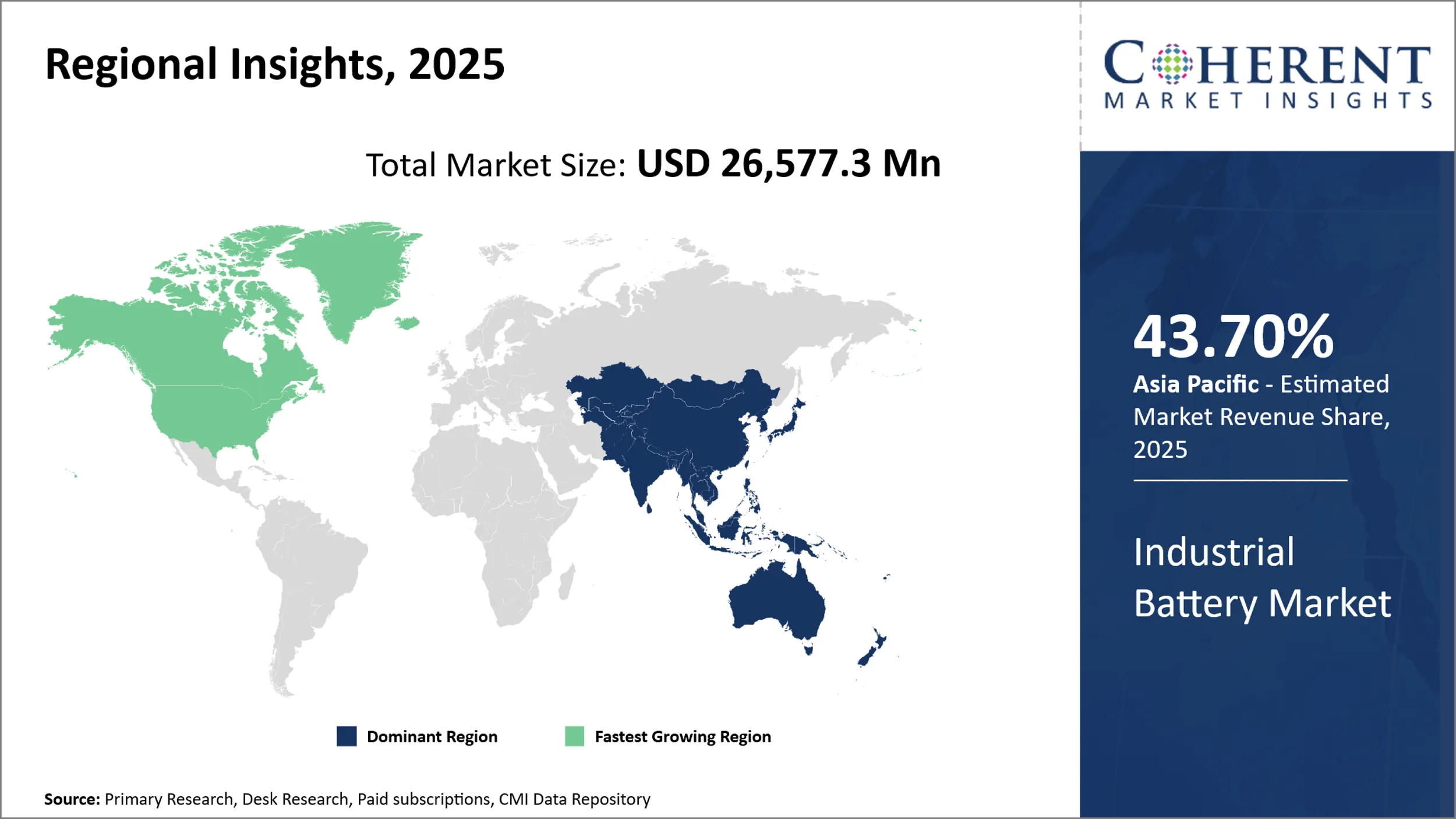
Asia Pacific Industrial Battery Market Analysis and Trends
Asia Pacific is projected to dominate the global industrial battery market in 2026, holding an estimated 43.70% share. This dominance is largely driven by rapid growth in the telecom sector and substantial increases in renewable power generation capacity, particularly in countries like China and India.
The telecom industry in the region is increasingly adopting industrial batteries as part of their shift towards renewable energy sources, improving energy reliability and reducing carbon footprints. Coupled with government initiatives to expand clean energy infrastructure, this has intensified demand for industrial batteries to support energy storage and backup systems.
Overall, strong industrialization, expanding telecom networks, and ambitious renewable energy targets are expected to fuel sustained growth in the Asia Pacific industrial battery market.
North America Industrial Battery Market Analysis and Trends
North America is expected to secure a significant share of the global industrial battery market over the forecast period, driven by the U.S. and Canada’s status as key hubs for industrial battery deployment. This leadership is underpinned by the region’s robust industrial infrastructure, rapid expansion of renewable energy installations, and increasing implementation of battery-based energy storage systems across various sectors.
In particular, the U.S. has seen strong growth in energy storage projects supported by favorable government policies and incentives promoting clean energy integration and grid modernization. These policies encourage adoption of efficient and reliable energy storage solutions, which in turn bolster demand for industrial batteries. The combination of technological innovation, industrial demand, and regulatory support positions North America as a critical market for industrial batteries worldwide.
Dominating Countries in the Asia Pacific Industrial Battery Market
China Industrial Battery Market Analysis and Trends
China leads the Asia Pacific industrial battery market, driven by aggressive investments in renewable energy and energy storage infrastructure. The country’s booming telecom sector is also a significant consumer of industrial batteries, as providers adopt battery-based solutions to enhance network reliability and efficiency. National policies aimed at reducing carbon emissions and promoting clean energy storage further accelerate market growth.
India Industrial Battery Market Analysis and Trends
India’s industrial battery market is rapidly expanding due to increasing renewable energy installations and a growing telecom industry. Government initiatives focused on electrification, grid modernization, and renewable energy adoption are fueling demand for battery energy storage systems. Additionally, India’s expanding industrial base is adopting battery technologies for backup power and energy management.
Japan Industrial Battery Market Analysis and Trends
Japan is a key market for industrial batteries in Asia Pacific, driven by its advanced industrial sector and renewable energy integration efforts. The country invests heavily in energy storage to support grid stability and energy efficiency, particularly as it increases reliance on renewable sources like solar and wind. Japan’s commitment to innovation and sustainability is sustaining demand for high-performance industrial batteries.
South Korea Industrial Battery Market Analysis and Trends
South Korea’s industrial battery market is benefiting from strong demand in telecommunications, manufacturing, and renewable energy sectors. Government policies promoting clean energy and smart grid technologies are enhancing the uptake of battery energy storage solutions. South Korea’s focus on technological advancement and energy security is accelerating market development.
Market Report Scope
Industrial Battery Market Report Coverage
| Report Coverage | Details | ||
|---|---|---|---|
| Base Year: | 2025 | Market Size in 2026: | USD 29,022.4 Mn |
| Historical Data for: | 2020 To 2024 | Forecast Period: | 2026 To 2033 |
| Forecast Period 2026 to 2033 CAGR: | 9.2% | 2033 Value Projection: | USD 53,739.3 Mn |
| Geographies covered: |
| ||
| Segments covered: |
| ||
| Companies covered: | Saft Groupe SA, C&D Technologies Inc., Panasonic Corporation, East Penn Manufacturing Company Inc., Amara Raja Batteries Ltd., EnerSys, GS Yuasa Corporation, and Exide Industries Ltd. | ||
| Growth Drivers: |
| ||
| Restraints & Challenges: |
| ||
Global Industrial Battery Market Drivers
- Declining cost of lithium-ion battery to boost the market growth
Increasing number of manufacturers are focused on reducing the cost lithium-ion technology. The cost of lithium-ion batteries has decreased steeply in the last decade. The cost of lithium-ion battery was US$ 176 per kWh in 2018, which was a 17.75% decrease compared to the cost in 2017.
Moreover, the rise in production volume is also driving the decrease in cost of these batteries, along with the increased capacity. This in turn has created a competitive environment for manufacturers, which again leads to decrease in cost of the lithium-ion batteries. Thus, global industrial battery market is expected to witness substantial growth over the forecast period, due to decreasing cost of lithium-ion batteries.
- Rise in demand from data centers to augment the market pace
The growing adoption of machine learning (ML) and artificial intelligence (AI) along with emergence of 5G, the construction and deployment of data center as well as upgrading efforts in existing data centers are increasing all over the world. As per Coherent Market Insights, by 2025, the amount of data is likely to be more than 175 zettabytes all over the world. Several data centers around the globe are now moving to modern lithium-ion batteries from lead-acid battery cells. This is thus, supporting growth of the global industrial battery market.
Global Industrial Battery Market Opportunities
- Technological development in batteries to create business opportunities
Technological developments and advances in materials have increased the output and reliability of modern battery systems substantially. Along with this, economies of scale have reduced the cost required drastically.
Batteries such as lithium-ion, lead-acid, and nickel-based batteries have been dominating the market significantly for a long time; however, these batteries also have limitations due to which manufacturers continue to be involved in technological development of these batteries. This in turn is anticipated to offer several growth opportunities in the global industrial battery market over the forecast period.
- Increasing use of AI in R&D phase of battery manufacturing to offer growth opportunities
The increase in battery life is viewed as one of the major improvements in batteries in recent times, as the number of cycles newer batteries can go through has increased. There is a heavy spending on research and development by battery manufacturers for improving the life of battery further.
Global Industrial Battery Market Trends
- Increasing focus of companies to find cheaper, lighter, and more powerful battery solutions is a recent trend
Several battery companies are focused on experimenting in order to achieve chemistries that are denser, cheaper, lighter, and more powerful. Various companies are engaging in extensive research on different types of battery technologies such as lithium-sulfur batteries, sodium-ion batteries, graphene batteries, foam batteries, and micro-supercapacitors among others. All these batteries show potential to transform the landscape of battery market in the coming future. This trend is likely to continue in the global industrial battery market over the forecast period.
- Rise in demand for data processing is a growing trend
The demand for data processing is increasing significantly all over the world due to rise in use of internet, use of technologies such as AI, ML, and IoT, and increasing data collection. This in turn is leading to companies such as Microsoft, Google, IBM, and Amazon among others heavily investing in data centers. As a result, the demand for data processing is increasing all over the world. The newer data centers come with larger capacities of processing data. Thus, this trend is expected to boost growth of the industrial batteries in the coming future.
Analyst Viewpoint
- The industrial battery market is currently experiencing strong momentum, fueled by an accelerating shift toward electrification across diverse sectors such as manufacturing, logistics, and energy storage. Industries are increasingly focused on reducing carbon emissions and meeting sustainability targets, which drives widespread adoption of battery-powered equipment, especially in material handling and backup power systems.
- Additionally, the growing integration of renewable energy sources heightens the demand for reliable energy storage solutions, positioning industrial batteries as essential components for grid stability and peak load management.
- However, the market is not without challenges. Volatility in raw material prices, particularly lithium, cobalt, and nickel, poses significant risks to profitability and pricing strategies. Furthermore, supply chain disruptions and geopolitical tensions surrounding key battery material sources continue to present hurdles for both manufacturers and end-users.
- Despite these constraints, significant growth opportunities arise from ongoing technological innovations. Advances in battery chemistry, including solid-state and next-generation lithium-ion technologies, promise enhanced performance, safety, and lifespan.
- The rapid expansion of the electric vehicle ecosystem also benefits the industrial battery market by fostering economies of scale and accelerating innovation.
- Regionally, Asia-Pacific leads the market, driven by well-established manufacturing infrastructure, supportive government policies, and swift industrial growth.
- China’s dominance in battery production and raw material processing strongly shapes global market trends. North America stands out as the fastest-growing region, supported by ambitious decarbonization policies, large-scale infrastructure investments, and increased adoption of automation in warehousing and logistics.
- Europe’s industrial battery market shows robust potential as well, propelled by strict environmental regulations and aggressive renewable energy targets, which create conducive conditions for industrial battery adoption across multiple applications.
Global Industrial Battery Market: Key Developments
- In October 2025, Toshiba launched a new SCiB™ 24V lithium-ion battery pack tailored for industrial and automotive use. Designed to replace lead-acid batteries, it offers high-load performance, scalability, and durability. Already adopted in Yamaha’s electric sightseeing boat, the waterproof and vibration-resistant pack support decarbonization across heavy machinery, commercial vehicles, and marine applications.
- In June 2025, Cummins India launched Battery Energy Storage Systems (BESS) to support India’s clean energy transition. Designed for industrial and commercial use, BESS enhances grid stability, enables renewable integration, and provides reliable backup power. This move aligns with Cummins’ commitment to sustainability and innovation in energy solutions for a decarbonized future.
Market Segmentation
- Global Industrial Battery Market, By Battery Type (Revenue, USD Mn, 2021 - 2033)
- Lead-acid
- Nickle-based
- Lithium-ion
- Other Battery Types
- Global Industrial Battery Market, By Application (Revenue, USD Mn, 2021 - 2033)
- Forklift
- Telecom
- UPS
- Other Applications
- Global Industrial Battery Market, By Region (Revenue, USD Mn, 2021 - 2033)
- North America
- U.S.
- Canada
- Latin America
- Brazil
- Argentina
- Mexico
- Rest of Latin America
- Europe
- Germany
- U.K.
- Spain
- France
- Italy
- Russia
- Rest of Europe
- Asia Pacific
- China
- India
- Japan
- Australia
- South Korea
- ASEAN
- Rest of Asia Pacific
- Middle East
- GCC Countries
- Israel
- Rest of Middle East
- Africa
- South Africa
- North Africa
- Central Africa
- Company Profiles
- C&D Technologies Inc.
- East Penn Manufacturing Company Inc.
- EnerSys
- Exide Industries Ltd.
- GS Yuasa Corporation
- Amara Raja Batteries Ltd.
- Panasonic Corporation
- Saft Groupe SA
Sources
Primary Research Interviews
- Industrial battery manufacturers (Tier 1 & Tier 2)
- Battery system integrators and distributors
- End-user industries representatives (manufacturing, telecommunications, utilities)
- Technology suppliers and component manufacturers
- Others
Databases
- Bloomberg Terminal
- S&P Capital IQ
- Others
Magazines
- Battery Industry Magazine
- Industrial Power Magazine
- Energy Storage Journal
- Power Electronics Magazine
- Others
Journals
- Journal of Power Sources
- Energy Storage Materials
- Applied Energy Journal
- Others
Newspapers
- Financial Times
- The Wall Street Journal
- Reuters Business News
- Bloomberg News
- Others
Associations
- Battery Association of Japan (BAJ)
- European Association for Storage of Energy (EASE)
- Energy Storage Association (ESA)
- International Battery Association (IBA)
- Others
Public Domain Sources
- International Energy Agency (IEA) reports
- U.S. Department of Energy publications
- European Commission energy reports
- National Renewable Energy Laboratory (NREL) data
- Others
Proprietary Elements
- CMI Data Analytics Tool
- Proprietary CMI Existing Repository of information for last 8 years
*Definition: Industrial batteries are used in a variety of applications such as electric forklifts, construction machinery and robotics. There are several factors that need to be considered when choosing the best industrial battery. These include battery size, voltage, and temperature.
Get access to 250+ pages report
Every segment, forecast, competitor profile and data table behind the analysis above — available for instant download.
- ESOMAR Member
- ISO 9001:2015 Certified
- D-U-N-S Registered
- GDPR & CCPA Compliant
Missing comfort of reading report in your local language? Find your preferred language:
Transform your Strategy with Exclusive Trending Reports
Frequently Asked Questions
The Industrial Battery Market size is estimated to be valued at USD 29,022.4 Mn in 2026, and is expected to reach USD 53,739.3 Mn by 2033.
The CAGR of the global Market is projected to be 9.2% from 2026 to 2033.
Declining cost of lithium-ion battery and rise in demand from data centers are fuelling the market.
The Forklift segment is the leading application segment in the market.
Saft Groupe SA, C&D Technologies Inc., Panasonic Corporation, East Penn Manufacturing Company Inc., Amara Raja Batteries Ltd., EnerSys, GS Yuasa Corporation, and Exide Industries Ltd.
The global market is valued in the tens of billions of dollars and is experiencing steady growth driven by demand in telecom, UPS, and renewable energy sectors.
Contemporary Amperex Technology Co. Limited (CATL), Panasonic, LG Energy Solution, and BYD are among the global leaders in the battery industry.