

Solid State Drive (SSD) Market Size & Trends
Solid State Drive (SSD) Market is estimated to be valued at USD 87.0 Mn in 2026 and is expected to reach USD 249.0 Mn in 2033, exhibiting a compound annual growth rate (CAGR) of 16.2% from 2026 to 2033.
Key Takeaways
- Based on SSD Interface, the SATA segment is expected to lead the market holding the largest share in 2026, attributed to its affordability, compatibility, and sufficient performance for everyday applications.
- Based on Application, Enterprise segment is projected to capture 53.8% share of the market in 2026, due to their growing need for faster, more reliable, and energy-efficient storage solutions.
- Based on Region, North America is estimated to lead the market with a share of 34.1% in 2026. While, Asia Pacific is projected to be the fastest growing region during the forecast period.
Market Overview
The Solid State Drive (SSD) Market is experiencing robust expansion driven by escalating demand for fast, reliable storage across enterprise and consumer applications. Faster performance, reduced latency, and lower power usage make SSDs the preferred choice over traditional hard disk drives (HDDs), especially for data-hungry workloads in cloud computing, AI, virtualization, and gaming.
Enterprise-level use, particularly in hyperscale data centers, is a major driver of Solid State Drive (SSD) Market demand, with workloads requiring high IOPS and low latency fueling growth. Meanwhile, consumer adoption is surging too: laptops, notebooks, and external portable SSDs are increasingly replacing HDDs due to performance benefits and declining flash memory costs.
Current Events and their Impact on the Solid State Drive (SSD) Market
Current Event | Description and Its Impact |
Technological Advancements in Storage Media |
|
Global Semiconductor Supply Chain Disruptions |
|
Price Analysis
The price analysis of the Solid State Drive (SSD) market shows a significant downward trend in average selling prices (ASPs), mainly due to advancements in NAND flash production, increased yield from 3D NAND (especially 96-layer and 128-layer), and intensified competition. As of 2024, the average price of consumer-grade SATA SSDs has dropped to $0.06–$0.08 per GB, down from around $0.10 per GB in 2022. For enterprise NVMe SSDs, prices remain higher, ranging between $0.12–$0.20 per GB, depending on endurance and performance specifications.
This reduction in cost is narrowing the price gap between SSDs and traditional HDDs, which currently average around $0.03–$0.04 per GB, making SSDs increasingly attractive for both enterprise and consumer applications. According to TrendForce, SSD contract prices declined by 8–13% year-over-year in Q1 2025, primarily due to excess NAND supply and slower-than-expected demand recovery in the PC and server markets.
Looking ahead, with memory vendors like Samsung, Micron, and SK Hynix ramping up QLC-based SSD production and optimizing controller technologies, prices are expected to fall further by 5–10% through 2026, supporting wider adoption in data centers, laptops, gaming consoles, and edge devices, in line with the Solid State Drive (SSD) Market Forecast.
- Current Industry Events of 2026
- Market Size Estimation
- Regional Breakdown
- Competitive Landscape
- Customer Intelligence
- Segmental Analysis
- Pricing Analysis
- Key Market Drivers, Challenges & Future Trends
- Customized Insights Section
Segmental Insights
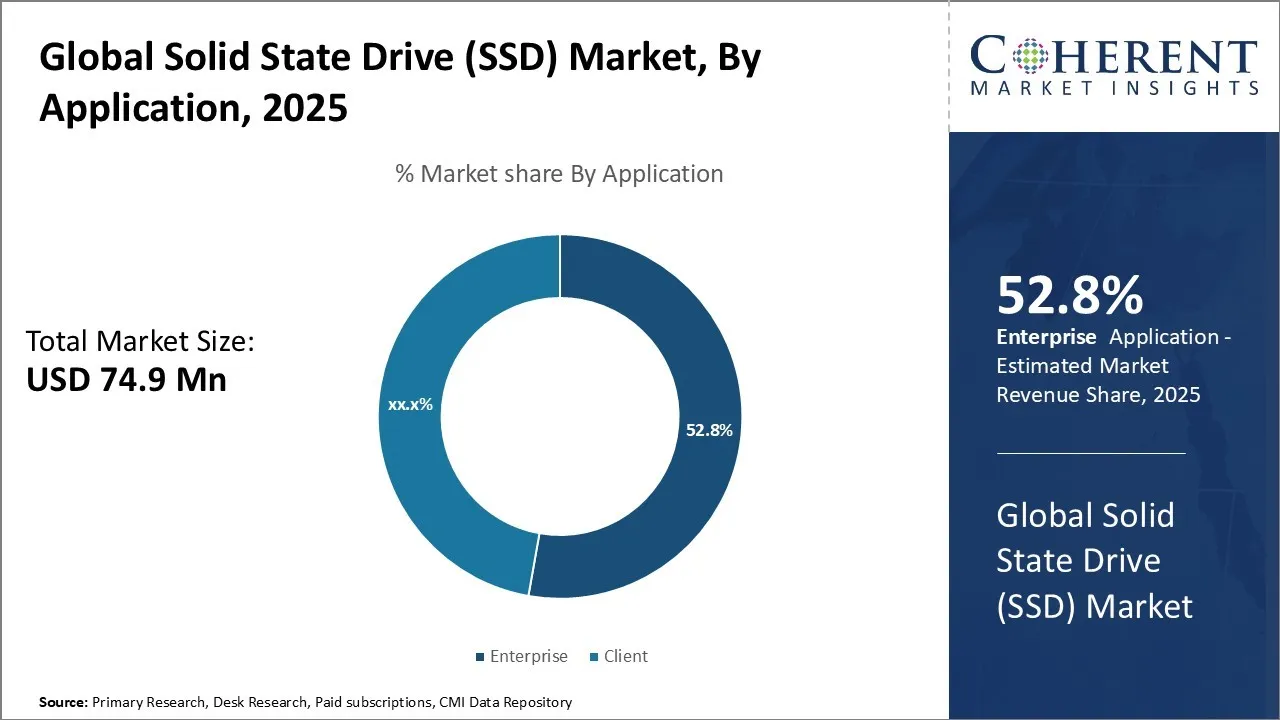
Solid State Drive (SSD) Market Insights, By Application: Enterprise Acquires the largest share on account of the Growing Need for Fast & Reliable Storage Solution
In terms of application, the enterprise segment is expected to dominate the global market with 53.8% share in 2026, due to their growing need for faster, more reliable, and energy-efficient storage solutions. As businesses increasingly rely on high-performance computing for applications like AI, big data analytics, cloud computing, and virtualization, SSDs offer the speed and low latency required for processing massive volumes of data in real time. Their smaller form factor and lower power consumption make them ideal for dense data center environments, helping reduce operational costs. Additionally, SSDs provide higher durability and reliability compared to traditional hard drives, minimizing downtime in critical operations. Enterprises also benefit from enhanced data security features in modern SSDs, including encryption and secure erase options, which help meet compliance requirements. As companies accelerate digital transformation and modernize IT infrastructure, the demand for enterprise-grade SSDs continues to grow, making them an essential component in supporting high-speed, scalable, and secure business operations.
For instance, in July 2025, MiPhi Semiconductors, the Micromax‑Phison joint venture, launched India’s first home‑grown enterprise‑grade SSDs, fully designed and manufactured domestically. The SSDs are engineered for ultra‑fast performance, enterprise‑level durability, and advanced security, tailored for data centres, AI workloads, cloud and high‑performance computing environments.
-market-by-ssd-interface.webp "Solid State Drive (SSD) Market, By Ssd Interface")
Solid State Drive (SSD) Market Insights, By SSD Interface: SATA Acquires the Dominant share owing to its Affordability and Compatibility
In terms of SSD interface, the SATA segment is expected to dominate the global market in 2026 with the largest share, attributed to its affordability, compatibility, and sufficient performance for everyday applications. While newer interfaces like NVMe and PCIe dominate the high-performance segment, SATA SSDs continue to be the preferred choice for cost-sensitive consumers, educational institutions, and businesses that prioritize reliability and storage capacity over speed. Their widespread compatibility with existing hardware makes them ideal for system upgrades without needing additional investment in new motherboards or connectors. In enterprise settings, SATA SSDs are still widely used for tasks like archival storage, where ultra-fast data transfer isn’t essential but reliability and power efficiency are. Additionally, the mature manufacturing ecosystem around SATA ensures stable pricing and steady availability. As a result, SATA continues to drive a significant portion of Solid State Drive (SSD) Market growth, especially in entry-level and mid-range segments.
For instance, in June 2025, Solid State Storage Technology Corporation (SSSTC), a subsidiary of Kioxia, launched its new CVD Series of SATA SSDs, optimized for high‑frequency, long‑duration continuous write tasks. Engineered for applications such as surveillance, media production, edge sensing, and vehicle logging, the drives feature Direct Write firmware that bypasses SLC cache to deliver consistent high-speed writes, reduced latency, and no video distortion or frame loss.
Regional Insights
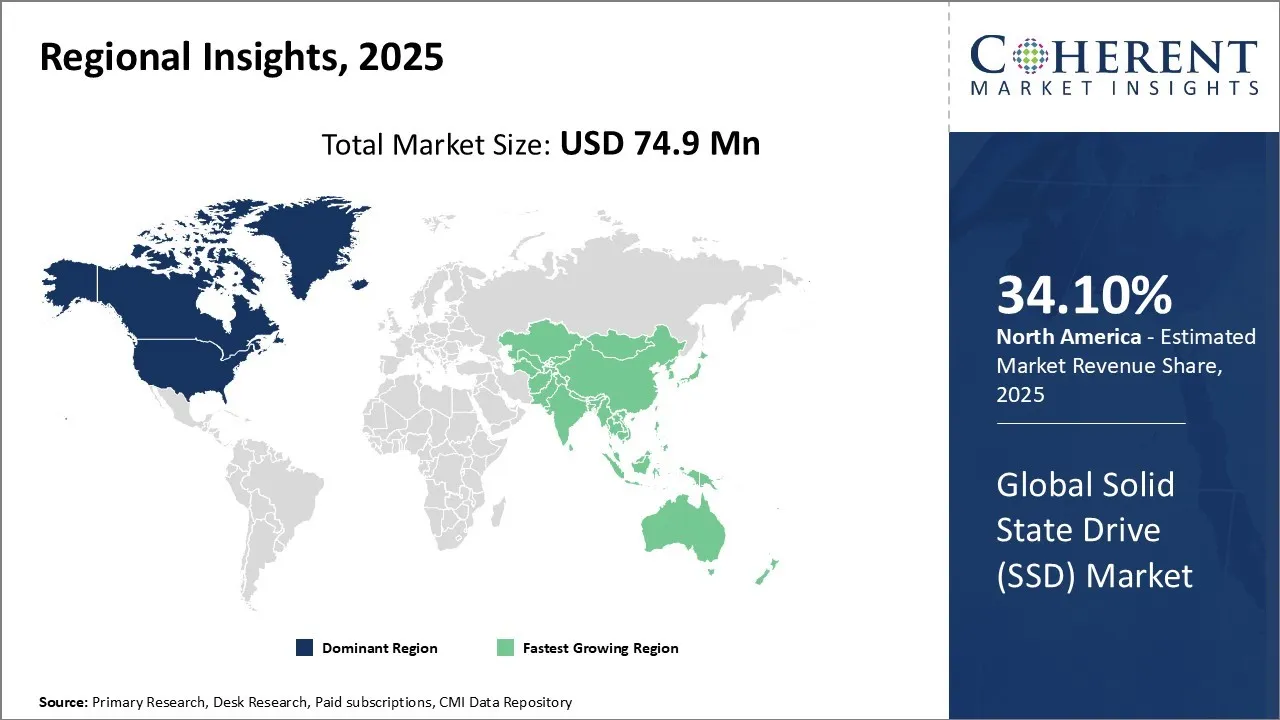
North America Solid State Drive (SSD) Market Analysis & Trends
North America is expected to dominate the global solid state drive (SSD) market with a 34.10% share in 2026. The regions have biggest markets for PCs, Laptops, and tablets. The adoption of SSDs in notebooks is growing across the region due to decreasing cost of SSD per gigabyte. Moreover, the demand for high-capacity local storage has declined in the region, which is driving the adoption of SSDs. Furthermore, technological developments in HPC, enterprise, and data centers in Canada is also expected to drive growth of the global solid state drive (SSD) market in the coming future.
For instance, in August 2026, Micron Technology launched a trio of new data‑center SSDs built on its G9 NAND platform, anchored by the Micron 9650, the world’s first PCIe Gen 6 NVMe SSD. The 9650 delivers up to 28 GB/s sequential read and 14 GB/s write speeds, roughly doubling Gen 5 performance, while offering energy efficiencies of up to 25 % (writes) and 67 % (reads) over prior Gen 5 models.
Asia Pacific Solid State Drive (SSD) Market Analysis & Trends
Asia Pacific is expected to witness fastest growing over the forecast period in the solid state drive (SSD) market, owing to presence of countries in the region that are fastest-growing in terms of data production, such as, China. The adoption of novel technologies and increasing number internet users in the region is driving the development of data centers. Moreover, the region consists countries that are major supplier of chips used for various computing hardware, which also includes SSDs. Thus, these aforementioned factors are likely to drive growth of the market across Asia Pacific.
For instance, in April 2026, South Korea’s semiconductor firm FADU and Taiwan-based storage leader ADATA have signed a strategic MOU to co-develop custom enterprise-grade SSDs under FADU’s new FlexSSD™ business model. The initiative begins with Gen5 triple-level‑cell SSDs and will extend to Gen6 and beyond. FADU will contribute controller design, firmware, and manufacturing expertise, while ADATA brings its global production and distribution strength.
Solid State Drive (SSD) Market Outlook Country-Wise
The U.S. Solid State Drive (SSD) Market Trends
The United States is a key driver of solid state drive (SSD) market demand due to its strong presence of tech giants, hyperscale data centers, and cloud providers like AWS, Microsoft Azure, and Google Cloud. Rapid adoption of cloud computing, edge infrastructure, and AI applications is fueling SSD use for faster, low-latency data storage. Enterprise IT upgrades and growing investments in data centers are further boosting SSD adoption across sectors such as healthcare, retail, and manufacturing.
For instance, in October 2024, Lexar unveiled the Professional Go Portable SSD with Hub, a sleek, ultra‑compact external storage solution aimed at mobile creators. Available in 1 TB and 2 TB capacities, the SSD delivers blazing‑fast USB 3.2 Gen 2 performance with up to 1050 MB/s read and 1000 MB/s write speeds, enabling direct 4K 60 fps Apple ProRes recording from iPhone 15 Pro/Pro Max and compatible Android devices.
Japan Solid State Drive (SSD) Market Trends
Japan is a key contributor to the solid state drive (SSD) market demand due to its strong electronics and automotive sectors. SSDs are essential for industrial automation, enabling fast, reliable data access in smart factories. In the automotive sector, SSDs support ADAS systems requiring real-time data processing. Additionally, Japan’s gaming and consumer electronics markets drive demand for high-performance, durable storage. With ongoing advancements in EVs, smart devices, and automation, SSD adoption in Japan is set to grow steadily.
For instance, in November 2024, Nextorage Corporation unveiled two new CFexpress 4.0 Type B memory card lines. The NX‑B3AE (Advanced Edition), followed by the NX‑B3SE (Standard Edition). Both series utilize high‑density 3D TLC NAND and support top-tier transfer speeds: up to 3,900 MB/s read, 3,600 MB/s (AE) or 3,500 MB/s (SE) write, and a minimum sustained write speed of 1,700 MB/s.
Market Report Scope
Solid State Drive (SSD) Market Report Coverage
| Report Coverage | Details | ||
|---|---|---|---|
| Base Year: | 2025 | Market Size in 2026: | USD 87.0 Mn |
| Historical Data for: | 2020 To 2024 | Forecast Period: | 2026 To 2033 |
| Forecast Period 2026 to 2033 CAGR: | 16.2% | 2033 Value Projection: | USD 249.0 Mn |
| Geographies covered: |
| ||
| Segments covered: |
| ||
| Companies covered: | Teclast Electronics Co. Limited, Intel Corporation, Transcend Information Inc., Samsung Group, Kingston Technology Corporation, Micron Technology Inc., ADATA Technology Co. Ltd., Western Digital Corporation, SK Hynix Inc., and Seagate Technology LLC. | ||
| Growth Drivers: |
| ||
| Restraints & Challenges: |
| ||
Global Solid State Drive (SSD) Market Drivers
- Increasing Adoption in Data Center Applications to Fuel Market Growth
A single solid state drive is capable of outperforming multiple spinning disks and it consumes lesser power. Thus, using SSD allows consolidation of servers and reduction in overall physical footprint of a storage racks. SSD used in data center applications rely upon a different set of metrics that consumer PCs. The adoption of SSDs is increasing in these applications. Several data center players are focused on establishment of colocations and hyper-scale data centers to gain large capacities of storage and to manage bulk of business data. Thus, this factor is further expected to fuel growth of the global solid state drive (SSD) market over the forecast period. For instance, in July 2025, Micron has launched the world’s first PCIe Gen‑6 NVMe SSD, the 9650, engineered specifically for AI data center workloads. Offering 28 GB/s sequential read and 14 GB/s sequential write speeds, along with up to 5.5 million IOPS for random reads and 900,000 IOPS for random writes, the drive delivers performance nearly twice that of Gen‑5 SSDs, while improving energy efficiency by up to 67% for reads and 25% for writes.
Global Solid State Drive (SSD) Market Opportunities
Increase in adoption of enterprise SSDs is expected to drive growth opportunities in the global solid state drive (SSD) market during the forecast period. As more industries transition from traditional HDDs to SSDs, these drives are projected to become increasingly cost-effective despite currently being more expensive on a per-gigabyte basis. The superior speed, performance, and durability of SSDs continue to attract enterprises, thereby boosting demand and benefiting market players. Additionally, constantly growing investments by memory companies are expected to create a favorable environment for market expansion. These investments support economies of scale and lead to gradual cost reductions, particularly for enterprise SSDs. This trend is anticipated to significantly contribute to the solid state drive (SSD) market forecast, enabling broader adoption and long-term growth potential across various sectors.
For instance, in June 2025, Micron Technology, Inc. and the Trump administration unveiled plans to invest approximately $200 billion in U.S. semiconductor manufacturing and R&D. The expanded commitment includes roughly $150 billion for memory fabrication facilities and $50 billion for research and development. Such innovations are driving the solid state drive market revenue.
Global Solid State Drive (SSD) Market Trends
- Emerging new device categories and architectures is a major trend
The emergence of novel device categories as well as architectures such as computational storage in Ethernet SSDs is growing rapidly. This in turn is likely to overcome tailbacks in the system. For instance, computational storage in future will be able to offload post-processing and cut down data movement for enabling improvements in performance of application and efficiency of infrastructure. Thus, this trend is likely to grow in the global solid state drive (SSD) market over the forecast period.
- Vertical stacking of storage cells is a recent trend
Several companies are adopting vertical stacking of storage cells, such as Samsung. The company has adopted this module in its 850 series, as it leveraged the ground-breaking advancement for expanding the offerings of high-capacity SSD of the company. This has established 3D V-NAND, as the standard for consumer SSDs of Samsung. Thus, this trend is likely to boost demand for solid state drive (SSD) market in the forecast future.
Analyst Opinion (Expert Opinion)
The Solid State Drive (SSD) market value is currently undergoing a pivotal structural shift driven not merely by the surge in data creation, but by the industry's escalating prioritization of latency-sensitive workloads, high Input/Output Operations Per Second (IOPS), and energy-efficient storage architecture. From an analyst’s perspective, the market is no longer about “if” SSDs will dominate but “how fast” traditional storage formats will be rendered obsolete in enterprise and consumer environments alike.
One of the clearest indicators of this shift is the aggressive adoption of NVMe (Non-Volatile Memory Express) protocol-based SSDs across hyperscale data centers. According to IDC, over 80% of enterprise SSDs shipped in 2024 used NVMe rather than legacy SATA or SAS interfaces—up from just 36% in 2020. This rapid protocol transition highlights how storage performance is no longer a peripheral concern, it is core to infrastructure competitiveness in AI model training, real-time analytics, and cloud-native applications.
Another structural tailwind is the price stabilization of NAND flash, particularly 3D NAND. While cost per gigabyte has historically been a limiting factor, the current price parity for 1TB-class SSDs compared to mid-range HDDs in client systems is now within a commercially negligible range in developed markets. This has enabled PC OEMs such as Dell and Lenovo to eliminate HDDs entirely from several consumer and SMB product lines, not as an upsell strategy, but as a baseline offering. The trend is especially pronounced in thin-and-light and ultra-portable categories, where SSDs offer both form factor and power consumption advantages.
Speak to the analyst
Want personalized insights?
Take the findings above to one of our principal consultants, or have the report rebuilt around the segments, geographies and competitors you actually track.
Global Solid State Drive (SSD) Market: Key Developments
- In April 2025, Sandisk introduced its latest WD BLACK SN7100 NVMe SSD in India, tailored for mainstream gamers seeking high-performance storage solutions. The base 500 GB variant starts at ₹4,899, with options available up to 4 TB. Equipped with TLC 3D NAND and PCIe Gen 4 interface, the 1 TB and 2 TB models deliver read speeds up to 7,250 MB/s and write speeds up to 6,900 MB/s, representing a 35% improvement over the SN770.
- In April 2025, ADATA’s XPG brand unveiled the MARS 980 Gen5 SSD Series, ushering in a new era of ultra‑fast storage, ideal for AI, gaming, and creators. The lineup delivers blistering sequential read/write speeds up to 14,000 MB/s and 13,000 MB/s, powered by an advanced 6 nm controller.
- In February 2025, MiPhi Semiconductors Private Limited, a joint venture between Micromax and Phison, launched its Storm 1100X external SSD in India, targeting content creators, gamers and professional users. The SSD delivers sequential read speeds of up to 1,100 MB/s and write speeds up to 1,000 MB/s via USB 3.2 Gen 2 Type‑C, supporting transfer rates up to 10 Gbps and backward‑compatibility with older USB standards.
- In September 2024, Samsung Electronics unveiled its 990 EVO Plus SSD, delivering PCIe 4.0 x4 / Gen 5 x2 NVMe 2.0 performance with sequential read/write speeds of up to 7,250 MB/s and 6,300 MB/s, representing a ~50% speed uplift over the previous 990 EVO model.
Market Segmentation
- Global Solid State Drive (SSD) Market, By SSD Interface
- SATA
- SAS
- PCIE
- Other SSD Interface
- Global Solid State Drive (SSD) Market, By Application
- Enterprise
- Client
- Global Solid State Drive (SSD) Market, By Region
- North America
- U.S.
- Canada
- Latin America
- Brazil
- Argentina
- Mexico
- Rest of Latin America
- Europe
- Germany
- U.K.
- Spain
- France
- Italy
- Russia
- Rest of Europe
- Asia Pacific
- China
- India
- Japan
- Australia
- South Korea
- ASEAN
- Rest of Asia Pacific
- Middle East
- GCC Countries
- Israel
- Rest of Middle East
- Africa
- South Africa
- North Africa
- Central Africa
- North America
- Company Profiles
- Intel Corporation
- Samsung Group
- Micron Technology Inc.
- Western Digital Corporation
- Seagate Technology LLC
- SK Hynix Inc.
- ADATA Technology Co. Ltd.
- Kingston Technology Corporation
- Transcend Information Inc.
- Teclast Electronics Co. Limited
Sources
Primary Research Interviews from the following stakeholders
Stakeholders
- Interviews with SSD manufacturers, NAND flash suppliers, storage system integrators, data center operators, IT hardware procurement heads, OEM product managers, and cloud infrastructure engineers across global markets.
Specific Stakeholders
- Procurement managers at hyperscale cloud providers
- Data center operations heads at colocation providers and telcos
- IT infrastructure leads at Fortune 500 enterprises and financial services companies
- Edge computing architects in retail chains, healthcare providers, and smart city projects
- Product and R&D heads at SSD controller and NAND flash chip makers
- Enterprise IT solution architects at technology and managed service providers
- Storage technology officers in military, aerospace, and high-performance computing labs
Databases
- Semiconductor Industry Association (SIA) Statistics
- World Trade Organization (WTO) Trade Data
- UN Comtrade Database
- Directorate General of Commercial Intelligence and Statistics (DGCIS), India
- Eurostat – Digital Economy and Society Statistics
- China Customs Statistics
- Korea International Trade Association (KITA)
- Japan External Trade Organization (JETRO)
- Ministry of Electronics and Information Technology (MeitY), India
- U.S. Bureau of Economic Analysis (BEA)
Magazines
- EE Times
- StorageReview
- Semiconductor Digest
- TechRadar Pro – SSD and Storage
- AnandTech – SSD Reviews and Storage Trends
- Tom's Hardware – Storage Section
- ServeTheHome – Enterprise SSDs
- Network World – Data Center and Infrastructure
Journals
- IEEE Transactions on Computers
- ACM Transactions on Storage
- Journal of Microelectronics and Electronic Packaging
- IEEE Transactions on Semiconductor Manufacturing
- Journal of Computer and System Sciences
- Materials Science in Semiconductor Processing
- Journal of Electronic Materials
Newspapers
- The Wall Street Journal – Semiconductor & Tech Hardware
- The Economic Times – Electronics & IT Infrastructure
- Financial Times – Digital Economy
- The Hindu Business Line – IT & Data Infrastructure
- South China Morning Post – Semiconductor Industry News
- Nikkei Asia – Chip and Storage Market Trends
Associations
- Joint Electron Device Engineering Council (JEDEC)
- Non-Volatile Memory Host Controller Interface (NVM Express – NVMe)
- Semiconductor Equipment and Materials International (SEMI)
- Open Compute Project Foundation (OCP)
- Storage Networking Industry Association (SNIA)
- Consumer Technology Association (CTA)
- Confederation of Indian Industry (CII) – Electronics Manufacturing Division
- Information Technology Industry Council (ITI)
Public Domain Sources
- U.S. Department of Commerce – Electronics and ICT Trade Reports
- National Institute of Standards and Technology (NIST), U.S.
- Ministry of Economy, Trade and Industry (METI), Japan
- Reserve Bank of India – Electronics Imports & Industrial Trends
- India Investment Grid – Semiconductor & Storage Opportunities
- EU Digital Economy Reports
- U.S. International Trade Commission (USITC)
- Technology Vision Documents from Ministry of Electronics & IT, India
- Smart City Mission (India) – IT Infrastructure Initiatives
Proprietary Elements
- CMI Data Analytics Tool, and Proprietary CMI Existing Repository of information for last 8 years
Get access to 250+ pages report
Every segment, forecast, competitor profile and data table behind the analysis above — available for instant download.
- ESOMAR Member
- ISO 9001:2015 Certified
- D-U-N-S Registered
- GDPR & CCPA Compliant
Missing comfort of reading report in your local language? Find your preferred language:
Transform your Strategy with Exclusive Trending Reports
Frequently Asked Questions
The Solid State Drive (SSD) Market is estimated to be valued at USD 87.0 Mn in 2026, and is expected to reach USD 249.0 Mn by 2033.
The CAGR of the Solid State Drive (SSD) Market is projected to be 16.2% from 2026 to 2033.
Increasing adoption in data center applications and growing demand from the high-end cloud segment are fuelling the market.
The SATA segment is the leading SSD interface segment in the market.
Concerns regarding total lifespan of SSDs and high cost of SSDs are the major factors restraining growth of the market.
Teclast Electronics Co. Limited, Intel Corporation, Transcend Information Inc., Samsung Group, Kingston Technology Corporation, Micron Technology Inc., ADATA Technology Co. Ltd., Western Digital Corporation, SK Hynix Inc., and Seagate Technology LLC
The SSD market is growing rapidly, driven by demand for faster data access, AI workloads, and cloud infrastructure expansion.