

Global Aesthetic Devices Market Size and Forecast – 2026 To 2033
The global aesthetic devices market is expected to grow from USD 18.7 Bn in 2026 to USD 34.2 Bn by 2033, registering a compound annual growth rate (CAGR) of 9% from 2026 to 2033. The market for aesthetic devices is poised for significant expansion, fueled by the surging demand for cosmetic skin treatments and minimally invasive aesthetic procedures.
The cosmetic procedures industry in the U.S. continues to thrive, as evidenced by the recent annual procedure data provided by 4esthetics Lounge. Dermal fillers and botulinum toxin procedures are the most popular treatments, with approximately 3.6 million and 4.7 million procedures annually. Skin resurfacing and skin tightening treatments also maintain a significant presence, with 1 million and 260,000 annual procedures, respectively.
(Source: 4esthetics Lounge)
Key Takeaways of the Global Aesthetic Devices Market
- Energy-based aesthetic devices are projected to hold 36.4 % of the global aesthetic devices market share in 2026, making it the dominant product type segment, across North America due to the prolific acceptance of non-invasive aesthetic procedures involving the use of light-based technologies. The region benefits from high consumer awareness, support from many advanced dermatology infrastructure, and quick acceptance of high-end optically driven aesthetics devices. For instance, U.S. FDA’s Laser Products and Instruments guidance provides regulatory oversight and safety standards for laser-based technologies widely used in aesthetic and dermatological procedures across North America. (Source: Food and Drug Administration)
- Skin rejuvenation and resurfacing is projected to hold 32.7 % of the global aesthetic devices market share in 2026, making it the dominant treatment type segment, across Europe due to rising trend among consumers for anti-aging therapies, non-invasive aesthetic procedures and cutting-edge skin reconstruction techniques in countries like Germany, France and Italy. Moreover, the region also has a robust aesthetic clinic penetration along with rising demand for laser-based dermatology therapies. For instance, the European Society for Lasers and Energy Based Devices (ESLD) encourages the scientific development and clinical acceptance of laser and energy-based devices that are extensively applied in the rejuvenation and resurfacing procedures of skin across Europe. (Source: European Society for Lasers and Energy Based Devices)
- Dermatology clinics are projected to hold 42.6 % of the global aesthetic devices market share in 2026, making it the dominant end user segment, across Asia Pacific due to the proliferation of cosmetic dermatology clinics, increasing medical tourism and surging demand for non-invasive aesthetic procedures in South Korea, China, Japan, Thailand and India. Additionally, the region has witnessed increasing investments in state-of-the-art aesthetic treatment infrastructure and cosmetic healthcare. For instance, according to FICCI India’s medical value travel market was valued at nearly USD 6 billion in 2022 and is projected to reach USD 13 billion by 2026, while the country ranks among the top medical tourism destinations globally for cosmetic procedures and wellness treatments, supporting the expansion of dermatology and aesthetic clinics across Asia Pacific. (Source: Federation of Indian Chambers of Commerce and Industry)
- North America maintains its dominance with an expected share of 38.5 % in 2026, bolstered by growing utilization of non-invasive cosmetic procedures and progressive regulatory infrastructure to support energy-based aesthetic technologies in the U.S. and Canada. The region remains an epicenter for new product innovations in laser, RF and ultrasound cosmetic systems. For instance, in April 2026, the Merz Aesthetics' product, RADIESSE, was granted U.S. FDA approval for wrinkle treatment in the decollete area, illustrating persistent approval and technological advancement in aesthetic treatment solutions across North America. (Source: Merz Aesthetics)
- Asia Pacific is expected to exhibit the fastest growth with an estimated contribution of 25.4 % share in 2026, driven by developing trend of beauty consciousness, rising disposable income, and strong growth in medical aesthetics procedures in other countries of South Korea, Japan, China, and South-East Asia. This region is experiencing robust end-user demand driven by strong government and healthcare industry endorsement of medical aesthetics and wellness-based healthcare services. For instance, Thailand Board of Investment (BOI)- Medical Hub Policy enhances the Thailand as a regional medical hub and wellness tourism center through incentives to cosmetic treatment centers, specialist health services, and medical equipment services projects under the Investment Promotion Act. (Source: Thailand Board of Investment)
- Growing adoption of AI-enabled aesthetic imaging and skin analysis systems: Use of AI and digital imaging techniques in aesthetic surgeries and procedures are opening up new avenues for growth of advanced aesthetic devices. AI-based skin analysis tools guide a dermatologist/dentist in catering tailored treatment plans, increasing accuracy of procedures and optimizing consumer involvement in skin regeneration, pigmentation correction, and aging care.
- Expansion of male aesthetics and preventive cosmetic treatments: Growing inclination towards aesthetic procedures among male and younger demographics is widening the potential target market for aesthetic devices. Surging demand for preventive anti-aging treatment, body contouring, hair restoration and skin tightening procedures is compelling the aesthetic clinics to invest in advanced laser, Radiofrequency (RF) and ultrasound-based treatment platforms.
Segmental Insights
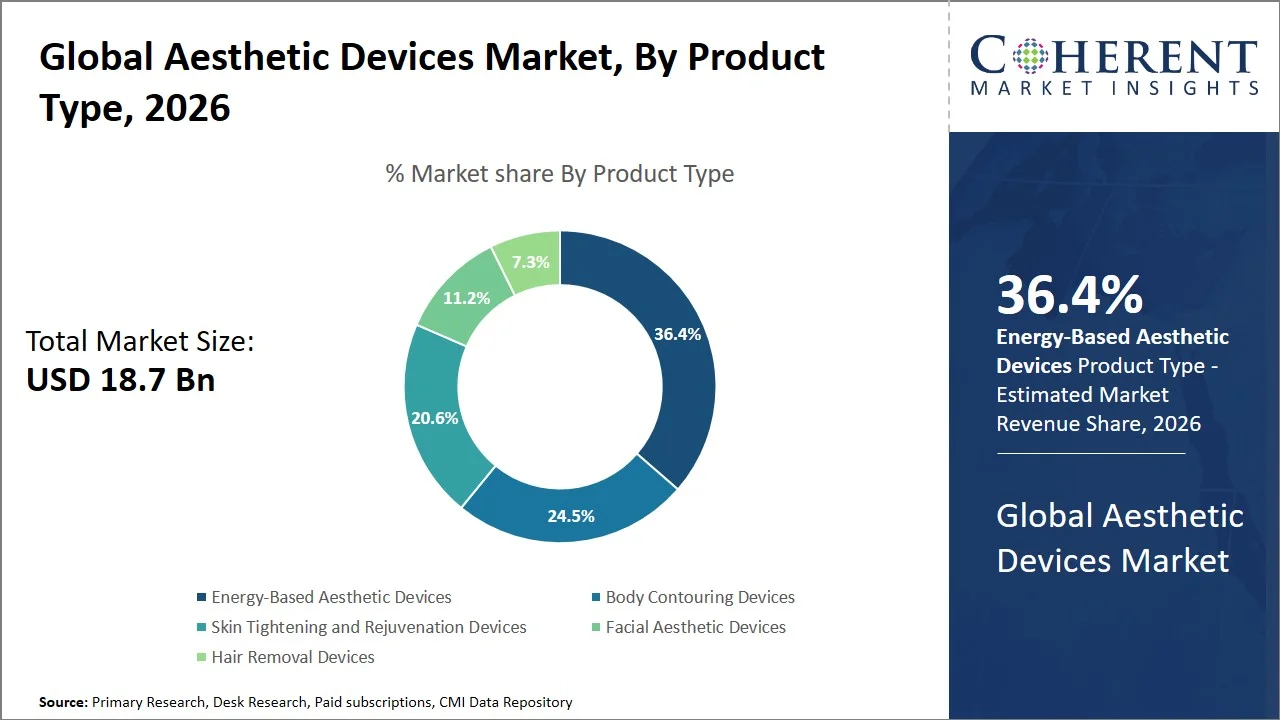
Why Do Energy-Based Aesthetic Devices Dominate the Global Aesthetic Devices Market?
Energy-based aesthetic devices are projected to hold a market share of 36.4% in 2026, owing to their broad therapeutic uses, technological developments and growing awareness about minimally invasive cosmetic treatments. Technologies such as laser, intense pulsed light (IPL), radiofrequency (RF), and ultrasound are heavily relied upon for skin aesthetic improvement, pigment correction, hair removal, acne treatment and body shaping with less recovery time and greater comfort to the patients.
Increasing developments related to multi-wavelength platforms, improving treatment accuracy, real-time monitoring of the skin condition are further expanding their presence across dermatology clinics and medical spas. For instance, in April 2024, AVAVA launches MIRIA advanced non-ablative laser aesthetic solution, an advanced energy-based skin vitality platform employing its own focal point laser technology, together with a strategic distribution collaboration with Jeisys, in order to accelerate commercialization in South Korea and Japan. (Source: AVAVA)
- Current Industry Events of 2026
- Market Size Estimation
- Regional Breakdown
- Competitive Landscape
- Customer Intelligence
- Segmental Analysis
- Pricing Analysis
- Key Market Drivers, Challenges & Future Trends
- Customized Insights Section
Why Does Skin Rejuvenation and Resurfacing Represent the Largest Treatment Type Segment in the Aesthetic Devices Market?
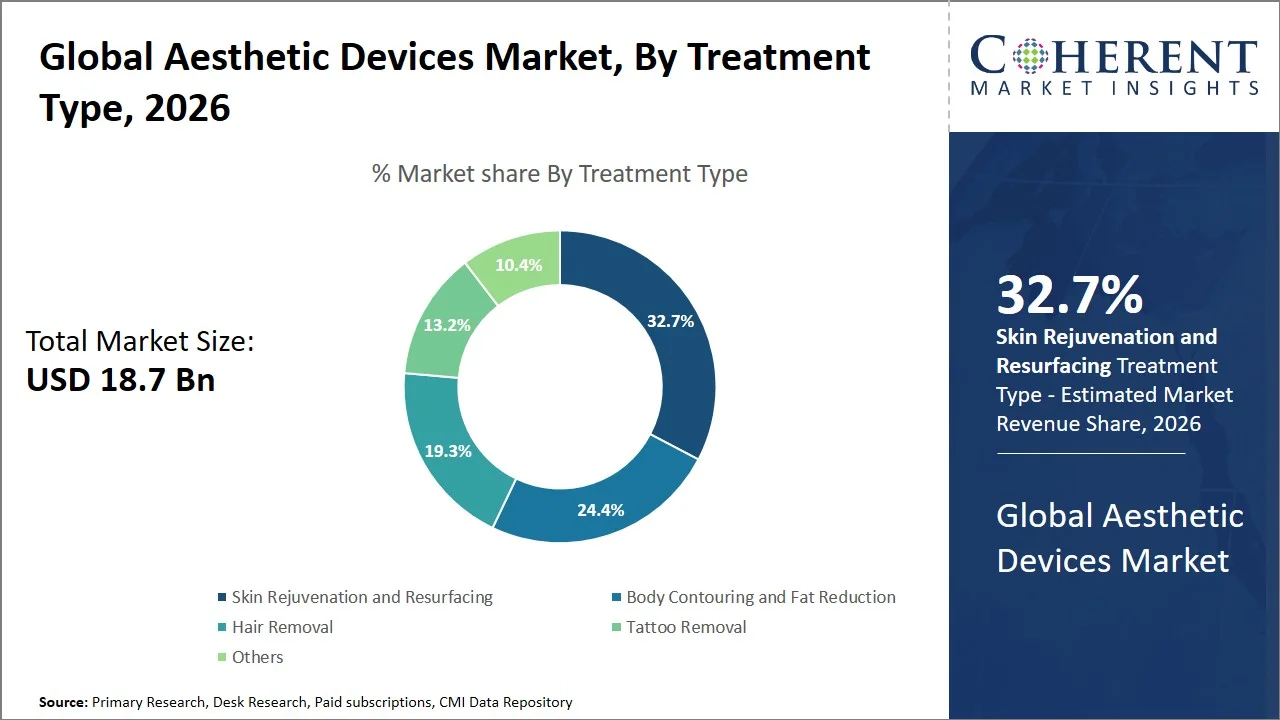
Skin rejuvenation and resurfacing is projected to hold a market share of 32.7% in 2026, on the account of the greater adoption of anti-aging, skin texture improvement, pigmented lesion treatment services. Technologies including fractional lasers, intense pulsed light (ILP), RF for skin microsclerotherapy, RF microneedling and laser skin resurfacing systems are employed on higher scale to treat fine lines and wrinkles, acne scars and uneven skin tone with less recovery time.
The growing preference for preventative treatments and non-invasive non-surgical cosmetic procedures among aging population, millennials and the youth is further resulting into increased adoption in dermatology clinics and medical spas. For instance, in July 2025, NEOVA entered the U.K. prejuvenation launch, which delivered innovative preventative skincare and repair options aimed at early process skin aging and a holistic approach to maintaining skin health over the long term. (Source: PFMA Journal)
Dermatology Clinics Segment Dominates the Global Aesthetic Devices Market
The dermatology clinics segment is projected to hold a market share of 42.6% in 2026, owing to increased penetration of innovative laser, radiofrequency, ultrasound, skin resurfacing platforms by the practitioners for performing non-invasive procedures. Supporting this trend is the surge in demand for dedicated skin treatment centers providing personalized, safe and cost-effective anti-aging, pigmentation, acne scarring and body contouring procedures at the dermatologist clinics. The increased penetration of state-of-the-art energy-based treatment platforms coupled with high procedural volumes continue to invigorate this sector of the aesthetic treatment paradigm. For instance, according to the American Society of Plastic Surgeons (ASPS), about 28.2 million minimally invasive procedures were performed in 2024, representing almost 91.5% of all aesthetic procedural volume (30.9 million) performed in 2024, highlighting strong consumer preference for non-invasive cosmetic procedures and increased utilization of sophisticated aesthetic devices globally. (Source: National Library of Medicine)
Currents Events and their Impact
Current Events | Description and its Impact |
European Union Strengthens Medical Device Regulation (MDR) Compliance for Aesthetic Laser and RF Devices (December 2025) |
|
U.S. FDA Issues New Safety Oversight for RF Microneedling Aesthetic Devices (October 2025) |
|
(Source: European Commission, Food and Drug Administration)
Aesthetic Devices Market Dynamics
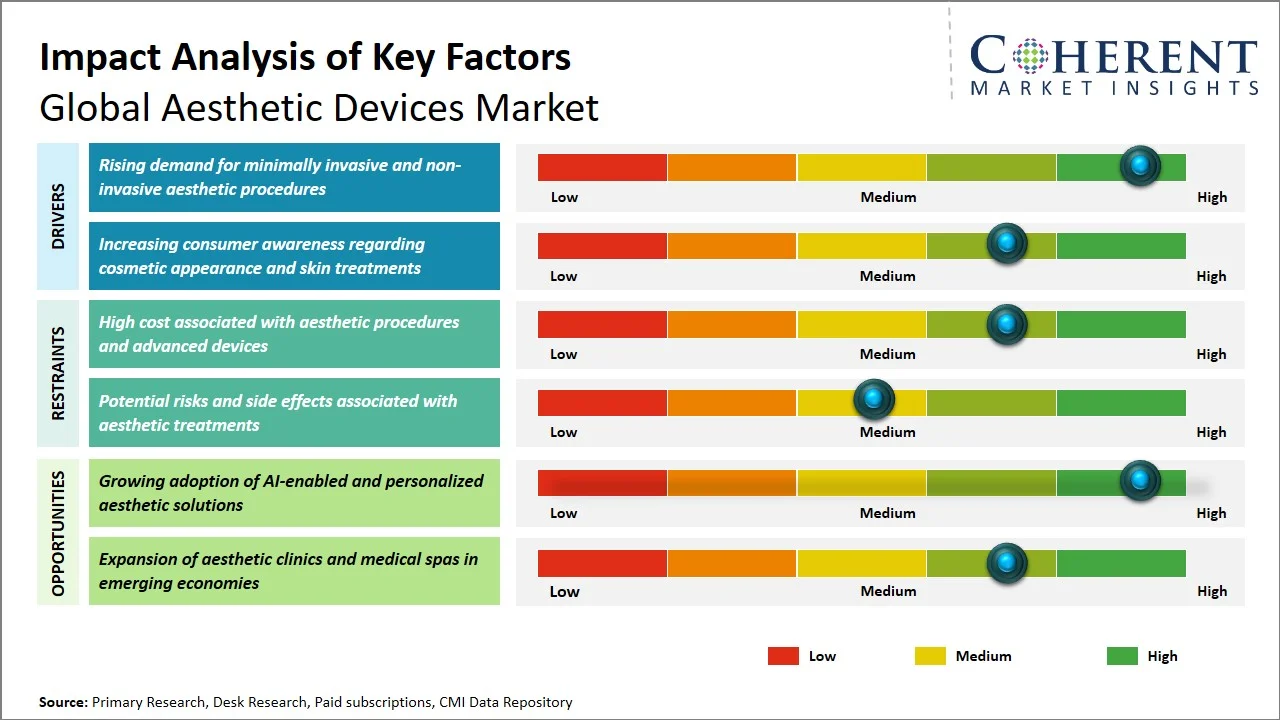
Market Drivers
- Rising demand for minimally invasive and non-invasive aesthetic procedures: Increasing consumer inclination towards minimally invasive and non-invasive aesthetic procedures is a major factor favoring the growth of the global aesthetic devices market. Growing consumer awareness for swift recovery time, lesser procedural risks and enhanced aesthetic results of non-invasive procedures has propelled global demand for more advanced laser, radiofrequency, ultrasound and cryolipolysis based aesthetic treatment platforms. Furthermore, the growth of the global aesthetic device landscape is contributed by the growing consumer preference for outpatient aesthetic procedures for a broad patient demographic including the working adults and youth. For instance, in April 2025, Lumenis unveiled advanced SPLENDOR X laser hair removal system at ASLMS 2025. The launch features innovative dual-wavelength laser system empowered to deliver improved non-invasive hair removal results across the U.S. and Canadian aesthetics markets. (Source: Lumenis Be Ltd.)
- Increasing consumer awareness regarding cosmetic appearance and skin treatments: Increased consumer exposure to digital channel of beauty, social media and more intensive education on skincare is driving consumer demand for aesthetic procedures in clinics and spas for skin rejuvenation and anti-aging, pigmentation correction, and body contouring. Consumers prefer next-generation, minimally invasive, technology driven aesthetic treatments that show tangible cosmetic results with minimal recovery time, further stimulating the demand across the globe for laser, radiofrequency (RF), ultrasound and light-based treatments. For instance, in March 2025, Candela unveils new Glace treatment for skin rejuvenation and advanced facial esthetic. The launch marks new state-of-the-art facial aesthetic treatment platform aimed at enhancing skin radiance, skin rejuvenation as well as providing customer-friendly cosmetic solutions. (Source: Candela Corporation)
Emerging Trends
- Increasing adoption of regenerative aesthetics and collagen stimulation treatments: The shift towards longer skin restoration timescale for aesthetic procedures is surging the demand for aesthetic devices that support collagen induction therapies, skin remodeling and tissue rejuvenation applications. These technologies include, among others microneedling radiofrequency technology, fractional laser systems and ultrasound-based skin tightening platforms.
- Rising popularity of at-home connected aesthetic devices: Rising consumer preferences for app-connected aesthetic devices for home use with LED therapy, microcurrent, customized skin care and monitoring capabilities. This trend is urging aesthetic companies to come up with portable and easy-to-use aesthetic gadgets, primarily for skin renewal, acne care and facial toning.
Regional Insights
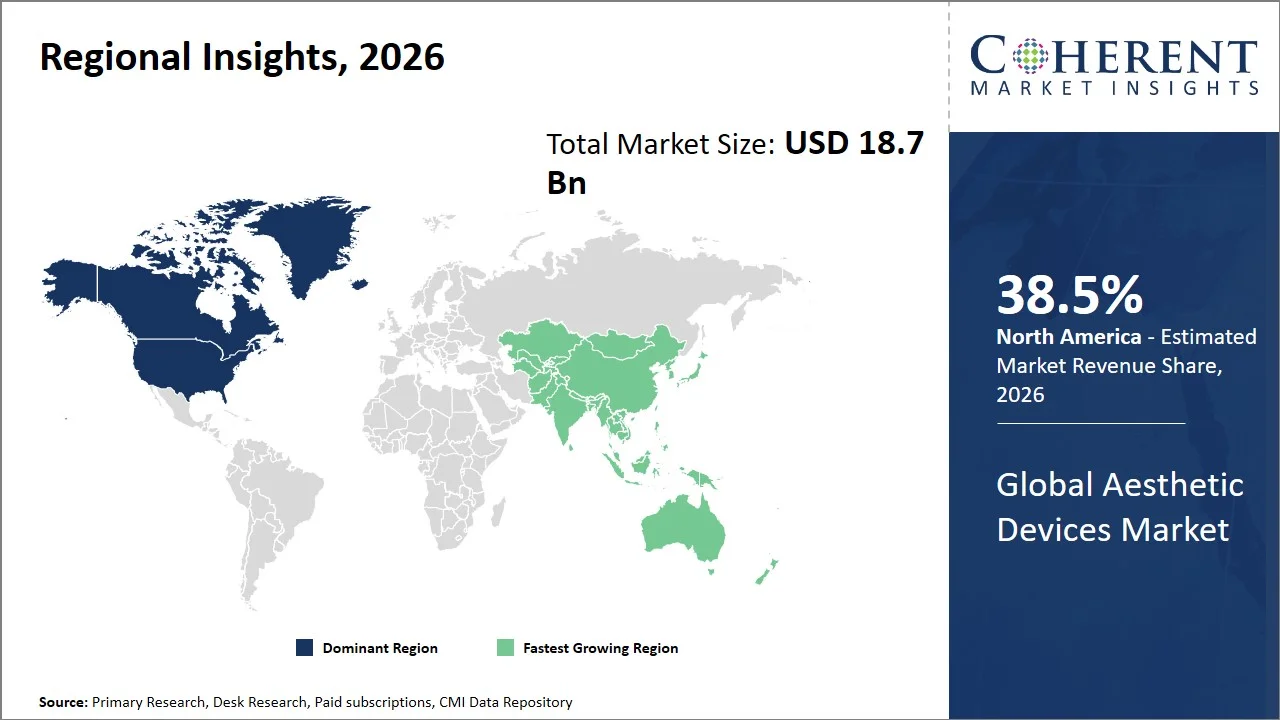
Why is North America a Strong Market for Aesthetic Devices?
North America leads the global aesthetic devices market, accounting for an estimated 38.5% share in 2026, due to established healthcare infrastructure, progressive and affluent population with high level of awareness. The region thrives on the presence of major medical technology companies along with aesthetic devices manufacturers such as Allergan, Lumenis, and Cutera. Well-developed regulatory structure in accordance with U.S. FDA ensures the end consumers' safety and product efficacy, increasing market acceptance. The growing preference for minimally invasive and non-invasive aesthetic procedures and an aging population contribute significantly to the growth of the aesthetic devices market in the region.
Furthermore, significant investment focused towards R&D is complimented by strategic tie-up between major market players and clinics to sustain the market position of North America. For instance, in January 2026, OrangeTwist entered into a strategic partnership with SBC Medical Group Holdings and announced the expansion to 24 locations across six U.S. states, reflecting the commercialization and expansion of geographic reach of advanced aesthetic treatments in the U.S. (Source: SBC Medical Group Holdings)
Why Does the Asia Pacific Aesthetic Devices Market Exhibit High Growth?
The Asia Pacific aesthetic devices market is expected to exhibit the fastest growth with an estimated contribution of 25.4% share to the global market in 2026, fueled by increasing urbanization, democratization of living standards, expanding middle class population and increasing disposable incomes. Consumers in the emerging economies like China, Japan, South Korea, and India exhibit an increased interest towards aesthetic procedures. The emerging trends in cosmetics and celebrities influence the consumers' interest towards various aesthetic procedures.
Additionally, supportive government policies, encouraging the development of medical devices, establishing barrier free regulatory pathways that ease market entry further bolsters the market growth. For instance, Japan's Sakigake Designation System enables accelerated review and approval of cutting-edge medical inventions in Japan-allowing faster commercialization of hi-tech aesthetic medicine and minimally-invasive treatment devices in the country. (Source: Pharmaceuticals and Medical Devices Agency)
Global Aesthetic Devices Market Outlook for Key Countries
Why is the U.S. Leading Innovation and Adoption in the Aesthetic Devices Market?
The U.S. is at the forefront of innovation and adoption in the aesthetic devices market as the country has a high concentration of developed dermatology practices, cosmetic surgery centers, and aesthetic device manufactures conducting active commercialization of innovative laser, radiofrequency, ultrasound, and injectable treatment systems (such as Candela Corporation, Cynosure, Cutera, and AbbVie). Innovations and high adoption levels of artificial intelligence in skin analysis and treatment design, multifunctional energy-based devices, and integration of digital medical records and treatment planning have also accelerated growth in the country. Furthermore, high customer demand for non-invasive aesthetic procedures will continue to promote high adoption of world leading skin rejuvenation, body contouring, and anti-aging devices.
Is South Korea a Favorable Market for Aesthetic Devices?
South Korea is considered one of the most viable markets for aesthetic devices because of the country's highly developed cosmetic treatment culture with well-established dermatology infrastructure and early adoption of technologically advanced aesthetic procedures. South Korea offers wide specialization in skin rejuvenation, facial contouring, laser dermatology and minimally invasive anti-ageing procedures performed at high density cosmetic clinics and aesthetic centers of the country. Furthermore, strong integration of beauty technology, personalized skincare solutions and AI enable aesthetic consultation platforms continue driving the demand for advanced energy based aesthetic devices across South Korea.
Is China Emerging as a Key Growth Hub for the Aesthetic Devices Market?
China is positioned as a key growth hub in the global aesthetic devices market with the proliferation of cosmetic dermatology clinics, rising consumer spending on appearance related treatments and high demand for non-invasive skin rejuvenation and body shaping treatments. The country is witnessing increasing penetration of laser dermatology systems, injectable aesthetics and AI-enabled skincare technologies across urban aesthetic clinics. The presence of a large number of emerging domestic beauty technology players in China and expanding medical aesthetics infrastructure are further enhancing commercialization of advanced aesthetic treatment devices in China.
Why Does Germany Top the European Aesthetic Devices Market?
Germany is the leader in the European market for aesthetic devices owing to a mature infrastructure of aesthetic dermatology and cosmetic surgery procedures, high adoption rate of energy-based aesthetic treatments as well as the large concentration of non-invasive anti-aging treatment modalities in the country. The high penetration of laser skin resurfacing, body sculpting and medical grade skin care procedures in several specialized dermatology clinics and aesthetic centers (such as M1 Med Beauty, Dermedis, and Rosenpark Klinik) across Germany was primarily driven by its well-established medical tech sector and early adoption of clinically advanced aesthetic treatment systems.
Is the Aesthetic Devices Market Developing in Japan?
Japan is emerging as a lucrative market for aesthetic devices due to the rapidly aging population and subsequent heightened demand for non-invasive anti-aging treatments, early age and comprehensive skin-care procedures and technologically advanced beauty solutions. The country enjoys high penetration of laser dermatology, skin tightening, pigmentation correction and facial rejuvenation procedures from specialized aesthetic and dermatology practices. Besides that, the country is driven by technological excellence, luxury skin care innovation and less-invasive elective procedures that further stimulate the need for advanced energy-based aesthetic devices.
Regulatory Landscape Governing the Global Aesthetic Devices Market
Region | Authority & Classification | Approval Pathway | Key Regulatory Insights |
North America | U.S. Food and Drug Administration (FDA) – aesthetic devices regulated as Class I, II, or III medical devices depending on risk profile and intended cosmetic use | 510(k) clearance, De Novo classification, or Premarket Approval (PMA) for high-risk aesthetic systems | Strong regulatory oversight for laser, RF, ultrasound, and light-based aesthetic devices with emphasis on clinical safety, electromagnetic compliance, and labeling requirements |
Europe | European Medicines Agency (EMA) and EU Medical Device Regulation (EU MDR 2017/745); CE marking classification under Class I, IIa, IIb, or III | CE Mark approval through notified bodies under EU MDR framework | EU MDR has strengthened post-market surveillance, clinical evidence requirements, and traceability standards for aesthetic and cosmetic medical devices |
Asia Pacific | National Medical Products Administration (NMPA-China), Pharmaceuticals and Medical Devices Agency (PMDA-Japan), CDSCO-India, MFDS-South Korea | Country-specific product registration, local clinical validation, and import/manufacturing approvals | Regulatory reforms across APAC are accelerating approvals for advanced aesthetic technologies while strengthening quality and safety compliance for imported cosmetic devices |
Latin America | ANVISA (Brazil), COFEPRIS (Mexico), INVIMA (Colombia) | Device registration and local regulatory review for cosmetic and energy-based systems | Increasing harmonization of medical device regulations is improving commercialization opportunities for aesthetic device manufacturers across Latin America |
Middle East & Africa | Saudi Food and Drug Authority (SFDA), UAE Ministry of Health & Prevention (MOHAP), South African Health Products Regulatory Authority (SAHPRA) | Medical device registration, Gulf conformity approvals, and import licensing pathways | Rising focus on medical aesthetics tourism and private dermatology infrastructure is driving stricter regulatory frameworks for aesthetic device quality and patient safety |
How is the growing adoption of AI-enabled and personalized aesthetic solutions creating new growth opportunities in the aesthetic devices market?
Increasing penetration of AI-based and customized aesthetic treatments is expected to create lucrative growth prospects in the aesthetic devices market by improving treatment accuracy, patient customization, and clinical results. AI-based skin analysis and imaging systems enable aesthetic practitioners to formulate customized treatment plans for skin rejuvenation, skin pigmentation correction, body sculpting, and anti-aging treatments. These approaches also boost operational efficiency, patient participation, and accuracy of treatment feedback estimation, thereby escalating the need for sophisticated aesthetic products across dermatology clinics and medical spas. For instance, in December 2025, Perfect Corp. debuts next generation AI beauty agent and API new solutions at CES 2026. The company launched sophisticated AI beauty and skincare analysis solutions to better enable tailored skin treatment, virtual professional guidance, and aesthetically-focused procedures. (Source: Perfect Corp.)
Market Players, Key Development, and Competitive Intelligence
Key Developments
- In February 2026, Bausch Health's aesthetics business, Solta Medical, launched the Clear + Brilliant Touch Laser in Canada after receiving approval from Health Canada. The laser broadens the availability of dual-wavelength technology that is used for non-invasive skin rejuvenation for health parameters, tattoo removal, abnormal hair reduction, and specifically designed aesthetic treatment.
- In October 2024, Tiger Aesthetics announced the strategic acquisition of a portfolio of specific product lines from Suneva Medical to further expand its regenerative aesthetics portfolio. Tiger Aesthetics created a regenerative aesthetics portfolio which broadens it aesthetic portfolio of adipose cell- and tissue-based products.
Competitive Landscape
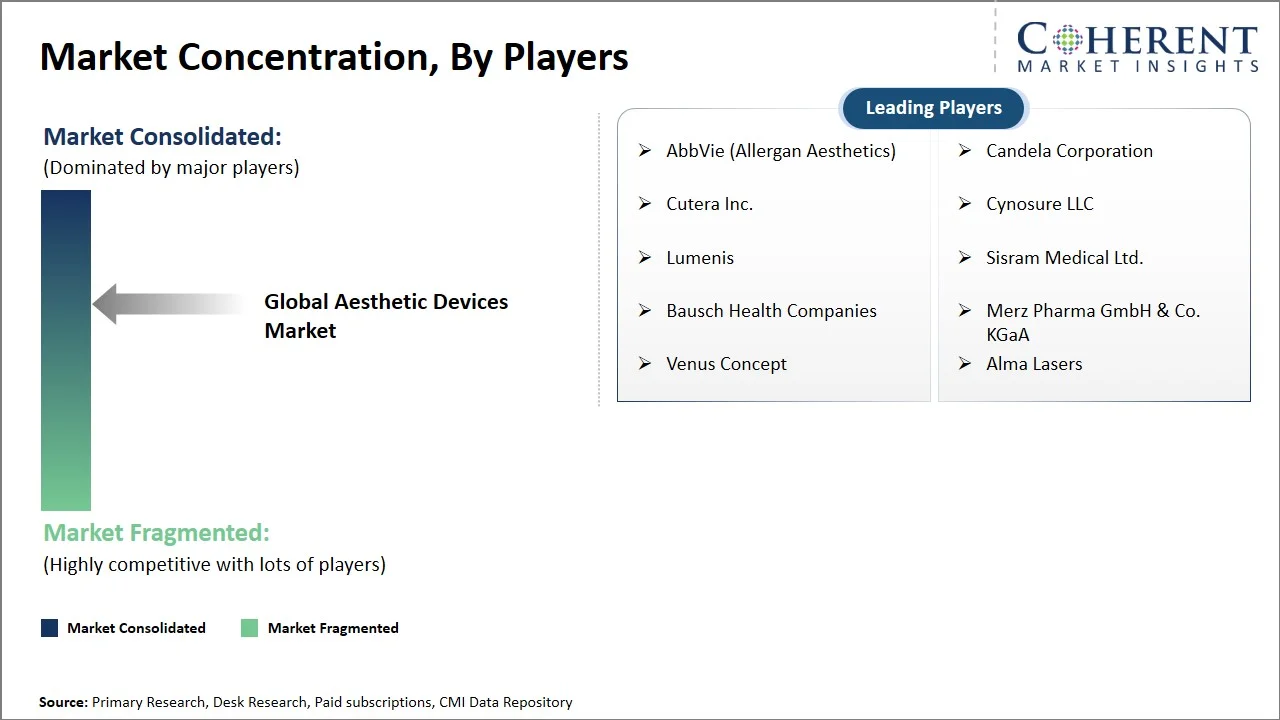
The global aesthetic devices market is moderately competitive, with multinational aesthetic technology companies, dermatology device manufacturers, as well as provider of cosmetic treatment solutions battling out against through enticing product development and market penetration strategies by offering robust portfolios of minimally invasive cosmetic treatments. Market players are introducing AI-enabled skin analysis systems, energy aesthetic systems and personalized cosmetic treatment tools to secure their inherent market positions. Industry players are also broadening market tie-ups with dermatology clinic systems, medical spa outlets as well as cosmetic surgical centers while bolstering regulatory clearances and regional distribution networks in light of increasing global consumer interest toward non-invasive aesthetic procedures. Key focus areas include:
- Development of advanced laser, radiofrequency, and ultrasound-based aesthetic treatment systems
- Expansion of minimally invasive and personalized skin rejuvenation solutions
- Integration of AI-powered imaging and treatment planning technologies
- Strengthening dermatology clinic partnerships and medical aesthetics distribution networks
Market Report Scope
Aesthetic Devices Market Report Coverage
| Report Coverage | Details | ||
|---|---|---|---|
| Base Year: | 2025 | Market Size in 2026: | USD 18.7 Bn |
| Historical Data for: | 2020 To 2024 | Forecast Period: | 2026 To 2033 |
| Forecast Period 2026 to 2033 CAGR: | 9% | 2033 Value Projection: | USD 34.2 Bn |
| Geographies covered: |
| ||
| Segments covered: |
| ||
| Companies covered: | AbbVie (Allergan Aesthetics), Candela Corporation, Cutera Inc., Cynosure LLC, Lumenis, Sisram Medical Ltd., Bausch Health Companies, Merz Pharma GmbH & Co. KGaA, Venus Concept, and Alma Lasers | ||
| Growth Drivers: |
| ||
| Restraints & Challenges: |
| ||
Analyst Opinion (Expert Opinion)
- The future outlook for the global market for aesthetic devices is positioned for an accelerated shift to non-invasive, customized cosmesis products in combination with intelligent, AI integrated hardware diagnostic systems and enhanced energy-based platforms. The global demand for less expansive procedures with less downtime, a focus on preventive anti–aging treatments and at home treatments makes the market attractive and likely to lead to a global growth in the adoption of mobile, multi-application, digitally interconnected devices. Medical aesthetics tourism and derma care procedures will see above average growth rate globally.
- The maximum growth opportunities are expected in energy-based aesthetic devices used for skin rejuvenation, body contouring, and hair restoration treatments across the Asia Pacific region, particularly in South Korea, China, and India. Rising disposable incomes, an expanding customer base at dermatology clinics, and growing medical tourism are driving the demand for advanced laser, Radiofrequency (RF), and ultrasound-based aesthetic treatment devices in the region.
- In order to obtain a competitive advantage, market participants should seek to extend their AI-enabled personalized treatment products, bolster the approval of advanced minimally invasive products, and keep up the partnerships with dermatology clinics and medical spa centers. Industry players should especially look upon multi-functional treatment device platform, portable aesthetic systems, and market specific commercialization pathways to provide a more accessible offering and later strengthen the putative long term market penetration.
Speak to the analyst
Want personalized insights?
Take the findings above to one of our principal consultants, or have the report rebuilt around the segments, geographies and competitors you actually track.
Market Segmentation
- Product Type Insights (Revenue, USD Bn, 2021 - 2033)
- Energy-Based Aesthetic Devices
- Body Contouring Devices
- Skin Tightening and Rejuvenation Devices
- Facial Aesthetic Devices
- Hair Removal Devices
- Treatment Type Insights (Revenue, USD Bn, 2021 - 2033)
- Skin Rejuvenation and Resurfacing
- Body Contouring and Fat Reduction
- Hair Removal
- Tattoo Removal
- Others
- End User Insights (Revenue, USD Bn, 2021 - 2033)
- Hospitals
- Dermatology Clinics
- Medical Spas and Beauty Centers
- Ambulatory Surgical Centers
- Others
- Regional Insights (Revenue, USD Bn, 2021 - 2033)
- North America
- U.S.
- Canada
- Latin America
- Brazil
- Argentina
- Mexico
- Rest of Latin America
- Europe
- Germany
- U.K.
- Spain
- France
- Italy
- Russia
- Rest of Europe
- Asia Pacific
- China
- India
- Japan
- Australia
- South Korea
- ASEAN
- Rest of Asia Pacific
- Middle East
- GCC Countries
- Israel
- Rest of Middle East
- Africa
- South Africa
- North Africa
- Central Africa
- North America
- Key Players Insights
- AbbVie (Allergan Aesthetics)
- Candela Corporation
- Cutera Inc.
- Cynosure LLC
- Lumenis
- Sisram Medical Ltd.
- Bausch Health Companies
- Merz Pharma GmbH & Co. KGaA
- Venus Concept
- Alma Lasers
Sources
Primary Research Interviews
- Aesthetic device manufacturers and cosmetic technology specialists involved in laser, RF, ultrasound, and light-based treatment system development
- Dermatology clinics, cosmetic surgeons, and medical spa operators utilizing minimally invasive aesthetic treatment platforms
- Healthcare distributors and aesthetic equipment suppliers managing global cosmetic device distribution networks
- Regulatory and clinical experts evaluating safety, efficacy, and adoption trends of energy-based aesthetic technologies
Stakeholders
- Aesthetic device manufacturers and cosmetic treatment technology providers
- End-use Sectors
- Dermatology clinics and cosmetic surgery centers
- Medical spas and wellness treatment providers
- Hospitals offering minimally invasive aesthetic procedures
- Beauty and skincare treatment chains
- Aesthetic training institutes and cosmetic procedure academies
- Regulatory & Health Bodies: U.S. Food and Drug Administration (FDA) – aesthetic laser and cosmetic device approvals, European Medicines Agency (EMA) – medical aesthetics and injectable product regulations, International Organization for Standardization (ISO) – medical device quality standards, World Health Organization (WHO) – healthcare and dermatology burden statistics
Databases
- WHO Global Health Observatory – healthcare infrastructure and dermatology-related statistics
- OECD Health Statistics – cosmetic procedure adoption and healthcare expenditure trends
- CDC National Center for Health Statistics – outpatient cosmetic treatment and dermatology utilization data
- World Bank Database – healthcare spending and wellness industry indicators
- International Society of Aesthetic Plastic Surgery (ISAPS) Database – global aesthetic procedure statistics and treatment trends
- Global Wellness Institute Database – wellness and beauty industry market indicators
Magazines
- Aesthetic Medicine – cosmetic treatment technologies and dermatology trends
- MedEsthetics Magazine – aesthetic devices and minimally invasive procedure advancements
- Dermatology Times – laser technology and skin rejuvenation developments
- Plastic Surgery Practice – cosmetic surgery and aesthetic device innovations
Journals
- Journal of Cosmetic Dermatology
- Lasers in Surgery and Medicine
- Aesthetic Surgery Journal
- Journal of Drugs in Dermatology
- Dermatologic Surgery
Newspapers
- Financial Times – global beauty and aesthetic technology market developments
- The Wall Street Journal – cosmetic healthcare investments and consumer trends
Associations
- International Society of Aesthetic Plastic Surgery (ISAPS)
- American Society for Dermatologic Surgery (ASDS)
- The Aesthetic Society
- European Society for Lasers and Energy Based Devices (ESLD)
- American Academy of Dermatology (AAD)
Public Domain Sources
- U.S. Food and Drug Administration (FDA) – aesthetic device approvals and laser safety regulations
- World Health Organization (WHO) – healthcare infrastructure and skin disorder statistics
- National Institutes of Health (NIH) – dermatology and cosmetic treatment research publications
- International Organization for Standardization (ISO) – medical device and aesthetic equipment standards
- World Bank – healthcare expenditure and wellness tourism indicators
Proprietary Elements
- CMI Data Analytics Tool, Proprietary CMI Existing Repository of information for last 10 years.
Get access to 250+ pages report
Every segment, forecast, competitor profile and data table behind the analysis above — available for instant download.
- ESOMAR Member
- ISO 9001:2015 Certified
- D-U-N-S Registered
- GDPR & CCPA Compliant
Missing comfort of reading report in your local language? Find your preferred language:
Transform your Strategy with Exclusive Trending Reports
Frequently Asked Questions
The global aesthetic devices market is estimated to be valued at USD 18.7 Bn in 2026 and is expected to reach USD 34.2 Bn by 2033.
Energy-based aesthetic devices dominate due to their wide adoption in non-invasive skin rejuvenation, hair removal, body contouring, and anti-aging procedures, supported by continuous advancements in laser, radiofrequency, ultrasound, and light-based treatment technologies.
Aesthetic devices are advanced medical or cosmetic technologies used for non-invasive and minimally invasive procedures aimed at improving physical appearance, skin quality, and body contour.
The CAGR of the global aesthetic devices market is projected to be 9%from 2026 to 2033.
Rising demand for minimally invasive and non-invasive aesthetic procedures, and increasing consumer awareness regarding cosmetic appearance and skin treatments are the major factors driving the growth of the global aesthetic devices market.
High cost associated with aesthetic procedures and advanced devices and potential risks and side effects associated with aesthetic treatments are the major factors hampering the growth of the global aesthetic devices market.
Energy-based devices are preferred because they offer reduced recovery time, improved treatment precision, and minimally invasive cosmetic outcomes compared to traditional surgical procedures.