

Anti Aging Treatment Market Size and Trends - 2026 to 2033
Anti Aging Treatment Market is estimated to be valued at USD 32.06 Bn in 2026 and is expected to reach USD 53.18 Bn in 2033, exhibiting a compound annual growth rate (CAGR) of 7.5% from 2026 to 2033.
Key Takeaways
- Based on Product Type, the UV absorbers segment is expected to hold the largest market share of 36% in 2026, driven by the increasing demand for wrinkle-reducing creams, serums, and lotions that contain key ingredients like retinol, peptides, and hyaluronic acid.
- Based on Technology, Botulinum Toxin Therapy is expected to dominate the market with 31% share in 2026, fueled by its popularity in non-invasive treatments for facial wrinkles and fine lines, along with its fast results and minimal downtime.
- Based on End User, Skin Care Clinics is projected to lead the market with a 26% share in 2026, as these clinics are the primary providers of professional anti-aging treatments such as Botox injections, dermal fillers, laser resurfacing, and chemical peels.
- Based on Region, North America is expected to maintain the largest market share of 43.8% in 2026, due to high disposable incomes, advanced healthcare infrastructure, and a strong cultural trend toward cosmetic procedures, particularly in the U.S.
Market Overview
The global Anti-aging Treatment Market is experiencing significant growth due to the rising demand for aesthetic treatments aimed at combating the visible signs of aging. Key factors driving this market include an increasing global aging population, heightened awareness about skin health, and growing cultural acceptance of cosmetic procedures. Popular treatments such as botulinum toxin therapy, dermal fillers, and microdermabrasion are leading the way. Additionally, technological advancements, including non-invasive treatments and innovative anti-aging products, are expanding treatment options.
Current Events and their Impact on the Anti Aging Treatment Market
Current Event | Description and its Impact |
Regulatory and Policy Developments in Key Markets |
|
Technological Breakthroughs and Innovation Acceleration |
|
Demographic and Economic Shifts |
|
Smart Anti-Aging Treatments in the Anti-Aging Market
Smart anti-aging treatments are revolutionizing the beauty and healthcare industry in 2025 by integrating advanced technology, personalized care, and sustainability to meet the growing demands of consumers seeking effective, non-invasive anti-aging solutions. These treatments include AI-powered skincare devices, wearable sensors for skin health monitoring, and personalized serums based on data-driven analysis of individual skin needs. In the anti-aging sector, smart treatments leverage technologies such as artificial intelligence, machine learning, and biometrics to analyze skin conditions, predict aging patterns, and create tailored treatment regimens that enhance efficacy and reduce waste.
For instance, in 2023, Estée Lauder unveiled its new Advanced Night Repair Serum, integrating AI-powered skincare technology to personalize the serum’s application based on individual skin needs. The product uses skin assessments to adapt to environmental factors and improve skin hydration, reducing visible signs of aging.
- Current Industry Events of 2026
- Market Size Estimation
- Regional Breakdown
- Competitive Landscape
- Customer Intelligence
- Segmental Analysis
- Pricing Analysis
- Key Market Drivers, Challenges & Future Trends
- Customized Insights Section
Segmental Insights
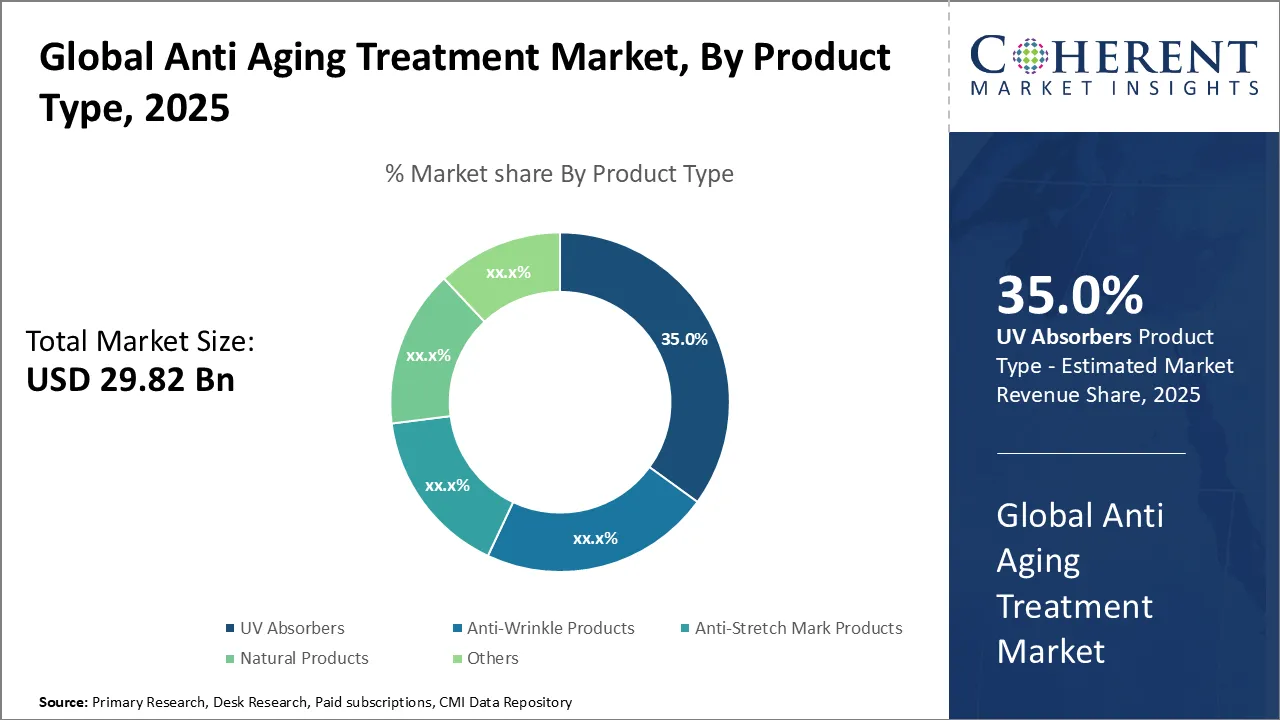
Anti-Aging Treatment Market Insights, By Product Type: UV Absorbers Lead Due to Their Demand in Wrinkle-Reducing Products
In terms of product type, the UV absorbers segment is expected to hold the largest market share of 36% in 2026. UV absorbers are crucial ingredients in anti-aging creams, serums, and lotions, as they protect the skin from harmful ultraviolet rays that contribute to aging signs like wrinkles, fine lines, and age spots. The increasing awareness of skin damage caused by sun exposure has significantly boosted the demand for products containing UV protection. As consumers prioritize skin protection and wrinkle reduction, UV absorbers are becoming integral in both daily skincare routines and professional treatments. This segment benefits from the growing popularity of anti-aging skincare solutions that combine active ingredients like retinol, peptides, and hyaluronic acid. These formulations not only combat sun-induced aging but also enhance skin texture, providing a multi-faceted approach to anti-aging.
For instance, in May 2025, Estée Lauder launched a new advanced anti-aging serum with UV protection, incorporating UV-absorbing technologies to prevent sun damage while simultaneously reducing visible wrinkles, leading to higher adoption rates of their products in the beauty market. This marks a significant step in integrating sunscreen protection into daily anti-aging skincare regimens.
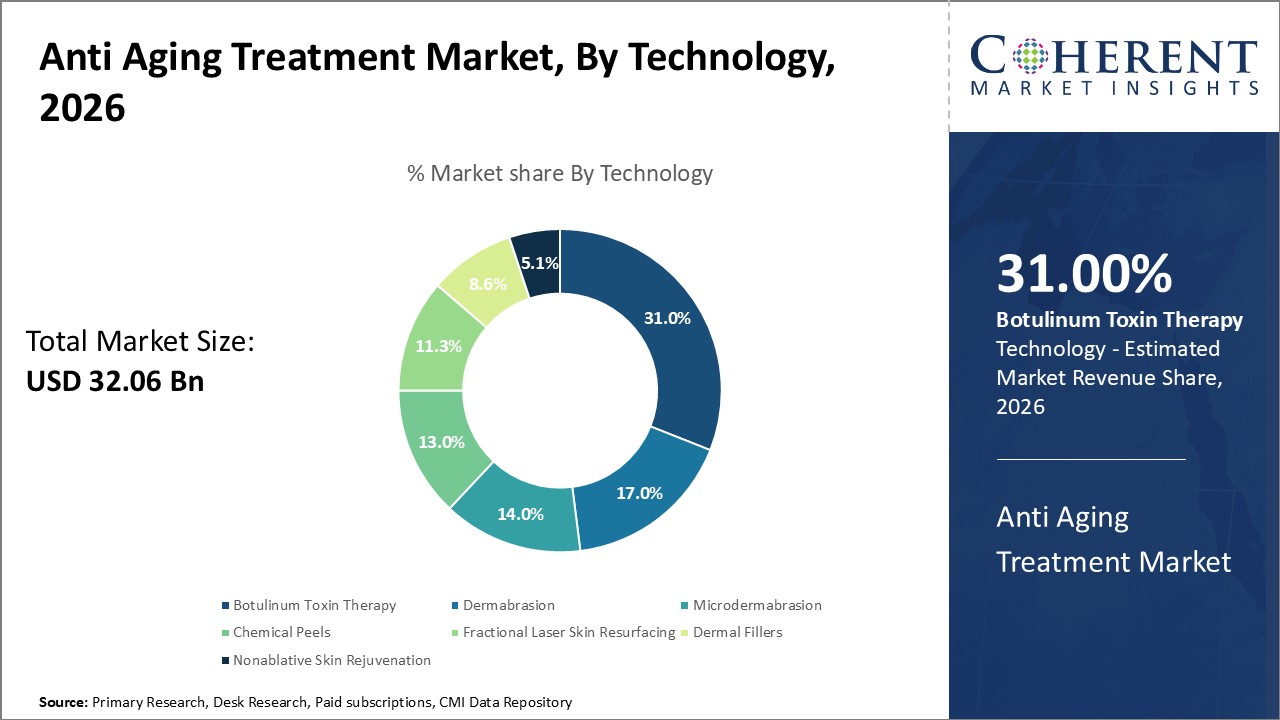
Anti-Aging Treatment Market Insights, By Technology: Botox Expected to Dominate with Significant Market Share
In terms of technology, Botulinum Toxin Therapy (Botox) is expected to dominate the market with 31% share in 2026. Known for its effectiveness in smoothing out facial wrinkles and fine lines, Botox remains one of the most popular non-invasive treatments for anti-aging. Its popularity stems from its quick results, minimal downtime, and high patient satisfaction. As consumers seek more convenient, less invasive alternatives to surgical treatments, Botox continues to lead the charge. The growing demand for non-surgical procedures that provide a youthful appearance with minimal recovery time drives the sustained growth of this segment. Additionally, Botox is widely used in conjunction with other anti-aging treatments, such as dermal fillers and chemical peels, creating a synergistic effect that enhances overall skin rejuvenation.
In February 2025, Allergan (the company behind Botox) announced a new botulinum toxin-based treatment designed for both wrinkle reduction and skin hydration, aimed at addressing broader signs of aging. This innovation is expected to further strengthen Botox's market dominance.
Anti-Aging Treatment Market Insights, By End User: Skin Care Clinics Lead the Market
In terms of end user, skin care clinics are projected to lead the market with a 26% share in 2026. These clinics are the primary providers of professional anti-aging treatments like Botox injections, dermal fillers, laser resurfacing, and chemical peels, which are performed by certified dermatologists and skincare professionals. The growing popularity of non-surgical treatments that offer quick results with minimal discomfort is driving the demand for specialized skincare clinics. As more consumers seek targeted treatments for aging skin, these clinics are expanding their offerings to meet the increasing demand for advanced anti-aging procedures. Additionally, the rise of cosmetic dermatology and aesthetic medicine has significantly contributed to the growth of this segment.
For instance, In September 2025, GeneIQ launched exclusively at Oliva's new flagship clinic in Banjara Hills, Hyderabad, and will be progressively rolled out across India.
Regional Insights
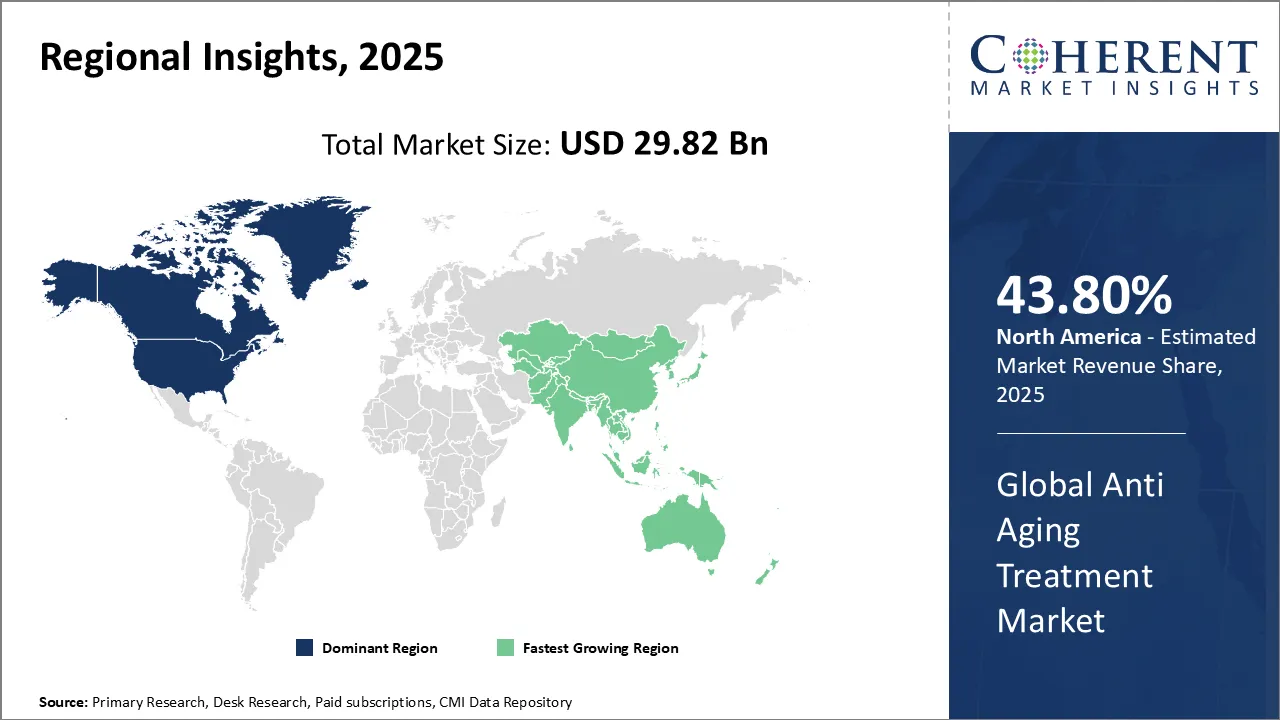
North America Anti Aging Treatment Market Analysis & Trends
North America is expected to maintain the largest share of 43.8% in 2026 in the global anti-aging treatment market, driven by high disposable incomes, advanced healthcare infrastructure, and a strong cultural inclination toward cosmetic and aesthetic procedures, particularly in the U.S. The region benefits from widespread availability of dermatology clinics, skin care centers, and cosmetic surgery facilities , which offer a range of professional anti-aging treatments such as Botox, dermal fillers, and laser therapies. Additionally, growing awareness about skin health, anti-aging skincare routines, and the adoption of technologically advanced treatments contribute to market growth. The U.S. also leads in innovation and product launches, supporting the uptake of both at-home and clinical anti-aging solutions, while insurance coverage and reimbursement policies for certain procedures further encourage adoption. This combination of economic, cultural, and healthcare factors ensures North America remains the most lucrative region for anti-aging treatments globally.
For instance, in April 2026, Neutrogena Corporation, a U.S. based cosmetics, skin care, and hair care company, unveiled its Rapid Wrinkle Repair range. Its formula contains stabilized retinol that slowly feeds skin with retinol in order to help minimize irritation, hence helping with dull skin, dark spots, wrinkles, or fine lines. It consists of Hyaluronic Acid, Glucose Complex, and Pure Retinol (Vitamin A).
Asia Pacific Anti Aging Treatment Market Analysis & Trends
Asia Pacific has emerged as the fastest-growing regional market for anti-aging treatments in recent years. Rising disposable incomes, increasing urbanization, and a growing middle-class population in countries like China, India, Japan, and South Korea have fueled demand for skincare and cosmetic solutions. Cultural emphasis on youthfulness, beauty, and personal grooming has accelerated the adoption of both clinical procedures such as Botox, dermal fillers, and laser resurfacing, as well as premium at-home anti-aging products including serums, creams, and UV-protection formulations. Local manufacturers and international brands are expanding their presence by launching region-specific products and leveraging e-commerce platforms to reach wider consumer bases. Additionally, increasing awareness about skin health, sun protection, and preventive skincare is driving growth in the anti-aging segment. The region also benefits from technological advancements in treatment options and rising medical tourism, particularly in South Korea and Thailand, making Asia Pacific a highly attractive market for anti-aging solutions.
For instance, in October 2026, ,4D Molecular Therapeutics, a leading late-stage biotechnology company advancing durable and disease-targeted therapeutics with potential to transform treatment paradigms and provide unprecedented benefits to patients, announced a strategic partnership with Otsuka Pharmaceutical Co., Ltd. (Otsuka) to develop and commercialize 4D-150 for the treatment of wet age-related macular degeneration (wet AMD) and diabetic macular edema (DME) in the greater Asia-Pacific (APAC) region including Japan.
Anti Aging Treatment Market Outlook Country-Wise
U.S. Anti Aging Treatment Market Trends
The U.S. leads the global anti-aging treatment market, driven by high disposable incomes, advanced healthcare infrastructure, and strong consumer preference for cosmetic procedures. Widespread availability of dermatology clinics, aesthetic centers, and innovative treatments like Botox, dermal fillers, and laser therapies, combined with rising awareness of skin health, fuels market growth.
For instance, in September 2026, Allergan Aesthetics announced the expansion of SKINVIVE by JUVÉDERM® into 35 new markets, reinforcing its commitment to advancing global skin quality.
China Anti Aging Treatment Market Trends
China is a rapidly growing market for anti-aging treatments, fueled by rising disposable incomes, an expanding middle class, and increasing beauty-consciousness among consumers. Demand is driven by both clinical procedures like Botox, dermal fillers, and laser therapies, as well as premium skincare products, supported by e-commerce platforms and urban lifestyle trends.
For instance, in March 2026, China announced a major new “human cell lineage” research center in Guangdong, South China. The project, led by the Guangzhou Institutes of Biomedicine and Health under the Chinese Academy of Sciences, aims to better understand how human cells grow, change, and age. Scientists plan to use AI to create digital models of cells and build a “digital human” to study development, diseases, and aging.
Market Report Scope
Anti Aging Treatment Market Report Coverage
| Report Coverage | Details | ||
|---|---|---|---|
| Base Year: | 2025 | Market Size in 2026: | USD 32.06 Bn |
| Historical Data for: | 2020 To 2024 | Forecast Period: | 2026 To 2033 |
| Forecast Period 2026 to 2033 CAGR: | 7.5% | 2033 Value Projection: | USD 53.18 Bn |
| Geographies covered: |
| ||
| Segments covered: |
| ||
| Companies covered: | Allergan Plc, Estée Lauder Companies, Shiseido Company, Beiersdorf AG, L'Oréal S.A, NuFACE, Ostium Cosmetics, PhotoMedex, Inc, Alma Laser, and Rodan & Fields, LLC | ||
| Growth Drivers: |
| ||
| Restraints & Challenges: |
| ||
Anti-aging Treatment Market Drivers
Increasing research and development activities for anti-aging treatments
Increasing research and development activities for anti-aging treatments are expected to drive the global anti-aging treatment market growth over the forecast period. For instance, according to an article published by the International Journal of Cosmetic Science on June 24, 2020, a study was conducted to check the anti-aging effect of chondroitin sulfate (CS) through skin regeneration. It was found that Chondroitin sulfate treatment increased the proliferation of keratinocytes and fibroblasts. It also stimulated the migration and synthesis of ECM components in fibroblasts. Further analysis revealed that CS induced the expression of type I procollagen by activating the extracellular signal-regulated kinase pathway. Using a full-thickness skin wound model and an aged skin model, it was confirmed that CS treatment promoted skin wound healing and regeneration.
Anti-aging Treatment Market Opportunities
Market Expansion and Innovation Prospects in Anti-Aging Treatments
The anti-aging treatment market presents significant growth opportunities across multiple fronts. Preventive and “pre-juvenation” treatments are attracting younger consumers, while non-invasive procedures like Botox and dermal fillers continue to gain popularity due to minimal downtime. Integration of AI-driven diagnostics and personalized regimens enhances customer engagement and loyalty. Emerging markets such as China and India offer expanding consumer bases with rising disposable incomes, and the demand for sustainable, clean-label skincare products allows brands to differentiate and capture niche, wellness-focused segments.
Analyst Opinion (Expert Opinion)
The anti‑aging treatment market is undergoing a structural shift driven by technological innovation, personalization and preventive health strategies. Advanced diagnostics and energy‑based devices, such as AI‑enabled skin scanning, radio‑frequency microneedling and fractional lasers, are gaining traction, accounting for around 45% of non‑surgical treatment uptake. Meanwhile, brand leaders and biotech firms are forming ingredient‑platform partnerships and engaging in intense patent‑building: over 79,960 patents were filed globally in anti‑aging technologies, with China alone representing 34,617 of them.
Healthcare payors and clinics are beginning to treat “aesthetic ageing” as part of wellness and longevity care rather than purely cosmetic, shifting reimbursement and service models accordingly. At the same time, younger cohorts are entering the treatment funnel earlier, preventive “pre‑juvenation” treatments are disrupting traditional age‑based segmentation. Clinics and brands that integrate digital ecosystems, personalized regimens and outcome‑tracking stand to secure supply‑chain and distribution advantages, while those relying solely on legacy product stacks will find themselves excluded from premium channels.
Speak to the analyst
Want personalized insights?
Take the findings above to one of our principal consultants, or have the report rebuilt around the segments, geographies and competitors you actually track.
Anti Aging Treatment Industry News
- In January 2025, Allergan Aesthetics launched the AA Signature Program and an immersive booth at IMCAS/AMWC 2025, introducing a personalized treatment planning approach that leverages its advanced facial portfolio and celebrates 10 years of MD Codes™.
- In January 2024,NuFACE launched its “Fitness For Your Face®” campaign, featuring the TRINITY+ Complete Device and a new 10-day “10/10 Facial Workout” available on the NuFACE Smart App, which combines microcurrent and LED red-light therapy.
- In April 2024, Beiersdorf and Rubedo Life Science entered into a multi-year strategic partnership in Hamburg to develop a breakthrough anti-aging solution for the global face care market.
Market Segmentation
- Product Type Insights (Revenue, USD Bn & KT, 2026 - 2033)
- UV Absorbers
- Anti-Wrinkle Products
- Anti-Stretch Mark Products
- Natural Products
- Others
- Technology Insights (Revenue, USD Bn & KT, 2026 - 2033)
- Botulinum Toxin Therapy
- Dermabrasion
- Microdermabrasion
- Chemical Peels
- Fractional Laser Skin Resurfacing
- Dermal Fillers
- Nonablative Skin Rejuvenation
- End Users Insights (Revenue, USD Bn & KT, 2026 - 2033)
- Hospitals
- Skin Care Clinics
- Homecare Settings
- Others
- Regional Insights (Revenue, USD Bn & KT, 2026 - 2033)
- North America
- U.S.
- Canada
- Latin America
- Brazil
- Argentina
- Mexico
- Rest of Latin America
- Europe
- Germany
- U.K.
- Spain
- France
- Italy
- Russia
- Rest of Europe
- Asia Pacific
- China
- India
- Japan
- Australia
- South Korea
- ASEAN
- Rest of Asia Pacific
- Middle East & Africa
- GCC Countries
- Israel
- Rest of Middle East & Africa
- North America
- Key Players Insights (Revenue, USD Bn, 2021 - 2033)
- Allergan Plc
- Estée Lauder Companies
- Shiseido Company
- Beiersdorf AG
- L'Oréal S.A,
- NuFACE
- Ostium Cosmetics
- PhotoMedex, Inc
- Alma Laser
- Rodan & Fields, LLC
Sources
Primary Research Interviews from the following stakeholders
Stakeholders
- Interviews with dermatologists, cosmetic surgeons, aesthetic clinic managers, skincare product formulators, device manufacturers, and regulatory affairs professionals across key regional markets.
Specific stakeholders
- Clinical directors and R&D specialists at leading aesthetic medicine companies (e.g., Allergan Aesthetics, Galderma, Revance Therapeutics)
- Product development and innovation managers at skincare brands (e.g., Estée Lauder, L’Oréal, Shiseido, Beiersdorf)
- Procurement and quality control teams from aesthetic device manufacturers (e.g., Alma Lasers, Cutera, Cynosure)
- Clinical researchers and academicians specializing in dermatology, anti-aging science, and regenerative medicine
- Marketing and consumer insights managers at luxury skincare and wellness companies (e.g., Rodan + Fields, NuFACE)
- Health insurance and reimbursement policy experts focusing on aesthetic and preventive care integration
- Regulatory compliance and safety officers in pharmaceutical and cosmetic manufacturing firms
- Executives from e-commerce and retail platforms managing cosmetic and aesthetic product distribution (e.g., Sephora, Amazon Beauty, Tmall Global)
Databases
- PubMed (U.S. National Library of Medicine)
- gov – Anti-Aging and Dermatology Studies
- World Health Organization (WHO) – Dermatological and Aesthetic Health Data
- U.S. Food and Drug Administration (FDA) – Approved Aesthetic and Cosmetic Devices Database
- European Medicines Agency (EMA) – Cosmetic Ingredient and Product Approvals
- National Center for Biotechnology Information (NCBI)
- World Bank – Health and Wellness Expenditure Data
- OECD Health Data Portal
- National Institutes of Health (NIH) – Research and Grants Database
Magazines
- Dermatology Times
- Aesthetic Medicine Magazine
- New Beauty
- Allure
- Cosmetics & Toiletries
- Vogue Beauty
- Skin Inc.
- The Aesthetic Guide
- Beauty Packaging
- Modern Aesthetics
Journals
- Journal of Clinical and Aesthetic Dermatology
- Journal of Cosmetic Dermatology
- International Journal of Dermatology
- The Aesthetic Surgery Journal
- Journal of Investigative Dermatology
- Plastic and Reconstructive Surgery Journal
- Journal of Cosmetic and Laser Therapy
- Dermatologic Surgery Journal
- Experimental Dermatology
- Clinical, Cosmetic and Investigational Dermatology
Newspapers
- The New York Times – Health & Beauty Section
- The Guardian – Lifestyle and Wellness
- Financial Times – Beauty and Consumer Health
- The Wall Street Journal – Health and Business
- South China Morning Post – Beauty Industry and Innovation
- Business Standard – Healthcare and Pharmaceutical Reports
- The Economic Times – Health and Wellness Industry Coverage
- Japan Times – Cosmetic and Personal Care Market Updates
Associations
- American Academy of Dermatology (AAD)
- International Society of Aesthetic Plastic Surgery (ISAPS)
- American Society for Dermatologic Surgery (ASDS)
- European Academy of Dermatology and Venereology (EADV)
- American Society for Aesthetic Plastic Surgery (ASAPS)
- International Dermal Institute
- World Anti-Aging Academy of Medicine (WAAAM)
- Asian Dermatological Association (ADA)
- Canadian Dermatology Association (CDA)
- International Association for Physicians in Aesthetic Medicine (IAPAM)
Public Domain Sources
- U.S. Food and Drug Administration (FDA) – Medical Devices & Cosmetic Regulations
- European Medicines Agency (EMA) – Cosmetic and Skincare Regulation Portal
- World Health Organization (WHO) – Global Dermatology and Skin Health Reports
- National Institutes of Health (NIH) – Agin g and Skin Health Research
- Centers for Disease Control and Prevention (CDC) – Health and Aesthetics Data
- Organisation for Economic Co-operation and Development (OECD) – Health and Wellness Reports
- Ministry of Health, Labour and Welfare (Japan) – Cosmetic Product Safety and Regulation
- Health Canada – Cosmetic and Personal Care Product Approvals
- European Commission – Cosmetics Regulation and Ingredient Safety Database (CosIng)
- U.S. National Library of Medicine – Cosmetic Ingredient Database
Proprietary Elements
- CMI Data Analytics Tool
- Proprietary CMI Existing Repository of information for last 8 years
Definition: In the early stages of human life, the body is healthy and resilient and thus, more adept at restoring lost cells. As the body ages, its ability to heal and restore such cells decreases, leading to cell death, which in turn leads to aging. Moreover, early aging is caused by unhealthy lifestyls such as smoking and excessive consumption of packaged foods and alcohol. Signs of aging include the increasing appearance of dark spots on the skin, sagging skin, lines and wrinkles, dullness, and patchy skin. Anti-aging treatments such as botulinum toxin therapy, chemical peels, microdermabrasion, and usage of ant-wrinkle and anti-aging products aid in slowing the process of aging.
Get access to 250+ pages report
Every segment, forecast, competitor profile and data table behind the analysis above — available for instant download.
- ESOMAR Member
- ISO 9001:2015 Certified
- D-U-N-S Registered
- GDPR & CCPA Compliant
Missing comfort of reading report in your local language? Find your preferred language:
Transform your Strategy with Exclusive Trending Reports
Frequently Asked Questions
The Anti Aging Treatment Market is estimated to be valued at USD 32.06 Bn in 2026, and is expected to reach USD 53.18 Bn by 2033.
The CAGR of the Anti Aging Treatment Market is projected to be 7.5% from 2026 to 2033.
Increasing research and development activities in anti-aging treatments and increasing launches of new products are expected to drive the market growth.
In product type, UV absorbers is the leading segment in the market.
High Cost of aesthetic procedures and side effects of anti-aging treatment are expected to hinder the market growth over the forecast period.
Major players operating in the market include Allergan Plc, Estée Lauder Companies, Shiseido Company, Beiersdorf AG, L'Oréal S.A, NuFACE, Ostium Cosmetics, PhotoMedex, Inc, Alma Laser, and Rodan & Fields, LLC